

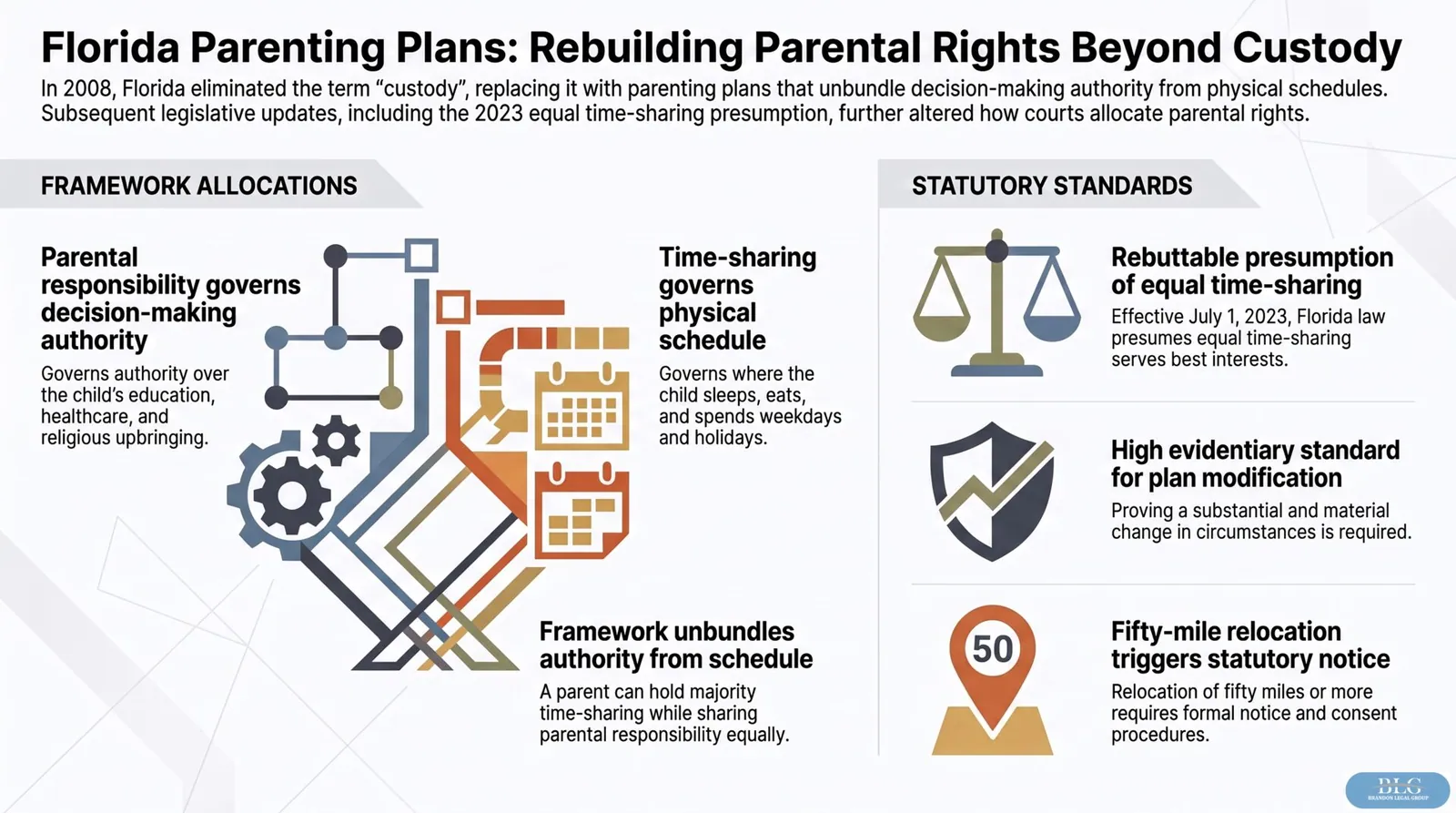
TL;DR: Florida stopped using the word "custody" in 2008. The state now uses "parenting plans" and "time-sharing" instead, a shift that changed more than terminology. The new framework reorganized how courts allocate parental responsibility, how schedules are built, and what gets argued when parents disagree. In 2023, Florida added a rebuttable presumption that equal time-sharing is in the child's best interest, which changed the starting line again.
The word "custody" still appears in old court orders, casual conversation, and every frustrated text message between co-parents. But Florida law abandoned it in 2008. What replaced it wasn't cosmetic. The statutory overhaul dismantled the custody framework entirely and rebuilt parental rights around a different set of assumptions, ones that sound cooperative on paper but collapse quickly when parents can't agree. Understanding what changed, and why it matters now, determines whether a time-sharing dispute gets resolved through modification or stays locked in the original order.

Parents who divorced before 2008 still carry final judgments that award "primary residential custody" or "joint legal custody." Those orders remain enforceable. But a modification filed today gets recast into the new language. Courts won't simply tweak the old custody schedule; they rewrite it as a parenting plan, complete with a time-sharing schedule, decision-making allocations, and communication protocols. The legal effect can differ substantially from what the original order contemplated.
What the 2008 Statute Actually Changed
Florida Statute § 61.13 was rewritten to eliminate "custody" as a legal concept and replace it with two distinct components: parental responsibility and time-sharing. Parental responsibility governs decision-making authority over the child's education, healthcare, and religious upbringing. Time-sharing governs the physical schedule, where the child sleeps, eats, and spends weekdays and holidays.
The old custody framework bundled those two concepts together. "Primary physical custody" usually meant both more overnights and default control over major decisions. "Joint legal custody" sounded equal but often deferred to the primary custodian on day-to-day calls. The 2008 revision unbundled them. A parent can hold majority time-sharing while sharing parental responsibility equally. Another parent might have only weekend time-sharing but retain full shared authority over medical and school decisions.
Courts order shared parental responsibility unless the court finds that shared responsibility would be detrimental to the child. That default is rebuttable, since evidence of domestic violence, substance abuse, or parental unfitness can overcome it, but the starting position shifted in 2008. The burden no longer rests on the parent seeking joint decision-making. It rests on the parent seeking sole authority to prove why shared responsibility would harm the child.
Parenting Plans as Binding Orders
Every final judgment involving minor children must now include a parenting plan. The plan is not an addendum or a worksheet; it is the operative court order. Florida Statute § 61.13(2)(b) requires the plan to describe, at minimum:
- How parents will share and be responsible for the daily tasks associated with raising the child
- The time-sharing schedule specifying the time the child will spend with each parent, including overnights, weekends, holidays, school breaks, and summer vacation
- Designation of who is responsible for health care, school-related matters (including the address used for school-boundary determination), and other activities
- The methods and technologies parents will use to communicate with the child
The more detailed the plan, the less room exists for later interpretation fights. Vague provisions, such as "reasonable phone contact" or "flexible holiday exchanges," generate contempt motions when parents stop cooperating. Plans that specify the exact hour of Sunday exchanges, the app used for schedule changes, and which parent claims the child as a tax dependent in even versus odd years provide enforceable benchmarks when conflict escalates.
Judges have discretion to approve agreed plans or impose plans after trial. But the statute does not give judges discretion to skip the plan. Even when one parent has minimal time-sharing, such as every other weekend and no overnights during the school week, the arrangement still gets memorialized as a parenting plan with an enumerated schedule and responsibility allocations.
When Time-Sharing Becomes the New Custody Battle
Eliminating the word "custody" did not eliminate the fight. It relocated the argument. Parents now litigate overnights with the same intensity they once litigated primary versus secondary custody. The count matters for child support calculations under Florida Statute § 61.30, which adjusts the support obligation based on the number of overnights each parent exercises. Once a parent exercises at least 20 percent of the overnights in a year, the gross-up formula applies and the numbers move. A parent who crosses into majority time-sharing may flip from payor to payee.
The statutory factors courts use to determine time-sharing arrangements appear in Florida Statute § 61.13(3). Those factors include the demonstrated capacity of each parent to meet the child's needs, the length of time the child has lived in a stable environment, evidence of domestic violence, the reasonable preference of a child the court deems sufficiently mature, and each parent's demonstrated willingness to facilitate a close and continuing relationship with the other parent. That last factor, often called the "friendly parent" provision, turns many cases. A parent who blocks phone calls, skips exchanges, or undermines the other parent's authority in front of the child risks losing time-sharing even when no other fitness concern exists.
Trial testimony in time-sharing disputes now focuses heavily on day-to-day caregiving history. Which parent attended medical appointments, managed homework, prepared meals, arranged playdates, and handled bedtime routines before the separation often shapes the initial time-sharing allocation. The parent who was minimally involved during the marriage faces an uphill argument for equal time afterward, not because the statute penalizes past behavior, but because the court assesses each parent's demonstrated capacity and the child's need for stability and routine.
Equal Time-Sharing: The 2023 Presumption and Its Limits
This is where the law moved again. Effective July 1, 2023, Florida Statute § 61.13(2)(c)(1) created a rebuttable presumption that equal time-sharing is in the best interest of the child. The court must start there. But "presumption" is not "guarantee." Either parent can rebut it by a preponderance of the evidence, and the court still applies the best-interest factors in § 61.13(3).
Equal schedules hold up when both parents live near the child's school, maintain appropriate housing, demonstrate historical involvement in caregiving, and can communicate about logistics without a referee. They get rebutted when those conditions don't exist, when parents live an hour apart, when one works night shifts, when a parent's work travel makes weekday overnights fiction, or when the evidence shows the child's need for predictability outweighs a symmetrical calendar. Do not walk into court assuming the presumption does the work for you. It shifts the burden. It does not win the case.
Shared parental responsibility survives unequal time-sharing. A parent with every-other-weekend time-sharing retains the right to access school and medical records, consent to non-emergency medical care, and participate in decisions about extracurricular activities. That parent does not control the day-to-day schedule, but holds equal authority over the major decisions that shape the child's upbringing.
When one parent seeks sole parental responsibility, the authority to make major decisions unilaterally, the burden rises. Florida Statute § 61.13(2)(c)(2) permits sole responsibility only when shared responsibility would be detrimental to the child. Evidence that meets that standard typically involves a documented history of parental unfitness, such as untreated addiction, repeated interference with the other parent's time-sharing, or a pattern of decisions that endangered the child's welfare. Disagreement over parenting philosophy, or the inability to co-parent amicably, does not satisfy the detriment standard on its own.
Modification Under the New Framework
Parenting plans are modifiable, but the threshold is high. A parent seeking to change time-sharing or parental responsibility must prove a substantial and material change in circumstances and demonstrate that modification serves the child's best interest. Florida Statute § 61.13(3) supplies the best-interest factors that govern both the initial determination and any modification. One 2023 change worth knowing: a parent's relocation within fifty miles of the primary residence can now qualify as a substantial change, removing an old obstacle to modification petitions.
Common triggering changes include a parent's relocation, a significant change in the child's needs as the child ages, or evidence that the current schedule has become unworkable due to a parent's changed work schedule or housing situation. The fact that a toddler is now school-aged and needs a consistent address for enrollment can justify revisiting a plan that alternated weeks. A parent's new job requiring frequent overnight travel may necessitate reducing that parent's weekday time-sharing.
Modification petitions that seek only to increase overnights for child support reduction often fail unless a legitimate best-interest basis supports the request. Courts will not modify a functioning arrangement solely to adjust a financial obligation. The child's welfare must drive the analysis, and the moving party must present evidence, not speculation, that the current plan no longer serves that welfare.
For parents operating under pre-2008 custody orders, a modification petition triggers conversion into the parenting-plan framework. That conversion can produce unexpected results. A parent who held "primary physical custody" under the old order may find that, recast as a time-sharing schedule, the arrangement now falls short of what is needed to control school-boundary decisions or to hold the position they assumed was permanent. Conversely, a parent with "visitation" may discover that the same schedule, translated into overnights, yields enough time to change the child support calculation or to strengthen a relocation objection.

The terminology shift was sold as a move toward cooperative co-parenting. In practice, it redistributed the levers of control. Parents who understand what a parenting plan actually governs, and what it leaves unresolved, can build plans that survive conflict. Those who treat the plan as a formality often return to court, discovering that the vague language they agreed to has become a weapon in the other parent's hands. The framework rewards specificity and punishes ambiguity. The law eliminated "custody," but it did not eliminate the fight. It simply moved the battlefield.
Closing Remarks
If a time-sharing modification is pending, a relocation notice just arrived, or shared parental responsibility has devolved into a series of unilateral decisions and blocked communications, the enforceability of the current plan determines what comes next. Brandon Legal Group represents parents navigating divorce and family law disputes across Florida with the strategic clarity needed when cooperation has ended and enforcement begins. Contact us to lock down a parenting plan that holds up under conflict, or to modify one that no longer fits the reality on the ground.
Frequently Asked Questions
Can a parenting plan be modified if both parents agree to the change?
Yes. When both parents agree to modify the parenting plan, they can file a stipulated modification with the court. The modification still requires judicial approval to become enforceable, and the court will review the proposed changes to confirm they serve the child's best interest. Informal agreements between parents, such as texts, emails, or verbal understandings, do not modify the court order. Only a signed order entered by the court changes the binding plan. Parents who operate under an informal modification for months and later disagree find themselves back under the original order, with no credit for the informal arrangement.
Does shared parental responsibility mean equal time-sharing?
No. Shared parental responsibility addresses decision-making authority, not the physical schedule. A parent can hold shared parental responsibility, meaning equal say in medical, educational, and religious decisions, while having far less than half of the overnights. Time-sharing and parental responsibility are separate allocations under the statute. Since July 1, 2023, Florida courts start from a rebuttable presumption that equal time-sharing is in the child's best interest, but that presumption is regularly rebutted when the parents live too far apart for a workable 50/50 split, or when one parent's work schedule cannot accommodate equal overnights, even though both parents remain fit and involved.
What happens to a custody order entered before 2008?
Pre-2008 custody orders remain enforceable until modified. The old terminology, such as primary custody, visitation, and joint legal custody, continues to govern until a parent files a modification petition. Once modification is sought, the court converts the arrangement into a parenting plan using current statutory language. That conversion can change the practical allocation of authority and time. Parents living under old orders should understand that a trip back to court will produce a new plan, not a simple tweak to the existing custody language.
Can a parent lose shared parental responsibility after it's been ordered?
Yes, but only through a modification proceeding that proves a substantial change in circumstances and shows that continued shared responsibility would be detrimental to the child. Evidence sufficient to support such a modification typically involves a pattern of conduct that endangers the child, such as repeated unilateral medical decisions against doctor advice, refusal to share school information, interference with the other parent's time-sharing, or proof of unfitness such as untreated substance abuse. A single disagreement, or even ongoing conflict between the parents, does not meet the detriment standard. The moving party must demonstrate that the other parent's exercise of shared authority has caused or will cause harm to the child, not merely inconvenience or frustration to the co-parent.
How does relocation affect an existing parenting plan?
A move of fifty miles or more from the principal residence, for at least sixty consecutive days, triggers the notice and consent or petition procedure under Florida Statute § 61.13001. The relocating parent must serve a formal notice of intent to relocate or obtain a written agreement from the other parent. If the other parent objects, the relocating parent must prove that the move is in the child's best interest. Courts evaluate factors including the reason for the move, the impact on the child's relationship with the non-relocating parent, the feasibility of preserving that relationship through a modified long-distance schedule, and whether the move will enhance the quality of life for the parent and child. Relocation disputes often require a full evidentiary hearing and can result in denial of the move or a significant restructuring of time-sharing and parental responsibility. Parents who relocate without complying with the statute risk contempt findings and an order compelling the child's return, and typically a contested court fight they could have avoided.
What role does the child's preference play in time-sharing decisions?
Florida Statute § 61.13(3) lists the reasonable preference of a child the court deems of sufficient intelligence, understanding, and experience as one factor among many. The weight given to that preference depends on the child's age, maturity, and the reasons behind it. A teenager's well-articulated preference based on school, friends, and stability carries more weight than a young child's preference driven by the parent who allows more screen time. Courts are cautious about preferences that appear coached or result from one parent's alienating behavior. Judges may interview the child, but such interviews are discretionary and relatively rare in Florida. The child's preference is never the sole determinant, and a stated preference does not override evidence that the preferred arrangement conflicts with the child's best interest.
References
- Florida Statute § 61.13 (Support of children; parenting and time-sharing; powers of court).
- Florida Statute § 61.30 (Child support guidelines).
- Florida Statute § 61.13001 (Parental relocation with a child).
- Chapter 2023 (213, Laws of Florida (creating the rebuttable presumption of equal time-sharing, effective July 1, 2023)).