
The difference between contested and uncontested divorcehinges on whether both spouses agree on all terms, custody, assets, support, everything, or whether even one issue remains unresolved. Most divorces that start contested can settle before trial, but misunderstanding which path applies wastes time, money, and leverage.
The question isn't whether a divorce will be hard. The question is whether it will be a negotiation or a fight. Contested and uncontested are not measures of how angry someone is or how much pain the marriage caused. They are procedural categories, and knowing which one applies determines how long the case takes, how much it costs, and what kind of attorney is needed. Misreading the situation, filing uncontested when the other side has no intention of cooperating, or bracing for war when settlement was always possible, creates unnecessary damage.
¶
What "Uncontested" Actually Means
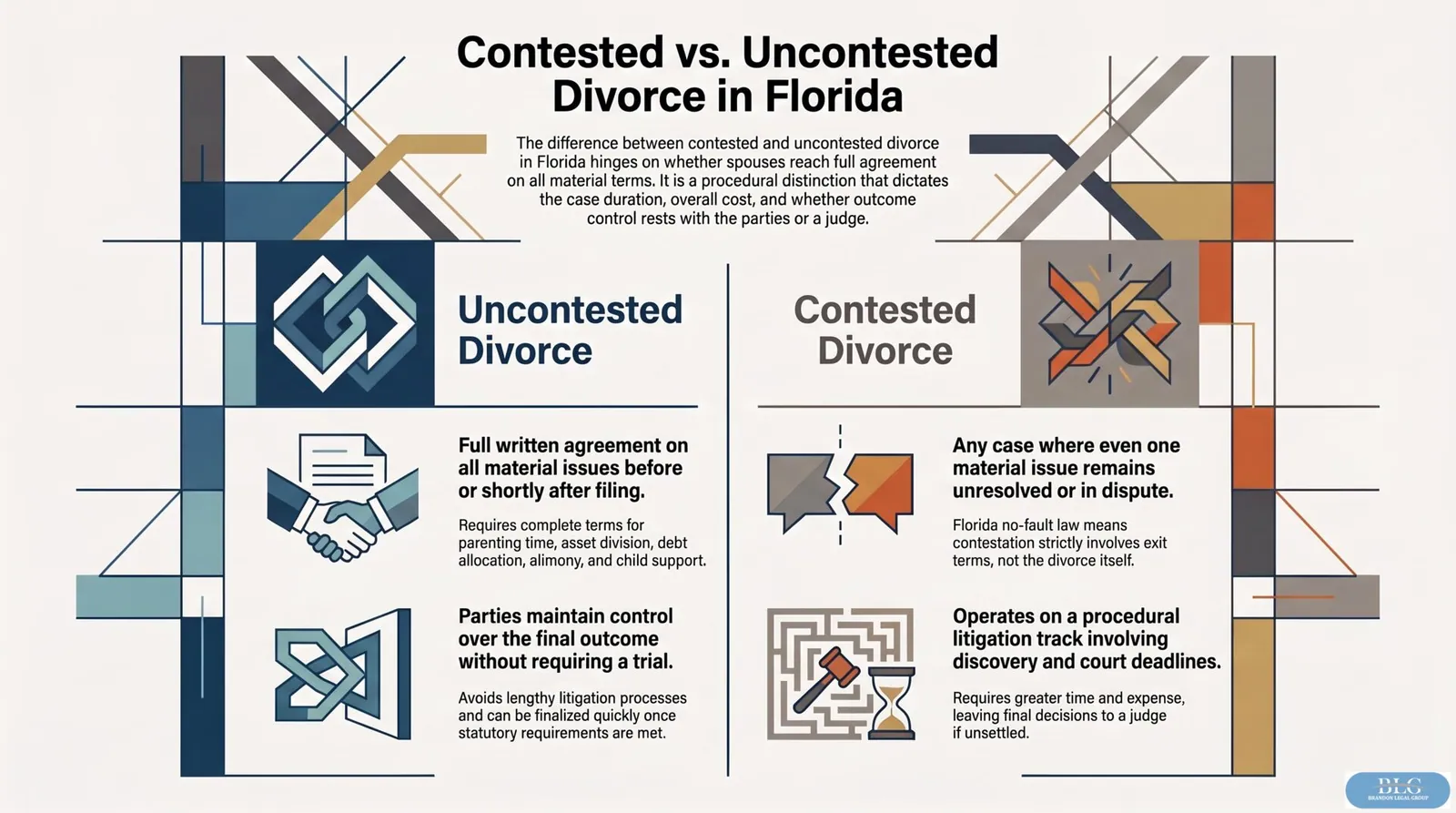
An uncontested divorce in Florida means both parties agree on every material issue before filing or very shortly after. Not "mostly agree." Not "agree in principle." Full, documented agreement on parenting time, decision-making authority, property division, debt allocation, alimony, and childsupport. If there is even one unresolved question, who keeps the house, whether spousal support is owed, how the 401(k) gets split, the case is contested.
¶Uncontested does not mean friendly. It means resolved. Two people can despise each other and still file uncontested if they have already worked out the terms, often with separate attorneys reviewing the agreement before signing. The hallmark of an uncontested case is that no trial is needed. The settlement agreement is drafted, filed with the petition or shortly after, and a final hearing, if required at all, is brief and procedural.
¶Florida Statute § 61.052 and Florida Family Law Rule 12.105 provide for simplified dissolution of marriage in cases meeting narrow criteria: no minor or dependent children, no pregnancy, both parties waiving alimony, full agreement on property and debt, and both parties appearing together at the final hearing. Simplified dissolution is a subset of uncontested divorce, available only when the spouses meet those statutory and procedural requirements. Most uncontested divorces do not qualify for simplified procedure but still avoid litigation because the spouses reach comprehensive settlement early.
What Makes a Divorce Contested
A contested divorce is anything that is not uncontested. If one spouse refuses to agree to terms, or if negotiation stalls on any required element, the case proceeds as contested.
However, it is vital to understand what you cannot contest in Florida. Because Florida is a strict "no-fault" divorce state under Florida Statute § 61.052, a spouse cannot block the divorce itself. If one party declares under oath that the marriage is "irretrievably broken," the court will grant the dissolution regardless of whether the other spouse wants to stay married. A contested divorce is never a battle over whether you can get divorced, it is strictly a battle over the terms of the exit.
Proceeding on the contested track does not mean a case will go to trial. Most contested divorces eventually settle. But the procedural path: discovery, motions, mediation, pretrial deadlines,is the contested track, and it costs more in time and money than an uncontested process.
Common flashpoints that turn a case contested include:
- Disagreement over parenting time or decision-making authority
- Dispute about the value or division of marital property
- One party seeking alimony and the other contesting entitlement or amount
- Hidden assets, undisclosed income, or financial dishonesty
- One spouse refusing to participate or respond to the petition
- Domestic violence allegations that affect custody or exclusive use of the home
Note on No-Fault Grounds: Because Florida is a no-fault state, emotional grievances like infidelity or incompatibility cannot be used as legal grounds to contest a divorce. A judge will generally not consider these issues unless the misconduct directly impacts a child's safety or involves a spouse spending marital funds on an affair or addiction (known as the dissipation of assets).
Even when both parties want the divorce, if they cannot agree on how to divide what they built or how to co-parent what they share, the case is contested. Florida is an equitable distribution state under § 61.075, meaning the court divides marital property fairly, not necessarily equally. When spouses cannot agree on what "fair" means, a judge decides. That process requires evidence, argument, and advocacy, hallmarks of a contested case.
¶How to Identify Which Path Applies
The clearest indicator is whether both parties can, right now, sign a written agreement covering every issue the court must resolve. If the answer is yes, the divorce can proceed uncontested. If the answer is no, or "maybe later" or "we're still talking," the case is contested until it is not.
Consider a hypothetical: Two spouses agree the marriage is over. They have one child, a mortgaged house, two cars, and retirement accounts. They agree on a parenting schedule but disagree on whether one parent should pay child support. They agree to sell the house but disagree on who gets to live there until closing. They agree to split the 401(k) but have not valued it or determined how to execute the division. That case is contested. Agreement on some issues does not make the divorce uncontested. Partial agreement just narrows the scope of litigation.
Another scenario: Both spouses have reviewed a marital settlement agreement drafted by one attorney and approved by the other's independent counsel. All financial disclosures are complete. Both have signed. The petition for dissolution references the settlement agreement, and both parties waive further discovery. That is uncontested, even if the negotiations leading to the agreement were difficult.
¶Default cases, where one spouse files and the other does not respond, can become uncontested by default, but they begin contested. Florida Family Law Rule 12.500 governs default procedure. A spouse who fails to respond loses the right to contest the petition, but the filing party must still prove entitlement to relief and provide evidence supporting the requested terms. Default is not the same as agreement; it is the absence of opposition.
Why the Distinction Controls Strategy and Cost
Uncontested divorces in Florida can often be finalized in weeks once the 20-day waiting period under § 61.19 has run, unless the court finds injustice would result from delay, and all paperwork is in order. Contested divorces typically take months, sometimes over a year if the case is complex or the docket crowded. The difference is not just duration; it is cost, stress, and control over outcome.
Uncontested cases require limited attorney involvement if the agreement is already negotiated. Legal fees cover drafting, filing, and ensuring the settlement complies with Florida law. Contested cases require full representation: financial discovery under Rule 12.285, mandatory disclosure, depositions if necessary, expert witnesses for valuation or custody evaluations, motion practice for temporary relief, and trial preparation. Each of those steps costs money.
More important than cost is control. In an uncontested divorce, the parties decide the outcome. In a contested divorce, a judge decides if the case does not settle. Judges apply Florida law and exercise discretion within statutory bounds, but they do not know the family, the history, or the nuances that matter to the people living the situation. Settlement, even hard-fought settlement, leaves more room for creative solutions than a trial does. Understanding early whether the case is truly uncontested or requires contested procedure allows for realistic planning and appropriate allocation of resources.
For those navigating this decision in Florida, understanding the framework of divorce representation helps clarify what kind of legal support the situation requires. And for readers weighing whether unresolved conflict justifies the cost of litigation, the analysis in The Real Cost of Staying 'For the Kids' offers a broader view of what prolonged indecision costs beyond legal fees.
When a Contested Case Becomes Uncontested
Florida courts commonly require mediation in contested family cases before trial, and Rule 12.740 authorizes referral of contested family matters to mediation unless waived or otherwise excused. Mediation is a structured negotiation facilitated by a neutral third party, often a family law attorney or retired judge trained in dispute resolution. Settlement reached in mediation is reduced to a written agreement, filed with the court, and incorporated into the final judgment. Once that happens, the contested case becomes uncontested for purposes of finalization.
The strategic question is not whether to avoid contested procedure when it is necessary, it is whether to recognize early when agreement is possible and act accordingly. Filing contested and proceeding through discovery when both sides are ready to settle wastes resources. Filing uncontested when the other side has not agreed, or is not negotiating in good faith, leaves the filing party exposed and without the procedural tools needed to compel disclosure or protect rights.

The path is not chosen based on preference. It is dictated by whether agreement exists or can be reached before filing. Misidentifying which process applies does not just delay resolution; it signals to the other side, and sometimes to the court, that strategy is unclear and leverage misunderstood. Knowing the difference is the first step in controlling what comes next.
Closing Remarks
If the other spouse is refusing to negotiate, hiding financial information, or dragging out discussions while the household deteriorates, the case is contested whether anyone wants to admit it or not. Brandon Legal Group represents clients in contested divorces throughout Florida with the strategic clarity and backbone those cases demand. Contact us to stop negotiating with someone who isn't listening and start building the case that ends this.
Frequently Asked Questions
Can a divorce start as contested and become uncontested?
Yes. Most divorces filed as contested settle before trial, often after discovery or mediation. Once a comprehensive settlement agreement is signed and filed, the case proceeds to final hearing on uncontested terms. The procedural path up to that point remains contested, meaning the time and cost invested in discovery, motions, and negotiation are not refunded just because settlement is eventually reached.
Does uncontested mean no attorneys are needed?
No. Even when both spouses agree on terms, at least one attorney should draft the marital settlement agreement and ensure it complies with Florida law. Many uncontested divorces involve both parties retaining separate counsel to review the agreement before signing. An uncontested divorce is faster and cheaper than a contested one, but it still involves binding legal documents and permanent consequences. Mistakes in drafting or omissions in the agreement create problems that surface later, often when they are expensive or impossible to fix.
What happens if one spouse agrees at first but changes their mind?
If a settlement agreement has not yet been signed and filed, either party can withdraw from negotiations and the case becomes or remains contested. If a marital settlement agreement has been signed, filed, and incorporated into a final judgment, it is binding and enforceable like any contract. Attempting to undo a final judgment requires showing fraud, duress, or other extraordinary circumstances under Florida law. Regretting the terms later is not grounds for reversal.
Is a simplified dissolution the same as an uncontested divorce?
Simplified dissolution is a specific type of uncontested divorce available only to couples with no minor children, no pregnancy, full agreement on property and debt, mutual waiver of alimony, and willingness to appear together at a final hearing. It is faster and involves less paperwork than a standard dissolution, but most divorcing couples do not meet all the requirements. An uncontested divorce can involve children, alimony, or complex assets as long as both parties agree on how to resolve those issues. Simplified dissolution is uncontested, but not all uncontested divorces qualify as simplified.
Can a case be contested on some issues and uncontested on others?
Procedurally, the case is either contested or uncontested. If any material issue remains unresolved, the case proceeds as contested. Practically, partial agreement narrows the scope of litigation. Spouses may stipulate to certain facts or terms and litigate only the disputed issues, which reduces trial time and cost. Florida courts encourage partial settlement and will incorporate agreed terms into temporary or final orders even while contested issues proceed to hearing. But until every issue is resolved, the case is not uncontested for filing or procedural purposes.
References
- Florida Statute § 61.052 (Dissolution of Marriage).
- Florida Statute § 61.075 (Equitable Distribution of Marital Assets and Liabilities).
- Florida Statute § 61.19 (Entry of Judgment of Dissolution of Marriage).