
⚠️ Who This Article Is For
This article is written for parents in marriages defined by chronic conflict, control, or contempt, parents who have been telling themselves they are staying “for the kids.” If that’s the calculation you’ve been making, keep reading.
If you are in a healthy marriage going through a hard season, this article is not written for you. Hard seasons are not toxic marriages, and the distinction matters. For general family planning, please contact our team directly.
The Real Cost of Staying “For the Kids”
What you’ll learn in this article: Why “staying for the kids” is one of the most well-intentioned and well-documented mistakes in family life. What decades of developmental research actually shows about children raised in high-conflict intact homes versus cooperative split homes. How children learn what love looks like, not from what you say about marriage, but from what they watch you tolerate. And what Florida law actually does to protect a child’s best interests when one parent is finally ready to act.
The Lie You’ve Been Telling Yourself
You’ve been running a calculation in your head for years. Maybe a decade. Maybe longer. The math goes something like this: It’s bad, but the kids would be worse off if we split. I can take it. I can absorb it. I can make it work until they’re out of the house.
That calculation feels noble. It feels like sacrifice. It feels like the responsible parent move.
It is also, in most cases involving chronic conflict or controlling behavior, factually wrong. And the research saying so isn’t ambiguous, isn’t new, and isn’t disputed in any serious academic circle.
You’ve been protecting your kids from the wrong thing.
What the Research Actually Says
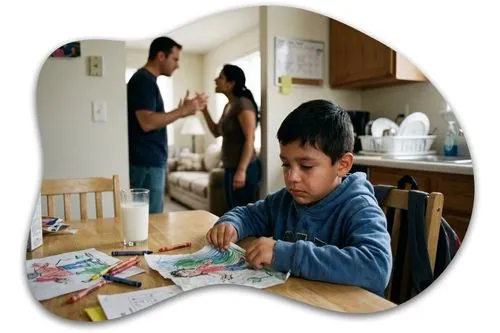 Decades of developmental research have converged on a finding that runs counter to almost everyone’s instinct. Paul Amato’s landmark meta-analyses reviewing nearly 160 studies, E. Mavis Hetherington’s three-decade Virginia Longitudinal Study of Divorce following 1,400 families, and the Cherlin and Furstenberg longitudinal study using the U.S. National Survey of Children all point in the same direction:
Children raised in high-conflict intact homes consistently fare worse than children raised in low-conflict separated homes.
Worse on measures of mental health. Worse on academic outcomes. Worse on the formation of stable adult relationships. Worse on substance abuse risk. Worse on every metric anyone has thought to measure.
The “intact family” advantage that gets quoted in cultural debates only holds when the intact family is functional. When it isn’t, when there is chronic conflict, contempt, control, or emotional volatility, the protective effect doesn’t just disappear. Itreverses. Kids in those homes are statistically more harmed by the staying than they would have been by a structured, cooperative separation.
Read that again. The thing you’ve been doing in the name of protecting them may be the thing causing the most damage.
What Children Are Actually Learning
Here’s where most articles on this topic stop, with statistics and a polite suggestion to consider your options. That’s not enough. The harder truth is about what childrenare learning, every day, in a high-conflict home, and they don’t need to be hit, screamed at, or directly involved to learn it.
They’re learning the volume and tempo of how adults are allowed to speak to each other. They’re learning whose feelings get to take up space and whose feelings get swallowed. They’re learning what one parent is allowed to do to the other and have itbe normal. They’re learning what love looks like, not from what you tell them about marriage, but from what they watch you tolerate.
This is the part nobody wants to say out loud: your children are not just witnesses. They are apprentices. Whatever dynamic exists between you and your spouse is the dynamic they will recognize as familiar, and human beings tend to choose what’s familiar, even when it hurts. The daughter who watches her mother get talked over for fifteen years will, with statistical reliability, find herself married to a man who talks over her. The son who watches his father absorb contempt and stay quiet will marry someone who serves him contempt, and he will stay quiet. Not because they want that. Because that is the shape of love they were trained to recognize.
And then they will tell themselves, as you have, that they’re staying for their kids.
¶
What a Healthy Marriage Looks Like, So They Have Something to Compare To
¶ 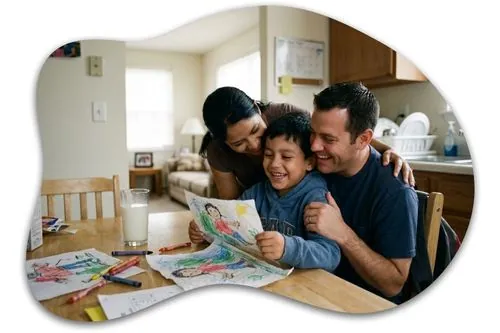 If you grew up watching dysfunction, you may not actually know what healthy looks like. Neither will your kids unless someone shows them, by living it, or by leaving so they can see it modeled somewhere, eventually, by someone.
Healthy doesn’t mean conflict-free. It means:
- Disagreements that end. Not grudges that compound for months.
- Repair after rupture. One party says the wrong thing, recognizes it, and circles back. The wrong thing doesn’t become a permanent weapon.
- Two voices in the room. Decisions are made together, finances are visible to both, and neither spouse needs permission to exist.
- Influence flowing both directions. Each spouse adjusts based on the other’s input. Neither one is just a passenger or just a manager.
- Contempt is rare and treated as an emergency. Researcher John Gottman found contempt to be the single strongest predictor of divorce, not because of how it ends marriages, but because of what it reveals about the marriage already.
- Children are off-limits as leverage. They are not messengers, witnesses to be performed at, or pieces on a board.
If you read that list and recognized none of it from your own marriage, that is information. If you read it and felt your throat tighten, that is also information. The kids in your house are reading the same list every day, just in their own way, just without the words for it yet.
The Particular Damage of Using Kids as Leverage
There is a specific category of harmful marriage that deserves naming: the marriage where one spouse uses the children as a weapon. Withholding access. Recruiting the kids into one parent’s narrative. Punishing the other parent through the children. Making love conditional on loyalty.
Children who grow up inside that pattern learn something even more corrosive than what’s on the list above. They learn that love is something a parent is allowed to use against the people who love them. The y learn that bullying gets results. That violence, physical, verbal, emotional, financial, is a normal tool of family life. And that loyalty to one parent requires betraying the other.
Those lessons don’t fade. They harden. They show up twenty years later in adult children who can’t form stable bonds, who flinch at intimacy, who choose partners who hurt them, who cannot find safe ground because the ground was never safe. Some of them survive it. Some of them don’t.
If you are the parent in that marriage who is not the one weaponizing the kids, if you are the one absorbing it, hoping things will calm down, tel ling yourself you’re keeping the peace by staying, please understand: your staying is not protecting them from this. It is exposing them to it longer. The only intervention that works is structural. The pattern doesn’t stop because you ask it to stop. It stops because the structure changes.
What Florida Law Actually Protects
One of the deepest fears keeping parents stuck i s the fear that leaving will mean losing the kids, or worse, that it will mean handing the kids to the spouse who is causing the harm.
That fear is understandable. It is also, in Florida, largely incorrect.
Florida law operates from one principle in custody decisions: the best interests of the child. Fla. Stat. § 61.13 sets out twenty specific factors a court must consider, including each parent’s ability to provide a consistent routine, each parent’s moral fitness, evidence of domestic violence, evidence of one parent disparaging the other to the children, each parent’s demonstrated capacity to put the child’s needs first, and each parent’s willingness to foster a relationship between the child and the other parent.
That last factor matters enormously and is often missed. A parent who actively works to damage the child’s relationship with the other parent is acting against the statutory best-interest factors. Courts notice this. Courts respond to this. Documented patterns of one parent attempting to alienate, weaponize, or sabotage the other parent’s relationship with the child are taken seriously and frequently affect time-sharing outcomes.
The fear that the controlling, manipulative, or abusive spouse will somehow “win” the kids in court does not match how Florida courts actually behave when the case is presented properly. What matter s is that the case is presented properly, with documentation, with strategy, with an attorney who knows what the court needs to see.
What “Doing It Right” Looks Like
The damage to children in divorce is not from the divorce. It is from the conflict. A divorce handled badly, with one parent using the kids as ammunition, with chaos and instability, with new partners paraded through, with the kids hearing every detail of every grievance, is destructive. A divorce handled well isn’t.
¶
¶ Doing it well looks like:
- A clear, enforceable parenting plan that gives both parents structured time and the kids predictability
- Both parents holding the line on never speaking ill of the other in front of the children, regardless of provocation
- Stability of school, home, and routine wherever possible
- Adults processing their feelings with adults, therapists, friends, attorneys, not with the kids
- A legal structure that prevents one parent from unilaterally controlling decisions about the children
- Clear consequences, established in the order, when one parent violates the structure
That doesn’t happen by accident. It happens because the parent who r ecognized the situation first acted strategically, got a lawyer who understood the dynamic, built the case carefully, and protected the structure that protects the kids.
The Hardest Part to Hear
If you have already been in this marriage for years, some damage has already been done. Pretending otherwise won’t help your kids. What helps them now is what you do next.
Children are remarkably resilient when given a stable structure, an honest parent, and a model of what healthy adulthood looks like. They are not infinitely resilient inside a system that is teaching them, every day, that love hurts and bullies win. The clock you have been running on “wait until they’re older” is not free. Every year on it has a cost. Some of those costs don’t show up until they’re 25, or 35, or until they choose a partner who looks suspiciously like the parent who never should have been allowed to model love fo r them.
¶
¶ You can stop teaching that lesson. And, this is t he part most articles on this topic refuse to say, you can start teaching a better one.
¶
What Else They Can Learn, If You Let Them See It
¶ The mechanism that teaches children to expect dysfunction is the same mechanism that can teach them to expect health. Modeling works in both directions. Kids absorb what they watch us tolerate, and they absorb what they watch us choose when we finally know better.
A parent who wa lks out of a destructive marriage and, eventually, not as a rebound, not as a rescue, walks into a healthy partnership is teaching the most durable lesson of all: that the first marriage was not the only available shape of love. That repair is possible. That partners can speak to each other with respect. That two adults can disagree without contempt, manage money together without secrets, and raise kids without using them as weapons. That a home can be a place where everyone gets to exhale.
Not every child will catch it. Some have absorbed too much for too long, and the work of unlearning will be theirs to do, not yours. But some of them will see it. Some of them will recognize, maybe for the first time, that the dynamic they g rew up inside was a story their parents told them, not a law of physics. And the ones who recognize it will hand the new pattern forward to their own marriages, their own children, their own quiet decisions about what to tolerate and what to refuse.
This is the part that gets left out of nearly every “should I stay or go” conversation: the upside is not just that the bad ends. It’s that something better can begin, and that what you build next is also something the kids are watching. They learned what unhealthy looks like by living inside it. Th ey can learn what healthy looks like the same way, by watching you live inside something different.
That’s not a guaran tee. Nothing is. But the parents who have done it, who walked out of the wrong marriag e, did the work, and eventually built a right one, almost always say the same thing about their adult children years later: they noticed. They were always noticing. The bond did not have to stay broken. The lesson did not have to stay learned.
Frequently Asked Questions
Doesn’t divorce harm children regardless of the marriage they came from?
The research consistently distinguishes between high-conflict intact homes and low-conflict separated homes. Children from cooperative divorced families do better on most outcomes than children from chronically conflicte d intact families. Divorce itself is not the harm, sustained exposure to conflict, contempt, and instability is the harm. A poorly handled divorce can absolutely add to that harm, which is why structure and strategy in the legal process matter so much.
What if my spouse threatens that I’ll lose the kids if I file?
Threats like this are common from controlling spouses and rarely match how Florida courts actually decide custody. Courts apply the twenty best-interest factors under Fla. Stat. § 61.13, including each parent’s actual involvement, capacity, and willingness to support the child’s relationship with the other parent. A spouse who has spent years controlling or denigrating the other parent often has a weaker case under those factors than they realize. Don’t let a threat from the person causing the harm dictate whether you act.
How does Florida handle parental alienation in custody decisions?
Florida courts can and do consider evidence that one parent has worked to damage the child’s relationship with the other parent. Under § 61.13, the willingness of each parent to facilitate the child’s relationship with the other parent is an explicit statutory factor. Documented patterns, communications, witness accounts, the child’s own changed behavior, can significantly affect time-sharing decisions and, in some cases, lead to a reversal of primary residential responsibility.
My kids say they don’t want us to split up. Doesn’t that matter?
Children almost always say that, regardless of how unhealthy the home is. It is not evidence that the marriage should continue. It is evidencethat children prefer the familiar to the unknown, which is exactly why the familiar pattern is so dangerous if the familiar pattern is unhealthy. Your job as the parent is not to outsource the decision to a child who lacks the developmental capacity to evaluate it. Your job is to protect them, including from patterns they can’t yet see.
Is it ever genuinely better to stay?
¶ Yes, when the marriage is recoverable. Hard seasons are not toxic marriages. Marriages going through grief, illness, financial stress, or a rough patch can absolutely heal, and couples therapy with a competent therapist is the right first move in those cases. The distinction this articleis drawing is about chronic, structural conflict: contempt, control, manipulation, weaponization of the children, that has not responded to good-faith repair efforts. If you are not sure which category you’re in, that is itself worth exploring with a professional. The point is that “staying for the kids” cannot be a reflex. It has to be a real evaluation.
Staying isn’t free. It costs your kids something every day, and the bill arrives later, sometimes much later, sometimes in ways that can’t be undone. But what comes after isn’t only the ending of something bad. It can also be the beginning of something they get to watch and learn from. Brandon Legal Group represents parents who are ready to stop running the wrong calculation and start protecting their children with structure, strategy, and the spine to act, and who understand that what they build next matters as much as what they’re leaving behind. We don’t coddle and we don’t sugarcoat. We tell you the truth about your situation and we hand you a plan. Call to schedule a consultation.