
TL;DNR
Many parents stay in unhappy or high-conflict marriages believing it protects their children. Under Florida law, prolonged instability, conflict, and informal arrangements often create greater legal risk later, especially in custody cases. Courts prioritize stability, predictability, and the child’s best interests, not how long parents stayed together. Waiting “for the kids” frequently leads to harder custody disputes, higher legal costs, and weaker outcomes.
The Belief That Staying Together Helps Children
Parents often delay divorce because they believe staying together is the least harmful option for their children.
This belief is deeply ingrained. Divorce feels disruptive. Separation feels final. Many parents fear that leaving will emotionally damage their children or be viewed negatively by a judge later.
From the outside, staying together can look like sacrifice and responsibility.
From a legal perspective, however, Florida courts do not evaluate appearances. They evaluate outcomes.
Under Florida family law, the question is not how long parents stayed together, but whether the child’s environment has been stable, healthy, and supportive of their emotional and developmental needs.
What Florida Law Actually Requires Courts to Consider
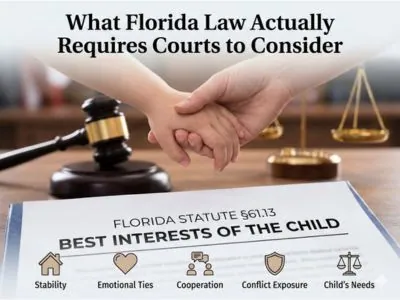 Florida custody and time-sharing decisions are governed by Florida Statute §61.13, which requires courts to determine arrangements based on the “best interests of the child.”
This statute directs judges to evaluate factors such as:
• Stability and continuity in the child’s life
• The emotional ties between parent and child
• Each parent’s ability to communicate and cooperate
• The child’s exposure to conflict
• Each parent’s capacity to put the child’s needs ahead of their own
Notably absent from the statute is any requirement that parents remain married as long as possible.
Florida law does not reward endurance in unhealthy environments. It prioritizes stability, predictability, and the child’s long-term well-being.
Why Prolonged Conflict Matters More Than Divorce Itself
Decades of child-development research consistently show that ongoing parental conflict, not divorce alone, is one of the strongest predictors of negative outcomes for children.
Widely cited findings across multiple longitudinal studies demonstrate that children exposed to chronic parental conflict are more likely to experience:
• Anxiety and depression
• Behavioral problems
• Academic difficulties
• Loyalty conflicts between parents
Importantly, these effects are observed whether parents remain married or eventually divorce.
Florida courts understand this distinction. Judges routinely see cases where children have already been affected by years of unresolved tension before a divorce is ever filed.
How Waiting Quietly Creates Custody Problems
When parents delay divorce despite ongoing conflict, several legal risks quietly develop.
First, children often adapt to instability. While that may look like resilience, courts may later view it as evidence that instability has already taken hold.
Second, parents frequently fall into informal parenting arrangements, such as who handles school, medical care, daily routines, or extracurricular activities.
Under Florida law, long-standing informal arrangements can influence custody outcomes. Judges often consider which parent has been functioning as the primary caregiver in practice, not just on paper.
Waiting without legal guidance can unintentionally shape the custody landscape before a case is ever filed.
The Myth That Time Makes Things Easier
 Many parents believe waiting will make divorce less contentious.
In reality, delay often increases conflict rather than reducing it.
Unresolved resentment builds. Communication deteriorates. Children become more aware of tension. Financial and parenting issues grow more complex.
When divorce finally occurs, courts are not dealing with a clean slate. They are addressing years of accumulated issues, which makes litigation more expensive, more adversarial, and harder to resolve.
This dynamic is particularly relevant under Florida Statute §61.075, which governs equitable distribution of marital assets and debts. Waiting can increase marital debt, complicate asset tracing, and blur the line between marital and non-marital property.
Why “Staying for the Kids” Can Backfire Legally
Many parents are surprised to learn that staying together too long can actually weaken their legal position.
Courts may question:
• Why conflict was allowed to continue unchecked
• Why children were exposed to prolonged instability
• Why no structure or boundaries were established earlier
Judges are tasked with creating forward-looking solutions. When a child’s environment has been unstable for years, courts must intervene more aggressively; sometimes through restrictive parenting plans, supervised time-sharing, or court-ordered evaluations.
For additional context on how courts frame these decisions, see:
Best Interests of the Child in Florida.
Stability Matters More Than Marital Status
Florida courts consistently prioritize stability over appearances.
A structured separation supported by a clear parenting plan often provides children with:
• Predictable routines
• Reduced exposure to conflict
• Clear expectations
• Healthier parental boundaries
¶
¶ In contrast, years of unresolved tension, even within an intact marriage, can undermine those same goals.
For parents weighing these realities, this article offers further perspective:
Supporting Children Through Divorce.
Why Delaying Often Increases Legal Costs
From a practical standpoint, waiting almost always increases the cost of divorce.
Entrenched conflict leads to:
• More contested custody disputes
• More discovery and expert involvement
• Longer litigation timelines
• Higher emotional and financial strain
¶
¶ Acting earlier, before conflict becomes entrenched, often allows for more controlled, strategic decision-making.
Florida Law Does Not Preserve Families at All Costs
Florida’s family law system is not designed to preserve marriages at all costs.
Its purpose is to:
• Protect children
• Establish enforceable rights and responsibilities
• Reduce future conflict through structure
Waiting in the hope that things will improve without intervention often shifts control away from parents and toward the court.
Frequently Asked Questions
Does Florida law favor parents who stay together longer?
No. Florida law focuses on the child’s best interests, not how long parents remained married despite conflict or instability.
Is staying together always better for children?
Not necessarily. Research and court experience both show that prolonged exposure to conflict can be more harmful than a structured separation.
Can waiting affect custody outcomes?
Yes. Long-standing informal arrangements, communication breakdowns, and instability can influence how courts evaluate custody and time-sharing.
When should parents consider speaking with a Florida family law attorney?
If staying together is increasing conflict, instability, or uncertainty for your children, speaking with an attorney early can help you understand your options before legal risks increase.