

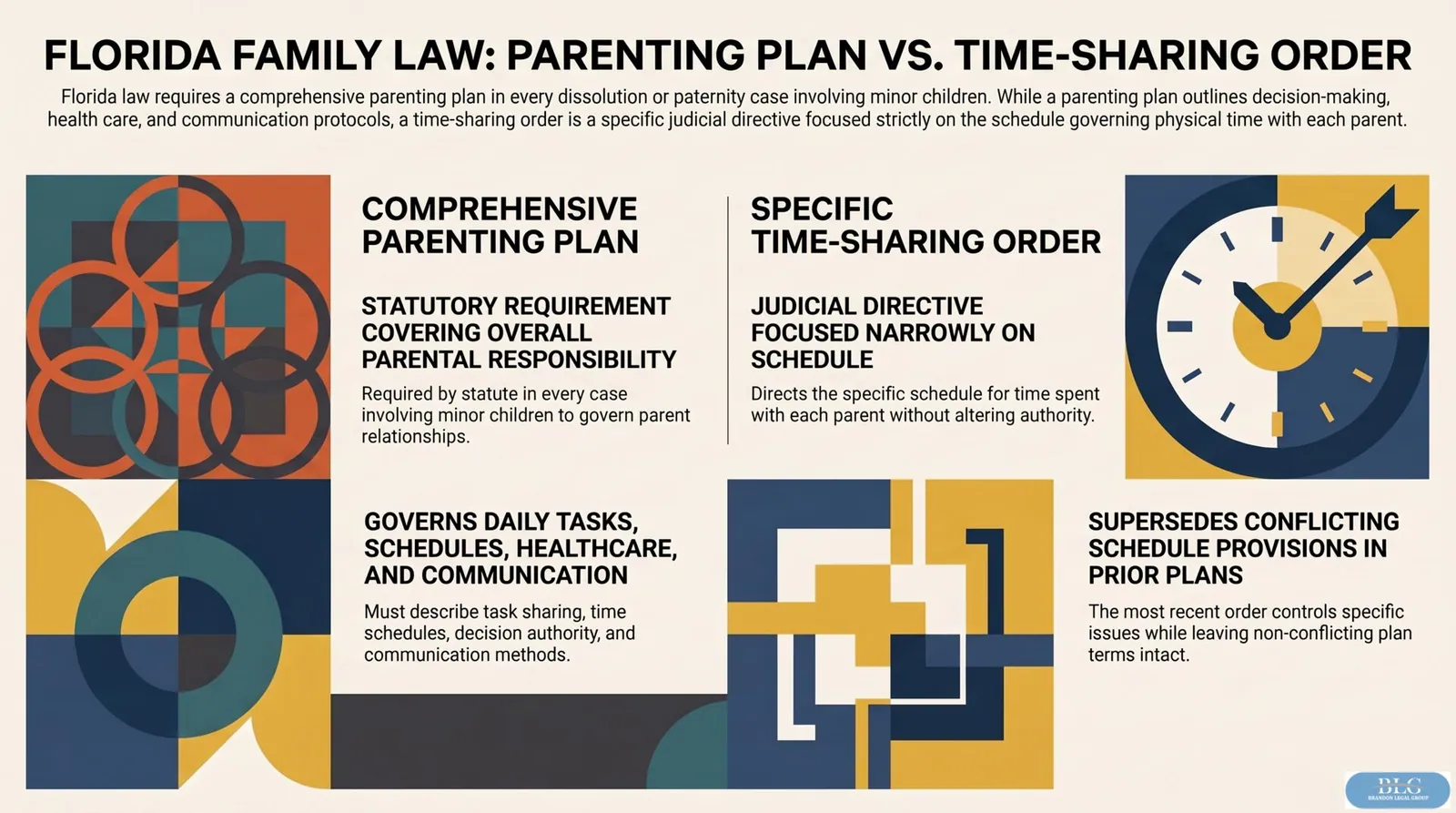
TL;DR: A parenting plan and a time-sharing order are not interchangeable documents; one is a comprehensive plan covering decision-making and schedules, the other is a court directive focused solely on time-sharing. Florida law requires a parenting plan in every case involving minor children, but courts routinely enter separate time-sharing orders on a temporary basis, on modification, or in an emergency. Understanding which document governs, and when one supersedes the other, determines enforceability and the path to any needed changes.
Folders full of unsigned drafts. Court orders filed three years apart. A parenting plan that says one thing and a judge's order that says another. When enforcement becomes necessary or modification unavoidable, the question of which document actually governs stops being academic. It becomes the difference between a motion that gets traction and a filing that gets dismissed for failing to address the controlling order. Confusion over terminology does not excuse noncompliance, and Florida courts do not accept "I didn't know which one applied" as a defense to contempt.

The distinction between a parenting plan and a time-sharing order is procedural, not cosmetic. One is required by statute in every dissolution or paternity case involving minor children. The other is a judicial remedy issued when agreement fails or circumstances change. Both can coexist in the same file, but only one controls a given issue at any given moment. Knowing which document has force, and what it takes to change it, is not optional background knowledge. It is the foundation of every enforcement action, every modification petition, and every relocation notice.
What a Parenting Plan Is and What It Must Contain
Florida Statute § 61.13(2)(b) requires that a parenting plan be approved by the court in every case involving a minor child, whether the parents agree on one or the court establishes it after trial. Florida Statute § 61.046(14) supplies the definition and the minimum contents. This is not a discretionary filing. A parenting plan governs the relationship between the parents regarding decisions that must be made about the minor child, and at a minimum it must:
- Describe in adequate detail how the parents will share and be responsible for the daily tasks associated with raising the child
- Include a time-sharing schedule specifying the time the child will spend with each parent, including overnights, weekends, holidays, and school breaks
- Designate who will be responsible for health care, school-related matters (including the address used for school-boundary determination and registration), and other activities
- Specify the methods and technologies the parents will use to communicate with the child
Parenting plans routinely go further, addressing how the parents communicate with each other, exchange locations and procedures, and similar logistics, and well-drafted plans should. A parenting plan can be agreed upon by both parents and submitted for court approval, or it can be established by the court after an evidentiary hearing when the parents cannot agree. Once approved and incorporated into the final judgment, the parenting plan is a court order. It is enforceable through contempt proceedings, and it cannot be altered unilaterally. The parenting plan is the governing document unless and until a subsequent court order modifies it.
What a Time-Sharing Order Is and When Courts Issue One
A time-sharing order is a court directive that addresses one narrow issue: the schedule governing the time the child spends with each parent. It does not necessarily address decision-making authority, communication protocols, or other parental responsibilities. Time-sharing orders are typically issued in one of three contexts: as a temporary measure during pending litigation, as a modification of an existing parenting plan's schedule, or as an emergency remedy when immediate intervention is necessary to protect the child.
Temporary time-sharing orders are common in the early stages of a dissolution or paternity case, before a final parenting plan is approved. These orders establish where the child will reside and what contact the other parent will have pending trial or settlement. They remain in effect until superseded by a final judgment that includes a full parenting plan.
Modification orders that adjust only the time-sharing schedule, without altering parental responsibility or other plan provisions, are also commonly called time-sharing orders. Florida Statute § 61.13 governs modifications and requires a showing of a substantial and material change in circumstances, along with a finding that the modification serves the best interests of the child. A time-sharing modification does not replace the entire parenting plan; it amends one component. The rest of the parenting plan remains in force.
Emergency time-sharing orders can be issued when there is an immediate threat to the child's welfare. These are rare and require evidence of danger that cannot wait for a noticed hearing. Even emergency orders are temporary and subject to prompt review at a hearing after notice to the other parent.
Which Document Controls When Both Exist
When a final judgment includes an approved parenting plan, that plan is the governing order for all aspects of time-sharing and parental responsibility. If a subsequent time-sharing order is entered, whether as a temporary measure or a modification, the most recent order controls the specific issue it addresses. Courts do not void prior orders wholesale; they supersede conflicting provisions.
Consider a hypothetical: A final judgment entered in 2020 includes a parenting plan designating equal time-sharing and shared parental responsibility. In 2023, one parent files a modification petition based on changed circumstances, and the court enters an order reducing that parent's time-sharing to every other weekend. The 2023 order supersedes the time-sharing schedule in the 2020 parenting plan, but the parental responsibility provisions, decision-making authority, communication protocols, remain governed by the 2020 plan unless the 2023 order explicitly modifies them.
Reading orders in isolation invites error. The operative framework is the final judgment's parenting plan, as amended by any subsequent orders. Enforcement motions must cite the controlling provision. Modification petitions must identify which order is being challenged and what has changed since that order was entered. Filing under the wrong procedural standard, or aiming relief at an order that no longer controls, wastes time and credibility.
¶Temporary Orders and Their Limited Shelf Life
Temporary time-sharing orders issued during pending litigation do not survive the final judgment. Once a final parenting plan is approved, temporary orders are superseded by it. However, if a final judgment is somehow entered without an approved parenting plan, a rare procedural failure, the court retains jurisdiction to correct the omission, and the prior directive may be all the parties have to work from in the interim.
Relying on an outdated temporary order after a final judgment has been entered is not a viable enforcement strategy. Courts will not hold a parent in contempt for violating a temporary order that has been replaced. The controlling document is the most recent order addressing the issue in question.
Modification Standards and What Triggers a New Order
Modifying a parenting plan's time-sharing provisions requires meeting the threshold set by Florida Statute § 61.13(3). The moving party must demonstrate a substantial and material change in circumstances since the last order, and must show that modification serves the best interests of the child. Courts do not modify time-sharing to reward good behavior or punish inconvenience. The change must be significant. Note that in 2023 the Legislature amended § 61.13(3) to remove the long-standing requirement that the change also be unanticipated, a meaningful shift, and one reason older articles and older advice on this subject are unreliable.
Common qualifying changes include a relocation that triggers the fifty-mile threshold addressed in Florida Statute § 61.13001, a parent's incarceration, documented substance abuse, or a child's serious medical or educational needs that render the current schedule unworkable. Whether a given change clears the bar is fact-specific, and a court is not required to disturb a working schedule simply because something in a parent's life has shifted.
Once the threshold is met, the court applies the best-interest factors enumerated in § 61.13(3). These include the child's relationship with each parent, each parent's ability to provide a stable environment, the child's developmental needs, and evidence of any domestic violence or substance abuse. A time-sharing modification does not require proving the other parent is unfit; it requires proving that a material change makes the current arrangement no longer serve the child's best interests.
Modifications addressing only the schedule can be sought without reopening parental responsibility. But if the modification petition also seeks to alter decision-making authority, moving from shared to sole responsibility, for example, the proof required is different and harder. Under § 61.13(2)(c), a court orders shared parental responsibility unless it finds that shared responsibility would be detrimental to the child, and that same detriment finding is what a parent seeking sole responsibility must support with evidence.
Relocation and Its Unique Procedural Path
Relocating with a child at least fifty miles from the principal residence, for at least sixty consecutive days, triggers specific statutory requirements under Florida Statute § 61.13001. A parent seeking to relocate must either obtain a written agreement signed by the other parent and any other person entitled to time-sharing, or serve and file a petition to relocate that complies with the statute's detailed content requirements. If the other parent does not timely object, the court may grant the relocation without an evidentiary hearing. If the other parent files a verified objection, the matter is set for hearing and the court applies the statutory factors.
Relocation cases often result in both a new time-sharing schedule and a modified parenting plan. The court must determine whether the relocation itself is permitted, and if so, what time-sharing arrangement will serve the child's best interests given the increased distance. A custody attorney handling a relocation must address both the substantive relocation factors and the procedural requirements for notice, pleading, and hearing.
When relocation is denied, the court may still modify time-sharing if the circumstances warrant. A counter-petition filed in response to a relocation petition can seek a change in the existing schedule based on the same changed circumstances that prompted the relocation attempt.

The interplay between parenting plans and time-sharing orders is not a matter of semantic preference. It is a structural question that determines which procedural path applies, what burden of proof must be met, and which provisions remain enforceable. Treating them as synonyms leads to motions filed under the wrong standard, orders that fail to address the controlling document, and enforcement actions that collapse under scrutiny. The controlling order is the one most recently entered that addresses the specific issue in dispute. Everything else is background.
Closing Remarks
If a temporary time-sharing order is being waved around after a final judgment replaced it, if a modification petition has been filed under the wrong standard, or if conflicting provisions between a parenting plan and a later order are being exploited to avoid compliance, the ground is already unstable; waiting will not steady it. Brandon Legal Group represents parents in Florida custody disputes where enforcement, modification, and relocation turn on knowing which document controls and what it takes to change it. Contact us to identify the controlling order and the strategic path forward.
Frequently Asked Questions
Can a time-sharing order be enforced the same way as a parenting plan?
Yes, if the time-sharing order was entered by the court and remains the controlling directive. Any court order related to time-sharing, whether part of a comprehensive parenting plan or a standalone modification, is enforceable through contempt and enforcement proceedings. The key is identifying which order is most recent and which provisions it governs. A motion for enforcement must cite the specific order being violated and the provision at issue. If a later order superseded the provision being enforced, the motion will fail.
Does modifying time-sharing require changing the entire parenting plan?
No. A petition can seek modification of only the time-sharing schedule without altering parental responsibility, communication provisions, or other elements of the parenting plan. The modification order will address the schedule and leave the rest of the plan intact. However, if circumstances also warrant a change in decision-making authority or other provisions, those can be requested in the same petition. The scope of the modification depends on what the evidence supports and what relief is requested.
What happens if a final judgment does not include a parenting plan?
A final judgment in a case involving minor children is supposed to include an approved parenting plan under Florida Statute § 61.13(2)(b). If one is missing, the judgment is incomplete, and the court retains jurisdiction to enter the required plan. In the meantime, the parties may be left relying on whatever prior directive exists, which is a poor substitute. A motion to correct the omission should be filed promptly, because the absence of a parenting plan leaves enforcement and modification on shaky footing.
Can a parenting plan be modified if there is no time-sharing dispute?
Yes. Parenting plans govern more than time-sharing. They also address parental responsibility, communication methods, decision-making authority, and other issues. A modification petition can seek to change any of these provisions if changed circumstances justify the request. For example, if shared parental responsibility has become unworkable due to one parent's refusal to communicate or pattern of unilateral decisions, a petition to modify parental responsibility can be filed even if the time-sharing schedule remains appropriate. A substantial and material change must still be shown, but the focus is on the provision being challenged.
How does a relocation order interact with an existing parenting plan?
A relocation order typically modifies the parenting plan's time-sharing schedule to account for the increased distance between the parents' residences. If relocation is approved, the court will enter a new time-sharing schedule reflecting the child's residence in the new location and the non-relocating parent's long-distance parenting time. The rest of the parenting plan, decision-making authority, communication protocols, remains in effect unless the relocation order also modifies those provisions. If relocation is denied, the existing parenting plan continues to govern unless a separate modification is sought based on changed circumstances.
References
- Fla. Stat. § 61.046. (definitions, including "parenting plan" and "time-sharing schedule").
- Fla. Stat. § 61.13. (parenting plans, parental responsibility, and modification).
- Fla. Stat. § 61.13001. (parental relocation with a child).