

TL;DR: Florida replaced traditional "custody" terminology in parenting-plan cases in 2008. The law now uses "parental responsibility" and "time-sharing," and the distinction is more than semantic. One term governs decision-making authority; the other governs where children sleep. Confusing the two creates enforcement disasters.
Parents walk into court expecting to argue over custody and walk out with documents that may never use the word once. The confusion is predictable. Florida law moved away from "custody" language and toward "shared parental responsibility" and "time-sharing" nearly two decades ago, but the old vocabulary still dominates every conversation, every Google search, and every family argument. The gap between what people say and what the statute requires creates problems that compound; misunderstood orders, plans that are difficult to enforce, and parents who think they won something they didn't actually get.

Understanding what Florida law actually requires starts with separating two concepts the statute treats as distinct: who decides, and where the child lives.
What Shared Parental Responsibility Actually Means
Florida Statutes § 61.046(17) defines "shared parental responsibility" as a court-ordered relationship in which both parents retain full parental rights and responsibilities and make major decisions affecting the child jointly. It is the statutory default. Courts begin with the presumption that shared parental responsibility serves the child's best interest unless evidence shows otherwise.
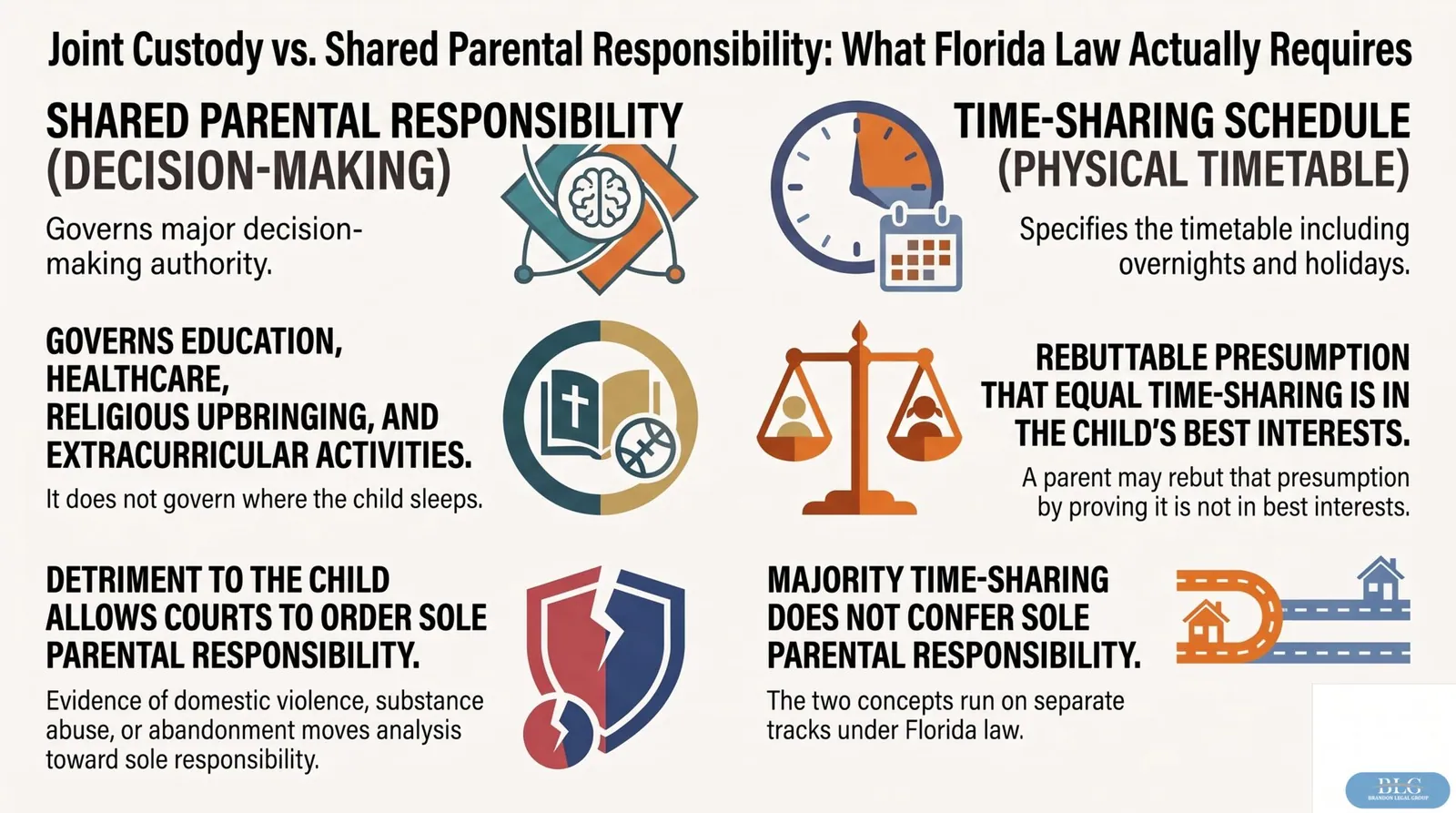
Shared parental responsibility governs decisions: education, healthcare, religious upbringing, and extracurricular activities. It does not govern where the child sleeps. That distinction matters because parents frequently assume equal decision-making guarantees equal time, or that majority time-sharing confers unilateral authority. Neither assumption is correct.
The statute allows modification when circumstances justify it. Florida Statutes § 61.13(2)(c)(2) permits a court to order sole parental responsibility to one parent with or without rights of consultation when shared responsibility would be detrimental to the child. Detriment is not disagreement. Parents who cannot agree on a school or a medical procedure do not automatically lose shared responsibility. Evidence of domestic violence, substance abuse, abandonment, or a demonstrated pattern of one parent undermining the other's relationship with the child moves the analysis toward sole responsibility.
Shared parental responsibility with ultimate decision-making authority is the middle ground. Courts assign one parent final say over specified categories, often medical decisions or education, while preserving consultation requirements. The parent without ultimate authority retains the right to be informed and heard but does not hold veto power. Orders that fail to specify which parent holds ultimate authority over which decisions create enforcement gridlock.
Timesharing Is Not Custody
Time-sharing governs the schedule. Florida Statutes § 61.046(23) defines the "time-sharing schedule" as the timetable that specifies the time, including overnights and holidays, that a minor child will spend with each parent. The term replaced "visitation" just as shared parental responsibility replaced "custody." The change was deliberate. Visitation implied one parent held custodial status while the other was a guest. Time-sharing recognizes both parents' ongoing role.
Equal time-sharing now has a statutory thumb on the scale, but it is not automatic. Florida Statutes § 61.13(2)(c) creates a rebuttable presumption that equal time-sharing is in a child's best interests. A parent may rebut that presumption by proving, by a preponderance of the evidence, that equal time-sharing is not in the child's best interests, and courts still evaluate the statutory factors in § 61.13(3). Equal time is a starting presumption, not a guaranteed outcome. When Equal Timesharing Still Fails Children in Real Life walks through scenarios where equal splits on paper collapse under logistical and relational strain.
Majority time-sharing does not confer sole parental responsibility. A parent may have the child 70% of overnights and still share all major decision-making authority with the other parent. Conversely, a parent with minority time-sharing may hold sole parental responsibility if the court finds the other parent unfit to share decisions. The two concepts run on separate tracks.
How Courts Determine Parental Responsibility and Timesharing
Florida Statutes § 61.13(3) lists twenty factors courts must consider when establishing parental responsibility and time-sharing. What matters most depends on the evidence. Key factors courts consider include:
- The capacity of each parent to encourage a close and continuing relationship between the child and the other parent
- Each parent's willingness to honor the time-sharing schedule
- The geographic viability of the parenting plan
- The moral fitness of the parents
- The mental and physical health of the parents
- The home, school, and community record of the child
- The reasonable preference of the child, if the court deems the child of sufficient intelligence, understanding, and experience
- Evidence of domestic violence, sexual violence, child abuse, child abandonment, or child neglect
- Evidence that either parent has knowingly provided false information to the court
- Each parent's participation in the child's life before and after separation
Courts weigh demonstrated behavior, not hypothetical promises. A parent who has never attended a parent-teacher conference does not win equal time-sharing by pledging future involvement. A parent who repeatedly cancels scheduled time does not retain a favorable schedule by citing work demands. The record speaks louder than the argument.
Evidence of one parent systematically alienating the child from the other, coaching, denigrating, withholding information, scheduling conflicts during the other parent's time shifts the analysis sharply. Florida courts recognize parental alienation as harmful, and cases involving it frequently result in modified time-sharing or sole parental responsibility to the targeted parent.
Why the Vocabulary Shift Matters in Practice
Language shapes expectations. Parents operating under the belief that they are fighting for "custody" arrive in mediation or trial unprepared for the questions Florida law actually asks. Custody is a winner-take-all concept. Shared parental responsibility and time-sharing are not. They are variables the court adjusts independently based on statutory factors.
Parenting plans drafted using outdated terminology, or drafted informally without legal review, frequently omit the specificity Florida law requires. Florida Statutes § 61.13(2)(b) mandates that a parenting plan include a detailed time-sharing schedule, designation of decision-making authority for health, education, and other matters, and methods for resolving disputes. Plans that use vague language like "reasonable visitation" or "mutual agreement required" can be difficult to enforce when conflict arises.
Do not count on a court to rescue sloppy language after the fight starts. The time to define terms is before the order is signed. Custody attorneys drafting parenting plans translate the parents' intentions into language that survives conflict.

Plans break down when they do not account for the difference between responsibility and time. A parent with shared parental responsibility but minority time-sharing may still expect to approve school enrollment or medical treatment. A parent with majority time-sharing may assume the right to relocate without seeking modification. Neither assumption aligns with the statute. The gap between expectation and enforceability often widens silently until one parent seeks contempt enforcement or emergency modification.
Closing Remarks
If you are negotiating a parenting plan under vocabulary that predates the statute, if your time-sharing order lacks decision-making specificity, or if the other parent is operating as though majority time confers unilateral authority, the distinction between what people call custody and what Florida law enforces is not academic. It is the difference between a plan that holds and one that fails the first time conflict surfaces. Brandon Legal Group represents parents who need parenting plans drafted to survive real-world pressure and enforcement actions when the other side ignores court orders. Contact us before you sign something built to collapse.
Frequently Asked Questions
Does shared parental responsibility mean equal timesharing?
No. Shared parental responsibility governs decision-making authority. Time-sharing governs the schedule. Courts assign them independently. A parent can hold shared decision-making authority while having less than half the overnights, or hold majority time-sharing while sharing all major decisions with the other parent.
Can a parent lose shared parental responsibility after it has been ordered?
Yes. A parent seeking modification must generally show a substantial, material, and unanticipated change in circumstances and that modification is in the child's best interests. Florida Statutes § 61.13(2)(c)(2) then allows the court to order sole parental responsibility when shared responsibility would be detrimental to the child. Evidence may involve domestic violence, substance abuse, alienation, chronic refusal to communicate, or abandonment. Disagreement over decisions alone does not meet the threshold.
What happens if the parenting plan does not specify who makes medical or educational decisions?
Ambiguity defaults to deadlock. If the plan orders shared parental responsibility but does not assign ultimate decision-making authority and the parents cannot agree, neither has the power to act unilaterally. Emergency medical situations may fall under statutory exceptions, but non-emergency disputes typically require court intervention or modification of the plan.
Can one parent relocate with the child if they have majority timesharing?
Not without following Florida's relocation statute. Florida Statutes § 61.13001 requires written agreement from the other parent or court approval before relocating more than 50 miles from the relocating parent's principal residence at the time of the last order establishing or modifying time-sharing, or at the time of filing the pending action, for at least 60 consecutive days. Majority time-sharing does not override the relocation requirement. Unauthorized relocation is grounds for contempt and modification.
Does a child's preference determine timesharing?
The child's reasonable preference is one of twenty statutory factors under Florida Statutes § 61.13(3)(i). Courts consider it when the child possesses sufficient intelligence, understanding, and experience to express a preference. Age alone does not determine weight. A teenager's articulated reasoning carries more weight than a young child's stated preference, particularly when there is evidence of coaching or manipulation by one parent.
References
- Florida Statutes § 61.046 (Definitions (Parental Responsibility and Time-Sharing)).
- Florida Statutes § 61.13 (Support of Children; Parenting and Time-Sharing; Powers of Court).
- Florida Statutes § 61.13001 (Parental Relocation with a Child).