

How Florida Courts Calculate Your Obligation: The Child Support Formula Unveiled
Your child support obligation isn’t a suggestion or a negotiation starting point. It’s the output of a rigid, mathematical formula used by every court in the state. Understanding the Florida child support calculation is the first step to preparing for your case, whether you are seeking support or are the obligated parent. We break down the Florida child support guidelines with no sugar-coating, so you know exactly how the court arrives at that number.
The Three Core Inputs of the Florida Child Support Calculation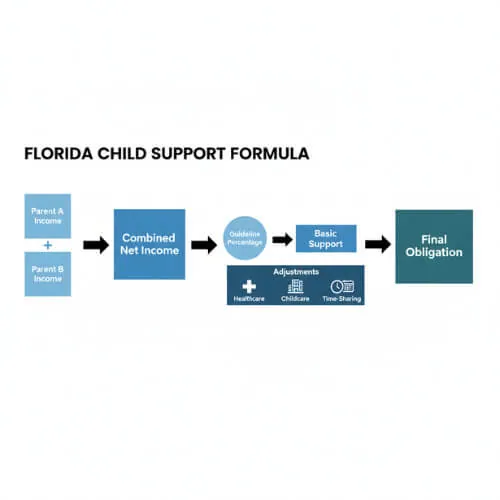
The court’s formula is a machine that requires three primary inputs. Get these numbers wrong, or fail to properly present them, and the output your financial future will be wrong. The entire Florida family court process for support hinges on accurately defining these inputs.
1. Net Income: The Foundation of Your Obligation
The first and most critical step is the child support income calculation. The court doesn’t use your gross pay. It calculates your net income by taking your gross income and subtracting mandatory deductions like taxes, social security, Medicare, and union dues. For the self-employed or those with variable income, this becomes a complex forensic exercise. The court will dissect your finances to find your true earning potential, not just what you report on a tax return. This is a primary focus in cases involving self-employment.
2. The Time-Sharing Credit: Where Overnights Equal Dollars
This is the factor most people misunderstand. The Florida child support guidelines provide a credit to the paying parent based on the number of overnights they have with the child each year. This isn’t about “visitation”; it’s about documented, overnight care. If you have the child for 40% of the overnights, you are directly covering their food, utilities, and other costs for that time, and the support calculation reflects that. Your physical custody schedule is a financial document.
3. Add-Ons: Health Insurance and Childcare Costs
The basic support amount from the formula covers primary needs. On top of that, the court adds the actual cost of the child’s health insurance and necessary childcare expenses. These costs are typically divided between the parents in proportion to their income. A failure to account for these can leave thousands of dollars on the table or create an unfair burden.
The Critical Child Support Obligation Factors That Adjust the Outcome
Beyond the core inputs, several key child support obligation factors can significantly alter the final number. The court has discretion to consider the special needs of a child, extraordinary medical or educational expenses, and the standard of living the child would have enjoyed if the marriage had not ended. Presenting evidence for these factors requires a strategic, documented approach within the contested divorce process.
Picture This: Certainty in an Uncertain Process
Imagine walking into court knowing exactly how the judge will calculate the number that will impact your life for years. Picture the power of having your financial documents organized to perfectly align with the state’s formula, leaving no room for error or manipulation by the other side. This isn’t a hope; it’s a predictable outcome when you understand the machine.
Your Next Step: Prepare for the Calculation, Don’t Fear It
You can either be a passive input into this legal formula, or you can actively shape the data that is entered. The difference is thousands of dollars and years of financial stability.
Florida Child Support Calculation FAQs
How do Florida courts calculate child support obligations?
Florida courts use a specific formula outlined in the Florida Child Support Guidelines. The calculation starts with combining both parents’ net incomes. The court then applies a percentage based on the number of children to determine the basic support need. This amount is then adjusted for factors like healthcare costs, childcare expenses, and the percentage of overnight time each parent has. The result is a precise, court-ordered obligation that is legally enforceable.
What factors affect child support in Florida?
The primary child support obligation factors are: 1) The net income of both parents, 2) The number of children, 3) The cost of the child’s health insurance, 4) The cost of daycare or necessary childcare, and 5) The number of overnights each parent has per year (the time-sharing schedule). The court may also consider extraordinary medical or educational expenses. Understanding these factors is critical, as they directly impact the final calculation in the Florida family court process.
Does parenting time affect child support payments in Florida?
Absolutely. The number of overnights is one of the most significant variables in the Florida child support calculation. The formula provides a credit to the parent paying support based on the percentage of overnights they have. Substantial time-sharing (often defined as 20% or more of overnights, or 73+ nights per year) can substantially reduce the support obligation. This is because the court recognizes that parent is directly bearing more of the child’s daily expenses. Your parenting plan and time-sharing schedule are therefore directly tied to your financial obligation.