

TL;DR: Florida probate becomes mandatory when an estate holds assets titled solely in the decedent's name above specific dollar thresholds, or when real property requires formal transfer. The size of the estate and the type of assets dictate whether summary administration, formal administration, or no probate at all applies. Understanding where those lines fall determines whether heirs face months of court supervision or a simple affidavit.
Most people assume probate is automatic after death. It isn't. Florida law triggers court involvement only when certain conditions align, threshold values, asset titling, and the presence or absence of probate-avoidance tools. Stay under the threshold, and the estate can clear in weeks with a sworn petition. Cross it, and the family enters a supervised process that can stretch six months or longer. The difference between summary administration and formal administration isn't academic; it's measured in time, cost, and whether creditors get a formal invitation to file claims. Knowing where the tripwires sit means heirs can plan around them or prepare for what's coming.

Florida statute divides estates into three lanes: those that avoid probate entirely, those eligible for summary administration, and those requiring formal administration. Each lane has its own thresholds, procedural requirements, and timelines. The estate's size and the nature of its assets determine which lane applies. Cross one threshold, and the process changes entirely.
The Summary Administration Threshold: $75,000 and Two Years
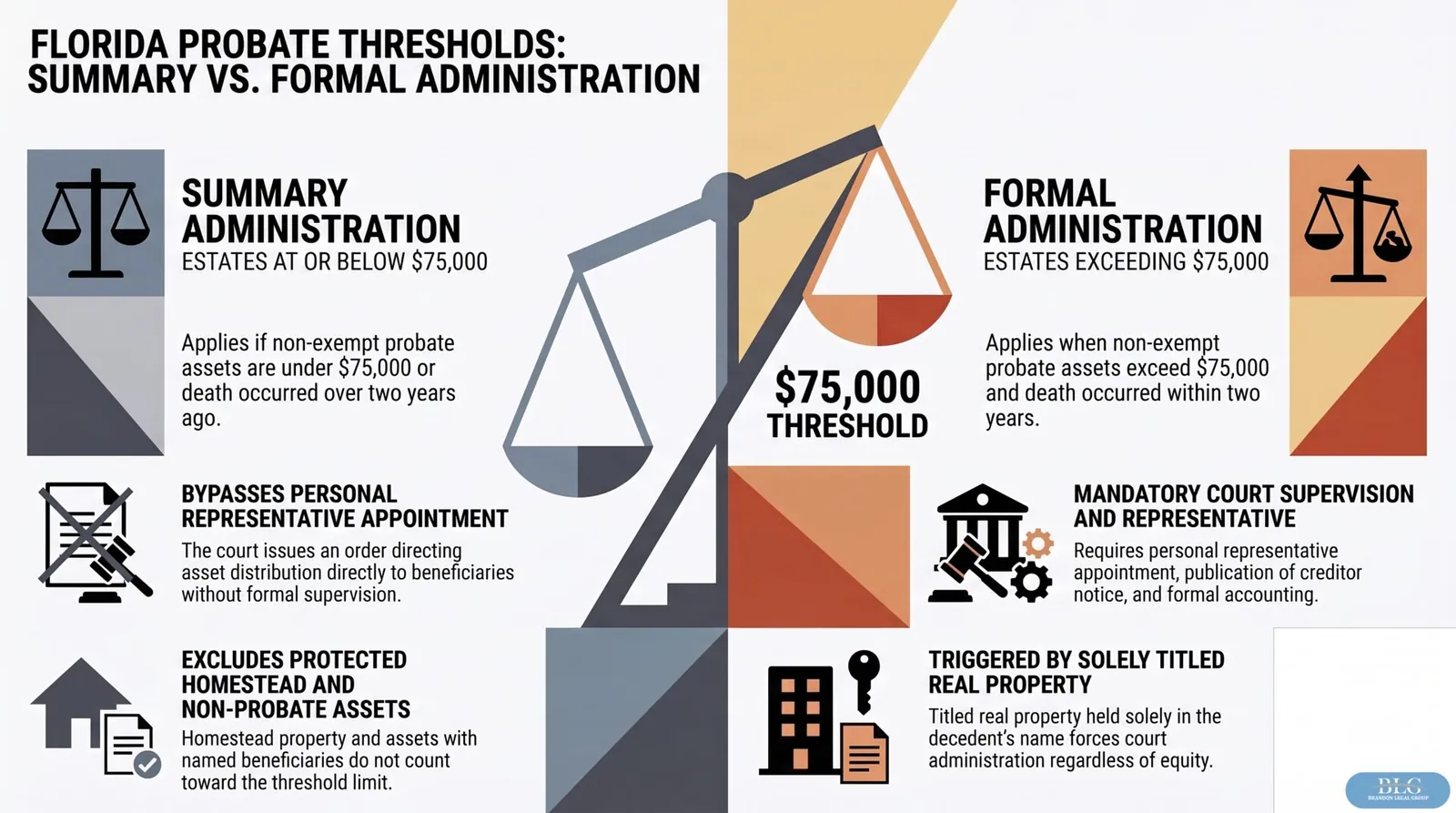
Summary administration under Florida Statute § 735.201 applies when the value of the entire estate subject to administration in Florida, less the value of property exempt from creditors' claims, does not exceed $75,000, or when more than two years have passed since death, regardless of estate size. That $75,000 figure refers to the value of assets subject to probate, bank accounts titled in the decedent's name alone, brokerage accounts without transfer-on-death designations, vehicles, personal property. It does not include exempt property such as protected homestead, or non-probate assets like payable-on-death accounts and life insurance with named beneficiaries.
Summary administration does not require appointment of a personal representative. Instead, a court order directs asset distribution directly to the beneficiaries. The petitioner files a verified petition listing all assets and debts, names the heirs or beneficiaries, and asks the court to authorize transfer. There is no formal creditor claim period tied to a notice to creditors as in formal administration. If debts exist, the petitioner must either pay them before distribution or provide for their payment in the petition. The process typically concludes in weeks, not months, and legal fees reflect the reduced complexity.
The two-year alternative applies when no administration was opened within two years of death. Under Florida Statute § 733.710, claims against the estate are generally barred two years after the decedent's death, whether or not a claim was filed. Summary administration becomes available even for larger estates because the exposure to unpaid claims has largely closed. This option serves families who delayed filing and now need to transfer title to real property or close an old account.
Formal Administration Thresholds: When the Estate Exceeds $75,000
When probate assets subject to administration exceed $75,000 and death occurred within the past two years, the estate falls outside the summary administration criteria of Florida Statute § 735.201 and formal administration under Chapter 733 becomes the required path. Formal administration requires court appointment of a personal representative, publication of notice to creditors, a three-month creditor claim period, an inventory, accountings, and often a final accounting before distribution. The court supervises every significant action: sale of real property, payment of claims, disputes among beneficiaries, interpretation of ambiguous will provisions.
The $75,000 threshold is measured against the value of the estate subject to administration, less exempt property, not against net equity after mortgages. A non-homestead house worth $200,000 with a $150,000 mortgage still counts as $200,000 for threshold purposes, even though net equity is only $50,000. The mortgage must be paid or assumed, but its existence does not reduce the estate's size for purposes of determining whether formal administration applies. The same rule applies to secured debts on vehicles or other titled property.
Formal administration protects creditors and provides a structured process for resolving disputes. It also consumes time and money. Attorney fees in formal administration are often measured against Florida Statute § 733.6171, which establishes presumptively reasonable fee amounts based on the compensable value of the estate. A $200,000 estate typically generates roughly $6,000 in presumptively reasonable legal fees, plus personal representative compensation, court costs, and publication expenses. Timelines rarely run shorter than six months and often extend beyond a year when real property sales, contested claims, or will disputes arise.
Assets That Bypass Probate Thresholds Entirely
Certain assets never enter probate regardless of value. These non-probate assets transfer by operation of law, contract, or beneficiary designation and do not count toward the $75,000 threshold:
- Bank accounts and brokerage accounts with payable-on-death or transfer-on-death designations
- Life insurance policies with named beneficiaries other than "estate"
- Retirement accounts (IRAs, 401(k)s) with designated beneficiaries
- Real property held as joint tenants with right of survivorship or as tenants by the entirety
- Assets titled in a revocable trust
- Protected homestead real property passing under Florida constitutional descent rules
A decedent could hold $500,000 in IRAs, a $400,000 home as joint tenant with a spouse, and $200,000 in a revocable trust, yet die with a probate estate of zero dollars if no other assets exist. Probate thresholds apply only to assets that require court intervention to transfer title. Proper titling and beneficiary designations eliminate the need for probate administration entirely, regardless of total wealth.
Homestead property deserves special attention. Under Article X, Section 4 of the Florida Constitution, homestead is protected from forced sale and from most creditor claims, and Florida law restricts how it can be devised when the decedent leaves a surviving spouse or minor child. If the decedent leaves a minor child, the homestead cannot be devised at all; if there is a surviving spouse but no minor child, it may be devised only to the spouse unless the spouse waived those rights. Otherwise it descends to the heirs. Protected homestead is excluded from the value used to test the summary administration threshold, but heirs commonly still file a petition to determine homestead status so the record shows clear title.
Disposition Without Administration: The Small-Estate Exception
Florida Statute § 735.301 permits disposition of personal property without any court administration when the decedent left only personal property exempt from creditors' claims plus non-exempt personal property whose value does not exceed the sum of preferred funeral expenses and reasonable and necessary medical and hospital expenses of the last 60 days of the last illness. In practice, that math usually confines this route to very small estates. A person who paid those expenses, or who is entitled to the property, files an informal application with the court, which may authorize the asset holder, usually a bank, to release the funds without full administration.
This process applies only to personal property, bank accounts, wages, security deposits. It does not apply to real estate. If the decedent owned even a small parcel of land titled in her name alone, formal or summary administration becomes necessary to transfer title, regardless of the property's value. Title companies will not insure title based on informal affidavits alone. A court order is what clears the chain.
Real Property as the Threshold Trigger
Real property titled solely in the decedent's name almost always forces probate, even when its value is modest. A vacant lot worth $30,000 requires at least summary administration to produce a court order clearing title. The reason is systemic: Florida's title industry does not treat affidavits or informal documents as sufficient proof of transferred ownership. Title insurers demand either a court order or a properly executed deed from a living grantor. Death certificates and inheritance affidavits, standing alone, do not satisfy that requirement.
One practical exception exists: protected homestead passing under constitutional descent. Heirs sometimes clear title by recording a certified copy of the death certificate together with an affidavit of heirs or continuous marriage affidavit. But that shortcut works only for homestead, only when descent follows the constitutional rules, and only when the title underwriter accepts it. Any deviation, any dispute, any ambiguity in heirship, and probate becomes necessary, most often through a petition to determine homestead status. For investment property, commercial real estate, or vacation homes, probate is unavoidable unless the property was titled in a trust or held with survivorship rights.
Consider a hypothetical: A decedent owns a rental duplex valued at $95,000, held in her name alone. She has no spouse, two adult children, and a will leaving everything equally to them. The estate also contains $15,000 in a checking account with no payable-on-death designation. Total probate estate: $110,000. That figure exceeds the summary administration threshold and points the family into formal administration, even though the net equity after the mortgage might be only $40,000. The children cannot sell the duplex, refinance it, or transfer title without a court order appointing a personal representative and authorizing the transaction. The threshold was crossed, and the process is no longer optional.

Thresholds are not suggestions. They are statutory gates that open or close entire procedural pathways. An estate sitting at $74,000 in non-exempt probate assets qualifies for summary administration, quick, inexpensive, minimal court involvement. At $76,000, formal administration applies, with all its procedural weight. That $2,000 difference determines whether the family spends a few weeks or the better part of a year in the system. Proper estate planning anticipates these thresholds and structures asset titling to stay below them or eliminate probate entirely. When planning did not occur, understanding where the estate falls on the threshold spectrum tells heirs what process to expect and how to prepare for it. The thresholds are drawn. The only question is which side of the line the estate lands on.
Closing Remarks
If the estate includes titled real property outside a trust, probate assets exceed $75,000, or confusion exists about whether summary administration applies, the procedural path is already narrowing. Brandon Legal Group structures estates to avoid probate thresholds before they matter and guides families through administration when avoidance is no longer an option. Contact us to determine which threshold applies and what comes next.
Frequently Asked Questions
Does a will eliminate the need for probate in Florida?
No. A will directs how assets are distributed during probate; it does not avoid probate. Whether probate is required depends on the value and titling of assets, not the existence of a will. A will generally must be admitted to probate to have operative effect, because only a court order gives the personal representative authority to act. Non-probate assets, those with beneficiary designations or held in trust, pass outside the will regardless of what the will says.
What happens if an estate is just above the $75,000 threshold?
Formal administration becomes the path unless the non-exempt estate value genuinely falls below the threshold. Exempt property and protected homestead are excluded from the calculation, which is often what moves an estate under the line. A qualified beneficiary may also disclaim an interest, though disclaimers must meet strict statutory requirements and cannot be used simply to dodge procedure. The court determines the estate's value based on the sworn petition and inventory. Underreporting asset values to avoid formal administration is a sworn misstatement to the court and exposes the filer to personal liability and potential criminal charges.
Can summary administration be used if there are debts?
Yes, but the petitioner must address them in the petition. Summary administration does not eliminate debts; it avoids the formal creditor claim process. The petition must show that the estate is not indebted or that provision for payment of debts has been made. Those who receive distributions can remain personally liable to creditors, up to the value of what they received, for the period allowed by statute. Ignoring known creditors does not make them disappear; it moves the exposure onto the beneficiaries.
Does homestead property count toward the probate threshold?
No. Protected homestead is excluded from the value of the estate used to test the $75,000 summary administration threshold. It passes under Florida's constitutional and statutory descent rules to the surviving spouse or descendants, subject to the restrictions on devise. Homestead value is excluded even if the estate undergoes formal administration for other assets. That exclusion can be the difference between summary and formal administration when the decedent owned both a homestead and non-exempt property.
What if the decedent died more than two years ago and nothing was filed?
Summary administration becomes available regardless of estate size once two years have passed from the date of death, because Florida Statute § 733.710 bars most claims against the estate after that point. This option serves families who delayed action or were unaware administration was necessary. However, real property still requires a court order to clear title, and secured creditors, mortgage holders and lienholders, retain their rights against the property. The two-year rule opens the door to summary administration; it does not extinguish liens or eliminate the need for court involvement when real property is involved.
Can probate be avoided entirely if all assets are jointly owned?
Yes, if the assets are titled as joint tenants with right of survivorship or tenants by the entirety. These ownership forms allow the surviving co-owner to take full ownership automatically upon the other owner's death, without probate. A death certificate and supporting affidavit are typically sufficient to clear the decedent's name from title. However, this strategy works only if all assets are jointly owned or otherwise designated to pass outside probate. A single asset titled solely in the decedent's name, particularly real property, can trigger probate even if everything else was jointly held. An estate planning attorney can review titling to identify gaps before they become probate triggers.
What if the will names a personal representative but the estate qualifies for summary administration?
Summary administration does not require appointment of a personal representative, even if the will names one. The petitioner, often a beneficiary or the person nominated in the will, files the petition, but no formal appointment or letters of administration follow. The court issues an order directing distribution of assets. If the will contains specific bequests, the order distributes according to those provisions, but bond, inventories, and ongoing court supervision do not apply. The goal is expedited distribution, not full estate administration.
Does the $75,000 threshold apply to each beneficiary or to the total estate?
The threshold applies to the total value of the estate subject to administration, less exempt property, not to individual shares. An estate worth $150,000 divided among three heirs does not qualify for summary administration simply because each heir receives less than $75,000. The value of all non-exempt assets subject to probate determines whether summary or formal administration applies. Division among multiple beneficiaries is irrelevant to the threshold calculation. Once the estate enters formal administration, the personal representative distributes shares according to the will or, if none, Florida's intestate succession statutes detailed in resources like Intestate Heirs: Who Claims What When There's No Will.
References
- Fla. Stat. § 735.201. (Summary administration; nature of proceedings).
- Fla. Stat. § 735.301. (Disposition without administration).
- Fla. Stat. § 733.6171. (Compensation of attorney for the personal representative).
- Fla. Stat. § 733.710. (Limitations on claims against estates).
- Fla. Stat. § 733.212. (Notice of administration; filing of objections).
- Fla. Const. art (X (§ 4 (Homestead; exemptions; restrictions on devise).