
TL;DR: You spent decades building something real. A business. A home. Savings. A life. And right now, none of it is protected the way you think it is. Most people assume their estate is “handled” because they made a will once, years ago. It is not. Estate planning is not a one-time checkbox. It is a living strategy. If yours is outdated, incomplete, or nonexistent, you are not protecting your legacy. You are gambling with it. This article is for the person who has worked too hard to let it fall apart on the back end.
 You Did the Hard Part. Now Do the Smart Part.
You built something. Maybe it was a business you poured fifteen years into. Maybe it is a home you fought to keep, real estate you accumulated slowly, or retirement accounts you never touched. Whatever it is, you did not get there by being careless. You made hard calls. You showed up when it was easier not to.
And yet, statistically speaking, there is a good chance you have done almost nothing to protect what you have built once you are gone.
That is not a judgment. It is just what happens. Life is busy. Estate planning feels morbid. You keep meaning to get around to it. And so it sits, unfinished, outdated, or completely absent, while everything you worked for hangs in the wind.
Here is the hard truth: a broken estate plan is worse than no plan at all. Because at least “no plan” does not pretend to protect you.
What “Broken” Actually Looks Like in 2026
 Most people imagine estate planning disasters look dramatic. Contested wills. Courtroom battles. Sometimes they do. But more often, the damage is quiet. It happens because the documents you signed years ago no longer match the life you actually live.
Here is what broken actually looks like in the real world:
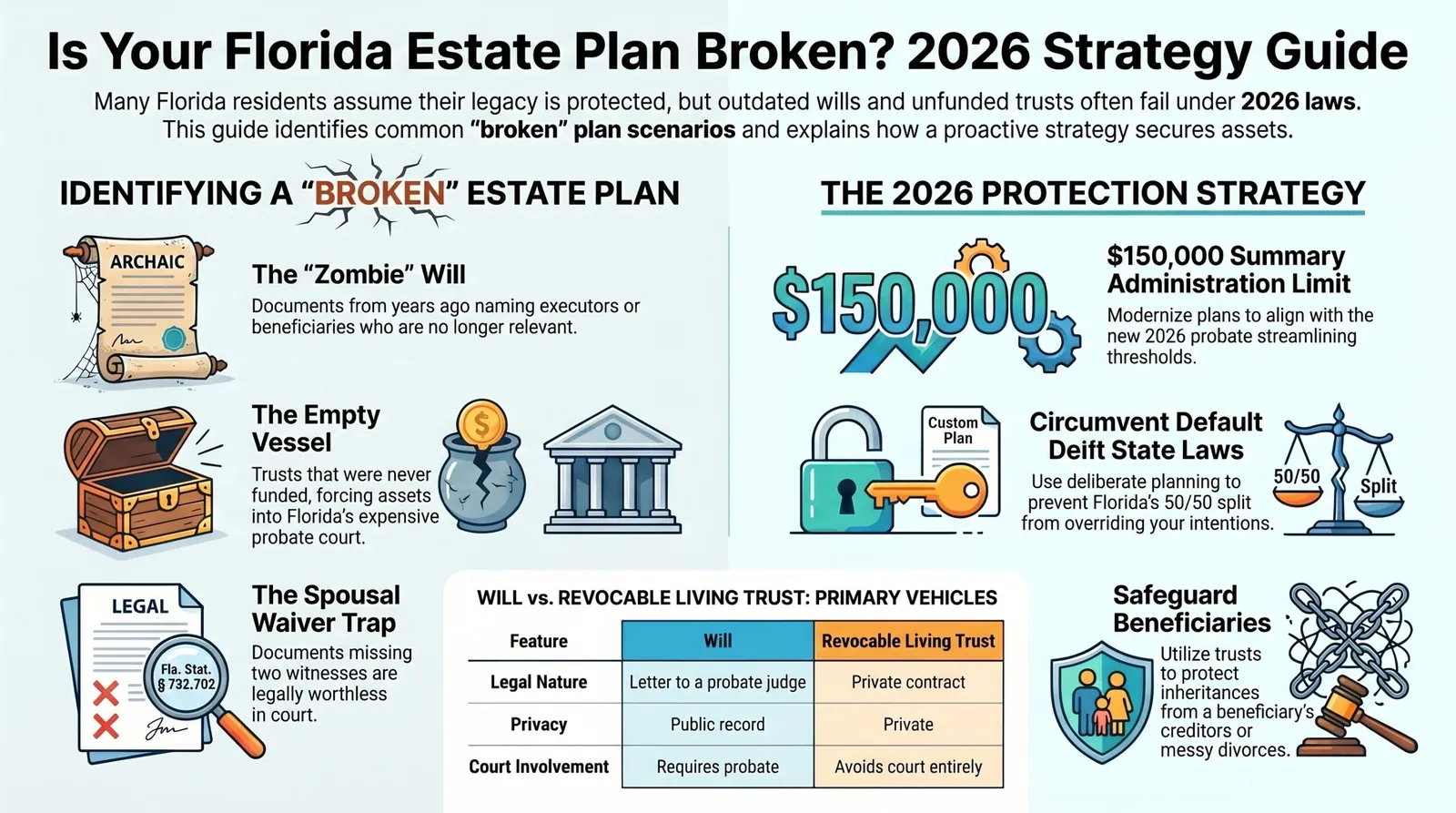
- The “Zombie” Will: A document written in 2011 that still names an ex-spouse as beneficiary, or an executor who is no longer in your life.
- The Ghost Business: A company with no succession plan, liquidated at pennies on the dollar because the owner was the only one with the keys.
- The Empty Vessel: A trust that was drafted but never “funded.” The assets were never retitled. In Florida, if it is not in the trust, it is headed for probate.
- The Spousal Waiver Trap: You have a prenup or a letter from your spouse waiving their rights to the house to protect your kids. But under Fla. Stat. § 732.702, if that document was not signed in the presence of two subscribing witnesses, it may be legally worthless. Your kids end up fighting a claim they thought was settled.
- The Blended Family Paradox: You assume Florida’s “50/50 split” law protects your kids from a first marriage. But because your house and bank accounts are titled “Joint with Right of Survivorship,” everything passes to your second spouse by operation of law. The kids get nothing, and the law cannot help them because the assets never hit probate. (Florida’s elective share protects surviving spouses from being cut out this way. It does not protect children.)
The Biggest Mistake Is Thinking You Have Time
Nobody calls an estate planning attorney because they feel urgency. They call when a parent dies without a plan and the family is suddenly at war. They call when a diagnosis arrives and the clock becomes visible.
By that point, options narrow. Costs rise. Family relationships fracture under the pressure of decisions that should have been made years earlier. The best time to do this was five years ago. The second-best time is right now, before anything happens, while you still have full control over the outcome.
What a Real Estate Plan Actually Does
A real estate plan is not just a document. It is a set of decisions, made deliberately, by you, while you are alive and clear-headed. Done right, it does three things:
1. It Circumvents the “Default” Laws
If you die in Florida without a plan, Florida Statute § 732.102 decides who gets your assets. If you have a spouse and children from a previous marriage, the law directs a 50/50 split of the probate estate.
The Catch: That 50/50 split only applies to “Probate Assets.” If your assets are tied up in joint accounts or life insurance policies with a single beneficiary, the state’s 50/50 safety net does not exist. A real plan ensures your intentions beat the “default” settings.
2. It Keeps the Court Out of Your Business
Probate is public, slow, and expensive. The 2026 Florida Legislature recently increased the Summary Administration limit to $150,000 (effective July 1, 2026, under CS/SB 1500), which will streamline more small estates. But probate remains a court-supervised process. A well-structured Revocable Living Trust avoids the court entirely, keeping your private business private.
3. It Protects Beneficiaries From Themselves
An outright inheritance hands your adult child a lump sum with zero protection. If they have creditors, a messy divorce, or a spending problem, that legacy disappears. A trust keeps those assets protected and ensures they are used for the purposes you intended.
Frequently Asked Questions
Do I need a trust, or is a will enough? For most people with real assets like a home, retirement accounts, or a business, a trust offers significantly more protection. A will is essentially a letter to a probate judge. A trust is a private contract that avoids the court entirely.
How often should I update my plan? Review it every three to five years, or any time you experience a “Life Event”: marriage, divorce, a new child, or a significant change in your net worth. Florida’s 2026 probate reforms (CS/SB 1500) are also a good prompt to take a fresh look.
What happens if I die without a plan in Florida? In a blended family, Florida law directs a 50/50 split of probate assets between your spouse and your children (Fla. Stat. § 732.102). However, surviving spouses also have Elective Share rights (30% of the elective estate) and Homestead rights that can effectively shut out children from a first marriage for decades. Without a plan, you are leaving your children’s future to chance.
Does Florida have an estate or inheritance tax? No. The Florida Constitution prohibits both. Florida residents are only subject to federal estate tax, which in 2026 applies only to estates exceeding $15 million per person ($30 million for married couples) under the One Big Beautiful Bill Act. For most families, the federal estate tax is not the concern. Probate, asset titling, and family dynamics are.
Don’t Leave This to Chance
You did not build what you have by hoping things would work out. You made decisions. You took action. You protected what mattered.
Your estate deserves the same level of intention. Brandon Legal Group works with clients who are serious about protecting their legacy. Not just for themselves, but for the people they are leaving it to. If your plan is outdated, incomplete, or nonexistent, now is the time to fix it.
Meet the attorneys and find out what a real strategy looks like.