

When someone dies without a will in Florida, state law decides who inherits: the order is rigid, mathematical, and often surprising. Spouses, children, parents, and siblings follow a strict statutory hierarchy that does not account for relationships, intentions, or need. What feels morally right carries no legal weight.
Most people assume intestacy sorts itself out fairly. It does not. Florida's intestate succession statutes apply a fixed formula to the entire estate, and the results can be brutal. A surviving spouse may receive far less than expected. Adult children from a prior marriage may inherit alongside a current spouse, creating conflict the deceased never anticipated. A parent who provided years of care may receive nothing while a sibling who vanished decades ago claims a share. The law does not measure worthiness; it measures relation and degree. Intestacy does not deliver fairness. It delivers certainty, and those are not the same thing.

Intestate estates are not rare edge cases. They are common, and the stakes escalate with every complication: blended families, estranged relatives, real property, business interests. Understanding the statutory order is not academic. It determines who gets the house, the bank accounts, the vehicles, and the authority to administer the estate. The hierarchy is unforgiving, and once death occurs, there is no negotiation.
How Florida Statutes 732.102 and 732.103 Assign the Estate
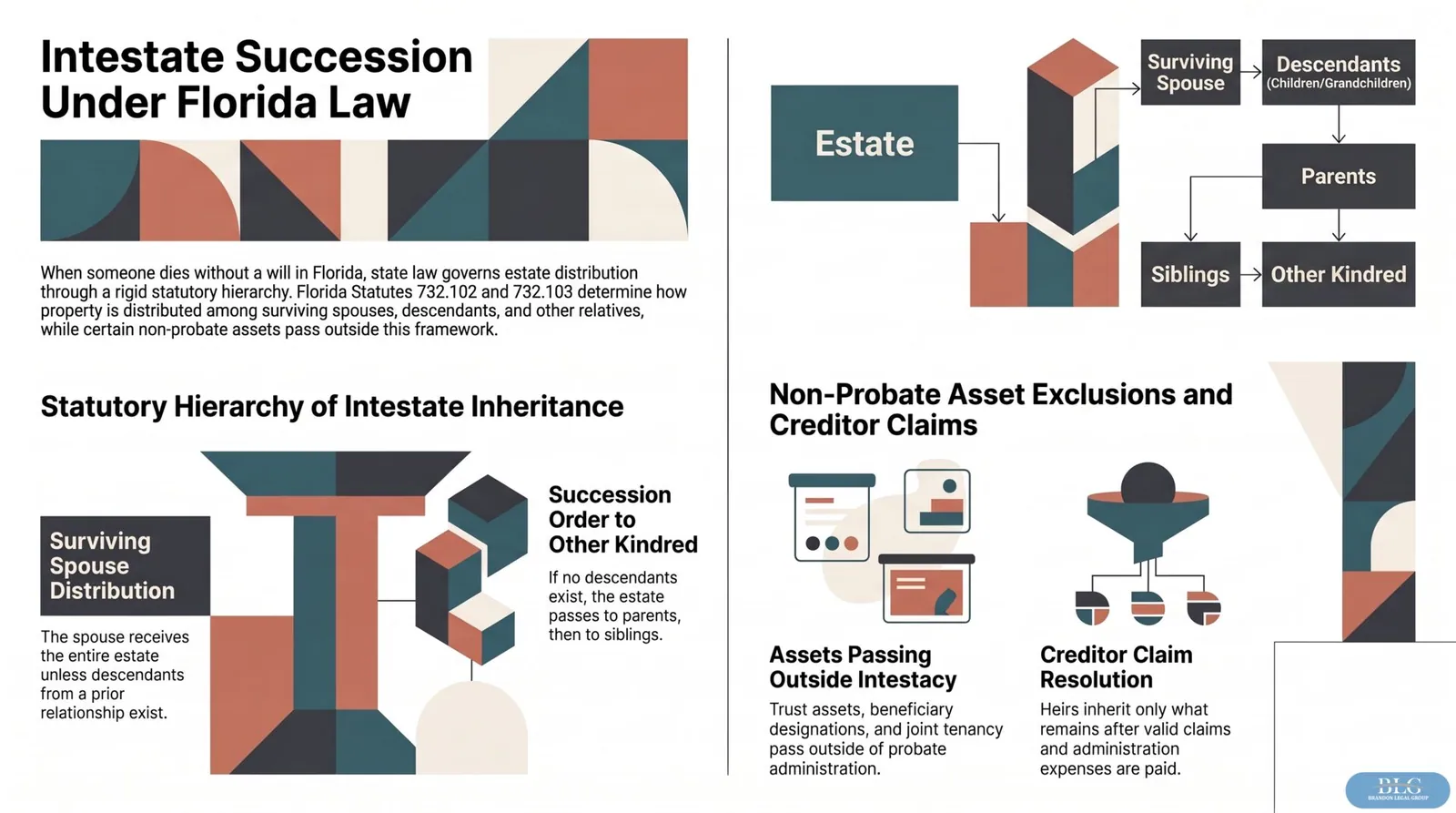
Florida Statute 732.102 controls the surviving spouse's share when there is no will. Florida Statute 732.103 controls who inherits the portion not passing to a surviving spouse, or who inherits when there is no surviving spouse. Together, those statutes move the estate first through the spouse and descendants, then upward and outward through the family tree.
If the decedent leaves a surviving spouse and no lineal descendants, no children, grandchildren, or great-grandchildren. The spouse inherits the entire estate. Clean and complete. But add children into the scenario, and the calculus shifts immediately.
If all descendants are also descendants of the surviving spouse, and the spouse has no other descendants from outside the marriage, the spouse still receives the entire estate. This covers traditional nuclear families where all children belong to both spouses. The moment one party has children from a prior relationship, the statutory share splits. The spouse receives half. The descendants receive the other half, divided per stirpes.
If the decedent has no spouse and no descendants, the estate passes to the decedent's parents equally, or to the surviving parent if only one remains. If no parents survive, the estate descends to the decedent's siblings and the descendants of deceased siblings. Under Florida law, half-blood relatives inherit half as much as whole-blood relatives of the same degree, a critical distinction that often blindsides families.
If no parents, siblings, or descendants of siblings exist, the law does not stop there. The estate moves upward to grandparents and their descendants. The law divides the estate in half, one for the paternal side and one for the maternal side, and follows those lines down. Only after this exhaustive search for kindred fails does the estate escheat to the State of Florida. The point remains: intestacy is a closed system. It will not pass your property to a close friend, a partner, or a stepchild, no matter how much you might have wanted it to.
Per Stirpes Distribution and the Generational Split
When descendants inherit, Florida uses per stirpes distribution under Section 732.104. This means the estate is divided by family branch, beginning with the decedent's children as the first generation below the decedent. If a child has died but left descendants, that deceased child's branch takes the share the child would have received.
Consider a hypothetical: the decedent dies intestate with three children, two living, one predeceased. The predeceased child left two children of her own. The estate splits into three parts at the first generation. Each living child receives one-third. The two grandchildren from the deceased child split their parent's one-third share, receiving one-sixth each. The result is not equal per person; it is equal per branch. This structure can produce resentment, particularly when grandchildren and children stand in the same probate proceeding with wildly unequal shares.
Adopted children and children born out of wedlock qualify as descendants under Florida law, provided paternity is legally established where required. Stepchildren and foster children do not, regardless of emotional ties or years of care. Biology and legal adoption define lineage. Moral proximity does not.
Blended Families and the Spousal Share Problem
Blended families collide hardest with intestacy statutes. When a decedent has children from a prior marriage and a surviving spouse, the spouse receives only half the estate. The children receive the other half. This outcome often contradicts the decedent's assumed intentions, particularly when the spouse contributed financially to the estate or when minor children still live at home.
Homestead property adds another layer. Under Florida's homestead rules, if the decedent is survived by a spouse and descendants, the surviving spouse generally receives a life estate in the homestead and the descendants receive the remainder, unless the spouse makes a timely statutory election to take a one-half tenant-in-common interest instead. Either structure can freeze liquidity, complicate administration, and fuel family conflict. The descendants cannot sell the whole property alone. The spouse cannot refinance or sell the whole property alone. Everyone is stuck in a property arrangement no one planned.
When an estate planning attorney prepares a comprehensive plan, these conflicts are avoided entirely. Intestacy does not offer flexibility. It offers a rigid statutory outcome, applied retroactively to a family structure the law does not understand.
What Does Not Pass Through Intestate Succession
Not every asset falls under intestate succession. Several categories of property transfer outside the probate estate entirely, governed instead by beneficiary designations, contract, or operation of law:
- Assets held in revocable trust pass according to the trust instrument, not by intestacy
- Retirement accounts, life insurance policies, and payable-on-death accounts transfer to named beneficiaries
- Real property held as joint tenants with right of survivorship or tenancy by the entireties passes automatically to the surviving co-owner
- Bank accounts with valid payable-on-death or transfer-on-death designations bypass probate
These non-probate transfers are not subject to intestate succession, but they are also not immune from problems. Outdated beneficiary designations can create disputes or, depending on the account type and governing law, unintended payouts. A forgotten payable-on-death designation may send funds to a sibling instead of a spouse. Coordination failures create the same chaos intestacy produces, just through a different mechanism. Understanding digital assets in estate plans becomes critical when financial and investment accounts exist entirely online, managed through platforms that may not surface beneficiary settings clearly.
Creditor Claims and the Priority Waterfall
Intestacy does not eliminate debt. Creditors file claims during estate administration, and Florida law establishes a priority order under Section 733.707. Administration expenses come first. Funeral and burial expenses, federally preferred debts and taxes, certain medical expenses from the last sixty days, family allowance, child support arrearages, post-death business debts, and other claims follow in the statutory order. Secured creditors are different: mortgages and other liens generally remain enforceable against the collateral and are not treated like ordinary unsecured claims.
If the estate lacks sufficient assets to satisfy all claims, some creditors receive nothing. Heirs inherit only what remains after valid claims are paid. The statutory share is a share of the net estate, not the gross. This surprises families who assume the house, the car, and the bank account will pass untouched. Debt does not vanish at death. It is merely transferred to the estate for resolution during probate.
Homestead property may be shielded from many unsecured creditor claims under Florida's constitutional protections, but mortgage liens, property taxes, assessments, and other protected homestead exceptions survive. The homestead exemption is powerful. It is not magic. Secured debt and legally recognized exceptions still have teeth.

Intestate succession does not adapt. It does not consider who sacrificed, who contributed, or who needs the inheritance most. It applies a formula. Families assume the law will reflect their values. It will not. The statute exists to provide an answer when the decedent left none, and that answer is mechanical, predictable, and often profoundly disconnected from the decedent's likely intent. Relying on intestacy is a choice to let the state write the estate plan.
Closing Remarks
If a blended family faces a spousal share conflict, if descendants and spouses will split an estate the decedent never intended to divide, or if creditor claims threaten to consume assets before heirs receive anything, the statutory outcome is already locked in unless action is taken now. Brandon Legal Group builds estate plans that ensure assets go where they are intended, not where a statute directs. Contact us to prevent intestacy from writing your plan for you.
Frequently Asked Questions
Does a surviving spouse automatically inherit everything in Florida if there is no will?
Not always. The surviving spouse inherits the entire estate only if the decedent left no descendants, or if all descendants are shared with the spouse and the spouse has no other children. If the decedent has children from a prior relationship, the spouse receives half and the children receive the other half. Blended families face automatic division under the statute.
Can stepchildren inherit under intestate succession in Florida?
No. Stepchildren are not included in Florida's intestate succession statutes unless they have been legally adopted by the decedent. Emotional bonds, years of care, and financial support do not create inheritance rights. Only biological children and legally adopted children qualify as descendants under the law.
What happens to property held in a trust if someone dies without a will?
Property held in a properly funded revocable trust passes according to the terms of the trust document, not under intestate succession. The trust operates as a separate legal arrangement with its own distribution rules. Only assets held in the decedent's individual name and not governed by beneficiary designation or joint ownership fall into the probate estate subject to intestacy statutes.
How does Florida's homestead law affect intestate succession?
Florida's homestead protections restrict who may receive the home and can give the surviving spouse a life estate when the decedent is also survived by descendants. The spouse may instead make a timely statutory election to take a one-half tenant-in-common interest. Homestead cannot be devised away from a surviving spouse or minor children if those protections apply. In intestate cases involving a surviving spouse and descendants, the default life-estate-and-remainder structure can limit liquidity and produce long-term conflict.
Do creditors get paid before heirs receive their intestate share?
Yes. Creditor claims are resolved during estate administration before probate distributions are made to heirs. Florida law prioritizes claims by type, with administration expenses at the front and general unsecured claims near the end. Secured creditors may also enforce valid liens against collateral. Heirs inherit only the net value remaining after valid claims and expenses are satisfied. Intestate succession determines the division, not the amount available after debts are paid.
References
- Fla. Stat. § 732.102 (Spouse's share of intestate estate).
- Fla. Stat. § 732.103 (Share of other heirs).
- Fla. Stat. § 732.104 (Inheritance per stirpes).
- Fla. Stat. § 732.105 (Half blood).
- Fla. Stat. § 732.108 (Adopted persons and persons born out of wedlock).
- Fla. Stat. § 732.401 (Descent of homestead).
- Fla. Stat. § 733.707 (Order of payment of expenses and obligations).
This article is provided for general informational purposes only and does not constitute legal advice, nor does reading it create an attorney-client relationship. Florida law changes and every situation turns on its own facts. Consult a licensed Florida attorney about your specific circumstances before acting.