

TL;DR: Revocable trusts offer control and flexibility but crumble under creditor pressure and Medicaid scrutiny. Irrevocable trusts can shield assets from creditors and long-term care costs, but only if structured correctly and funded before the threat arrives. The decision isn't philosophical; it's tactical.
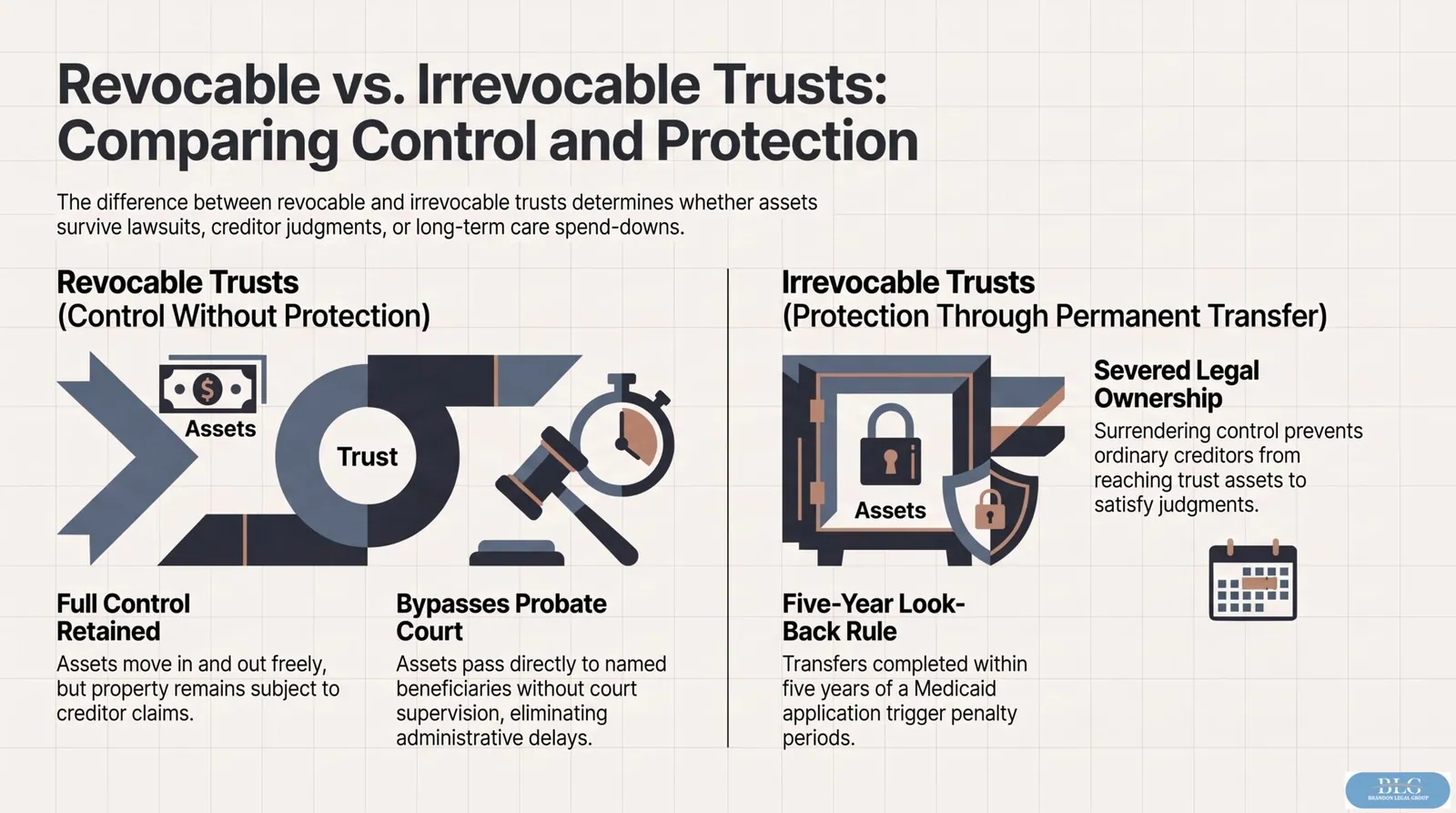
Most people create trusts thinking the document itself is armor. It isn't. A revocable trust is a filing cabinet with a combination lock, useful for organization, useless against anyone with a court order. An irrevocable trust is a vault buried in concrete, but only if it was poured before the ground started shaking. The difference between these two instruments determines whether assets survive a lawsuit, a nursing home spend-down, or a creditor with a judgment. Choose wrong, and the trust becomes expensive stationery.

The question isn't which trust sounds better on paper. It's which one holds up when someone comes to take what's inside.
Revocable Trusts: Control at the Cost of Protection
¶ ¶A revocable trust, sometimes called a living trust, exists to avoid probate and streamline asset transfers after death. The grantor retains full control: assets can be moved in and out, beneficiaries can be changed, and the trust can be dissolved entirely at any moment. That flexibility is the point for most people. It's also the fatal flaw when protection matters.
Because the grantor keeps control, Florida law treats revocable trust assets as still available to the grantor's creditors. Under Florida Statute § 736.0505, the property of a revocable trust is subject to the claims of the settlor's creditors during the settlor's lifetime, and remains subject to those claims at death to the extent the estate is insufficient. Medicaid likewise treats revocable trust principal as a countable resource when determining eligibility for long-term care assistance. The trust changes nothing from an asset-protection standpoint; it simply rearranges who signs the checks after death.
Revocable trusts excel at probate avoidance. Assets titled in the name of the trust pass directly to named beneficiaries without court supervision, bypassing the delays and costs of estate administration. For someone focused on simplifying the transfer process or maintaining privacy, a revocable trust is a strong planning tool. For someone worried about a lawsuit, a business failure, or the cost of memory care five years from now, it offers nothing.
Irrevocable Trusts: Asset Protection Through Permanent Transfer
An irrevocable trust works by severing the grantor's legal ownership. Once assets are transferred into the trust and the trust terms are set, the grantor cannot unilaterally undo the transfer, reclaim the property, or change the beneficiaries without consent of the trustee or beneficiaries, if at all. That loss of control is what creates the protection.
Because the grantor no longer owns the assets, creditors generally cannot reach them to satisfy a judgment against the grantor. Medicaid generally does not count irrevocable trust principal as an available resource, provided the trust was created and funded outside the five-year look-back period and the grantor holds no right to demand distributions of principal. The insulation is real, but it requires giving up something most people are unwilling to surrender: the ability to change their mind.
Irrevocable trusts are used most often in three scenarios:
- Medicaid planning to shield a home or other assets from estate recovery while preserving eligibility for nursing home coverage
- Asset protection for business owners, professionals, or anyone facing elevated liability risk
- Wealth transfer strategies designed to remove future appreciation from the taxable estate while maintaining income flow to beneficiaries
Each use case hinges on timing. The transfer must occur before the threat materializes. Transferring assets into an irrevocable trust after a lawsuit is filed, after a claim arises, or shortly before a Medicaid application will not work; it may be undone as a fraudulent transfer under Florida Statute § 726.105.
Fraudulent Transfer Risk and the Look-Back Period
Creating an irrevocable trust does not immunize assets if the transfer was made to dodge an existing or imminent creditor. Florida's Uniform Fraudulent Transfer Act, Chapter 726, Florida Statutes, allows creditors to set aside transfers made with intent to hinder, delay, or defraud. Badges of fraud listed in Florida Statute § 726.105 include transferring assets while insolvent or when insolvency was imminent, transferring assets to an insider for little or no consideration, and retaining possession or control of the property after the purported transfer.
Medicaid imposes a separate penalty: the five-year look-back period under federal law, codified at 42 U.S.C. § 1396p(c). Any transfer for less than fair market value made within five years of a Medicaid application can trigger a period of ineligibility calculated by dividing the value of the transferred asset by Florida's published average monthly cost of nursing home care. Transfer a $400,000 home into an irrevocable trust three years before applying for Medicaid, and the applicant may face a penalty period measured in years, during which Medicaid will not pay for long-term care.
The lesson is not to avoid irrevocable trusts. It's to fund them early, when protection is still theoretical and not reactive. An estate planning attorney structures the trust, selects the trustee, drafts distribution standards, and times the transfer to avoid triggering penalties that undo the entire strategy.
Homestead Property and Trust Funding
Florida's constitutional homestead protections add a wrinkle. Under Article X, Section 4 of the Florida Constitution, a homestead residence is exempt from the claims of most creditors during the owner's lifetime and is subject to restrictions on devise at death if the owner is survived by a spouse or minor child. Transferring homestead property into a revocable trust generally does not forfeit the exemption, the grantor is still treated as the equitable owner.
Transferring homestead into an irrevocable trust is a different matter. Depending on the interest the grantor retains, the transfer can jeopardize the creditor exemption because the grantor no longer holds legal title or a qualifying beneficial interest. If the trust allows the grantor to continue residing in the home under an arrangement that looks like retained ownership, a creditor may argue the transfer was fraudulent. The interplay between homestead protection, irrevocable trust design, and Medicaid planning requires precise drafting to preserve both benefits.
¶ ¶ ¶A lady bird deed, an enhanced life estate deed, offers an alternative that preserves homestead protection, avoids probate, and keeps the property out of the probate estate without requiring an irrevocable trust. The grantor retains a life estate with the power to sell, mortgage, or revoke the remainder interest during their lifetime, but the property passes directly to the named remainderman at death. For more detail on how these instruments operate before probate, see Lady Bird Deeds: What They Protect Without Probate.
When Each Structure Makes Sense
Revocable trusts are appropriate when probate avoidance, not creditor protection, is the primary goal. They work well for individuals with no significant liability exposure, no long-term care planning concerns, and estates that would otherwise require ancillary probate in multiple states. The flexibility to amend terms as circumstances change makes them useful in dynamic family situations, blended families, minor children, beneficiaries with substance abuse or financial instability.
Irrevocable trusts make sense when the stakes justify losing control. Business owners facing professional liability, individuals with significant wealth seeking to reduce estate tax exposure, and retirees planning for the possibility of nursing home care all benefit from the protective walls an irrevocable trust can provide, if the trust is funded well in advance of need and drafted to meet Florida statutory requirements.
Hybrid strategies exist. Some clients establish a revocable trust to manage the bulk of their estate and fund a separate irrevocable trust with specific high-value or high-risk assets, such as a family business interest, investment real estate, or life insurance policies. The revocable trust remains flexible; the irrevocable trust locks down what must be protected.

The choice is not philosophical. It is tactical. Each trust type serves a distinct function, and neither works unless the structure matches the threat, the timing aligns with the law, and the funding is completed before the crisis arrives.
Closing Remarks
If a creditor judgment is on the horizon, a Medicaid application is becoming necessary within five years, or a vulnerable asset needs permanent insulation before the lawsuit lands, the structure chosen today determines what remains tomorrow. Brandon Legal Group handles irrevocable trust design, revocable trust administration, and asset protection strategy for Florida families who need plans that hold up under pressure. Contact us before the threat becomes a claim.
Frequently Asked Questions
Can a revocable trust be converted to an irrevocable trust after it is created?
Yes, but conversion does not reset the clock for creditor or Medicaid purposes. If assets are moved from a revocable to an irrevocable trust after a claim arises or within the five-year Medicaid look-back period, the transfer may be set aside as fraudulent or trigger a penalty period. Conversion is a legitimate planning tool when done proactively, not as a reactive shield.
Does placing assets in an irrevocable trust mean losing all access to them?
Not necessarily. Irrevocable trusts can be drafted to allow the grantor to receive income generated by trust assets, or to permit discretionary distributions by an independent trustee under specific standards. The key is that the grantor cannot demand principal or change beneficiaries unilaterally. Note that retaining an income interest has consequences for Medicaid eligibility, so the drafting must match the goal. Proper drafting balances protection with practical access.
Will an irrevocable trust protect assets from all creditors?
No. Certain claims receive special treatment and can reach trust assets that ordinary creditors cannot, including child support, spousal support, and federal tax liens. An irrevocable trust also will not protect assets if the transfer occurred after the claim arose or if the grantor retained sufficient control that a court disregards the trust. Timing and structure are dispositive.
What happens to homestead protection if a residence is placed in an irrevocable trust?
Transferring a Florida homestead into an irrevocable trust can forfeit the constitutional creditor exemption if the grantor no longer holds legal title or an equivalent qualifying beneficial interest. The property may also lose eligibility for the Save Our Homes assessment cap and the homestead tax exemption if the transfer is not carefully structured. Homestead and trust planning must be coordinated to preserve both benefits.
Can a trustee of an irrevocable trust be removed or replaced?
Yes, but only under the terms specified in the trust instrument or through a court proceeding under Florida Statute § 736.0706, which allows removal for serious breach of trust, lack of cooperation among cotrustees, or unfitness, unwillingness, or persistent failure to administer the trust effectively. The grantor of an irrevocable trust typically cannot remove a trustee unilaterally. Selecting the right trustee at creation, drafting succession provisions is critical to long-term administration.
References
- Florida Statute § 726.105 (Transfers fraudulent as to present and future creditors).
- Florida Statute § 736.0505 (Creditors' claims against settlor).
- 42 U.S.C. § 1396 (p(c): Liens, adjustments and recoveries, and transfers of assets).
- Article X, Section 4, Florida Constitution: Homestead; exemptions
- Florida Statute § 736.0706 (Removal of trustee).