

A Lady Bird deed transfers Florida homestead property to named beneficiaries automatically at death, bypassing probate while preserving the owner's full control during life. It can help avoid probate-based Medicaid estate recovery and many creditor problems without sacrificing homestead exemption, property tax benefits, or the ability to sell or mortgage. The protection is real, but only if the deed is drafted, recorded, and aligned with the rest of the estate plan.
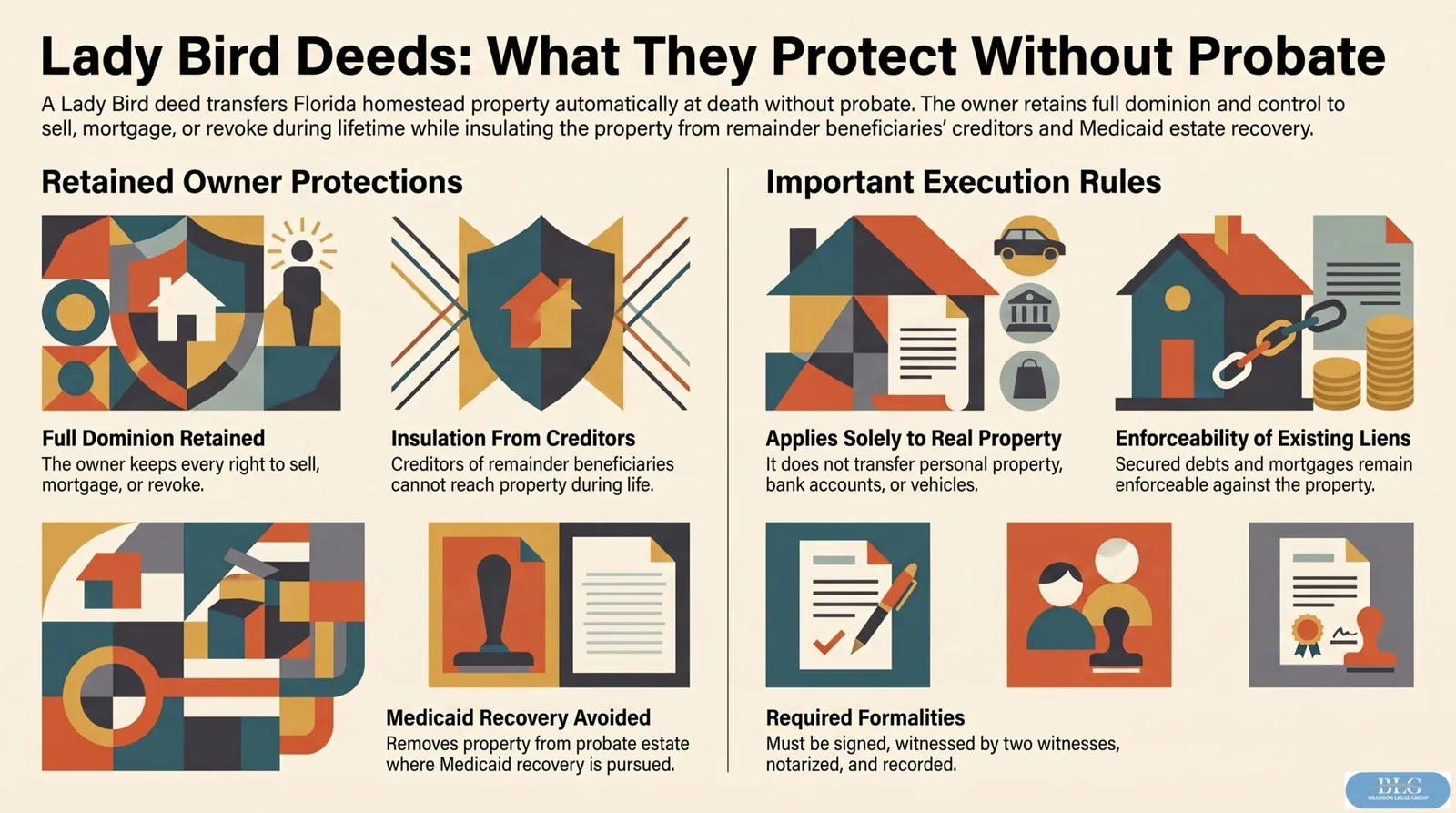
Property passes outside probate in two ways: by contract or by deed structure. Lady Bird deeds, enhanced life estate deeds, belong to the second category, and they deliver what most people want without the things most people fear. No loss of control. No gift tax. No Medicaid transfer penalty. No probate. The homestead stays protected, the tax bill stays low, and the owner keeps every right to sell, mortgage, or revoke until the moment of death. That combination makes Lady Bird deeds one of the sharpest tools in Florida estate planning, but only when the mechanics are understood and the execution is clean.
A Lady Bird deed reserves a life estate to the current owner with an enhanced power: the unrestricted right to convey the property during life without the consent of the remainder beneficiaries. Traditional life estate deeds require the remainderman's signature to sell or refinance. Enhanced life estate deeds do not. The owner retains full dominion. The remainder interest is contingent; it vests only if it survives the life tenant. That contingency is what keeps the transfer from being a completed gift for federal tax purposes and avoids the Medicaid transfer penalty that derails so many other strategies.
What a Lady Bird Deed Protects During the Owner's Life
Florida homestead enjoys constitutional protection from forced sale by most creditors under Article X, Section 4 of the Florida Constitution. A Lady Bird deed does not compromise that protection. The homestead exemption remains in place. The Save Our Homes cap on assessed value remains in place. The owner continues to qualify for every property tax benefit available to a fee-simple homeowner because the owner still holds the life estate with full control.
Creditors of the remainder beneficiaries cannot reach the property during the life tenant's lifetime. The remainder interest is contingent and unripened. No creditor can force a sale, attach a lien that affects the life tenant's rights, or foreclose on an interest that may never vest. If a remainder beneficiary files bankruptcy or faces a judgment, the homestead remains untouchable while the original owner is alive.
The same insulation can apply to Medicaid estate recovery. Federal law allows states to seek reimbursement for certain Medicaid benefits, but Florida recovery is generally pursued from the recipient's probate estate under Florida Statute § 409.9101. A properly drafted Lady Bird deed removes the homestead from the probate estate. When the life tenant dies, the property vests immediately in the remainder beneficiaries by operation of law. Nothing passes through the will. Nothing flows through intestate succession. If the property was protected homestead and does not enter probate, the Agency for Health Care Administration generally has no probate estate interest in that property from which to recover.
What Transfers at Death Without Probate
At the moment of death, the life estate extinguishes and the remainder interest vests automatically in the named beneficiaries. No probate administration is required for that property. A death certificate and, when needed, a title-clearing affidavit are typically sufficient to update the public records and property appraiser's records. That is the clean result people want. But Florida homestead is not a toy. If the owner is married, the spouse generally must join in any deed conveying an interest in homestead property. If a spouse or minor child has constitutional homestead rights, the deed must be planned carefully instead of treated as a shortcut around those rights.
This is a critical distinction. Florida's constitutional homestead descent rules restrict a homeowner's ability to devise homestead property by will if survived by a spouse or minor child. A Lady Bird deed operates by recorded conveyance, not by a probate devise. That can give a homeowner more control over the non-probate transfer plan, but it does not erase the need for spousal joinder, capacity, correct execution, and a hard review of minor-child issues. Parents can name adult children, siblings, trusts, or other eligible grantees, but the deed must be built around Florida's homestead rules, not in defiance of them.
What a Lady Bird Deed Does Not Protect Against
A Lady Bird deed transfers only the real property described in the deed. It does not transfer personal property, bank accounts, vehicles, or any other asset. If estate planning stops at the deed, everything else flows into probate. That creates the same problem a comprehensive estate plan is designed to avoid: partial administration, unnecessary expense, and delayed distribution.
Secured debts survive the transfer. If the property is encumbered by a mortgage, the lien remains enforceable against the property in the hands of the remainder beneficiaries. The lender's rights are unaffected. The beneficiaries take title subject to the mortgage, and if payments cease, foreclosure follows. The same applies to property tax liens, mechanics' liens, and HOA assessments. These obligations attach to the property itself, not merely to the owner's interest.
Fraudulent transfer claims remain a risk if the deed is executed with actual intent to hinder, delay, or defraud creditors under Florida Statute § 726.105. A creditor who can prove fraudulent intent may void the transfer, but the burden is high and the timeline is limited, often four years, subject to the discovery rule and the specific claim under Florida Statute § 726.110. Where the deed is executed as part of legitimate estate planning, with no pending litigation and no insolvency, fraudulent transfer claims rarely succeed.
- Secured creditors retain full rights to foreclose or enforce liens
- Medicaid eligibility is usually not harmed because the transfer is not complete during life, but resource rules still require a separate eligibility review
- Federal estate tax inclusion occurs if the life tenant retains the power to revoke, but Florida has no state estate tax
- Constitutional homestead protections continue during life and may extend to surviving family depending on use, occupancy, and family status
Coordination with Revocable Trusts and Other Estate Planning Tools
Lady Bird deeds and revocable trusts serve overlapping but distinct functions. A revocable trust centralizes asset management, provides incapacity planning, and controls distribution timing and conditions. A Lady Bird deed transfers one specific asset, the homestead, outside probate without ongoing administration. Both tools avoid probate. Neither sacrifices control. The question is which structure fits the broader estate plan.
Some clients use both. The homestead passes by Lady Bird deed to avoid probate and preserve tax benefits. Other assets fund the revocable trust. This hybrid approach works when the cost of trust administration on real property outweighs the benefit or when the trust is better used for non-homestead assets. But coordination is essential. A Lady Bird deed that names individual beneficiaries while the trust is designed to receive all assets creates a mismatch. The homestead bypasses the trust, and the intended distribution scheme fractures.
Alternatively, the Lady Bird deed can name the revocable trust as the remainder beneficiary. The property still avoids probate, but the trust provisions govern distribution after death. This preserves the benefits of probate avoidance while maintaining unified control over timing, conditions, and contingent beneficiaries. It also prevents the problem described in cases involving unfunded trusts, where assets slip through the gaps because transfers were never completed.
Spousal elections present another coordination issue. A surviving spouse's elective share is 30% of the elective estate under Florida Statute § 732.2065, and the elective estate can include property over which the decedent retained a power to revoke or amend under Florida Statute § 732.2035. Because a Lady Bird deed reserves broad control to the life tenant, it should be reviewed in any elective-share analysis. That issue is separate from the spouse's joinder rights in homestead property. Blended families, estranged spouses, and late-life planning are exactly where sloppy deed work turns into litigation.

Execution requires precision. The deed must be signed, witnessed by two witnesses, notarized, and recorded in the county where the property is located. Disinterested witnesses are cleaner, even when not strictly required. A defective signature, a missing witness, or a failure to record can void the transfer or create a cloud on title that forces probate anyway. The granting clause must clearly reserve the enhanced life estate and enumerate the powers retained. Boilerplate language copied from other states or outdated forms often fails to satisfy Florida's requirements. Remaindermen must be clearly identified and legally able to receive title. Ambiguity in the deed produces litigation after death, when correction is impossible and positions are entrenched.
Closing Remarks
If homestead protection without probate is the goal, if Medicaid estate recovery is a concern, or if family circumstances could override the plan you thought you had, a Lady Bird deed may be the most direct path forward, but only if it is drafted and recorded correctly and only if it is coordinated with the rest of the estate plan. Brandon Legal Group structures estate plans that align tools with goals, not the other way around. Contact us to review whether a Lady Bird deed fits your situation or whether another strategy serves better.
Frequently Asked Questions
Can a Lady Bird deed be revoked after it is recorded?
Yes. The life tenant retains full power to revoke, amend, or replace the Lady Bird deed at any time without the consent of the remainder beneficiaries. Revocation is accomplished by recording a new deed or a formal revocation instrument in the same county where the original deed was recorded. Until the life tenant's death, the remainder interest remains contingent and subject to divestment.
Does a Lady Bird deed affect eligibility for Medicaid long-term care benefits?
Usually, no transfer penalty is created because the life tenant retains full ownership and control during life. That is different from saying Medicaid eligibility is automatic. The homestead must still fit Medicaid resource rules, including intent to return home or the presence of a spouse or dependent child when those rules apply. Medicaid estate recovery is generally blocked as to the homestead because the property does not pass through the probate estate.
What happens if one of the named remainder beneficiaries dies before the life tenant?
If the deed does not include survivorship language, the deceased beneficiary's interest typically passes to that beneficiary's estate, creating a probate problem for that share. Well-drafted Lady Bird deeds include a survivorship provision so that the interest of any predeceased remainderman automatically divests and the surviving remaindermen take the entire property. Anti-lapse statutes that apply to wills under Florida Statute § 732.603 do not automatically apply to deeds, so the language must be explicit.
Can a Lady Bird deed name a trust as the remainder beneficiary?
Yes. Naming a revocable trust as the remainder beneficiary allows the property to avoid probate while still flowing into the trust for distribution according to the trust's terms. This is common when the estate plan includes specific conditions, staggered distributions, or provisions for minor or disabled beneficiaries. The trust must exist and be properly funded for this structure to work, and the deed must reference the trust by name and date to avoid ambiguity.
Does recording a Lady Bird deed trigger a property tax reassessment in Florida?
No. Recording a Lady Bird deed does not normally constitute a change in ownership for property tax purposes because the life tenant retains full control and beneficial ownership. The Save Our Homes assessment cap remains intact, and homestead exemption continues without interruption. Reassessment may occur when the life tenant dies and the property vests in the remainder beneficiaries, subject to any applicable statutory exceptions. New owners must apply for homestead exemption if they intend to use the property as their primary residence.
What is the difference between a Lady Bird deed and a transfer on death deed?
Florida does not recognize transfer on death deeds for real property. A handful of states authorize TOD deeds by statute, but Florida is not among them. Lady Bird deeds are the primary non-probate transfer mechanism for real property in Florida outside of joint tenancy with right of survivorship or tenancy by the entireties. Unlike joint tenancy, a Lady Bird deed does not grant any present possessory interest to the beneficiaries and does not expose the property to their creditors during the owner's life.
References
- Fla. Const. art (X (§ 4 (Homestead; exemptions)).
- 42 U.S.C. § 1396 (p (Liens, adjustments and recoveries, and transfers of assets)).
- Fla. Stat. § 409.9101 (Recovery for payments made on behalf of Medicaid-eligible persons).
- Fla. Stat. § 732.4015 (Devise of homestead).
- Fla. Stat. § 726.105 (Transfers fraudulent as to present and future creditors).
- Fla. Stat. § 726.110 (Extinguishment of cause of action).
- Fla. Stat. § 732.2065 (Amount of the elective share).
- Fla. Stat. § 732.2035 (Property entering into elective estate).
- Fla. Stat. § 732.603 (Antilapse; deceased devisee; class gifts).
- Fla. Stat. § 689.01 (How real estate conveyed).
This article is provided for general informational purposes only and does not constitute legal advice, nor does reading it create an attorney-client relationship. Florida law changes and every situation turns on its own facts. Consult a licensed Florida attorney about your specific circumstances before acting.