

TL;DR: A Qualified Domestic Relations Order (QDRO) is the legal instrument that divides retirement accounts in divorce, but its protection depends entirely on execution. The marital settlement agreement does not transfer pension or 401(k) assets; the QDRO does. When the order is drafted incorrectly, delayed, or never filed, the alternate payee loses the right to funds already awarded on paper.
The divorce decree says the account gets split. The settlement is signed. Everyone assumes the hard part is over. Then months pass, sometimes years, and the retirement account never gets divided. By the time someone checks, the participant spouse has retired, borrowed against the balance, or remarried. The paper victory becomes a collection nightmare. A QDRO is not automatic and it is not self-executing. It is a separate court order, governed by federal pension law and the plan's own administrative rules, and if it does not get done right the first time, the window to fix it may already be closed.

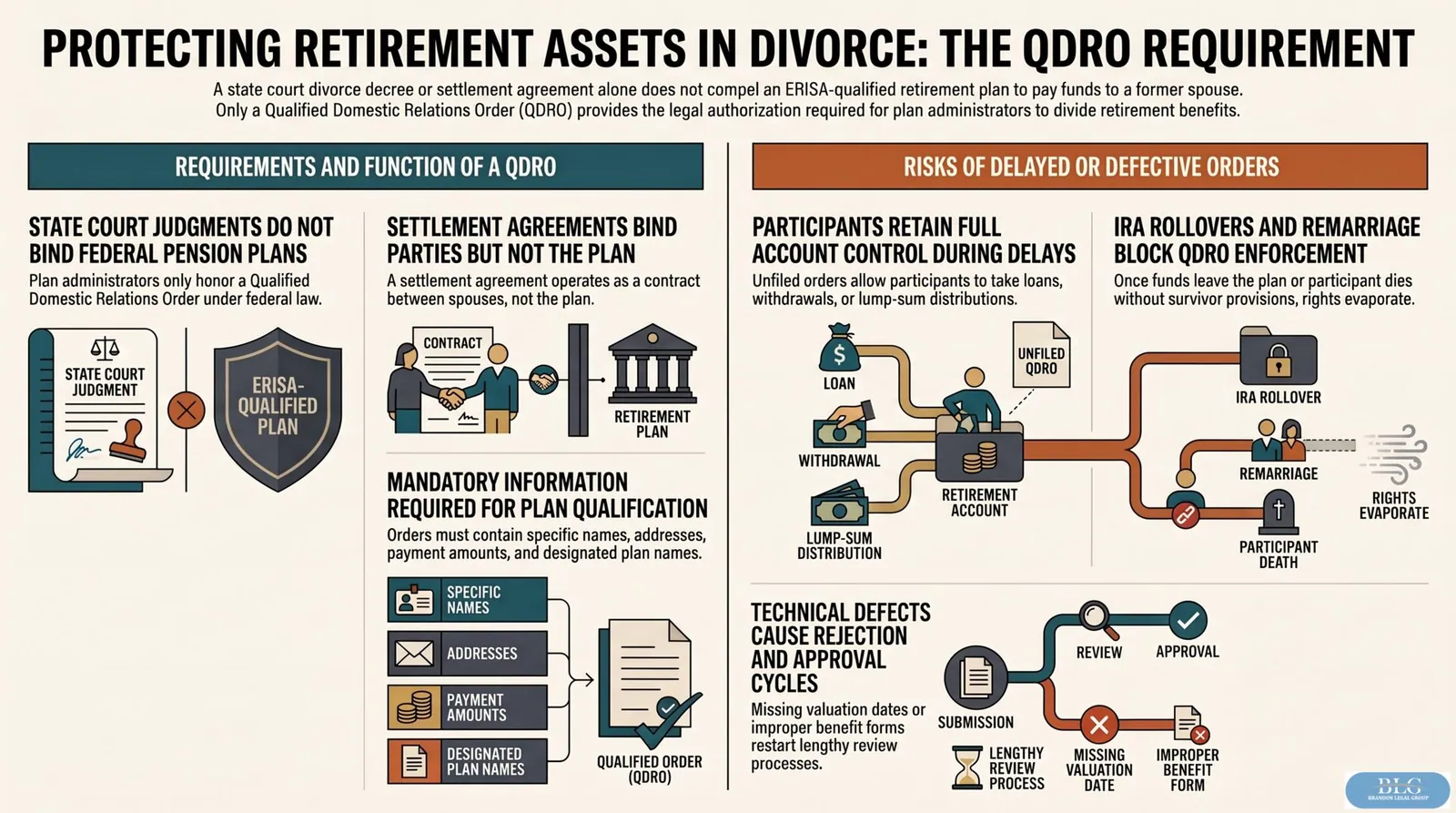
Florida divorce courts divide marital property under equitable distribution pursuant to Fla. Stat. § 61.075. Retirement accounts earned during the marriage, such as a 401(k), 403(b), pension, or 457 plan, are marital property subject to division. But a state court judgment alone does not compel a federal ERISA-qualified plan to pay anyone but the participant. The plan administrator will not honor a divorce decree, a marital settlement agreement, or even a judge's general instruction. The only document that permits a plan to pay benefits to someone other than the participant is a Qualified Domestic Relations Order under 26 U.S.C. § 414(p) and 29 U.S.C. § 1056(d)(3). Without it, the non-participant spouse, called the alternate payee, has no enforceable claim against the plan, no matter what the divorce judgment says.
What a QDRO Actually Does
A QDRO creates a legal right for the alternate payee to receive all or a portion of the participant's retirement benefit. It instructs the plan administrator how much to pay, when to pay it, and in what form. It operates independently of the divorce decree. The settlement agreement may state that the wife receives 50 percent of the husband's pension. That language binds the parties as a contract. It does not bind the pension plan. The plan will reject any distribution request until it receives an order that satisfies its qualification requirements and the requirements of federal law.
The order must contain specific information: the name and last known mailing address of the participant and each alternate payee, the amount or percentage of the benefit to be paid, the number of payments or period covered, and the name of each plan to which the order applies. It cannot require the plan to provide any type or form of benefit not otherwise available, cannot require increased benefits, and cannot require payment to an alternate payee if benefits are already required to be paid to another alternate payee under a previous order. Each plan has its own pre-approval procedure. Some plans provide model QDRO language. Others require custom drafting and months of back-and-forth with the plan's legal department.
Timing: When the Order Gets Delayed or Never Filed
The gap between the divorce judgment and the filing of the QDRO is where most damage occurs. During that gap, the participant retains full control of the account. Depending on the plan, that control may include the ability to take loans, make hardship withdrawals, change beneficiaries, or elect lump-sum distributions at retirement. The alternate payee has no practical ability to stop any of it until the QDRO is entered and accepted by the plan administrator.
Consider a hypothetical: the divorce is final in March, and the settlement awards the wife 50 percent of the husband's 401(k). The attorney tells her the QDRO will be "handled separately." She assumes it is being done. In June, the husband retires and takes a lump-sum rollover into an IRA. By the time the wife's lawyer drafts the QDRO in September, the plan no longer holds the funds. The QDRO cannot reach an IRA. The wife now has a breach-of-contract claim against her former husband, requiring new motions or a new lawsuit, new attorney fees, and the challenge of collecting a judgment from someone who may have already spent or hidden the money. The equitable distribution awarded in the divorce case becomes a debt-collection problem.
This scenario is common. So is the opposite: the participant dies before the QDRO is entered, and the plan pays the entire benefit to the named beneficiary, often the participant's new spouse or adult children. The alternate payee's claim can evaporate unless the divorce decree included specific survivorship language and the QDRO was drafted to honor it. Even then, enforcement depends on whether the plan administrator received and qualified the order in time under the plan's procedures.
Defined-Benefit Pensions vs. Defined-Contribution Plans
The mechanics of a QDRO depend on the type of retirement account. Defined-contribution plans, such as a 401(k), 403(b), or thrift savings plan, hold individual account balances. The QDRO assigns a dollar amount or percentage of that balance to the alternate payee, who typically receives a direct rollover into their own IRA or retirement account. The split happens once, and the alternate payee's portion is thereafter independent.
Defined-benefit pensions, by contrast, pay monthly income for life starting at retirement. The QDRO must specify whether the alternate payee will receive a share of each monthly payment (shared-payment approach) or a separate interest calculated as of a specific date, often the date of divorce (separate-interest approach). Each method has tax, timing, and survivor consequences. The shared-payment model ties the alternate payee's benefit to the participant's retirement election and lifespan. If the participant delays retirement, the alternate payee waits. If the participant dies, the alternate payee's benefit may stop unless the QDRO includes survivor protections. The separate-interest model allows the alternate payee to begin distributions at their own eligibility date, independent of the participant's choices, but requires actuarial calculation and plan cooperation.
Some plans limit or discourage separate-interest QDROs, and many charge fees to administer them. The negotiation over QDRO structure often reveals more about a retirement asset's real value than the discovery ever did.
Common Drafting Failures That Void the Order
Plan administrators reject QDROs for technical defects. The most frequent failures include:
- Using incorrect plan names or outdated participant information
- Failing to specify the valuation date or coverture fraction for accounts that grew before and after marriage
- Ordering the plan to pay benefits in a form the plan does not offer
- Attempting to assign benefits already awarded to a prior alternate payee
- Using percentage language that does not align with the plan's recordkeeping system
- Omitting survivor provisions or other terms the plan requires to process the division
Each rejection restarts the approval process. Some plans take 90 days or more to review a submitted order. Revisions add months. During the entire pendency, the participant's control continues. For more on how marital and non-marital portions are calculated, Florida's equitable distribution rules provide the foundation, but the QDRO must translate those rules into language the plan can execute.
Protecting the Alternate Payee's Interest During the Gap
The marital settlement agreement should include hold-harmless and cooperation clauses. The participant must agree not to take loans, withdrawals, or distributions that would reduce the alternate payee's share before the QDRO is qualified. The participant must cooperate in providing plan documents, summary plan descriptions, and beneficiary designation forms. The agreement should specify which party pays for QDRO preparation and who bears the cost if the plan rejects the order and revisions are needed. It should prohibit changes to beneficiary designations until the QDRO is final.
Enforcement of these provisions requires going back to court if the participant breaches. That enforcement is easier when the settlement agreement is incorporated into the final judgment and the court reserves jurisdiction to enforce it. But prevention is better. The faster the QDRO is drafted, submitted, and qualified, the narrower the window for mischief.
Some practitioners prepare the QDRO alongside the settlement so it can be entered at or immediately after final judgment, particularly when the case is uncontested and the plan publishes a model order. Others ask the court to reserve jurisdiction over retirement division until the QDRO is complete. Either approach reduces the gap. The riskiest path is assuming the QDRO will be handled "later" by whoever drafts it. Later becomes never more often than it should.
A QDRO is not a formality. It is the only mechanism that converts a divorce court's equitable distribution order into an enforceable claim against an ERISA-qualified retirement plan. Every month of delay increases the risk that the asset awarded on paper will be unreachable in fact. Drafting, submitting, and qualifying the order is not post-divorce cleanup; it is a critical component of the divorce itself, and it requires precision, urgency, and attention to each plan's unique requirements.
Closing Remarks
If your settlement awards you a share of your spouse's retirement account, if months have passed since the divorce and no QDRO has been filed, or if the plan administrator has rejected the order your prior attorney submitted, the protection you were promised may not exist yet. Brandon Legal Group handles retirement division in Florida divorce cases with the same intensity we bring to contested litigation, because a poorly executed QDRO is a loss, even when you won the case. Contact us to review your settlement, draft or revise your QDRO, and make sure the order gets qualified before the account disappears.
Frequently Asked Questions
Can I divide my spouse's retirement account without a QDRO?
Not if it is an ERISA-qualified plan. Those plans will not divide benefits based on a divorce decree, settlement agreement, or any other state court order that does not qualify as a Qualified Domestic Relations Order. The plan administrator's duty runs to the plan document and federal law. Without a QDRO, the alternate payee has no enforceable right against the plan, regardless of what the divorce judgment says. IRAs are different: they are divided by transfer incident to divorce under 26 U.S.C. § 408(d)(6) rather than by QDRO, but that division still requires a court order and custodian cooperation.
What happens if my ex-spouse takes money out of the retirement account before the QDRO is entered?
The plan will generally permit it, because the participant still controls the account until the plan receives and qualifies the order. If the withdrawal reduces the balance below what was awarded in the divorce, the alternate payee must seek enforcement through a motion to enforce or for contempt, or a separate breach-of-contract action. The plan will not restore funds it distributed in compliance with its own rules. This is why speed matters. The settlement agreement should prohibit distributions pending QDRO qualification, but enforcement after the fact is expensive and uncertain.
How long does it take to get a QDRO approved?
Plan review times vary. Some administrators approve straightforward orders in about 30 days. Others take 90 days or longer, especially for defined-benefit pensions or government plans with multilayered approval processes. If the plan rejects the order, the revision and resubmission cycle starts over. Drafting the order itself can take weeks if the plan requires custom language or the division involves complex valuation issues. The entire process, from drafting to final approval, often takes three to six months, and longer if complications arise. Waiting until after the divorce is final to begin the process adds months of risk.
Can a QDRO be filed after my ex-spouse has already retired?
Often yes, but the options narrow. If the participant elected a single-life annuity and payments have begun, the alternate payee may be limited to a share of ongoing monthly payments with no survivor rights and no ability to elect a different payment form. If the participant took a lump sum and rolled it into an IRA, the QDRO cannot reach those funds; IRAs are not divided by QDRO. The alternate payee is left pursuing the participant personally for breach of the settlement agreement. Getting the QDRO qualified before retirement preserves the widest range of distribution options and protections. After retirement, the elections already made constrain what the QDRO can do.
Does the QDRO have to be entered by the same court that handled the divorce?
In practice, yes. A QDRO is a domestic relations order issued by a state court with jurisdiction over the divorce or legal separation. It is normally entered by the same court that issued the final judgment, or by a court with continuing jurisdiction over the dissolution. The order is then submitted to the plan administrator for qualification review. The plan does not issue the order; the court does. The plan determines whether the order meets the qualification requirements under federal law and the plan document. If it does, the plan administrator accepts it and implements the division. The process requires coordination between the court, the attorneys, and the plan's legal and benefits departments.
References
- 26 U.S.C. § 414(p) (Qualified domestic relations order defined).
- 29 U.S.C. § 1056(d) ((3). Assignment or alienation of plan benefits).
- 26 U.S.C. § 408(d) ((6). Transfer of IRA interest incident to divorce).
- Fla. Stat. § 61.075. (Equitable distribution of marital assets and liabilities).