

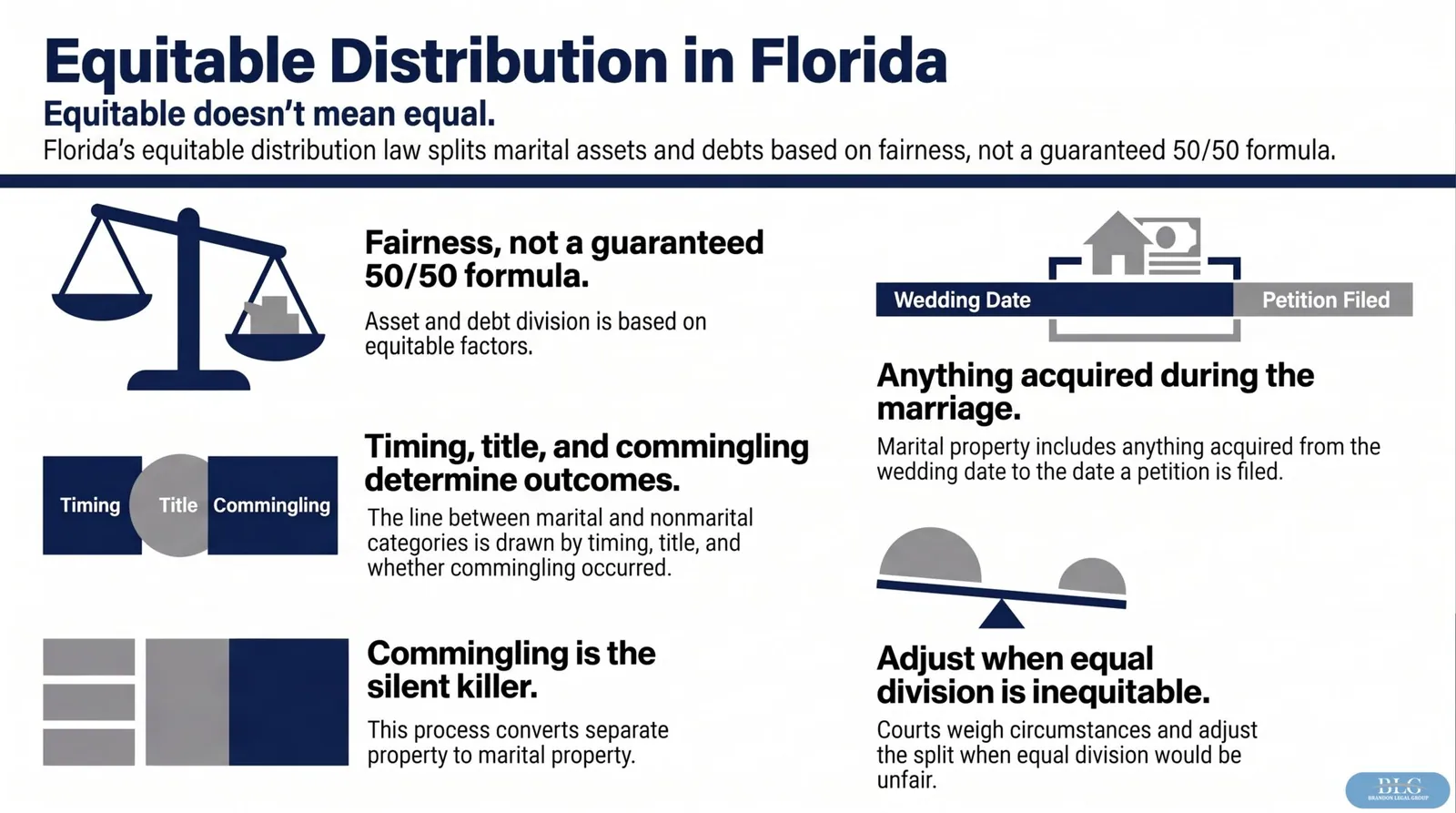
Florida's equitable distribution law splits marital assets and debts based on fairness, not a guaranteed 50/50 formula. What gets divided depends on when it was acquired, how it was titled, and whether separate property became entangled with marital funds. Misunderstanding these rules before filing means leaving leverage, and money, on the table.
¶
Most people walk into a divorce assuming everything gets cut down the middle. Then discovery starts. The house bought before the marriage. The retirement account that existed for fifteen years before the wedding. The inheritance that landed in a joint checking account. The business built with marital sweat equity but titled in one name. Suddenly, the clean line between "mine" and "ours" blurs, and the assumption of a neat split collapses. Florida doesn't do community property. It does equitable distribution, and equitable doesn't mean equal. It means the court weighs a list of factors and decides what's fair. That calculation determines who walks away with what, and it's decided long before the final hearing if the groundwork isn't laid early.

Equitable distribution applies only to marital assets and marital liabilities. Everything else stays separate. The line between the two categories controls the outcome, and that line is drawn by timing, title, and whether commingling occurred. Missing the distinction costs people retirement accounts, home equity, and business value they thought was protected.
Marital Property vs. Nonmarital Property
Marital property includes anything acquired during the marriage, from the date of the wedding to the date a petition for dissolution is filed. The source of funds matters. If marital income paid for it, marital effort built it, or marital funds improved it, it's marital. Title alone doesn't control. A car titled in one spouse's name is still marital if it was purchased with marital earnings. A brokerage account opened during the marriage is marital even if only one name appears on the statements.
Nonmarital property includes assets owned before marriage, assets received by gift or inheritance to one spouse alone, and assets designated as nonmarital by valid written agreement. Florida Statute § 61.075 defines these categories, and the burden of proving nonmarital status falls on the spouse claiming it. That burden requires documentation, account statements showing pre-marriage balances, inheritance records, gift letters. Without proof, the asset defaults to marital.
The timing trap catches people who refinance homes, roll over retirement accounts, or deposit separate funds into joint accounts. A house purchased before marriage remains nonmarital, but if mortgage payments during the marriage came from marital income, or if a marital-funded renovation increased its value, a marital interest attaches. That interest gets calculated, valued, and distributed. The same applies to retirement accounts: the balance on the wedding date stays separate, but every dollar of appreciation or contribution during the marriage is subject to division.
What the Court Considers When Dividing Marital Assets
Once assets are classified as marital, the court applies the factors listed in Florida Statute § 61.075(1) to determine how they should be distributed. The statute starts with a presumption of equal distribution, but that presumption is rebuttable. Courts weigh the circumstances and adjust the split when equal division would be inequitable.
- Each spouse's contribution to the marriage, including homemaking, child care, education, and career-building of the other spouse
- Each spouse's economic circumstances at the time distribution becomes effective
- The duration of the marriage
- Any interruption of personal careers or educational opportunities
- Each spouse's contribution to the acquisition, enhancement, or production of income or the improvement of marital and nonmarital assets
- The desirability of retaining any asset, including an interest in a business, intact and free from claims by the other party
- Each spouse's contribution to the intentional dissipation, waste, depletion, or destruction of marital assets after filing or within two years before filing
- The desirability of retaining the marital home as a residence for any dependent child when it would be equitable to do so and financially feasible
Courts don't rubber-stamp 50/50. A spouse who stayed home for two decades to raise children while the other built a business has a claim to more than half if the contributions weren't equal in earning power but were equal in building the marital estate. A spouse who drained accounts or racked up debt in anticipation of filing can see their share reduced. A spouse with significantly lower earning capacity may receive a larger share of liquid assets to offset future economic disparity. These adjustments hinge on evidence presented during discovery and argued at trial or mediation.
How Commingling Converts Separate Property to Marital Property
Commingling is the silent killer of nonmarital claims. Deposit an inheritance into a joint checking account, and unless every dollar can be traced with forensic precision, it's marital. Use separate funds as a down payment on a marital home, then pay the mortgage with marital income, and the entire equity becomes a tangled mess requiring expert testimony and tracing analysis.
Florida courts require clear and convincing evidence to overcome the presumption that commingled funds are marital. That means bank records, deposit slips, wire transfer confirmations, and an unbroken chain of documentation showing the separate property was never used for marital purposes and was always kept isolated. Most people don't maintain that level of record-keeping during a functional marriage. By the time the marriage ends, the documentation is incomplete, and the separate property claim fails.
Consider a hypothetical: one spouse inherits $200,000 and deposits it into a joint savings account "temporarily" while deciding how to invest it. Over the next year, funds move in and out, marital paychecks get deposited, mortgage payments get withdrawn, a car loan gets paid off. Three years later, $150,000 remains in the account. Proving which dollars are inheritance dollars and which are marital becomes a forensic accounting exercise, and if the tracing isn't perfect, the court treats the entire balance as marital. Separate accounts, titled solely in the inheriting spouse's name, with no marital deposits, would have preserved the nonmarital character. The convenience of joint accounts costs people six-figure mistakes.
Special Asset Categories That Complicate Distribution
Certain assets resist clean division and generate the most contentious litigation. Businesses, professional practices, unvested stock options, and defined-benefit pensions each require specialized valuation and create strategic choices about how to equalize distribution without forcing liquidation.
A closely held business started during the marriage is marital property, even if only one spouse holds title and operates it. Valuation requires a forensic accountant, consideration of goodwill, and projections of future earning capacity. Courts won't typically order a business sold to divide proceeds; instead, the operating spouse retains the business and the other spouse receives offsetting assets of equivalent value, retirement accounts, real property, or a lump-sum payment. When there aren't sufficient liquid assets to offset, divorce attorneys negotiate structured payouts or argue for a greater share of other marital property.
¶ ¶ ¶Retirement accounts, 401(k)s, IRAs, pensions, are marital to the extent contributions and growth occurred during the marriage. Division requires a Qualified Domestic Relations Order (QDRO) for most employer-sponsored plans. Without a QDRO, direct transfers trigger taxes and penalties. Pension valuation is more complex: a defined-benefit plan pays monthly income after retirement, not a lump sum. Valuing the marital portion and determining whether to award a percentage of future payments or an immediate offset against other assets depends on the age of the parties, the years until retirement, and what other assets exist to balance the scales.
Stock options, restricted stock units, and deferred compensation create timing problems. If the right to the asset vested during the marriage but the payout occurs after dissolution, courts apportion value based on the marital effort that earned it. If stock options were granted as compensation for work performed during the marriage but don't vest until after the divorce, a formula divides them between marital and separate based on the marriage's overlap with the vesting period. These formulas, often called "time rule" formulas, require precision and generate disputes over what work period the grant compensated.

Debt follows the same equitable distribution rules as assets. Credit card balances, car loans, and mortgages incurred during the marriage are marital liabilities, divided based on who benefited and who has the capacity to pay. One spouse running up debt for personal expenses, gambling, an affair, secret purchases, can result in that debt being assigned entirely to the spouse who created it. But the creditor isn't bound by the divorce decree. If both names are on the account, both remain liable to the creditor regardless of what the court orders. Protecting against that risk requires refinancing, closing joint accounts, and obtaining indemnity agreements. Assuming the other party will simply pay as ordered is how credit scores get destroyed post-divorce. Understanding what you're responsible for before the final judgment is signed prevents financial ambush a year later when a missed payment appears on a credit report.
Closing Remarks
If separate property has been commingled with marital funds, a business was built during the marriage, or the assumption of a 50/50 split doesn't match the contributions made or sacrifices endured, the outcome hinges on how the case is prepared and argued from the start. Brandon Legal Group represents clients in Florida divorce cases where equitable distribution determines financial futures. Contact us to build the strategy that protects what you've earned.
Frequently Asked Questions
Does Florida automatically split everything 50/50 in a divorce?
No. Florida follows equitable distribution, which begins with a presumption of equal division but allows courts to adjust based on statutory factors. Duration of marriage, economic circumstances, contributions to the marital estate, and intentional waste of assets all influence the final distribution. Equal is the starting point, not the guaranteed result.
Is property acquired before marriage always safe from division?
Not if it was commingled with marital funds or improved with marital labor or income. A home owned before marriage remains nonmarital in title, but if mortgage payments came from marital earnings or renovations increased value using marital funds, a marital interest attaches to the appreciation or equity gain. Keeping separate property truly separate requires deliberate financial isolation throughout the marriage.
Can a spouse be forced to sell a business to divide its value?
Courts rarely order a business sold. Instead, the business is valued, and the non-operating spouse receives an offsetting distribution from other marital assets, retirement accounts, real estate, or a lump-sum payment. When liquid assets aren't sufficient to equalize, courts may approve structured payments or award a disproportionate share of other property. Valuation disputes and arguments over goodwill generate significant litigation costs.
What happens if one spouse hid assets or spent marital money recklessly?
Florida Statute § 61.075(1)(i) allows courts to consider intentional dissipation, waste, or destruction of marital assets when determining distribution. If one spouse drained accounts, gambled away funds, or made large unexplained transfers within two years before filing or after, the court can assign a greater share of remaining assets to the other spouse as compensation. Proving dissipation requires financial records, transaction histories, and testimony. As discussed in Narcissistic Spouses and Florida Divorce Law, strategic financial misconduct often coincides with controlling behavior, and early discovery is essential to building the case.
How are retirement accounts divided without triggering taxes?
For employer-sponsored plans like 401(k)s and pensions, a Qualified Domestic Relations Order (QDRO) allows transfer of a portion to the non-employee spouse without tax penalties. For IRAs, the divorce decree itself authorizes a trustee-to-trustee transfer, which is also tax-free if executed correctly. Direct withdrawals or distributions not made under a QDRO or divorce decree trigger income tax and early withdrawal penalties. Timing and proper drafting of these orders are critical.
References
- Florida Statute § 61.075 (Equitable distribution of marital assets and liabilities).