
TL;DR: Trying to “prove your spouse is a narcissist” is almost always the wrong strategy. Florida courts decide cases on documented behavior and statutory factors, not on diagnoses no one will commit to in writing. This article explains how to shift from chasing a labelto building a case the court can actually act on, and how Brandon Legal Group helps you do it. ¶ ¶
If you are reading this, you haveprobably already lost count of the times someone,a friend, a therapist, a Reddit thread at 2 a.m., has told you that your spouse is a narcissist. You may believe it. You may be right. But here is the hard truth that most articles on this topic refuse to say out loud:
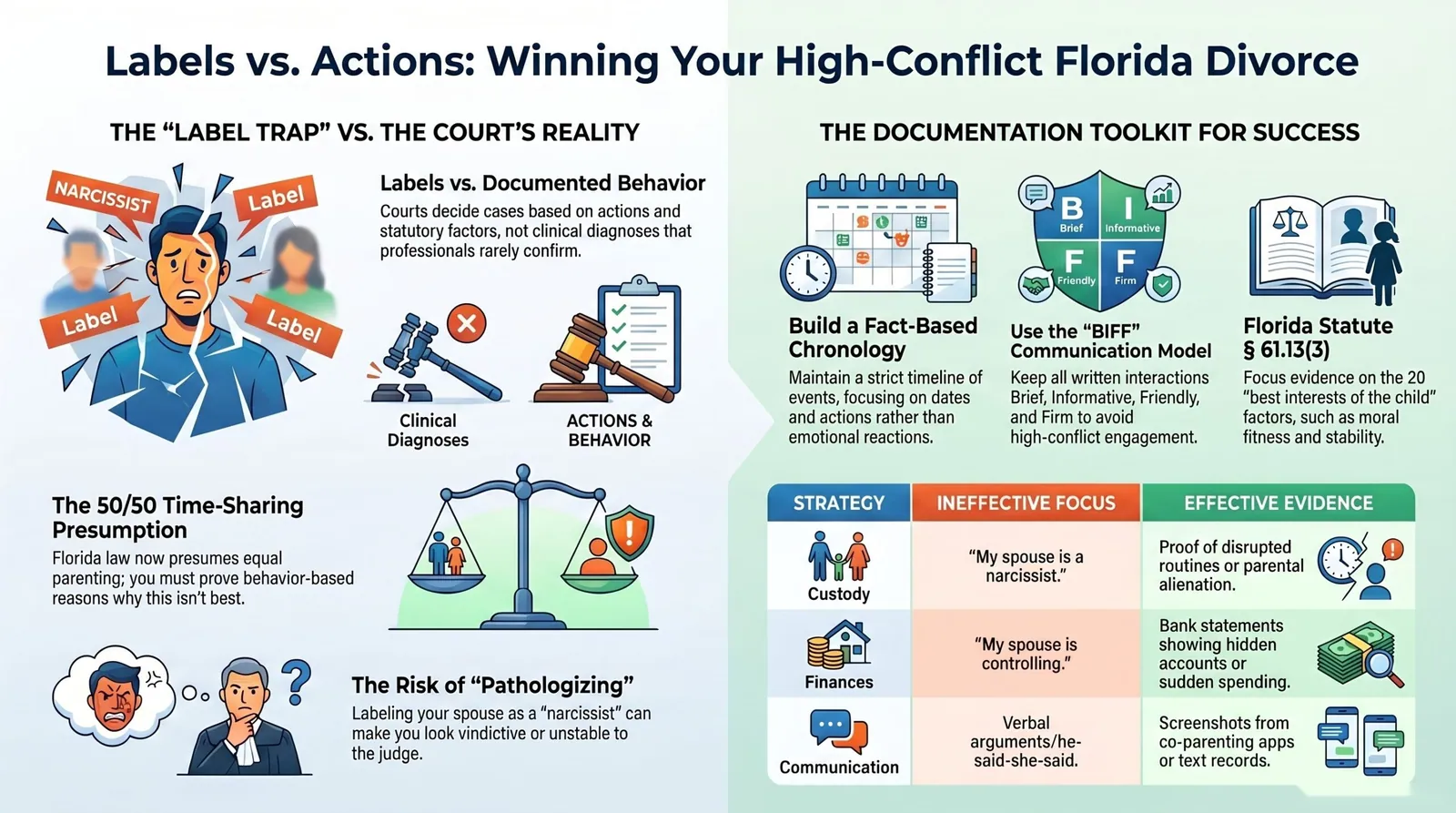
Trying to win your divorce by proving your spouse has Narcissistic Personality Disorder is, in nearly every case, a losing strategy.
That is not a comfortable opening, and it is not what most people in your situation want to hear. But it is the most useful thing an honest Florida family law firm can tell you, and the rest of this article is built on it.
 Why “Proving Narcissism” Almost Never Works in Court
Personality disorders are clinical diagnoses. They require a licensed mental health professional, a structured evaluation, and, critically, that professional’s willingness to put a specific label in a written report that they will defend on the witness stand.
In contested divorces, that almost never happens. Evaluators see the same red flags you see. They will write pages describing manipulative behavior, lack of empathy, grandiosity, rage cycles, parental alienation. What they will rarely do is write the words “Narcissistic Personality Disorder” or “Borderline Personality Disorder” as a formal diagnosis. There are reasons for this: professional liability, the limits of a forensic evaluation versus a treating relationship, the ethical caution against diagnosing someone in an adversarial setting, but the practical effect on your case is the same. You wanted a label. You got a thirty-page report that hedges.
Judges notice the hedge. A report that describes terrible behavior but stops short of a diagnosis often gets read as “concerning but not conclusive,” and the case is decided on other factors anyway.
Meanwhile, your spouse’s attorney has been preparing for exactly this. The narrative they want to put in front of the court is that you are obsessed, vindictive, and pathologizing a difficult divorce. Every email where you used the word “narcissist,” every text where you diagnosed them in front of the kids, every social media post, all of it becomes their evidence that you are the unstable one.
The label is a trap. The behavior is the case.
What Florida Courts Actually Decide On
 Florida family law does not require a diagnosis to protect you, your finances, or your children. It requires evidence of behavior and its impact, measured against the statutory factors the court is already obligated to consider.
For parenting and time-sharing decisions, Florida Statute § 61.13(3) lists roughly twenty “best interests of the child” factors. Among them are several that map directly onto the conduct of a high-conflict spouse: each parent’s demonstrated capacity to facilitate a close relationship between the child and the other parent; the moral fitness of each parent; the mental and physical health of each parent; evidence of domestic violence; and the demonstrated capacity to provide a consistent routine, communicate honestly, and shield the child from ongoing litigation.
Note what is on that list and what is not. “Diagnosis of personality disorder” is not on it. “Behavior that disrupts the child’s stability” is. The same is true throughout Chapter 61; equitable distribution turns on documented financial conduct, alimony on income, need, and (since the 2023 reforms under SB 1416) durational caps tied to the length of the marriage rather than indefinite “permanent” awards. Across the board, the court is looking at what someone did, not what they are.
This is also why the 2023 amendments to § 61.13 matter so much in cases involving a high-conflict spouse. Florida now begins every parenting case with a rebuttable presumption that equal (50/50) time-sharing is in the child’s best interests. To get anything other than 50/50, the parent asking for it must prove by a preponderance of the evidence that equal time-sharing is not in the child’s best interests. If your strategy was to walk into court, gesture at your spouse’s behavior, and assume the judge would give you majority time-sharing because the other parent is “obviously” unfit, that strategy no longer works. You have to come with evidence.
The Documentation That Actually Wins
If behavior is the case, documentation is how you put the case in front of a judge. The good news is that high-conflict spouses generate documentation almost compulsively, the work is in capturing and organizing it. ¶ ¶ Start with these, today:
- A written timeline. Dates, what happened, who was present, what was said. Not a diary of feelings, a chronology of events. Courts care about the second. Therapists care about the first. Keep them separate.
- Communications in writing. Move as much of your communication with your spouse as possible to text, email, or a co-parenting app like OurFamilyWizard or TalkingParents. Verbal arguments cannot be cross-examined. Screenshots can.
- Financial records. Statements, transfers, hidden accounts, sudden spending. In high-conflict divorces, financial control and dissipation of marital assets are extremely common, and they leave a paper trail that equitable distribution analysis can act on.
- Third-party witnesses. Teachers, pediatricians, neighbors, coaches. People who have seen the child’s reaction after a transition, or who have observed your spouse’s behavior at a school event, are far more credible than your own testimony about the same incident.
- Police reports, injunction filings, and medical records. If there has been violence, threats, or any incident that drew an outside response, those records exist whether or not anything came of them. They are part of the case.
What not to do is equally important. Do not vent about your spouse on social media. Do not text the kids’ other parent in anger and leave a record of yourself escalating. Do not record audio in violation of Florida’s two-party consent law (§ 934.03), illegally recorded conversations are not just inadmissible, they are a crime that will be used against you. ¶
Manipulation Tactics: Recognize Them, Don’t Engage Them
¶  A high-conflict spouse will often shift tactics the moment a divorce is filed. Common patterns include sudden charm offensives aimed at mutual friends, the lawyer, or the children; weaponizing finances by cutting off accounts or stalling document production; flooding you and the court with motions and emergency filings designed to drain your money and patience; and what clinicians call DARVO: Deny, Attack, and Reverse Victim and Offender, where they recast themselves as the victim of you.
The right response to all of this is the same: do not engage on their terms. Respond through counsel. Keep your communications short, factual, and child-focused (the “BIFF” model, brief, informative, friendly, firm, is widely used for exactly this reason). Every time you refuse to be drawn into a fight on the record, you are quietly building the picture the court will eventually see.
Prenups, Postnups, and Mediation in High-Conflict Cases
Prenuptial and postnuptial agreements are often dismissed as something only the wealthy need. In a high-conflict marriage, they are something everyone should consider. A properly drafted agreement can take entire categories of fight off the table before the divorce begins; separating non-marital property, defining what counts as marital, addressing alimony in advance under the post-2023 framework. The protection is in the predictability.
Mediation is more complicated. Florida courts will often order it before trial, and for many divorces it is faster, cheaper, and less destructive than litigation. With a high-conflict spouse, mediation can still work, but only when your attorney enters the room with a documented case, a clear bottom line, and the willingness to walk away. Mediation is not the right venue for catharsis or for hoping your spouse will finally see reason. It is a negotiation, and it works when the other side has more to lose by stalling than by settling.
¶
FAQ: What if My Spouse Refuses Mediation?
¶ Florida courts can compel mediation, and refusal itself becomes part of the record. If your spouse continues to obstruct, that obstruction is evidence the court can consider when evaluating the § 61.13(3) factors and when allocating fees and costs. Refusal is rarely the win the refusing party thinks it is.
¶
FAQ: Do I Need to Get a Psychological Evaluation Ordered?
Sometimes, but not always, and rarely as the centerpiece of your case. Court-ordered evaluations are expensive, slow, and, as discussed above, frequently produce reports that describe troubling behavior without committing to a diagnosis. Your attorney should treat an evaluation as one possible tool among many, not as the magic bullet that will end the case. In most high-conflict divorces, well-organized documentation of behavior, financial conduct, and impact on the children carries more weight than a psychological report ever will.
Working With Brandon Legal Group
Ingrid and the team at Brandon Legal Group have handled exactly this kind of case; the cases where the other side is not negotiating in good faith, where every motion is a maneuver, where the goal of opposing counsel is to exhaust you. The work is not glamorous. It is methodical. It is building the chronology, marshaling the financial records, preparing the witnesses, and presenting the court with a case that does not depend on a label anyone is willing to assign.
If that is the kind of representation you need, contact Brandon Legal Group for a confidential consultation. You do not have to prove your spouse is a narcissist. You have to prove what they did, and what it cost. That is a case Florida law is built to hear.
Internal Linking: