

TL;DR: Per stirpes distribution divides an inheritance by family branch, not by headcount. When a beneficiary predeceases the decedent, that beneficiary's share passes to their own descendants in equal portions. The mechanic determines who receives what, and the math changes drastically depending on how many branches survive and how many descendants each branch produces.
Estate plans collapse into confusion when the people named in them don't outlive the testator. Per stirpes distribution is the default fallback written into Florida law and most trust instruments, but few heirs understand what it actually means until the asset split lands in front of them. The term sounds academic until three siblings expect equal thirds and discover one predeceased sibling's four children now split that third into four slivers. The emotional weight of grief meets the cold arithmetic of statutory distribution, and the result feels arbitrary to anyone who didn't draft the language or understand the doctrine before the death occurred.

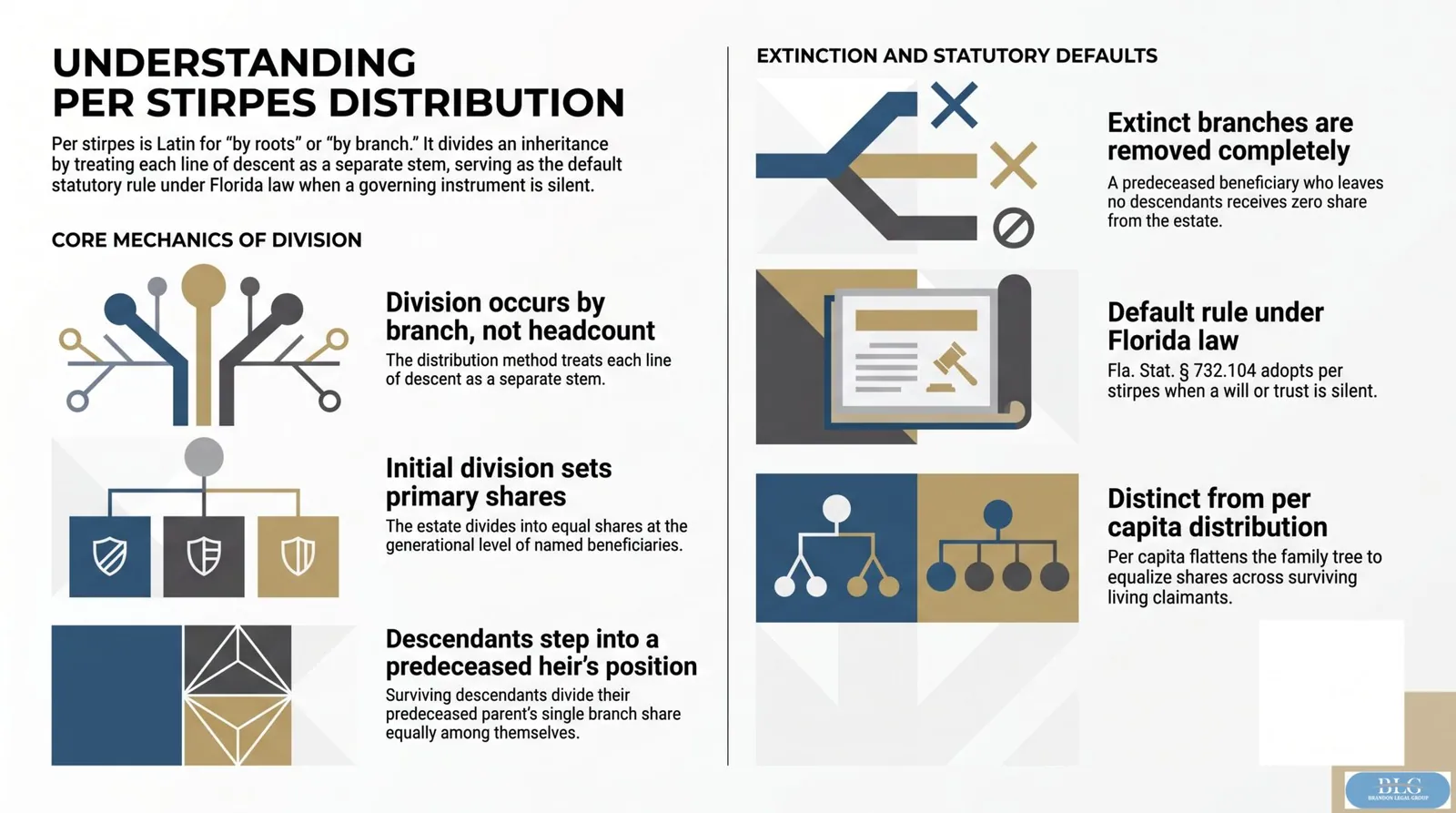
Per stirpes is Latin for "by roots" or "by branch." The distribution method treats each line of descent as a separate stem. When an heir survives, that heir takes their share outright. When an heir predeceases the decedent but leaves descendants, those descendants step into the predeceased heir's position and divide that share equally among themselves. The key mechanic: the initial division happens at the generational level of the named beneficiaries, not at the level of the surviving claimants.
How the Initial Division Is Calculated
The first step determines how many primary shares exist. If a will or trust names three children as equal beneficiaries,the estate divides into three parts at the outset, regardless of whether all three children are alive. Each child represents one branch. If all three survive the decedent, each receives one-third. If one child predeceased the decedent but left two children of their own, the estate still divides into three parts: two surviving children each take one-third outright, and the predeceased child's two descendants split the remaining third, receiving one-sixth each.
This initial division is what separates per stirpes from per capita distribution. Per capita would count all surviving heirs at the closest living generation and divide the estate equally among them, flattening the family tree. Per stirpes preserves the branch structure, even when some branches have grown deeper than others. Florida's intestate succession statute, Fla. Stat. § 732.104, adopts per stirpes as the default rule when a will is silent or when no will exists and descendants of a predeceased heir survive.
What Happens When an Entire Branch Is Extinct
If a named beneficiary predeceases the decedent and leaves no descendants, that branch disappears. The share does not pass to that beneficiary's surviving siblings unless the governing instrument includes a specific survivorship or anti-lapse provision. Under per stirpes, the extinct branch is simply removed from the calculation, and the estate is divided only among the branches that have surviving members.
Consider a hypothetical: a testator names four children as equal beneficiaries. Two children survive. One predeceased child left three grandchildren. The fourth child predeceased the testator and left no descendants. The estate divides into three shares, not four. The two surviving children each receive one-third. The three grandchildren of the third child split one-third, receiving one-ninth each. The fourth child's extinct branch receives nothing, and that share does not redistribute to the other branches unless the will explicitly directs otherwise. This is a frequent source of surprise among families who assume equal love translates to equal redistribution when a branch ends.
How Per Stirpes Interacts With Florida's Anti-Lapse Statute
Florida's anti-lapse statute, Fla. Stat. § 732.603, applies when a beneficiary predeceases the testator and is a grandparent or a lineal descendant of a grandparent. If that beneficiary left descendants who survive the testator, the anti-lapse statute presumes the gift passes to those descendants unless the will expressly provides otherwise. The distribution to those substitute takers follows per stirpes unless the will specifies a different method.
The anti-lapse statute does not apply to beneficiaries outside the protected class, friends, unmarried partners, or remote relatives.When such a beneficiary predeceases the testator, the gift lapses entirely unless the will includes a backup provision. The distinction matters because per stirpes only activates when there are descendants to take by representation. Without descendants, and without a survivorship clause, the lapsed share typically falls back into the residuary estate or passes under intestate succession if the residuary clause also fails.
Multi-Generational Cascades and Unequal Results
Per stirpes can produce dramatically unequal outcomes when family size varies across branches. A testator with three children may have one child who never had children, one child with two children, and one child with six children. If all three of the testator's children predecease and the estate passes to grandchildren, per stirpes divides the estate into three parts. The branch with no children is extinct. The branch with two children splits one-third into two pieces. The branch with six children splits one-third into six pieces. The result: two grandchildren receive one-sixth each,and six grandchildren receive one-eighteenth each, despite all being grandchildren of the same testator.
The mechanic becomes more complex when deaths occur across multiple generations before the estate settles. If a grandchild named as a substitute taker also predeceases the testator, that grandchild's share passes to their own children, the testator's great-grandchildren, under the sameper stirpes logic. Each new generational layer subdivides the original branch share, and the fractions grow smaller with each descent. These cascading divisions are mathematically correct under the statute, but they frequently conflict with the emotional expectation that all grandchildren or all great-grandchildren should receive equal treatment.
Most modern estate planning instruments address this tension byspecifying the distribution method in plain terms, either confirming per stirpes or selecting an alternative like per capita at each generation. The choice determines whether family size advantages one branch over another or whether the estate flattens into equal shares at the first surviving generation. The decision is strategic, not sentimental, and the consequences are financial.
When Trusts Use Modified Per Stirpes Language
Many irrevocable trusts and testamentary trusts use "modified per stirpes" or "per capita at each generation" language to avoid the unequal results that strict per stirpes produces. Modified per stirpes divides the estate into shares at the first generation where at least one member survives, then redistributes any shares allocated to predeceased members equally among all descendants at the next level. The modification preserves some branch loyalty while equalizing outcomes among cousins.
The distinction is invisible in single-generation scenarios but becomes critical when multiple beneficiaries predecease and leave unequal numbers of descendants. Trust language controls, and the definition section of the instrument often specifies which distribution rule applies. Heirs who assume "per stirpes" means "everyone at my level gets the same amount" are often reading per capita expectations into per stirpes mechanics; and the surprise arrives only after the trustee issues the distribution schedule.
Practical Impact on Estate Administration
Estate administrators and trustees calculate per stirpes distributions during the accounting phase, often months after the death. Heirs typically learn their actual share amount when the preliminary distribution schedule is issued, not when the will is read or the trust becomes irrevocable. By that point, no mechanism exists to renegotiate the split unless all beneficiaries agree to a family settlement agreement, and such agreements require unanimous consent, competent parties, and often court approval under Fla. Stat. § 733.815.
Disputes over per stirpes calculations most often arise in blended families, where children from different marriages expect equal treatment, or in families where one sibling's large number of children dilutes the per-capita value of each grandchild's inheritance compared to a sibling with fewer descendants. The math is governed by statute and instrument language, not fairness or need. Understanding the distribution method in advance, while the testator is alive and the plan is stillrevocable, is the only opportunity to adjust the design if the default rule produces an unacceptable result.
- The estate divides at the first named generation, not at the generation of survivors.
- Each branch receives an equal share; descendants within that branch subdivide it equally.
- Extinct branches (no surviving descendants) are removed from the calculation entirely.
- Per stirpes does not equalize across cousins unless modified language is used.
- Anti-lapse protections apply only to specific relatives and only when descendants survive.
The doctrine assumes the testator's intent follows bloodline loyalty, that a parent's share should pass to that parent's children rather than being redistributed among surviving siblings. That assumption reflects centuries of common-law inheritance tradition, but it does not reflect every family's values. Some testators prefer per capita distribution to equalize outcomes among grandchildren. Others prefer hybrid models that favor certain branches. The governing document can specify any of these, but silence defaults to per stirpes under Florida law, and silence is common in older wills and generic form instruments.

Heirs who discover they are receiving a smaller share than expected due to per stirpes mechanics often believe an error has occurred. The calculation is not an error; it is the statutory and contractual default. The time to address distribution preferences is during the estate planning process, when language can be tailored to achieve the intended result. After death, the instrument controls, and per stirpes distributions proceed according to the family tree as it existed at the moment of death, frozen in time and divided by branch according to a rule most families never discussed and few fully understand until the checks are cut. For more context on how Florida handles inheritance when no will exists, see Intestate Heirs: Who Claims What When There's No Will.
Closing Remarks
If a family member has predeceased and the will or trust does not clearly define how their share should pass, if the number of descendants per branch varies widely and the resulting distribution feels unjust, or if estate administration has begun and the per stirpes calculation does not match what anyone expected, the governing instrument may need review or the distribution may need formal challenge before finalization. Brandon Legal Group handles estate planning and administration disputes throughout Florida. Contact us to review the instrument, verify the calculation, or discuss modification while the plan is still revocable.
Frequently Asked Questions
Does per stirpes mean all grandchildren receive equal shares?
No. Per stirpes divides the estate by branch, not by headcount at the grandchild level. If three children are named and all predecease, the estate splits into three parts. Each child's descendants divide their parent's one-third share. A grandchild from a branch with two siblings receives one-sixth; a grandchild from a branch with five siblings receives one-eighteenth. The distribution is equal within each branch, but not equal across all grandchildren.
What happens if a named beneficiary dies before the testator and has no children?
If the predeceased beneficiary has no surviving descendants, that branch is extinct and receives nothing under per stirpes. The estate divides only among the branches that have surviving members. The extinct branch's share does not automatically pass to surviving siblings unless the will includes a survivorship provision or the anti-lapse statute redirects it. Without either, the share may lapse into the residuary estate or pass under intestate succession if the residuary also fails.
Can a will override per stirpes and use a different distribution method?
Yes. The testator controls the distribution method through the language of the will or trust. Common alternatives include per capita, per capita at each generation, or specific dollar amounts or percentages to named individuals. The governing instrument can specify any distribution scheme that is legal and unambiguous. Per stirpes is only the default when the instrument is silent. Clarity in drafting prevents disputes during administration.
Does per stirpes apply if someone dies after the testator but before the estate is distributed?
Generally, no. Per stirpes determines distribution based on who survived the testator at the moment of death. If a beneficiary survives the testator but dies before receiving their share, that share typically passes under that beneficiary's own estate, not by per stirpes through the original testator's plan, unless the original instrument includes a survivorship period or contingent distribution clause. The timing of death relative to the testator's death is the controlling factor, and even a survival by minutes can change the outcome.