

TL;DR: Supervised visitation orders are not permanent. Courts modify them when the supervised parent demonstrates sustained behavioral change, consistent compliance with court directives, and evidence that unsupervised contact serves the child's best interest. The process requires a formal supplemental petition, proof of a substantial, material, and unanticipated change in circumstances, and often a forensic evaluation.
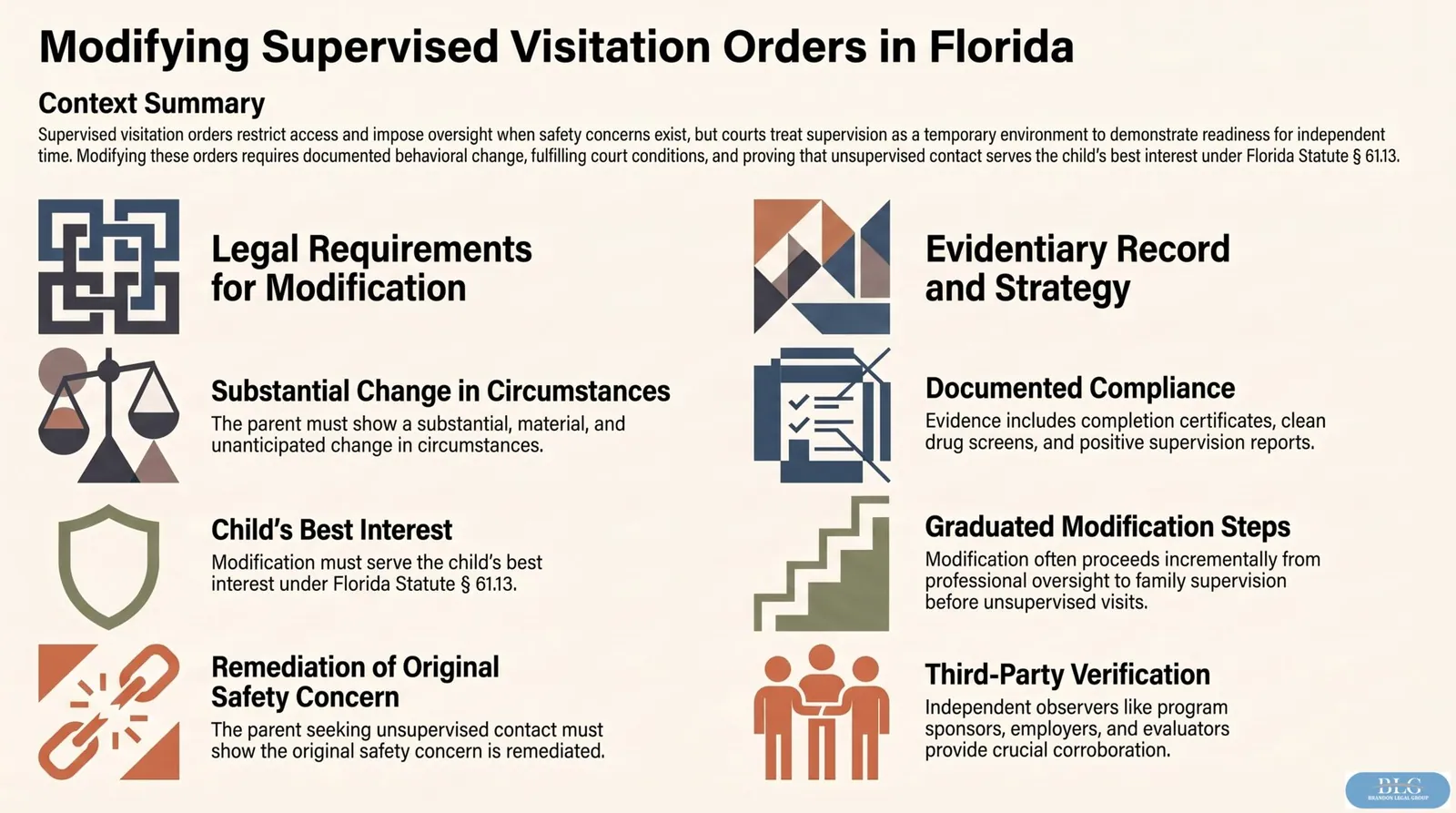
A supervised visitation order lands like a boulder in the middle of a parenting relationship. It restricts access, imposes oversight, and signals judicial concern about safety or fitness. But supervision is rarely meant to last forever. Courts use it as a gate, not a wall, a controlled environment in which a parent can prove readiness for independent time with the child. Modifying that order requires more than elapsed time or good intentions. It demands documented change, strategic presentation, and a record that answers the court's original concern with sustained, verifiable proof that the risk no longer exists.

The legal mechanics of modification begin with Florida Statute § 61.13, which governs parenting plans and time-sharing arrangements. Florida courts retain continuing jurisdiction to modify time-sharing when there is a substantial, material, and unanticipated change in circumstances and modification serves the child's best interest. A supervised visitation order is a form of restricted time-sharing, and modifying it follows the same procedural path as any time-sharing modification, except the practical burden is steeper. The parent seeking unsupervised contact must show not only that circumstances have changed, but that the original safety concern has been remediated.
What Changed Circumstances Actually Mean in a Supervision Context
Generic improvement is not enough. Courts expect specific, measurable change tied directly to the behavior or condition that triggered supervision in the first place. A parent ordered into supervision for substance abuse must show sustained sobriety, documented through testing, treatment completion, and lifestyle stability. A parent flagged for anger or domestic violence must complete a batterers' intervention program, demonstrate behavioral controls in multiple settings, and often submit to psychological evaluation. Vague assertions of being "better now" or character letters from friends carry almost no weight.
The change must also be substantial and enduring. A few months of compliance rarely suffices. Courts look for patterns measured in quarters or years, depending on the severity of the original concern. A single relapse, missed therapy session, or violation of a no-contact order can reset the clock entirely. Consistency across time is the metric. The parent's life must reflect structural change, steady employment, stable housing, supportive relationships that reinforce rather than undermine sobriety or safety. Changed circumstances are not about good weeks. They are about transformed routines.
Building the Evidentiary Record Before Filing
Modification petitions succeed or fail on documentation assembled long before the hearing. Court orders accompanying supervised visitation typically include conditions: complete a parenting course, submit to drug testing, attend therapy, maintain employment. Those conditions are not suggestions. Each one represents a benchmark the court will later evaluate. Parents serious about modification treat compliance as a performance file, saving certificates of completion, maintaining logs of clean drug screens, securing letters from treatment providers that detail progress and prognosis.
The supervised visits themselves generate a record. Professional supervisors and supervised visitation programs often file reports with the court. Those reports note punctuality, engagement with the child, appropriateness of interactions, and any concerning behavior. A parent who arrives late, argues with the supervisor, or behaves inconsistently during visits creates a record that works against modification. Conversely, months of stable, child-focused visits where the supervisor observes nothing problematic build the foundation for a persuasive petition. Experienced custody attorneys advise clients to request copies of supervision reports throughout the process, not just at the end, to identify and correct any recurring concerns before filing.
Third-party verification strengthens the record significantly. Employers, landlords, sponsors from recovery programs, therapists, and religious leaders can provide affidavits or testimony corroborating stability. The court is not looking for cheerleaders. It is looking for independent observers who can speak to day-to-day functioning, reliability, and the absence of the behavior that originally justified supervision. A letter from a recovery program sponsor detailing two years of meeting attendance and sobriety milestones carries more weight than a dozen letters from relatives vouching for character.
The Petition Itself and What It Must Contain
The supplemental petition to modify must identify the original order, specify the current restrictions, and articulate the changed circumstances with precision. General allegations fail. The petition should cite specific compliance milestones, attach supporting documentation, and explain how each change addresses the court's original concern. If the supervision order arose alongside a domestic violence injunction, the petition must show completion of the batterers' intervention program, absence of new incidents, stable housing, and testimonial or evaluative evidence that the behavior pattern has been disrupted. Keep in mind that an injunction entered under Florida Statute § 741.30 has its own separate modification or dissolution process; relaxing time-sharing supervision does not automatically alter the terms of an outstanding injunction.
The petition must also address the child's best interest under Florida Statute § 61.13(3), which lists the factors courts weigh in time-sharing determinations. Those factors include the mental and physical health of each parent, the child's developmental needs, the demonstrated capacity to maintain a safe environment, and the willingness to facilitate a relationship with the other parent. A petition focused solely on the parent's progress, without addressing how modification serves the child, is incomplete. Courts care less about rehabilitation as personal achievement and more about what it means for the child's safety and emotional welfare.
- Completion of court-ordered programs (substance abuse treatment, anger management, parenting courses)
- Clean drug and alcohol screens over a sustained period
- Stable employment and housing
- Positive reports from professional supervisors
- Psychological or social investigation evaluation recommending modification
- Absence of new criminal charges, injunctions, or child welfare involvement
- Demonstrated ability to co-parent and communicate appropriately with the other parent
Graduated Steps and Interim Modifications
Courts rarely leap from fully supervised visitation to unsupervised overnights in a single order. Modification often proceeds in stages. An initial modification might reduce the level of supervision, moving from professional supervision to supervision by a mutually agreed family member, or allowing brief periods of unsupervised contact in public settings. A subsequent modification might extend the duration or allow visits in the parent's home. The final step transitions to a standard time-sharing schedule without oversight.
Requesting graduated modification can make the petition more palatable to both the court and the opposing party. It signals reasonableness and acknowledges that trust must be rebuilt incrementally. A parent who files a petition seeking immediate, unrestricted overnight time-sharing after a year of supervised day visits may face skepticism, even with strong documentation. A parent who seeks a six-month period of family-supervised visits, with a review hearing to follow, presents a lower-risk proposal that courts are more inclined to approve. Strategic modification requests anticipate judicial caution and work with it rather than against it. Understanding how parenting plan modifications work helps frame realistic interim goals.
When Evaluations Become Necessary
In contested modifications involving serious safety concerns, such as allegations of abuse, severe mental illness, or profound substance dependency, courts frequently order a social investigation, parenting plan evaluation, or psychological examination. The evaluator interviews both parents, observes interactions with the child, reviews records, and issues a report with recommendations. These evaluations carry significant weight. A recommendation in favor of modification can overcome opposition from the other parent. A recommendation against it can sink the petition entirely.
Parents seeking modification should assume an evaluation is likely and prepare accordingly. That means maintaining therapeutic relationships, being forthcoming in interviews, and ensuring the evaluator has access to all compliance documentation. Attempts to hide unfavorable information or minimize past behavior backfire. Evaluators are trained to detect inconsistency and deception, and a finding of dishonesty undermines the entire case. Transparency, even when the facts are uncomfortable, builds credibility. An evaluator who sees sustained insight, accountability, and structural change in a parent's life is far more likely to recommend relaxing supervision.

Modification hearings are not informal check-ins. They are evidentiary proceedings where the burden rests entirely on the parent seeking the change. Cross-examination will probe for gaps in the timeline, inconsistencies between testimony and records, and any evidence that the original concern persists. The opposing parent's attorney will highlight every missed appointment, every late payment, every relapse or misstep. Preparation requires not just assembling favorable documents but anticipating every argument against modification and having responsive proof ready. Hearings are won in the months before the petition is filed, not in the moments before testimony begins.
Closing Remarks
You already know the supervision order was never supposed to be the end of the story. If supervision was imposed because of substance abuse and two years of sobriety can now be documented with testing and treatment records, if an evaluation recommends unsupervised contact and the supervisor's reports reflect consistent, appropriate parenting, or if every court-ordered condition has been met and the other parent still objects, the case needs counsel who understands both the procedural mechanics and the strategic narrative. Brandon Legal Group handles Florida custody modifications where the stakes involve parental fitness, child safety, and time-sharing restrictions that need to change. Contact us to build the record and file the petition that moves the case forward.
Frequently Asked Questions
How long does supervised visitation typically last before modification is possible?
No automatic timeline exists. Courts evaluate the nature of the original concern and the pace of remediation. Minor issues like an incomplete parenting class might justify modification within months if compliance is swift. Serious concerns like substance abuse or domestic violence often require a year or more of sustained, documented change before courts consider modification. The duration depends less on calendar time and more on whether the supervised parent has addressed the root behavior and demonstrated stability across multiple domains of life.
Can a parent modify supervision without the other parent's consent?
Yes. Modification petitions do not require agreement from the other parent. The supervised parent files the supplemental petition, serves it on the other party, and presents evidence at a hearing. The other parent has the right to oppose the modification and present contrary evidence. If the evidence establishes a substantial change in circumstances and shows that modification serves the child's best interest, the court can modify the order over objection. Contested modifications are more difficult and require stronger proof, but consent is not a legal prerequisite.
What happens if a parent violates the terms of supervised visitation?
Violations undermine any future modification petition and can result in immediate enforcement action. Attempting unsupervised contact, failing to appear for scheduled visits, using substances during or before visits, or violating other conditions can lead to contempt findings, suspension of visitation, or additional restrictions. Violations reset the timeline for modification because they demonstrate ongoing disregard for court authority and child safety. Courts treat compliance as the minimum threshold; a record that goes beyond bare compliance is what earns modification.
Does the child's preference matter in modifying supervised visitation?
Florida law allows courts to consider a child's reasonable preference when the court finds the child is of sufficient intelligence, understanding, and experience to express a preference, but it is one factor among many and never dispositive. A young child's stated preference carries little weight, especially if the child cannot articulate reasons or may be influenced by a parent. An older child's reasoned preference, grounded in experience and articulated clearly, may inform the court's decision. The best interest analysis remains paramount. A child's desire to spend unsupervised time with a parent does not override documented safety concerns unless the underlying risk has been addressed.
Can supervision be reinstated after it has been removed?
Yes. If new evidence emerges that the parent has relapsed, engaged in dangerous behavior, or otherwise poses a renewed risk to the child, the other parent can file a supplemental petition to modify the order and reinstate supervision. The burden then rests on the parent seeking the restriction, who must prove a substantial change in circumstances warranting the renewed limitation. No time-sharing order is immune from future change. Florida courts retain continuing jurisdiction as long as the child is a minor, and supervision can be reimposed if circumstances justify it.
References
- Florida Statute § 61.13. (Support of children; parenting and time-sharing; powers of court).
- Florida Statute § 741.30. (Domestic violence; injunction; powers and duties of court and clerk).