

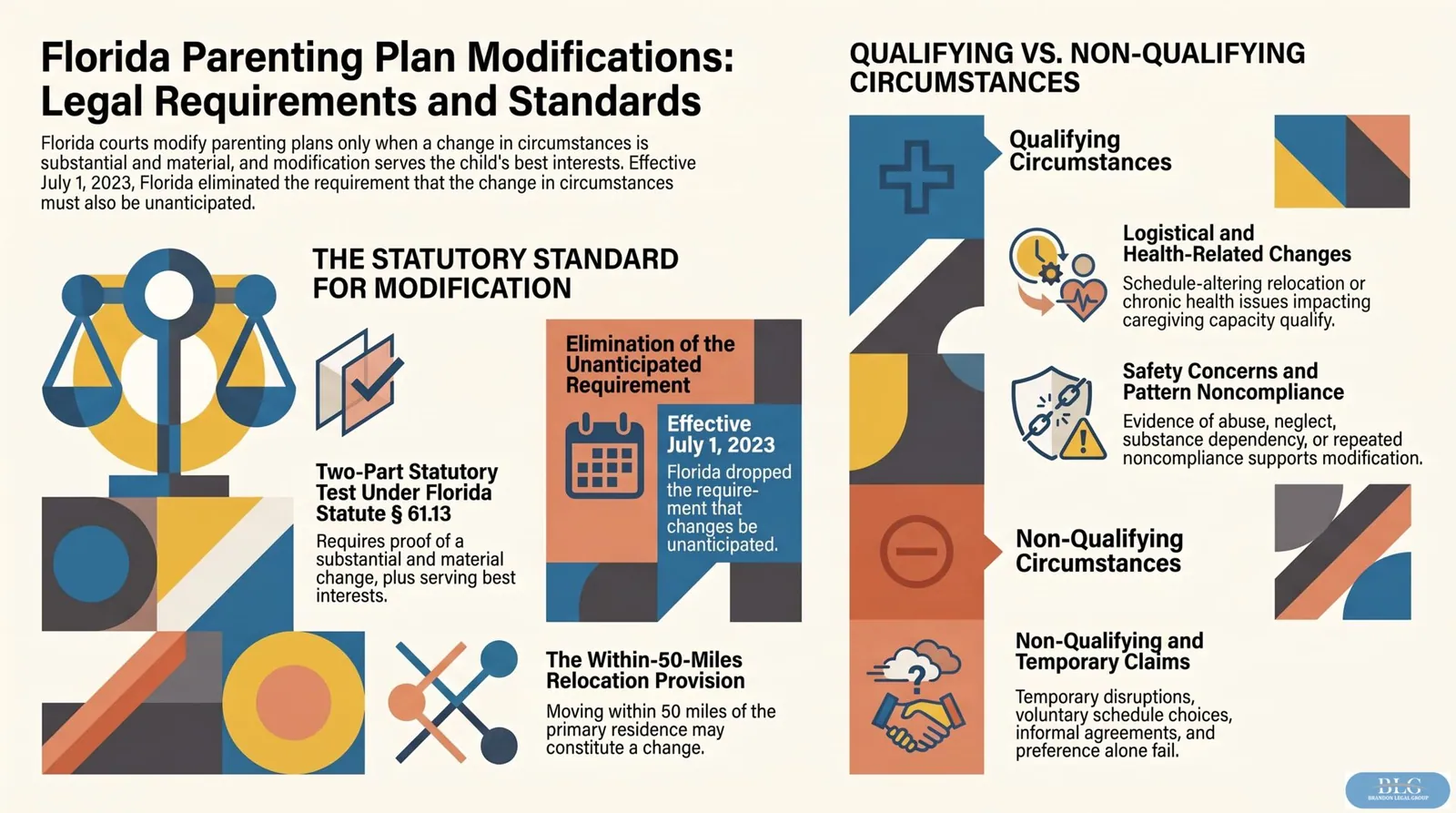
Florida courts will modify a parenting plan only when a change in circumstances is substantial and material, not merely temporary or inconvenient, and only when modification serves the child's best interests. A 2023 amendment made this timelier than many parents realize: Florida dropped its long-standing requirement that the change also be "unanticipated," lowering one hurdle while leaving the rest of the standard intact. The burden is still on the moving party, and vague claims of "things are different now" still won't survive scrutiny. Knowing what actually qualifies, and what changed, can mean the difference between getting relief and wasting months on a petition that never had a chance.
Most parents assume that because life has shifted, new job, new partner, new schedule, the parenting plan should shift with it. The assumption feels reasonable until it meets Florida law. Courts do not revisit custody arrangements every time someone's circumstances change. They revisit them when the change is so significant that continuing under the current plan would harm the child or render the existing order unworkable. The distinction matters. Walk into court asking for modification based on convenience or frustration, and the petition dies on arrival. Walk in with evidence of a substantial, material change that harms the child under the c urrent plan or makes the existing order unworkable; and proof that a different arrangement would serve the child better, and the door opens.
¶
The 2023 Change: Florida Dropped the "Unanticipated" Requirement
This is the part that is ea sy to get wrong, because the rule changed recently, and a lot of older guidance still repeats the outdated version. For decades, a parent seeking to modify a parenting plan or time-sharing schedule had to prove three things: that the change in circumstances was substantial, that it wa s material, and that it was unanticipated, meaning the parents did not and could not reasonably have foreseen it when the last order was entered. That third element came from Florida Supreme Court case law, principally Wade v. Hirschman, and it defeated many petitions on its own.
Effective July 1, 2023, the Florida Legislature eliminated the "unanticipated" element. Chapter 2023-301, Laws of Florida (CS/HB 1301, the companion to SB 1416) amended § 61.13 so that a parent seeking modification now must show only a substantial and material change in circumstances, plus that modification serves the child's best interests. The change no longer has to be something nobody saw coming.
Practically, this lowered one hurdle without erasing the others. A parent no longer loses automatically just because the other side argues "you should have expected this." But the change still has to be genuinely substantial and material, and it still has to serve the child, so the reform made modification more accessible, not automatic. The same 2023 law also added a concrete new trigger: a parent who moves to within 50 miles of the child's primary residence may, by itself, be considered a substantial and material change f or purposes of modifying the time-sharing schedule, and that move does not need to have been unanticipated either.
What Florida Law Actually Requires
Florida Statute § 61.13(2)(c) governs parenting plan and time-sharing modifications. As amended in 2023, the statute requires proof of a substantial and material change in circumstances since the last order, plus a determination that modification is in the child's best interests. That two-part test: a su bstantial and material change, plus best interests, is the gatekeeper. Each element must be satisfied, and the burden rests entirely on the parent seeking the change.
Substantial means the change is significant enough to affect the child's welfare or the feasibility of the current arrangement. Material means i t directly impacts the terms of the parenting plan, timesharing, decision-making authority, or the child's day-to-day stability. As a practical matter, the change usually must be more than momentary: a temporary or speculative disruption rarely rises to the level of "substantial and material." And while the change no longer has to be strictly "unanticipated," courts remain wary of problems a parent created voluntarily or could plainly have foreseen, because those often fail the substantial-and-material test or the best-interests analysis.
Section 61.13 also requires that modification serve the best interests of the child, using the factors listed in § 61.13(3). Even when a changed circumstance is proven, the court will not alter the plan unless doing so improves the child's welfare. This is not a rubber stamp. It is a second layer of scrutiny.
What Courts Actually Accept as Changed Circumstances
Not all life changes qualify. The following categories may support modification in Florida when they are specific, documented, and tied to the child's welfare or the workability of the existing plan:
- Relocation of a parent that fundamentally alters the logistics of the existing timesharing schedule, particularly when distance makes the current plan impossible to execute.
- Serious health issues affecting either the child or a parent, where the condition is chronic, documented, and directly impacts caregiving capacity or the child's needs.
- Evidence of abuse, neglect, or substance dependency that was not known or not occurring at the time of the prior order and now poses a risk to the child's safety.
- A parent's repeated, documented failure to comply with the existing plan. Not isolated lapses, but a pattern that undermines the child's stability or the other parent's ability to exercise their rights.
- A child's developmental or educational needs that have evolved since the plan was entered and now require a different structure or allocation of time.
- Remarriage or cohabitation that introduces new household members whose presence materially affects the child's environment, particularly if there are credible concerns about those individuals.
Consider a hypothetical: A father's work schedule allowed him to exercise his Wednesday overnights and alternating weekends when the plan was entered. Two years later, his employer shifts him to a rotating schedule that conflicts with those exact days. He petitions for modification, proposing a revised timesharing structure that maintains his total overnights but adjusts the calendar. If he can sh ow the schedule change is substantial and material, that the current plan gen uinely no longer works for the child's consistency, and that a revised calendar serves the child better, he may meet the threshold. If, instead, he took the new schedule voluntarily for higher pay and simply prefers a rewritten plan, the petition likely fails: a self-created scheduling preference rarely rises to a substantial and material change, and it does little to show the child's best interests are served.
The custody modification process turns on the quality of the evidence and the specificity of the claim, not on the sincerity of the parent's belief that things s should be different.
¶What Does Not Qualify, and Why Parents Lose
¶Courts reject modification petitions for reasons that, in hindsight, should have been obvious from the start. The most common failures involve chan ges that are temporary, voluntary, or manufactured, or that reflect dissatisfaction with the original order rather than a genuine shift in circumstances.
A parent's remarriage, standing alone, does not justify modification unless there is evidence that the new spouse's presence harms the child or materially disrupts the existing arrangement. The other parent's dislike of the new spouse is not a changed circumstance. A child's expressed preference for one household over the other is not, by itself, a changed circumstance unless tied to a developmental milestone or a documented shift in needs. Florida law allows the court to consider a child's preference, but preference alone does not meet the statutory test.
A temporary job loss, a short-term illness, or a brief period of non compliance usually is not substantial and material. These are transient, not the lasting kind of shift that justifies reworking a child's routine. Neither is a parent's belated realization that they should have negotiated different terms at the time of the original order. A change of heart is not a change of circumstances: if nothing about the family's situation actually shifted, there is nothing to modify.
Frustration with how the other parent exercises their time or makes decisions within the boundaries of the existing plan is not a basis for modification. The plan governs what happens; it does not govern how the other parent feels about what happens. When the real complaint is enforcement rather than changed circumstances, the correct remedy is a motion for contempt or enforcement, not a petition for modification. Trying to use modification as a back-door enforcement mechanism wastes time and credibility. For more on this distinction, see When Co-Parenting Breaks Down Despite a Court Order.
The Procedural Reality of Proving Change
Filing the petition is the easy part. Proving the case requires documentation that predates the petition, spans a meaningful period, and ties directly to the child's welfare or the plan's workability. Courts do not accept narratives. They accept records.
Medical records, school reports, employment verification, police reports, communications between parents, and third-party observations from teachers, therapists, or childcare providers form the evidentiary foundation. Testimony matters, but testimony unsupported by documentation rarely prevails when the other parent contests the facts. If the existing plan requires mediation or another dispute resolution process before court action, the moving parent should be prepared to show compliance unless circumstances made that impossible or unsafe.
Florida courts apply the best-interests analysis found in § 61.13(3), which considers factors including each parent's capacity to facilitate the child's relationship with the other parent, the child's developmental needs, the geographic viability of timesharing, and any history of domestic violence or substance abuse. Even when a changed circumstance is established, modification is denied if the proposed new arrangement does not serve the child better than the current one.

The statute does not reward dissatisfaction. It protects stability. Changing a parenting plan mid-stream disrupts the child's routine, introduces new conflict, and signals to the child that their living situation is subject to renegotiation whenever a parent decides to file paperwork. Courts understand that cost. They modify only when the cost of not modifying is higher.
Closing Remarks
If relocation has made the current schedule unworkable, documented safety concerns have emerged since the last order, or a parent's repeated noncompliance is undermining the child's stability , the question is not whether to seek modification. It is whether the evidence is strong enough to win. Brandon Legal Group represents parents in custody modification cases throughout Florida, building the record and presenting the case courts actually require. Contact us to assess whether the change in your situation meets the statutory threshold and what it will take to prove it.
Frequently Asked Questions
Did Florida really change the standard for modifying custody?
Yes. Effective July 1, 2023, Florida eliminated the requirement that a change in circumstances be "unanticipated." Before that date, a parent had to prove the change was substantial, material, and unanticipated, meaning it could not reasonably have been foreseen when the last order was entered. Chapter 2023-301, Laws of Florida (CS/HB 1301, the companion to SB 1416) removed that third element. Today, a parent must show a substantial and material change in circumstances plus that modification serves the child's best interests. The practical effect is that a parent no longer loses a petition simply becaus e the other side argues the change was foreseeable, but the change must still be genuinely substantial and material, and it must still serve the child.
How long do I have to wait after the last order before I can file for modification?
Florida law does not impose a mandatory waiting period for modification petitions based on changed circumstances. The relevant question is whether the change is substantial and material and whet her modification serves the child's best interests, not how much time has passed. That said, courts are skeptical of petitions filed shortly after an order is entered, especially when the alleged change could have been raised during the original proceeding. If the circumstances justifying modification arose within weeks or months of the last order, expect scrutiny regarding whether a genuine, substantial change has actually occurred or whether the petition is an attempt to relitigate an unfavorable result.
Can a child's preference alone support a modification petition?
A child's preference is a factor the court may consider among the best-interest factors in Florida Statute § 61.13(3), but it is not a standalone basis for modification. The child's preference must be considered alongside the child's age, maturity, reasons for the preference, and whether the preference is informed or the product of influence by one parent. More importantly, the preference must be tied to a changed circumstance that meets the statutory test. A teenager expressing a desire to spend more time with one parent because of school, activities, or developmental needs may carry weight if supported by other evidence. A younger child's stated preference, particularly one that shifts frequently or appears coached, will not.
What if the other parent agreed to informal changes but now refuses to continue them?
¶Informal agreements between parents, arrangeme nts made outside the court-approved parenting plan, do not modify the court's order and usually are not enforceable as a new parenting plan. If one parent allowed the other to deviate from the plan and now insists on returning to the plan's terms, the court will generally enforce the written order, not the informal practice. This creates a strategic trap: parents who accommodate changes without formalizing them may later find themselves unable to enforce what they thought was a new arrangement. If circumstances have changed in a way that justifies modification, the solution is to petition the court and obtain an amended order. Relying on handshake agreements leaves both parents vulnerable and provides no protection if the arrangement falls apart.
Does moving to a new home in the same city count as a changed circumstance?
A local move within the same school district and general geographic area typically does not, by itself, meet the threshold for a substantial and material change in circumstances. Florida law distinguishes between relocation, defined as a move of 50 miles or more from the principal residence for at least 60 consecutive days, and local residential changes. Note that since the 2023 amendments, a parent moving to within 50 miles of the child's primary residence may be considered a substantial and material change for purposes of modifying the time-sharing schedule. Otherwise, a local move might become relevant if it introduces new factors that affect the child's welfare, such as a demonstrably unsafe neighborhood, a household member with a criminal history, or a living situation that violates terms of the existing plan. Absent such factors, changing addresses within the same area generally does not justify modification and does not trigger the statutory relocation requirements found in Florida Statute § 61.13001.
References
- Florida Statute § 61.13 (Support of children; parenting and time-sharing; powers of court, including the § 61.13(3) best-interest factors).
- Florida Statute § 61.13001 (Parental relocation with a child).
- CS/HB 1301 / SB 1416 (Ch. 2023-301, Laws of Florida), effective July 1, 2023; eliminated the "unanticipated" element for modifying a parenting plan or time-sharing schedule and added the within-50-miles provision
- Wade v. Hirschman (903 So. 2d 928 (Fla. 2005) states the pre-2023 modification test; the "unanticipated" element it announced was superseded by the 2023 amendment).
Effective July 1, 2023, Florida eliminated the "unanticipated" element for modifying a parenting plan or time-sharing schedule (Ch. 2023-301 / CS/HB 1301, amending § 61.13); the current standard is a substantial and material change in circumstances plus the child's best interests. Wade v. Hirschman (2005) predates that amendment and no longer controls on the "unanticipated" point.
This article is provided for general informational purposes only and does not constitute legal advice, nor does reading it create an attorney-client relationship. Florida law changes and every situation turns on its own facts. Consult a licensed Florida attorney about your specific circumstances before acting.