

TL;DR: You worked it out between yourselves. No lawyers, no court, no drama. It felt mature, even reasonable. But informal custody arrangements have no legal weight, and when things go sideways, you have nothing to stand on. This article breaks down exactly what you're risking and why a court order isn't optional. ---
When "We Figured It Out" Becomes a Legal Trap
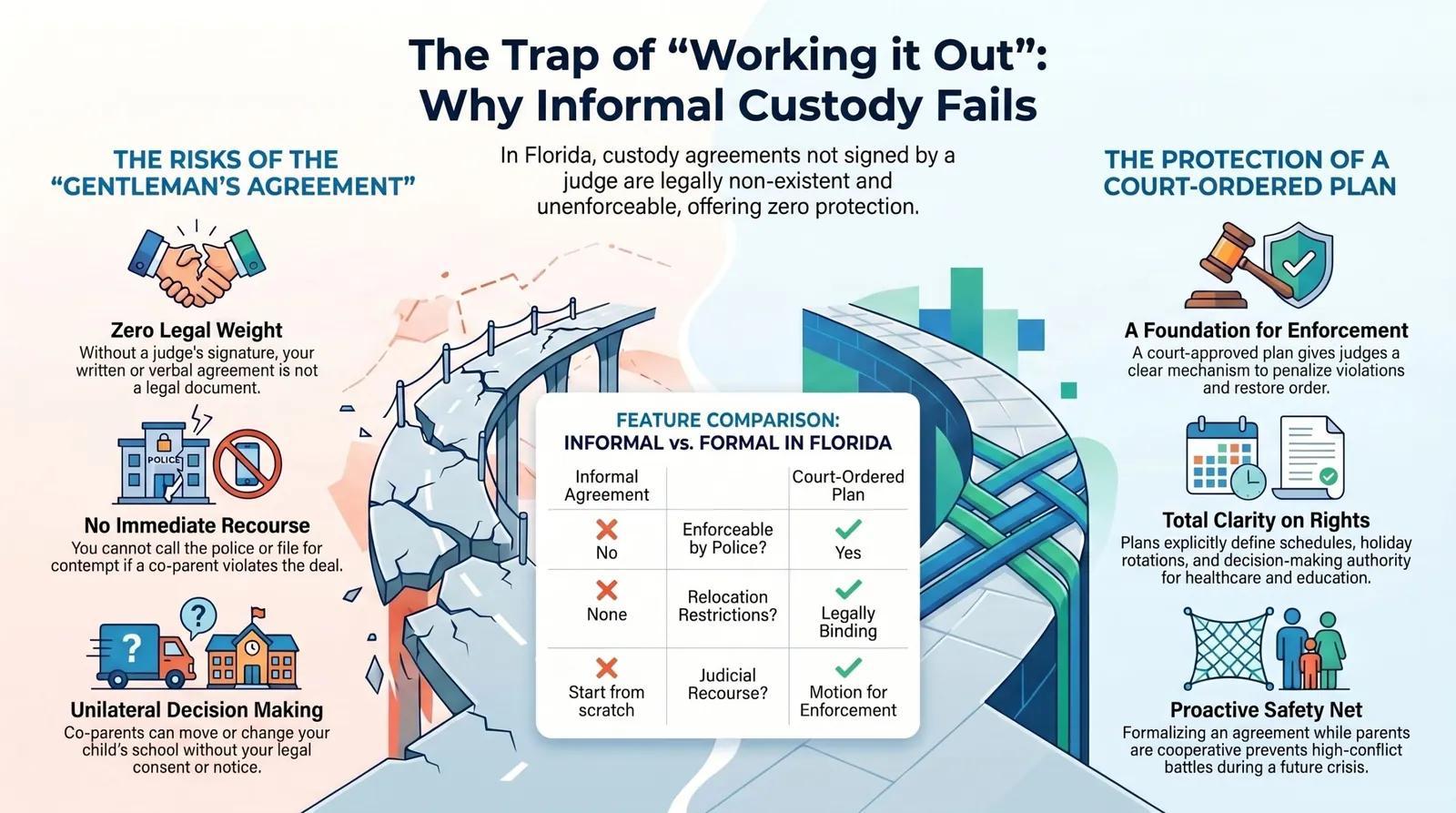 You two sat down, kept it civil, and worked out a schedule. The kids go here on weekdays, there on weekends. Holidays rotate. Nobody had to get lawyers involved. Nobody had to fight. It felt like the adult thing to do.
And for a while, it worked.
Then it stopped working. Maybe your co-parent stopped following the schedule. Maybe they moved without telling you. Maybe they started making decisions about your children, school, doctors, extracurriculars, without consulting you at all. And when you went to do something about it, you hit a wall.
Because there is nothing to enforce. No order. No documentation. Nothing a judge can act on.
That is the hidden cost of informal custody arrangements. They feel like peace. They function like a trap.
What "Informal" Actually Means in a Courtroom
 An informal custody arrangement is any agreement between two parents that has not been reviewed and approved by a court. It does not matter how detailed it is. It does not matter if you wrote it down and both signed it. It does not matter if you had a witness. If a judge has not signed off on it, it does not exist as a legal document.
In Florida, custody, legally called "time-sharing," is only enforceable when it is part of a court-approved parenting plan. Without that, you are not operating under a legal framework. You are operating under a gentleman's agreement. And gentlemen's agreements fall apart the moment one party stops being a gentleman.
If your co-parent decides tomorrow to keep the children an extra week, change their school, or relocate to another county, you have no immediate legal recourse. You cannot call the police and point to an order. You cannot file a motion for contempt. You have to start from scratch, filing for a formal order while your children are already living inside the chaos you were trying to avoid.
The Risks Parents Don't See Coming
Most parents who use informal arrangements are not naive. They aretired. They want to avoid conflict. They believe, genuinely, that their co-parent will be reasonable. What they underestimate is how quickly "reasonable" evaporates when a new partner enters the picture, when finances get tight, when resentment builds, or when one parent simply decides the arrangement no longer suits them.
Here is what that can look like in practice:
- Parental relocation. Without a court order, there is no legal mechanism reqquiring your co-parent to notify you before moving, even out of state. By the time you find out, they may already be gone.
- Decision-making disputes. Who has the right to choose your child's doctor? Their school? Their therapist? Without a formal order establishing legal custody and parental responsibility, both parents technically have equal standing, which means disputes have no clear resolution.
- Schedule manipulation. An informal schedule can be ignored without consequence. Your co-parent can refuse drop-offs, extend their time, or simply stop showing up, and you have no enforcement tool. 
- Your time being used against you. If you've been the primary caregiver under an informal arrangement, your co-parent can walk into court and claim otherwise. Without documentation and a formal order, proving your actual role is harder than it should be.
- Emergency situations. If something happens and the children need to be with you immediately, no hospital, school, or authority figure is bound by your informal agreement. A court order speaks. A handshake does not.
Why Parents Keep Choosing Informal Arrangements Anyway
The reasons are understandable. Nobody wants to spend money on attorneys when things seem fine. Nobody wants to trigger a fight by suggesting they need something in writing. Nobody wants to be the one who "made it legal" and risk looking adversarial.
But here is what that thinking costs you: control. Every day you operate without a court order is a day your parental rights exist on goodwill alone. You are betting your relationship with your children on the assumption that your co-parent will always be cooperative, always be reasonable, and never change their mind.
That is not a plan. That is a prayer.
The parents who end up in the worst custody battles are often the ones who waited. They avoided the process when it wassimple, and they entered it when it was a crisis, when emotions were high, positions were entrenched, and every day without an order was another day the other parent was solidifying their position.
What a Formal Custody Order Actually Gives You
 A court-approved parenting plan is not a weapon. It is a foundation. It tells both parents exactly what to expect, and it tells the court exactly what to enforce.
A solid parenting plan covers time-sharing schedules in detail, holiday rotations, decision-making authority over education and healthcare, communication protocols, and relocation restrictions. When both parents know the rules and those rules carry legal weight, the relationship is cleaner. There is less room for manipulation, less ambiguity, less opportunity for one parent to rewrite history.
¶And when your co-parent violates the order because sometimes they will, you have a mechanism. You file for enforcement. A judge sees a clear violation of a clear order. That is a very different conversation than "we had an agreement."
Working with child custody attorneys who understand how to build parenting plans that actually hold up is the difference between having a document and having protection.
If You're Already in an Informal Arrangement
You have not made an irreversible mistake. But you are operating without a safety net, and the longer it continues, the more complicated formalizing it can become, especially if the current arrangement has drifted away from what either of you originally intended.
The first step is documentation. Start keeping detailed records of when the children are with each parent, how decisions are being made, and any communications that reflect the existing arrangement. This matters if you eventually go to court and need to demonstrate what has actually been happening.
The second step is getting a real order in place before something forces your hand. It is significantly easier to formalize an arrangement when both parents are still cooperative than when one of them has already decided to change the terms.
Do not wait for a crisis to care about this. The parents who protect their rights are the ones who move before the situation deteriorates, not after.
¶ ¶ ¶Frequently Asked Questions
Is a written custody agreement between parents legally binding in Florida?
¶No. A written agreement between parents, even a signed one, is not legally enforceable in Florida unless it has been approved and entered by a court. Only a court-ordered parenting plan carries legal weight.
What happens if my co-parent stops following our informal agreement?
Without a court order, you have no enforcement mechanism. You cannot file for contempt. You cannot call law enforcement. Your only option is to file for a formal custody order, which takes time and puts you in a reactive position rather than a protected one.
Can an informal custody arrangement be used against me in court?
Yes. If your co-parent files for formal custody and the informal arrangement has established a pattern, even one that doesn't reflect your actual intentions, a court may consider that pattern when determining what is in the children's best interest. What you've been doing matters, documented or not.
How do I convert an informal arrangement into a legal custody order?
You file a petition with the court and submit a proposed parenting plan. If both parents agree, the process can be relatively straightforward. If there is disagreement, the court will decide. Either way, having an attorney draft a parenting plan that is detailed, enforceable, and tailored to your situation is the most important step you can take.
Does it matter who files first?
Strategically, timing matters. Filing first does not guarantee you a better outcome, but it does allow you to shape the initial framework and respond from a position of preparation rather than reaction. If you believe your co-parent may move to formalize custody on their own terms, getting ahead of it is worth serious consideration.

Informal arrangements feel manageable, right up until the moment they don't. If you are operating without a court order, you are not protected. Brandon Legal Group works with parents who are done leaving their rights to chance. Call us and let's put something real in place before you need it.