

A healthcare surrogate makes medical decisions when incapacity strikes and the patient cannot speak. Florida law defines what authority they hold, what decisions they can and cannot make, and what happens when no designation exists. The document sitting unsigned in a drawer does nothing when the crisis arrives.
The ventilator hums. The attending physician needs an answer: surgery, comfort care, aggressive intervention, or withdrawal. The patient cannot respond. Someone must decide. That someone is determined by a document most people sign once and never think about again, or by a statute most families discover only when the ICU social worker hands them a photocopied flowchart. Healthcare surrogate designation is not theoretical. It is the transfer of life-and-death authority at the moment clarity is gone and time is short.

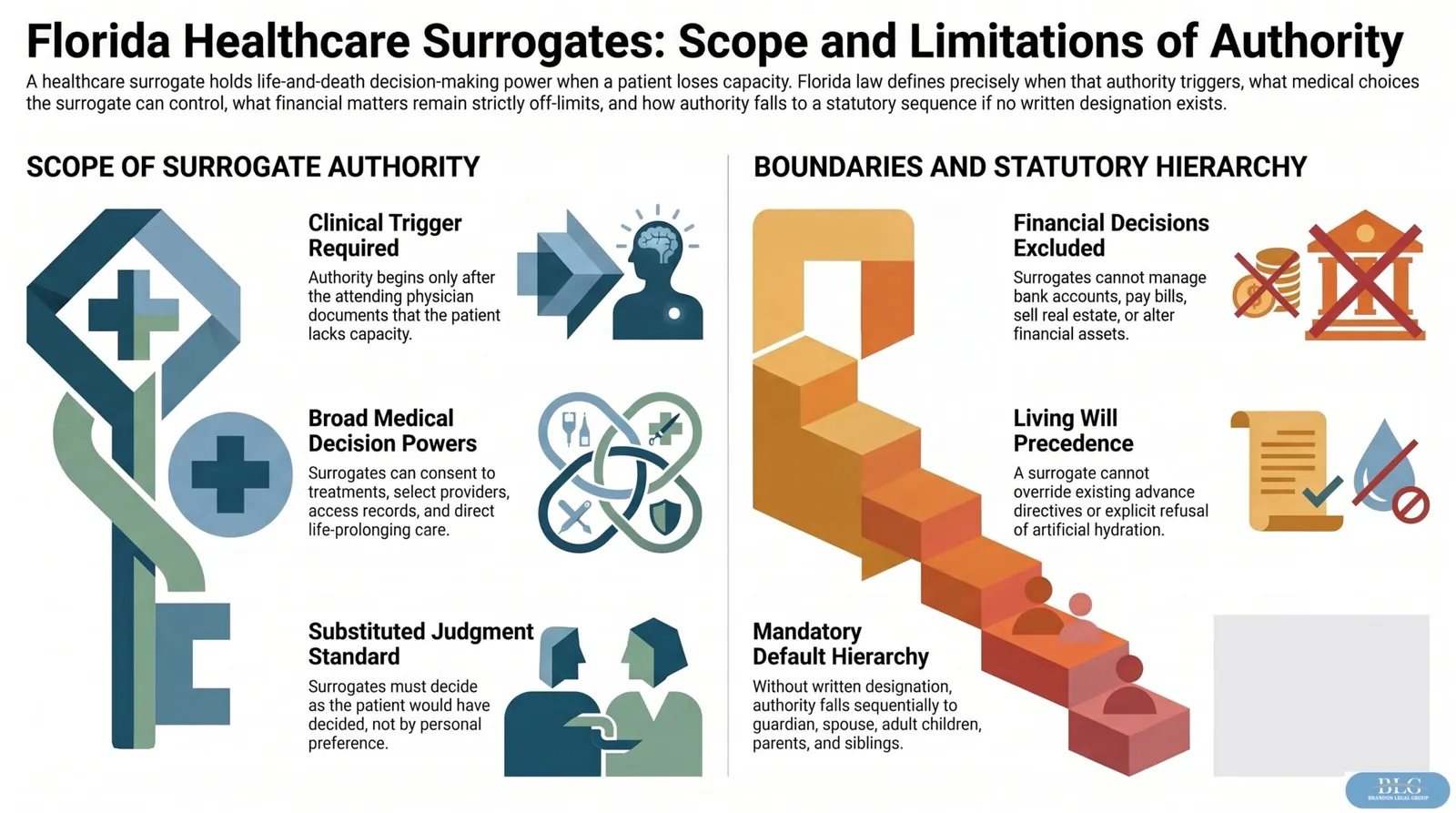
Florida Statute § 765.202 governs the designation. The surrogate steps into the patient's shoes for medical decisions after the attending physician determines and documents that the patient lacks capacity, with additional physician review when Florida law requires it or the capacity determination is in question. That trigger is clinical, not emotional. Families often believe they automatically hold authority. They do not. Without a valid written designation, decision-making authority follows the statutory priority list in § 765.401, and that list does not always align with family expectations or patient wishes.
What the Surrogate Can Decide
The healthcare surrogate's authority is broad but not unlimited. Florida law grants the surrogate the power to make any healthcare decision the patient could have made, including decisions about life-prolonging procedures, unless the designation document explicitly restricts that authority. The statute contemplates full substituted judgment: the surrogate is supposed to decide as the patient would have decided, not as the surrogate personally prefers.
¶That standard, substituted judgment, creates friction in practice. The surrogate may hold religious or philosophical beliefs that conflict with the patient's known wishes. The designation itself rarely includes detailed guidance. Most forms are one-page templates downloaded, signed, notarized, and filed away. When the crisis comes, the surrogate may face decisions the patient never articulated: experimental treatment, organ donation, psychiatric intervention, or whether to transfer to hospice. The absence of documented direction does not suspend the surrogate's authority; it simply forces the surrogate to make the choice without a map.
Specific categories the surrogate typically controls include:
- Consent to or refusal of any medical or surgical treatment
- Selection or discharge of healthcare providers and facilities
- Approval of diagnostic tests, medications, and therapies
- Decisions regarding life-prolonging procedures, unless restricted in the designation
- Access to medical records under HIPAA and Florida law
- Anatomical gifts and organ donation, if the designation or a separate anatomical-gift document grants that authority
Healthcare providers rely on the surrogate's authority once incapacity is documented. Challenges to that authority, by other family members, estranged spouses, or adult children, rarely succeed unless the challenger can prove the designation was executed under duress, fraud, or undue influence, or that the surrogate is acting against the patient's known wishes in bad faith.
What the Surrogate Cannot Decide
The surrogate's authority stops at the borders of healthcare. Financial decisions, property transfers, and contractual obligations remain outside the scope. A durable power of attorney is the instrument that governs financial and legal matters; the healthcare surrogate designation is not a substitute. Confusion on this point is common and costly. A surrogate cannot access bank accounts, pay bills from the patient's funds, sell real estate, or manage investments, even when those actions are necessary to fund ongoing care.
The surrogate also cannot override an existing advance directive. If the patient executed a living will that expressly refuses artificial nutrition and hydration in the event of a terminal condition or persistent vegetative state, the surrogate cannot disregard that instruction, even if family pressure mounts or personal beliefs clash. Florida's living-will statutes control how those written instructions are made and honored. The surrogate's role in that scenario is to ensure the directive is followed, not to substitute personal judgment.
Certain decisions require heightened procedural safeguards. Withholding or withdrawing life-prolonging procedures from a patient in a persistent vegetative state, for example, can require clear and convincing evidence of the patient's wishes when no advance directive exists and family members disagree. The surrogate may face a court proceeding before medical providers will act. The Terri Schiavo case, litigated under Florida law, illustrates the collision of statutory authority, family conflict, and evidentiary burdens when end-of-life wishes were never documented.
When No Surrogate Was Named
The absence of a designation triggers the statutory default under § 765.401. Authority flows to the next available person in a fixed hierarchy: judicially appointed guardian, spouse, adult child or majority of reasonably available adult children, parent, adult sibling or majority of reasonably available adult siblings, adult relative, close personal friend, or, if no one else is available, a licensed clinical social worker selected through the statutory process. The list is mandatory and sequential. A sibling cannot jump ahead of a parent. An estranged spouse retains priority over devoted adult children unless a court intervenes.
This default structure generates predictable conflict. The spouse who has been separated for years but never divorced. The adult child who has been estranged for a decade. The parent whose values diverge sharply from the patient's known beliefs. All hold statutory authority ahead of the people who may know the patient best or whom the patient would have trusted. Without a written designation, the law does not care about relationship quality, recent involvement, or emotional proximity. It cares about category and sequence.
When multiple people in the same category disagree, two adult children, for instance, and no statutorymajority exists, healthcare providers often refuse to act until the conflict is resolved, either by family consensus or by court order. That delay occurs while the patient remains in a clinical limbo. Hospitals and physicians will not risk liability by choosing one family member's direction over another's absent clear legal authority. The result is a guardianship proceeding, additional expense, and decisions made by a judge rather than by someone who knew the patient's wishes. Integrating healthcare surrogate designation into broader estate planning prevents that outcome.
How Disputes Arise and What Happens Next
Disputes typically surface in three contexts: ambiguity in the designation document itself, allegations that the surrogate is not acting in accordance with the patient's wishes, or competing claims to authority when the designation's validity is questioned. Florida law allows interested parties to petition for an order determining incapacity, challenging the surrogate's authority, or seeking injunctive relief to prevent a specific decision.
Proving bad faith is difficult. The challenger must show more than disagreement with the surrogate's decision; evidence must demonstrate that the surrogate is acting from personal interest, ignoring known patient preferences, or making decisions that are medically contraindicated without justification. Medical providers, ethics committees, and sometimes expert testimony become necessary. The litigation is urgent. Decisions often cannot wait for a trial, but the evidentiary standard remains high.
Consider a hypothetical: A mother designates her eldest son as healthcare surrogate. Years later, a stroke leaves her unable to communicate. The eldest son directs comfort care only; the younger daughter believes aggressive rehabilitation is warranted and consistent with their mother's expressed wishes. The hospital will follow the surrogate's direction unless the daughter obtains a court order. Her belief, even if genuine, does not override the written designation. The daughter must file an emergency petition, present evidence of the mother's prior statements, and argue that the son's decisionviolates those known wishes or reflects bad faith, a fact-intensive, time-sensitive, and emotionallycorrosive process. A detailed designation document, or a recorded conversation incorporated into the estate plan, would have prevented it.
Disputes also arise when the surrogate is asked to make decisions about newer medical interventions that did not exist when the designation was executed: certain biologics, gene therapies, or experimental protocols. The surrogate's authority extends to those decisions, but the absence of guidance leaves the surrogate vulnerable to second-guessing and conflict with other family members. Updating healthcare directives periodically, and documenting general values and treatment preferences rather than listing specific procedures, provides a more durable framework.
The Intersection with Probate and Estate Administration
Healthcare surrogate authority terminates at death. The surrogate cannot make post-mortem decisions about autopsy, anatomical gifts, or disposition of remains unless another legally effective document gives that authority. Anatomical gifts are governed separately under Florida's anatomical-gift statutes, and disposition of remains follows the legally authorized person hierarchy in Florida Statute § 497.005. Confusion on this point is common; family members assume the person who held authority during incapacity continues to hold it after death. They do not.
Estate administration and healthcare decision-making are parallel tracks with different governing instruments. A person may name one individual as healthcare surrogate and a different individual as personal representative. That split can be strategic, choosing the family member best equipped for medical decisions and the family member best equipped for financial administration, but it also creates potential for miscommunication and conflict, particularly when end-of-life medical costs deplete estate assets or when the surrogate's decisions are later questioned during probate. Coordination between the healthcare surrogate designation, durable power of attorney, living will, and the will or trust that governs estate distribution is not optional. It is structural.
Articles addressing related estate-planning concerns, such as challenges to testamentary documents, often discuss the evidentiary issues that arise when a person's intent is disputed after they can no longer speak. The same evidentiary problems appear in surrogate disputes: Was the designation made freely? Did the patient have capacity at the time of execution? Were there subsequent oral statements that contradict the written document? Healthcare surrogate litigation and will contests share a factual overlap. Both hinge on proof of intent, capacity, and the absence of undue influence. Both become exponentially more complex when the patient or testator did not document their reasoning.

The healthcare surrogate designation is a small document with large consequences. Executed properly, it ensures that medical authority rests with someone chosen and trusted. Ignored or poorly drafted, it becomes another layer of conflict in a family's worst moment. The decisions it governs, whether to continue life support, consent to amputation, approve a feeding tube, or transition to palliative care, are not abstract. They happen in hospitals, in real time, under clinical pressure. The surrogate will make those decisions whether or not the patient left guidance. The question is whether the right person is making them.
Closing Remarks
If a healthcare surrogate designation sits unsigned, names someone who is no longer the right choice, or lacks the specificity needed to prevent family conflict, the authority it grants will be tested exactly when clarity matters most. Brandon Legal Group structures healthcare surrogate designations within comprehensive estate plans that align medical, financial, and testamentary authority. Contact us to ensure the right person holds the right authority at the right time.
Frequently Asked Questions
Does a healthcare surrogate need to be a family member?
No. Florida law permits a competent adult to serve as healthcare surrogate, subject to statutory restrictions, and the named surrogate should not serve as a witness to the designation. The designation can name a close friend, a domestic partner, or another legally eligible person if that person is best positioned to honor the patient's values and preferences. The critical requirement is that the named individual is willing and able to serve when incapacity occurs. Naming someone outside the family can prevent conflict when family relationships are strained or when no family member is geographically close or emotionally suited to the role.
Can a healthcare surrogate be removed or replaced?
Yes, but only by specific mechanisms. The patient can revoke the designation at any time while they retain capacity, either by executing a new designation or by providing written notice of revocation. Once the patient loses capacity, removal requires a court proceeding. An interested party must petition the court and prove that the surrogate is not acting in accordance with the patient's wishes, is acting in bad faith, or is otherwise unfit. The standard is high, and the process is urgent but procedurally demanding. Simply disagreeing with the surrogate's decisions is not sufficient grounds for removal.
What happens if the healthcare surrogate is unavailable when a decision is needed?
The designation should name an alternate surrogate. If the primary surrogate cannot be reached or is unwilling to serve, the alternate steps in with the same authority. If no alternate is named and the primary surrogate is unavailable, authority reverts to the statutory default list under Florida Statute § 765.401. That reversion can result in the exact scenario the designation was meant to prevent: decision-making authority falling to someone the patient would not have chosen. Naming at least one alternate, and ensuring that both individuals have copies of the designation and know they have been named, prevents that gap.
Does the healthcare surrogate designation need to be notarized?
No. Florida Statute § 765.202 requires the designation to be signed in the presence of two adult witnesses, and at least one witness cannot be the principal's spouse or blood relative. The named surrogate may not serve as a witness. Notarization is not the statutory requirement. That does not mean the document should be treated casually. Proper witnesses are mandatory, and notarization may provide an extra layer of authentication when used correctly. But a notary seal does not cure a missing statutory witness. In a crisis, sloppy execution gives a hesitant hospital or a dissenting family member ammunition. Do it right the first time.
Can a healthcare surrogate authorize mental health treatment or involuntary commitment?
It depends on the language of the designation and the nature of the mental health crisis. A healthcare surrogate generally has authority to consent to voluntary mental health treatment, including psychiatric hospitalization and medication, if the patient lacks capacity due to mental illness. However, involuntary commitment under the Florida Mental Health Act (the Baker Act) follows a separate statutory procedure and is typically initiated by law enforcement, a physician, or a mental health professional, not by a surrogate. The surrogate's authority is strongest when the patient's incapacity is due to a medical condition and the mental health treatment is part of a broader care plan. When mental illness is the sole basis for incapacity and the patient is resisting treatment, the legal framework shifts, and guardianship may be required.
References
- Fla. Stat. § 765.202 (Designation of a health care surrogate).
- Fla. Stat. § 765.204 (Capacity of principal; procedure).
- Fla. Stat. (§§ 765.302–765.304 (Living will; execution and procedure)).
- Fla. Stat. § 765.305 (Procedure in absence of a living will).
- Fla. Stat. § 765.401 (The proxy; absence of advance directive).
- Fla. Stat. § 497.005 (Definitions; legally authorized person for disposition of remains).
- Fla. Stat. Ch. 765 (Part V (Florida Anatomical Gift Act, §§ 765.510–765.547)).
- Fla. Stat. Ch. 394 (Part I (The Florida Mental Health Act, Baker Act)).
- 45 C.F.R. § 164.502(g) (HIPAA; personal representatives).
This article is provided for general informational purposes only and does not constitute legal advice, nor does reading it create an attorney-client relationship. Florida law changes and every situation turns on its own facts. Consult a licensed Florida attorney about your specific circumstances before acting.