
TL;DR: A Florida will can be challenged on grounds including lack of capacity, undue influence, duress, mistake, improper execution, revocation, or fraud. The document holds up when it was executed by someone with testamentary capacity, free from coercion, and according to the strict formalities required by Florida law. Courts scrutinize the circumstances surrounding the signing, not just the signature itself.
¶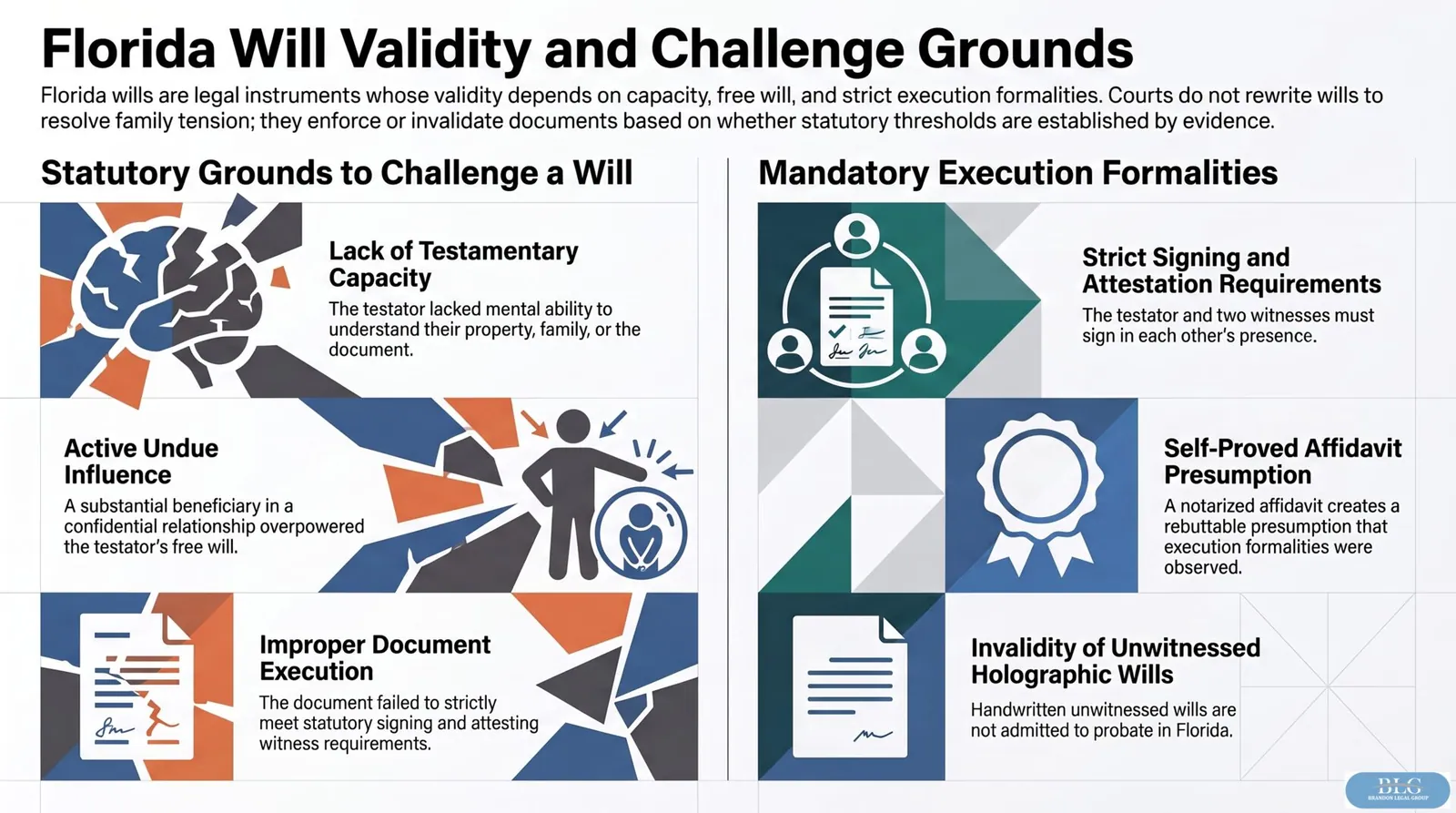
The will looked perfect on paper. Signed, witnessed, notarized. Filed with the probate court without objection until someone filed a petition to contest it. Now the estate is frozen. The bank accounts, the house, the brokerage statements, all locked behind a challenge that hinges on what happened in the room the day that signature went on the page. Florida law does not treat wills like sacred documents. It treats them as legal instruments whose validity depends on capacity, free will, and strict execution formalities, and it gives interested parties the tools to challenge them if the circumstances do not hold up.

A will contest isn't a referendum on fairness. It's a test of validity. The person challenging the document carries the burden of proving something was wrong, fundamentally wrong, with how it came into existence. The will's proponents defend it. If the challenger meets the legal standard for their claim, the will fails. If they don't, it stands. The outcome turns on evidence, not emotion.
The Grounds That Actually Succeed
Florida Statutes § 732.5165, Fla. Stat. § 732.502, and related probate law identify a handful of grounds that survive judicial scrutiny. These aren't abstract theories. They are specific legal defects that, when proven under the applicable legal standard, can void a will or invalidate portions of it.
- Lack of testamentary capacity: The testator did not understand the nature of the act, the extent of their property, or the natural objects of their bounty at the time of execution.
- Undue influence: A substantial beneficiary in a confidential relationship actively procured the will in a way that overpowered the testator's free will.
- Duress or mistake: The will was signed because of coercion, pressure, or a material misunderstanding that undermined the testator's true intent.
- Improper execution: The will was not signed by the testator in the presence of two attesting witnesses, or the witnesses did not sign in the presence of the testator and each other, as required by Fla. Stat. § 732.502.
- Fraud: The testator was deceived about the nature of the document or its contents.
- Revocation: The testator executed a later will, physically destroyed the document, or took other acts demonstrating intent to revoke under Fla. Stat. § 732.505.
Everything else, disappointment, perceived unfairness, family tension falls outside the statute. Courts do not rewrite wills to restore harmony. They enforce them or invalidate them based on whether the legal threshold was met.
Capacity Is Contextual, Not Binary
Testamentary capacity is a lower bar than the capacity required to manage a business or enter a contract, but it is not automatic. Florida law presumes competence. The burden of proving incapacity rests on the contestant. That proof must show that at the moment of execution, the testator lacked the mental ability to understand what they owned, who their family members were, and what signing the document would accomplish.
A diagnosis of dementia does not, by itself, void a will. Medical records showing cognitive decline establish context, but capacity is assessed at a specific point in time. A person may have lucid intervals. A neurologist's report from three months before or after the signing does not resolve the question. Witness testimony about the testator's behavior on the day of execution often carries more weight than a retrospective diagnosis. If the attorney who supervised the signing observed the testator answering questions coherently, understood the terms of the document, and appeared oriented to person and place, that testimony becomes difficult to overcome.
Conversely, when the testator signed in a hospital bed, medicated, within days of a stroke, with no independent legal counsel present, the inference shifts. Capacity can exist in compromised conditions, but the weaker the testator's condition, the more scrutiny the document receives.
Undue Influence Requires More Than Proximity
Undue influence claims often arise when a family member, caregiver, or romantic partner appears in the will as a primary beneficiary and occupied a position of trust or dependency with the testator. Florida courts focus on whether a substantial beneficiary had a confidential relationship with the testator and actively procured the will. If that showing is made, Florida's burden-shifting rule requires the will's proponent to prove the absence of undue influence.
Active procurement can include isolating the testator, arranging the lawyer, being present when the will is discussed, giving instructions to the drafting attorney, knowing the contents before execution, securing witnesses, or storing the signed document. Consider a hypothetical: an elderly man revises his will three months after hiring a live-in aide. The new will leaves the aide 60% of the estate. She drove him to the lawyer's office. She was present during the consultation. The adult children, previously equal beneficiaries, receive nominal bequests. No attorney interviewed the testator alone. That pattern invites scrutiny.
If the proponent cannot show the testator received independent advice, that the disposition was consistent with prior intent, or that the transaction was initiated by the testator rather than the beneficiary, the will may fail on this ground. Proximity, caregiving, and influence are not illegal. Dominance that substitutes the beneficiary's intent for the testator's is.
Execution Formalities Are Unforgiving
Florida Statutes § 732.502 requires that a will be signed at the end by the testator, or by another person in the testator's presence and at the testator's direction, attested by two witnesses, both of whom sign in the presence of the testator and each other. The statute is not a suggestion. A missing witness signature, a witness who signed hours after the testator, or attestation outside the testator's presence voids the will as a formal matter. No amount of evidence about the testator's intent cures a defect in execution.
¶ ¶ ¶Self-proved wills, those executed with notarized affidavits under Fla. Stat. § 732.503, carry a procedural advantage. The affidavit creates a rebuttable presumption that the formalities were observed. Challengers must produce compelling evidence that the ceremony did not occur as attested. Without self-proving affidavits, the witnesses must testify or submit affidavits during probate. If a witness has died, moved, or cannot recall the event, the proponent faces difficulty establishing proper execution.
Some contested wills fail not because of fraud or coercion, but because someone cut corners on a Saturday afternoon with a form downloaded from the internet. Florida law does not validate intent when the formalities collapse. An estate planning attorney supervises execution to foreclose this category of challenge before it arises.
Interested Witnesses Create Risk, Not Automatic Invalidity
Florida does not void a will or any provision of it solely because a beneficiary served as a witness. Fla. Stat. § 732.504 expressly allows an interested witness. That does not make it smart. A beneficiary-witness can become powerful evidence in an undue influence fight, especially if that person also arranged the lawyer, controlled access to the testator, or participated in the signing. The cleaner approach is simple: never use a beneficiary as a witness.
What Happens When a Challenge Succeeds
If a will is invalidated in whole, the estate passes under the most recent prior valid will, or if none exists, through Florida's intestacy statutes under Chapter 732. If only a portion of the will is invalidated, such as a bequest procured by undue influence, the remainder of the document may stand. Partial invalidity depends on whether the invalid provision can be severed without disrupting the testator's overall intent.
A successful challenge does not necessarily benefit the contestant. Intestacy or a prior will may distribute assets in a manner no party anticipated. This is why many will contests settle. Once the procedural defects or evidentiary weaknesses are exposed in discovery, the incentive to litigate often evaporates. Mediation resolves the dispute without a final adjudication, and the estate moves forward under negotiated terms.
Litigation itself imposes costs. Attorney fees, expert witness fees for medical or handwriting analysis, court costs, and the delay in distribution accumulate quickly. Personal representatives owe fiduciary duties to the estate and may defend the will when a reasonable, good-faith basis exists, but they are not required to litigate losing positions. The calculus shifts when the evidence is weak.

Estate plans drafted with attention to execution formalities, documented capacity, independent legal advice, and consistency with prior intent withstand most challenges. When a will invites litigation, drafted in haste, signed under questionable circumstances, deviating sharply from established patterns without explanation, the question is not whether it will be contested, but when. For more context on structuring estate plans that anticipate conflict, see Revocable vs. Irrevocable Trusts in Florida: Which One Protects Your Assets.
Closing Remarks
If a family member signed a will while medicated in a hospital bed, a new romantic partner suddenly appears as a primary beneficiary, or the execution ceremony lacked proper witnesses, the document is vulnerable. Brandon Legal Group structures estate plans that foreclose these challenges before they begin. Contact us to draft or defend a plan built to hold up under scrutiny.
Frequently Asked Questions
How long does someone have to challenge a will in Florida?
Under Florida Statutes § 733.212, an interested person must file a challenge within specific, unforgiving deadlines. Generally, an objection must be filed by the later of two dates: three months after the date of the first publication of the Notice of Administration, or 30 days after the date you were formally served with that notice. Once these deadlines pass, the opportunity to contest the will is permanently lost, except in rare cases of concealed fraud.
Can a no-contest clause prevent a challenge?
No. Florida Statutes § 732.517 makes no-contest clauses, also called in terrorem clauses, unenforceable in wills. A clause threatening forfeiture for contesting the will does not bar a legitimate challenge and does not punish a beneficiary for filing one. If the facts support a contest based on capacity, undue influence, fraud, or improper execution, the clause is not the shield some families think it is.
Does a handwritten will hold up in Florida?
¶ ¶Holographic wills, handwritten and unwitnessed, are not valid in Florida unless they meet the full execution requirements of Fla. Stat. § 732.502, including two attesting witnesses. A handwritten document signed only by the testator, without witnesses, will not be admitted to probate, regardless of the testator's intent.
What role does the personal representative play in defending a will contest?
The personal representative has a fiduciary duty to act in the best interest of the estate and may defend the validity of the will when there is a reasonable, good-faith basis to do so. This can include retaining counsel, producing evidence, and participating in discovery. However, if the evidence clearly favors the contestant or the estate lacks funds to finance protracted litigation, the personal representative may choose to settle or decline to oppose the contest vigorously. The representative does not have unlimited discretion; they must act in the best interest of the estate and its beneficiaries.
Can someone contest a will if they were left something in it?
Yes. A beneficiary who believes they are entitled to a larger share, or who contends that the will as executed does not reflect the testator's true intent, may challenge the document. The fact that they received a bequest does not preclude standing to contest. Florida law grants standing to any interested person, which includes beneficiaries under the challenged will or under a prior will, as well as heirs who would take under intestacy.
References
- Florida Statutes Chapter 732 (Probate Code: Intestate Succession and Wills).
- Florida Statutes § 732.5165 (Will contests).
- Florida Statutes § 732.502 (Execution of wills).
- Florida Statutes § 732.503 (Self-proof of will).
- Florida Statutes § 732.504 (Who may witness).
- Florida Statutes § 732.505 (Revocation of wills).
- Florida Statutes § 732.517 (Penalty clause for contest).
- Florida Statutes § 733.212 (Notice of administration; filing of objections).