

In Florida custody cases, timesharing, the physical schedule, and parental responsibility, the authority to make major decisions, are separate fights. Florida law starts with a rebuttable presumption for equal timesharing and a separate presumption for shared parental responsibility. A judge may depart from equal time when the evidence supports it, but stripping a parent of shared decision-making authority requires proof that shared responsibility would be detrimental to the child.
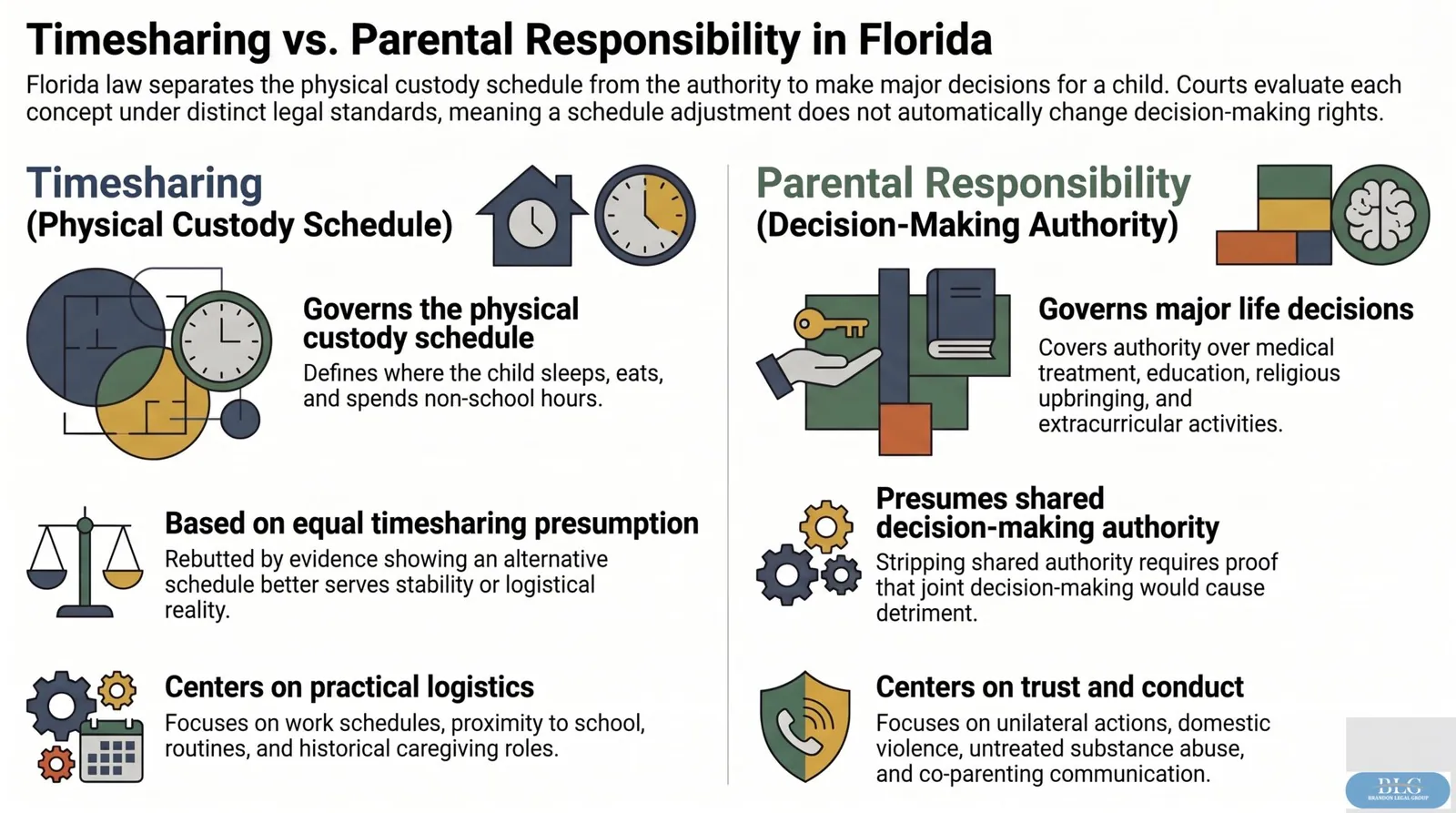
Most parents walk into court believing the fight is about overnights. Who gets weekends. Who keeps the summer. Who claims Christmas morning. The calendar becomes the battlefield because it feels concrete, proof that someone won. But Florida law treats the schedule and the authority to make binding decisions as separate questions, governed by different standards, and judges do not move them in tandem. A parent can lose half the overnights and still retain equal say over schooling, religion, and medical care. Or a parent can keep a 50/50 rotation and discover they no longer have a vote when it matters. Which part gets contested, and which part a court will actually redistribute,depends on the conduct that brought everyone into the courtroom.

Timesharing refers to the physical custody schedule: where the child sleeps, eats, and spends non-school hours. Parental responsibility refers to the authority to make major decisions about the child's welfare, medical treatment, education, religious upbringing, and extracurricular activities. Florida courts begin every case with the statutory presumption that shared parental responsibility serves the child's best interest. That presumption is strong. It does not evaporate because parents dislike each other or because one parent wants sole control. It falls only when the evidence shows that shared decision-making would be detrimental to the child.
Timesharing also carries a rebuttable presumption, but it is a different one. Florida law now presumes that equal timesharing is in the child's best interest. That does not mean every case ends 50/50. The court still must order a schedule that serves the child's best interest, considering the statutory factors that range from each parent's historical caregiving role to the child's relationship with siblings, school, and community. A judge can award one parent 70% of the overnights without making any finding of unfitness if the evidence rebuts equal time and shows that the alternative schedule better serves stability, continuity, or logistical reality.
This structural difference shapes what gets fought over. Timesharing disputes center on logistics, work schedules, proximity to school, the child's established routine, and which parent has historically managed daily care. Decision-making disputes center on trust, credibility, past unilateral conduct, and whether one parent has demonstrated an inability or unwillingness to communicate, cooperate, or prioritize the child's needs over personal grievances. A parent seeking to rebut equal timesharing does not need to prove detriment. A parent seeking to strip the other of shared parental responsibility must prove something more serious than inconvenience.
What Florida Law Requires to Overcome the Shared-Responsibility Presumption
Section 61.13(2)(c)2., Florida Statutes, permits a court to order sole parental responsibility only after finding that shared responsibility would be detrimental to the child. Detriment is not demonstrated by conflict alone. Parents in litigation are, by definition, in conflict. The question is whether one parent's conduct, past or likely future, creates a risk that shared decision-making will harm the child. Evidence that supports a finding of detriment includes:
- A verified history of domestic violence, even if it did not result in criminal charges
- Substance abuse that remains untreated or unacknowledged ¶
- Documented parental alienation, active efforts to damage the child's relationship with the other parent
- A pattern of unilateral decision-making on major issues, such as enrolling the child in a new school or initiating medical treatment without notice or discussion
- Mental health conditions that impair judgment and remain untreated despite court intervention
- Child abandonment or a prolonged, voluntary absence from the child's life
Even where these issues exist, the court may order shared parental responsibility with one parent holding ultimate decision-making authority in specified areas, a hybrid arrangement that preserves some joint input while assigning a tiebreaker. This middle path appears more often than outright sole responsibility because it aligns with the statutory preference for both parents to remain involved.
Timesharing modification, by comparison, does not require a showing of detriment. A parent seeking to modify an existing timesharing schedule generally must show a substantial and material change in circumstances and prove that modification serves the child's best interest. The change might be a new job, a school transfer, a remarriage that shifts household dynamics, or a teenager's stated preference. None of these facts alone would justify removing decision-making authority, but any could justify adjusting the overnight schedule if the statutory standard is met. The standards are different because parental responsibility is a question of fitness and trustworthiness, while timesharing is a question of practicality, stability, and benefit.
Why Timesharing Gets Litigated More Often
The math is simple: most parents can meet the baseline for shared decision-making authority. They may not communicate well. They may harbor resentment. They may require a detailed parenting plan to avoid constant disputes. But absent serious misconduct, neither parent presents the kind of risk that justifies sole responsibility. Courts preserve joint authority and manage the friction through specificity, spelling out who notifies whom, how decisions get escalated, and what happens when parents deadlock.
Timesharing, however, must be divided. The child cannot sleep in two homes simultaneously. Someone gets Tuesday. Someone gets spring break. Even with Florida's equal-timesharing presumption, the actual calendar still has to work in real life. One parent wants week-on, week-off; the other believes that schedule disrupts the child's routine. One parent refuses to drive more than fifteen minutes for exchanges; the other moved an hour away for work. The negotiations fracture not because anyone doubts the other's fitness to make decisions, but because the schedule determines day-to-day control, household income calculations for child support, and, most acutely, the emotional experience of parenthood.
Consider a hypothetical: A father works a rotating shift and cannot commit to fixed pickup times. The mother proposes a schedule where the child stays with her during the school week and spends weekends with the father when his schedule allows. She does not allege abuse, neglect, or any conduct that would justify sole parental responsibility. She argues only that the child needs predictability and that the father's work makes equal timesharing unworkable. If the evidence rebuts the equal-timesharing presumption, the father may receive fewer overnights without losing his right to weigh in on the child's schooling, medical decisions, or extracurriculars. The timesharing dispute resolves around logistics; the decision-making authority remains shared because neither parent has proven the other unfit to participate.
When Decision-Making Authority Becomes the Central Issue
Certain cases invert the usual pattern. When one parent has engaged in conduct that directly undermines the child's welfare or the co-parenting relationship, the fight shifts from how much time each parent gets to whether one parent should be allowed to make binding decisions at all. These cases involve fact patterns that go beyond poor communication.
A parent who enrolls the child in a new school without notice, refuses to provide medical records, cancels the other parent's time without cause, or makes false allegations to child protective services is not simply difficult to co-parent with; that parent has demonstrated a willingness to act unilaterally in ways that harm the child or obstruct the other parent's relationship. When this conduct is proven, the court may order sole parental responsibility to one parent or assign ultimate authority in specific domains to prevent continued interference.
Domestic violence cases often center decision-making authority, not just timesharing. A conviction for a first-degree misdemeanor or higher involving domestic violence creates a rebuttable presumption that shared parental responsibility is detrimental to the child, and even without a conviction, the court must weigh evidence of domestic violence as evidence of detriment. The court may still award timesharing to the offending parent, supervised or otherwise, but the decision-making authority is far more likely to be restricted. The logic is straightforward: a parent who has used violence or coercion to control the other parent may use decision-making authority the same way, turning every school choice or medical decision into an opportunity for manipulation.
Relocation cases also push decision-making authority to the foreground. When one parent seeks to move at least fifty miles from the child's principal residence for at least sixty consecutive days, the court evaluates whether the move serves the child's best interest using statutory factors that overlap with the parental responsibility analysis: each parent's relationship with the child, the reason for the move, the quality of life in the new location, and the feasibility of preserving the relationship with the non-relocating parent. A parent who seeks to relocate and has historically excluded the other parent from major decisions will struggle to gain approval. The court examines not just the proposed timesharing schedule post-move, but whether the relocating parent can be trusted to honor the non-relocating parent's remaining involvement. Sole parental responsibility is not automatic in relocation orders; it requires separate evidence that shared authority would be detrimental.
How Courts Resolve Genuine Deadlocks on Major Decisions
Shared parental responsibility assumes that parents will consult, discuss, and attempt to agree on major decisions. When they cannot, the parenting plan may specify a tiebreaker mechanism: one parent holds ultimate authority in a defined area, or the parents submit the dispute to a parenting coordinator or mediator. These mechanisms do not eliminate shared responsibility; they manage it.
¶Florida Statutes authorize the appointment of a parenting coordinator in high-conflict cases. The coordinator, typically a mental health professional or attorney with specialized training, helps parents implement the parenting plan and resolve day-to-day disputes. The order appointing the coordinator may grant limited authority over specific implementation issues, such as scheduling changes, transportation, or minor routine matters, but the coordinator does not override the court's allocation of parental responsibility on major decisions like school enrollment or surgery. When parents cannot agree even with coordinator assistance, the issue returns to court.
This procedural complexity is why decision-making disputes often consume more resources than timesharing disputes. A disagreement over whether the child attends public or private school cannot be resolved by simply looking at a calendar. It requires evidence about the child's educational needs, each parent's involvement in schoolwork, the quality of the proposed schools, and the financial impact. A disagreement over whether to authorize a medication or elective medical procedure may require expert testimony. These disputes are slower, costlier, and more emotionally corrosive than a fight over which parent gets the child on spring break.
What Happens When Both Parts Are Contested Simultaneously
Some cases present parallel disputes: one parent seeks a greater share of timesharing while the other seeks sole parental responsibility. These cases are the most resource-intensive because the evidence must address both the child's day-to-day needs and the trustworthiness of each parent to make binding decisions. A parent who has been the primary caregiver may seek majority timesharing on that basis while simultaneously arguing that the other parent's history of unilateral decisions justifies sole responsibility. The other parent may counter that the primary-caregiver role was the result of exclusion, not choice, and that shared responsibility should be preserved even if the timesharing schedule is adjusted.
Courts do not treat these requests as a package deal. A parent can prevail on timesharing and lose on parental responsibility, or vice versa. The analysis is separate. The parenting plan factors that govern timesharing overlap with, but do not duplicate, the factors that determine whether shared responsibility is detrimental. A judge might conclude that one parent should have 60% of the overnights due to logistical advantages, proximity to school, work flexibility, sibling placement, while also concluding that both parents have demonstrated the capacity to make joint decisions responsibly. Or a judge might award equal timesharing but assign sole parental responsibility to one parent after finding that the other has repeatedly acted in bad faith on major decisions.
The outcome depends on what the evidence actually shows. Timesharing contests are won with calendars, school records, work schedules, and testimony about who has managed the child's daily life. Decision-making contests are won with communication logs, evidence of unilateral conduct, testimony about trust and cooperation, and proof of harm or risk to the child. A parent who focuses all their energy on proving the other parent is difficult to deal with may lose both issues if they cannot show how that difficulty affects the child.

The question of which part gets contested is not a matter of strategy; it is a matter of fact. Timesharing disputes arise when the practical realities of the child's life require a schedule that one parent opposes. Decision-making disputes arise when one parent has demonstrated conduct that makes shared authority unworkable or dangerous. Both can be fought simultaneously, but the evidence required to prevail is different, the standard is different, and the consequences are different. Courts do not redistribute authority to punish a parent for being difficult. They redistribute it to protect the child from conduct that creates detriment. The part that gets litigated most often is the part where the other side made the mistake.
Closing Remarks
If the other parent has refused to share information about school or medical care, made unilateral decisions that affect your child's welfare, or continues to use visitation exchanges as opportunities for conflict, the issue is not just time; it is authority. Brandon Legal Group represents parents in Florida custody cases where decision-making power and timesharing are both on the table. Contact us to build the record the court will actually look at.
Frequently Asked Questions
Can a parent lose decision-making authority but keep 50/50 timesharing?
Yes. Florida courts treat timesharing and parental responsibility as separate determinations. A parent may retain equal or near-equal overnights while the other parent holds sole decision-making authority if the evidence shows that shared responsibility would be detrimental to the child. Equal time does not guarantee equal authority.
What conduct is serious enough to justify sole parental responsibility?
Domestic violence, substance abuse, child abuse or neglect, parental alienation, a pattern of unilateral decision-making on major issues, mental health impairment that affects judgment, or abandonment can all support a finding that shared parental responsibility would be detrimental. Conflict alone is not enough. The court must find that joint decision-making creates a risk of harm to the child.
Does majority timesharing give a parent more decision-making power?
No. A parent with 70% of the overnights does not automatically gain greater authority over major decisions unless the court orders sole or ultimate parental responsibility. Day-to-day decisions during parenting time, bedtime, meals, supervision, belong to the parent on duty. But decisions about school enrollment, non-emergency medical care, religious upbringing, and extracurricular activities require consultation and agreement if parental responsibility is shared.
Can a parent request modification of decision-making authority without changing timesharing?
Yes. A parent can petition to modify parental responsibility based on a substantial change in circumstances that affects the child's welfare, without seeking to adjust the timesharing schedule. Examples include new evidence of substance abuse, repeated unilateral decisions, or a parent's refusal to follow court orders. The modification request must show that the current allocation of responsibility is no longer in the child's best interest.
What happens if parents with shared parental responsibility cannot agree on a major decision?
If the parenting plan assigns ultimate authority to one parent in the disputed area, that parent's decision controls. If the plan does not specify a tiebreaker, either parent can file a motion asking the court to resolve the dispute. Some orders require mediation or consultation with a parenting coordinator before returning to court. The process can be lengthy, which is why parents with a documented history of cooperation are more likely to retain shared responsibility.
Can a judge order shared parental responsibility even when one parent objects?
Yes. The statutory presumption favors shared parental responsibility unless the evidence rebuts it. A parent's objection or preference for sole authority is not, by itself, sufficient. The objecting parent must prove that shared responsibility would be detrimental to the child. If the evidence does not support that finding, the court will order shared responsibility and leave it to the parenting plan to manage conflict through communication protocols, tiebreakers, or third-party assistance.
References
- Florida Statutes § 61.13. (Parental Responsibility and Timesharing).
- Florida Statutes § 61.125. (Parenting Coordination).
- Florida Statutes § 61.13001. (Parental Relocation with a Child).
This article is provided for general informational purposes only and does not constitute legal advice, nor does reading it create an attorney-client relationship. Florida law changes and every situation turns on its own facts. Consult a licensed Florida attorney about your specific circumstances before acting.