

TL;DR: Florida law requires written notice before most relocations with a child, but the trigger isn't the distance traveled. It's whether the move materially affects the existing timesharing schedule. Missing that threshold, or misjudging it, can turn a routine move into a contested relocation case with serious consequences.
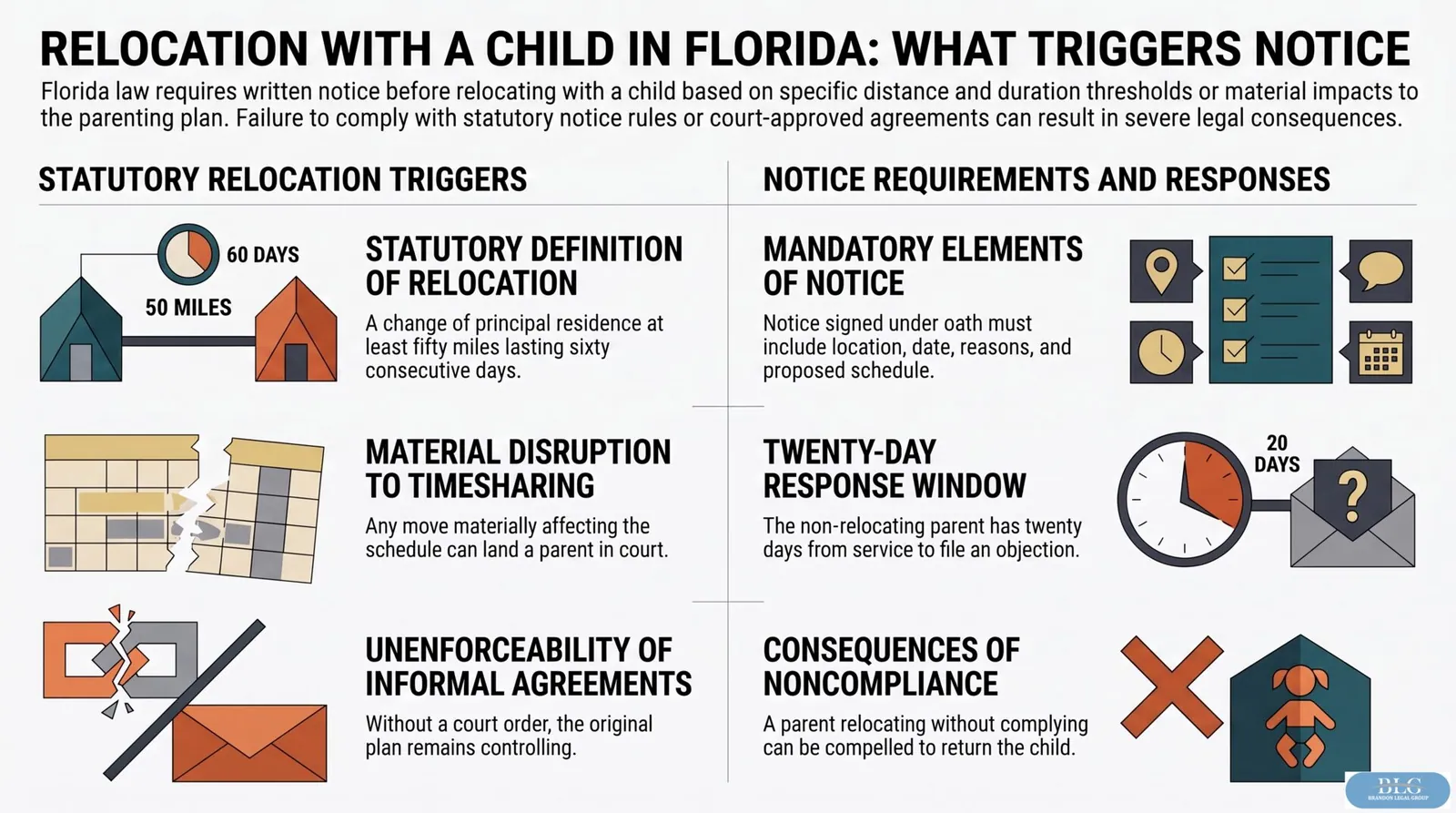
Plenty of parents assume they can move freely within Florida as long as they stay in-state. Others think fifty miles is the magic number. Both assumptions collapse the moment a motion to relocate lands in court. The statute doesn't care about county lines or odometer readings. It cares about one thing: whether the move disrupts the current parenting plan. Misjudge that, and a parent faces contempt, an emergency hearing, or worse, an order sending the child back.
¶
Understanding what actually triggers the notice requirement keeps a straightforward relocation from becoming a protracted custody fight. The difference between compliance and catastrophe often comes down to reading the schedule correctly before packing the first box.
The Statutory Threshold: What Actually Triggers Notice
Florida Statute § 61.13001 defines relocation as a change in the principal residence of a parent or other person entitled to timesharing that is at least fifty miles from the current principal residence and lasts for at least sixty consecutive days, not counting a temporary absence for vacation, education, or providing care for a family member. That is the statutory definition, and it is a hard line. But the notice machinery is only half the story. Any change in residence that materially affects the current timesharing schedule can still land a parent in front of a judge on a motion to modify or a motion for contempt, even when the move falls short of fifty miles.
That distinction matters. A thirty-mile move does not trigger the formal relocation statute. It can still blow up an existing parenting plan, crossing district lines that change school starttimes, or adding an hour of drive time to midweek exchanges. When that happens, the parenting plan itself governs, and many Florida parenting plans contain their own notice-of-move provisions that operate independently of § 61.13001. Read the plan before assuming the fifty-mile rule is the only rule.
Parents often discover the problem after the fact. A lease signed, utilities transferred, the child enrolled in a new school, and then a motion for contempt arrives. The statute does not excuse ignorance, and family courts do not treat retroactive notice as substantial compliance. Plan the compliance before the move, not after.
What Counts as Material Disruption to the Timesharing Schedule
Material disruption is not a feeling. It is a measurable change to the mechanics of the existing parenting plan. Courts examine whether the move forces modification of pickup times, exchange locations, transportation responsibilities, or the child's daily routine in ways that cannot be absorbed by minor adjustments.
Consider a hypothetical: a parenting plan grants the non-relocating parent every Wednesday overnight and alternating weekends. The relocating parent moves forty-five miles north, under the fifty-mile mark that triggers the relocation statute, but across a county line that shifts the child into a different school district with a start time thirty minutes earlier. Wednesday overnights now require the non-relocating parent to wake at 5:00 a.m. for the school run, or the relocating parent to drive back Wednesday mornings. Either option rewrites the plan's assumptions. The formal relocation statute may not apply, but the parenting plan no longer functions, and that is a modification fight waiting to happen.
Other examples include moves that eliminate the feasibility of frequent contact, such as a shift from a ten-minute drive to a route requiring tolls, ferries, or bridge traffic that doubles travel time. Practical impact also arises when a move changes the child's access to extracurriculars, medical providers, or family support systems addressed in the parenting plan. The question is always whether the current schedule can survive the move without court intervention.
¶When the Fifty-Mile Rule Applies, and When It Doesn't
¶ ¶The fifty-mile threshold is the statutory trigger. Any move of fifty miles or more from the principal residence, intended to last sixty or more consecutive days, requires compliance with § 61.13001, either by written agreement of the parties or by serving notice of intent to relocate. A parent relocating from Orlando to Daytona Beach, roughly sixty miles, must comply even if both parents believe the weekend schedule remains workable and no one objects.
But the rule is not a license to ignore everything under fifty miles. A shorter move that guts the timesharing schedule exposes a parent to a modification petition, a contempt motion, or both, and to a judge who now sees a parent willing to act unilaterally. A twenty-mile move that forces the other parent to miss work for exchanges is not a relocation under the statute, but it is still a court problem.
The sixty-day minimum matters too. Temporary absences, summer stays with extended family, education, or care for a family member, are carved out of the definition. But stringing together multiple fifty-nine-day moves to evade the statute is transparent. Courts are not obligated to accept a pattern engineered to look temporary when the intent is permanent.
The Notice Requirement: Timing, Content, and Consequences of Noncompliance
If the parties do not sign a written relocation agreement, the relocating parent must serve a notice of intent to relocate on every other person entitled to timesharing or access under the current parenting plan. The notice must be served by mail, certified, return receipt requested. And it must be signed under oath, subject to the penalties of perjury. This is not a text message or a letter dashed off the night before the truck arrives.
The notice itself must include specific content mandated by § 61.13001(3). Missing an element gives the other side a clean argument that the notice is defective. Required elements include:
- A description of the location of the intended new residence, including the state, city, and specific physical address, if known
- The mailing address of the intended new residence, if not the same as the physical address, if known
- The home telephone number of the intended new residence, if known
- The date of the intended move or proposed relocation
- A detailed statement of the specific reasons for the proposed relocation, including a copy of any written job offer if the move is for employment
- A proposal for a revised post-relocation timesharing schedule, along with a proposal for transportation arrangements
- Substantially the statutory warning that the other party must file a response within twenty days, and that failure to timely respond means the court may allow the relocation without further notice or hearing
Noncompliance is not a technicality. A parent who relocates without complying can be compelled to return the child, held in contempt, and ordered to pay the other parent's fees and costs. Courts may also treat the unauthorized move as a factor in determining or modifying the parenting plan. Judges read a unilateral move as a statement about how that parent intends to handle shared parenting, and that impression carries into modification proceedings and shifts the calculus on the court factors for approving relocation.
Objections, Agreements, and the Path After Notice Is Served
The non-relocating parent has twenty days from service of the notice to file a verified response objecting to the relocation. That response must state the specific factual basis for the objection, including the extent of the objecting party's involvement in the child's life. A response that simply says "I object" invites a ruling nobody wants.
If no timely response is filed, the statute permits the court to presume the relocation is in the child's best interest and to enter an order adopting the proposed schedule, without an evidentiary hearing, provided the notice complied with the statute and the proposed plan is in writing and signed. Silence is a decision, and it is usually the wrong one.
If a response is timely filed, the relocation cannot proceed absent a court order, and the matter is set for hearing. The relocating parent bears the burden of proving by a preponderance of the evidence that the relocation is in the best interest of the child, measured against the factors in § 61.13001(7). Those factors include the nature and quality of the child's relationship with each parent, the child's age and developmental needs, the feasibility of preserving the relationship with the non-relocating parent, the child's preference where appropriate, and the reasons for and against the move. There is no presumption for or against relocation.
Parents can skip all of this by agreeing. A written agreement that reflects consent to the relocation, defines a revised timesharing schedule, and addresses transportation, signed by both parents and ratified by the court if a hearing is requested, allows the move to proceed without a contested fight. Oral agreements carry no weight. Without a signed writing, either parent can repudiate and enforce the original schedule.

The notice requirement exists to prevent ambush. It gives the non-relocating parent time to evaluate the impact, propose alternatives, and, if necessary, mount a defense. Treating it as optional turns a manageable transition into an emergency motion and a credibility problem that can take months to repair.
Closing Remarks
If a planned move puts fifty miles between the child and the other parent for two months or more, the statute is in play. If it falls short of fifty miles but wrecks the exchange schedule or changes the school district, the parenting plan is in play. Either way, the question gets answered before the lease is signed, not after. Brandon Legal Group represents parents navigating Florida custody relocation, whether serving the notice, responding to one, or litigating a contested petition. Call us first.
Frequently Asked Questions
Does a move within the same city still require relocation notice?
Only if it puts at least fifty miles between the new residence and the old one for sixty or more consecutive days, which is rare inside a single city. But that is not the end of the analysis. A short move that changes school zones, doubles exchange distances, or makes midweek visits impractical can still violate or break the existing parenting plan. Many plans also contain their own move-notification clauses. Read the plan, then decide.
What happens if the other parent never responds to the relocation notice?
If no verified response is served within twenty days of service of a compliant notice, Florida law allows the court to presume the relocation is in the child's best interest and to enter an order adopting the proposed timesharing and transportation schedule without an evidentiary hearing. The relocating parent still needs that court order. Moving on the strength of silence alone, with nothing filed, is a mistake.
Can a parent relocate immediately in an emergency situation?
The statute permits a court to grant a temporary order authorizing relocation pending a final hearing, and courts can act quickly where there is credible evidence of domestic violence or another imminent threat to the child or the relocating parent. But the relief comes from a judge, not from self-help. A parent who leaves first and asks permission later is gambling with the case. Emergency exceptions are narrow, and generalized fear or old conflict usually will not carry the day.
What if both parents agree to the move but never filed anything with the court?
Informal agreements are not enforceable. Even if both parents verbally agree to a relocation and a revised schedule, either parent can later claim the move violated the existing court order and demand enforcement or modification. To protect the relocation, the agreement must be in writing, signed by both parties, reflect consent to the move, and define the revised timesharing and transportation arrangements. Get it filed and ratified. Without a court order, the original plan remains controlling.
How much lead time does the notice really give the other parent?
The statute does not impose a flat sixty-day waiting period before the move. It imposes a twenty-day response window after service, and it bars relocation before a court order once a timely objection is filed. Practically, that means a contested relocation takes months, not weeks. Parents who serve notice three weeks before a job start date usually discover that the calendar, not the law, becomes the biggest obstacle. Serve early.
References
- Florida Statute § 61.13001. ("Parental relocation with a child." www.leg.state.fl.us).