

TL;DR:
Life changes. Parenting plans often don't keep up. If your current custody order no longer reflects reality; the schedules, the needs, the other parent's behavior, you don't have to keep forcing it to work. Florida courts allow modifications when circumstances change significantly. The question is whether you know when to act and how to do it without losing ground. ---
You agreed to that parenting plan at a specific moment in time. Maybe it made sense then. Maybe you were just trying to get out of the marriage with something intact. Either way, that moment is gone. The plan you signed may have nothing to do with the life your child is actually living now.
That gap between what the order says and what's actually happening is exactly where problems breed. You either spend your energy forcing a broken schedule to work, or you quietly let things slide until they spiral. Neither is a strategy. Neither protects your kid.
Here's what you need to know about when parenting plans stop fitting reality. And what you can actually do about it.
¶ Why Parenting Plans Break Down Over Time
Parenting plans are written for a snapshot. They capture what both parents agreed to, or what a judge ordered, based on circumstances that existed at one point in time. Children grow. Parents move. Jobs change. New partners enter the picture. And sometimes, one parent simply stops showing up the way they were supposed to.
None of that is unusual. What's unusual is thinking that the original plan should survive all of it without adjustment.
The plans that fall apart fastest are usually the ones built on assumptions; that both parents would stay local, that work schedules would remain stable, that the other parent would actually follow through. When those assumptions collapse, the plan collapses with them.
Common Situations That Signal a Plan Needs to Change
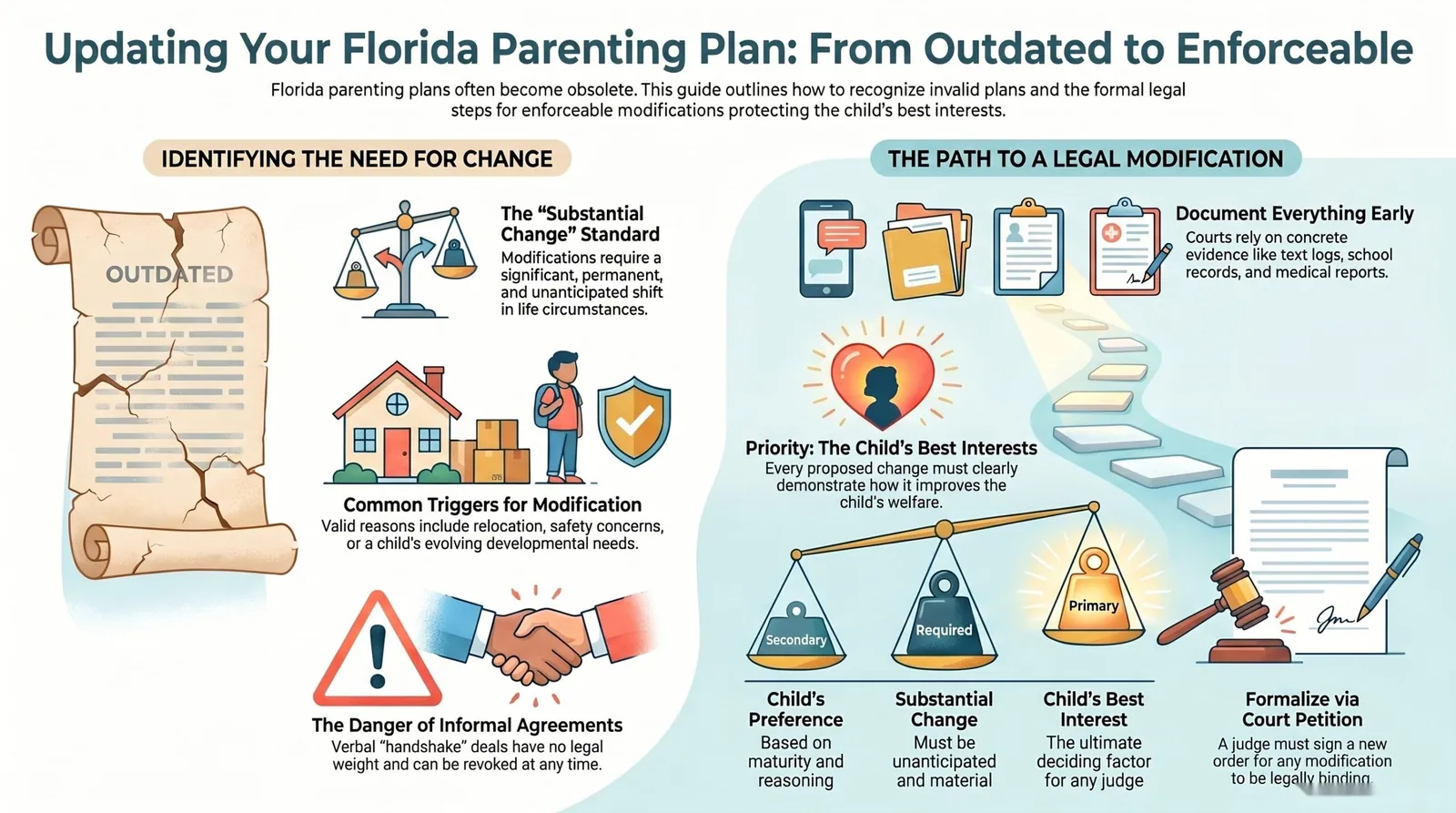
Florida courts don't modify parenting plans just because one parent is unhappy. There has to be a substantial, material, and unanticipated change in circumstances. That's the legal standard; but in plain terms, it means something significant has shifted in a way that affects your child's welfare.
Here are the situations that most often qualify:
- Relocation. One parent is moving, across the county, across the state, or out of Florida entirely. Distance makes the existing schedule physically impossible. This almost always requires a formal modification.
- The child's needs have changed. A medical diagnosis, a mental health issue, a change in school, a new developmental need; any of these can make an old schedule not just inconvenient but actually harmful.
- One parent is consistently failing to follow the plan. Missed exchanges, withheld time, unilateral decisions that override the order. If this is happening, you're not dealing with a minor inconvenience. You're dealing with a pattern that courts take seriously.
- Substance abuse or safety concerns. If a parent's behavior has deteriorated, and that deterioration puts your child at risk, the original plan needs to be revisited urgently.
- The child is older and the schedule no longer fits their life. A schedule designed for a five-year-old often makes no sense for a thirteen-year-old with a full school and social life. Courts recognize this.
- Significant change in either parent's work schedule or availability. The plan assumed a certain structure. If that structure is gone, the plan may need to go with it.
What "Substantial Change" Actually Means in Court
This is where people get tripped up. They assume that because something feels major to them, it will feel major to a judge. That's not how it works.
Courts look at whether the change was significant, whether it was permanent or ongoing rather than temporary, and whether it was something that couldn't have been anticipated when the original plan was written. A parent working a new shift schedule for three weeks doesn't clear that bar. A parent who has relocated two states away, or who has been arrested, or whose child has been diagnosed with a serious condition. Those situations are different.
¶The burden is on you to show that the change is real, that it matters, and that modifying the plan serves your child's best interests. Courts don't just hand out modifications. You have to make the case.
This is precisely why having a child custody attorney in your corner before you file matters. The way you frame the modification request, the evidence you gather, the timeline you establish, the narrative you build, determines whether you win or lose.
¶The Risk of Doing Nothing
Here's the hard truth most people don't want to hear: waiting costs you.
Every month you spend operating under a broken plan without addressing it formally is a month the other parent can point to and say, "We've been doing it this way, that's the established routine." Courts pay attention to patterns. If you've been quietly accommodating a situation that doesn't work, you may have inadvertently helped the other side build their argument.
Informal agreements feel easier in the moment. They avoid conflict. They let you sidestep the conversation you don't want to have. But informal agreements have no legal weight. If the other parent decides tomorrow to revert to the original order, or weaponize the deviation against you, you have nothing to stand on.
Doing nothing is not neutral. It's a choice that accumulates consequences.
What the Modification Process Looks Like
Filing for a parenting plan modification in Florida means going back to court and demonstrating that the change in circumstances warrants a new order. That process involves a petition, service on the other parent, and often a hearing where both sides present their case.
In some situations, both parents agree that the plan needs to change, they just need it made official. In others, one parent is fighting tooth and nail to keep things exactly as they are, either because the current plan benefits them or because they want to control the outcome. Those cases require a different level of preparation and strategy.
Either way, a judge's final decision will come back to one question: what is in the best interest of the child? Every argument you make, every piece of evidence you present, every witness you call needs to answer that question clearly and directly.
Documentation Is Not Optional
¶If you are building a case for modification, or defending against one, documentation is everything. Text messages, emails, school records, medical records, missed exchange logs, police reports if applicable. Courts do not run on feelings or verbal testimony alone. They run on evidence.
Start building your record now, not after you file. The pattern you document over time tells a more compelling story than anything you say in a courtroom. If the other parent has been unreliable, inconsistent, or harmful, that needs to be on paper before you walk into that hearing.
Frequently Asked Questions
Can I modify a parenting plan without going to court?
If both parents agree to changes, you can formalize those changes through a written agreement that gets court approval. Verbal agreements or informal understandings carry no legal weight. If one parent later decides to revert to the original order, there is nothing to stop them. Any real modification needs to be signed off by a judge to be enforceable.
How long does a parenting plan modification take in Florida?
It depends on whether the modification is contested. An uncontested modification, where both parents agree, can move relatively quickly once the paperwork is filed. A contested modification, where one parent opposes the change, will take longer and may require a full hearing. Emergency modifications involving immediate safety concerns can be addressed faster through the court's emergency relief process.
What if my co-parent refuses to follow the current plan?
Consistent violations of a parenting plan are a serious matter. You have the right to file for enforcement, and repeated violations can factor into a modification request. Courts do not look kindly on a parent who treats the existing order as optional. Document every violation and speak to an attorney about your enforcement and modification options before the pattern gets worse.
Does my child get a say in the new parenting plan?
I n Florida, a child's preference can be considered, but it is not the deciding factor. Judges look at the maturity of the child, the reasoning behind the preference, and whether that preference aligns with the child's actual best interests. An older, more mature child carries more weight than a younger one, but no child's preference automatically overrides the court's analysis.
What is the biggest mistake parents make when seeking a modification?
Waiting too long and showing up without evidence. Parents often come to court with a clear sense of what's been happening but no documentation to back it up. By then, the pattern has been normalized and the other parent has built their own narrative. Acting early, documenting consistently, and working with a strategic attorney from the start puts you in a fundamentally stronger position.
If your parenting plan stopped reflecting your child's reality a long time ago, you already know something has to change. The question is whether you act on that or keep hoping the other parent will cooperate. At Brandon Legal Group, we don't deal in hope. We deal in strategy. If you're ready to stop managing a broken plan and start fixing it, contact us and let's talk about what that looks like.