
TL;DR: Florida's homestead protection shields a primary residence from most creditors' claims during life and after death, but it doesn't block everything. Mortgages, tax liens, and specific obligations punch through. Understanding what homestead actually protects, and what it doesn't, prevents costly surprises during estate administration.
Homestead protection sits on a property title like armor, until the moment someone tests whether that armor holds. Most people believe the protection is absolute. It isn't. Homestead shields a Florida primary residence from unsecured creditor claims during the owner's life and restricts who can inherit it after death, but secured debts, tax obligations, and constitutional restrictions create gaps wide enough to lose a house through. The protection works as designed only when the estate plan accounts for what homestead doesn't cover.

Homestead in Florida operates on two distinct planes: creditor protection and devise restrictions. Each layer applies different rules. Conflating them produces estate plans that fail at the worst possible moment, when the surviving family discovers the house was never as protected as believed.
What Homestead Shields from Creditors
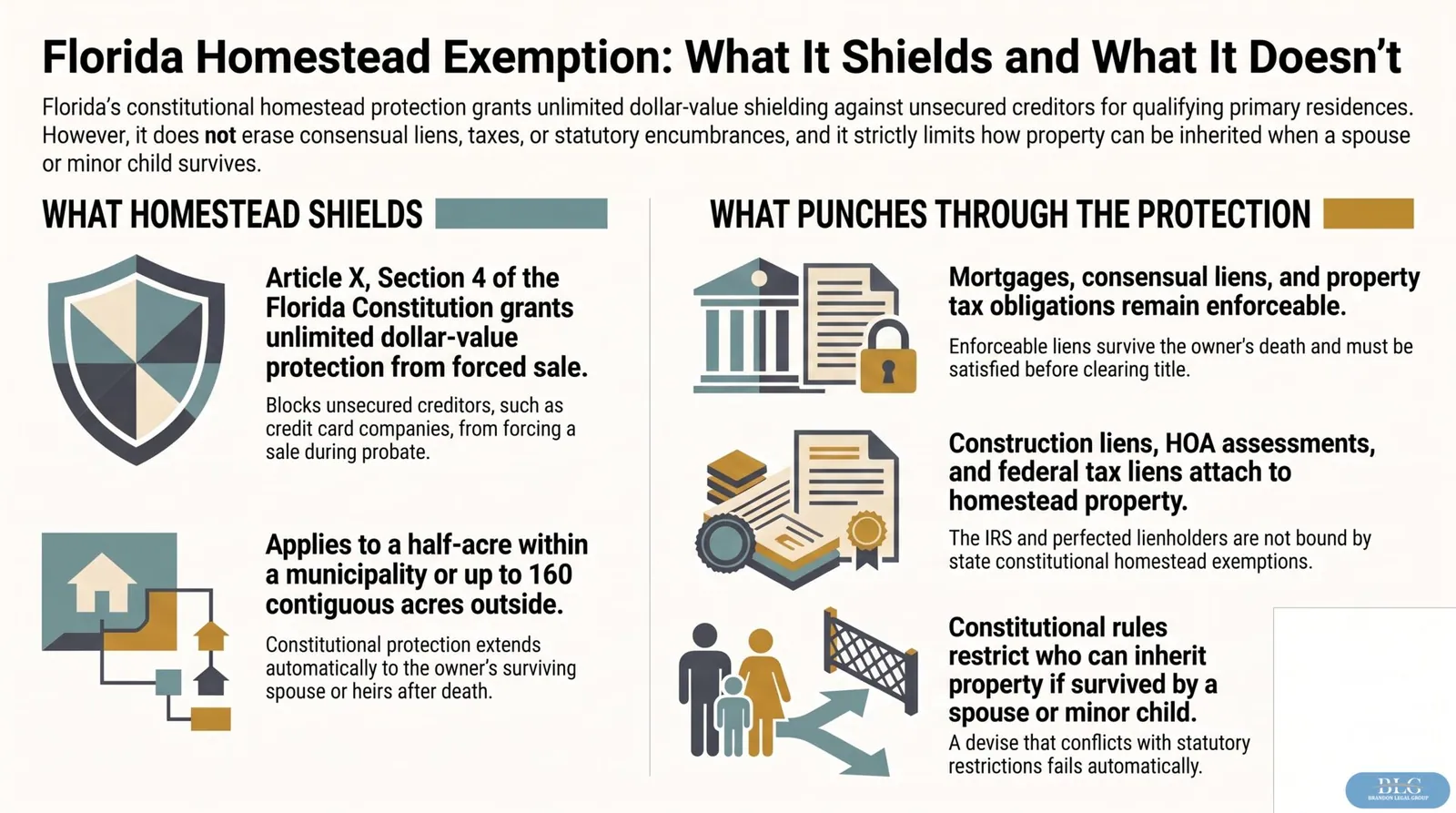
Article X, Section 4 of the Florida Constitution grants homestead property unlimited dollar-value protection from forced sale to satisfy judgments. A $5 million estate home receives the same protection as a $200,000 starter property, provided it qualifies as homestead. The protection applies to a half-acre within a municipality or up to 160 contiguous acres outside a municipality, and it extends to the owner's surviving spouse or heirs after the owner's death.
The protection blocks unsecured creditors, such as credit card companies, personal loan lenders, and judgment holders from civil litigation, from forcing a sale during probate or estate administration. A decedent who dies owing $400,000 in unsecured debts but whose only substantial asset is a homestead property leaves that debt largely uncollectible if the property passes to a surviving spouse or heirs. Creditors file claims in probate, but homestead property remains beyond their reach when constitutional protections apply.
This is not asset protection by planning. It is constitutional protection by status. Homestead protection does not require advance structuring, trust funding, or recorded declarations beyond establishing that the property serves as the owner's primary residence. But status-based protection carries status-based limits.
What Punches Through the Protection
Homestead is not a universal shield. The Florida Constitution itself carves out specific obligations that survive the protection and attach to the property regardless of homestead status. These exceptions do not suspend the protection; they sit outside its scope entirely.
- Mortgages and consensual liens: Any obligation voluntarily secured by the property remains enforceable. A mortgage lien or home equity line of credit signed by the owner, and, where the property is homestead, joined by the owner's spouse, survives the owner's death and must be satisfied before heirs receive clear title.
- Property tax obligations: Ad valorem taxes and special assessments attach directly to the real property and take priority over homestead protections.
- Construction liens: Contractors, subcontractors, and material suppliers who perform work or supply materials for improvements to the property hold lien rights under Chapter 713, Florida Statutes, which reach homestead property when properly perfected.
- Homeowners' association and condominium assessments: Recorded covenants, together with Chapters 718 and 720, Florida Statutes, give associations lien rights for unpaid assessments, enforceable through foreclosure against homestead property.
- Federal tax liens: The IRS is not bound by state constitutional exemptions. Federal tax liens attach to homestead property and survive the owner's death as claims against the estate.
These obligations do not disappear when a homestead owner dies. They transfer with the property as encumbrances. A surviving spouse or heir who takes homestead property under Florida's constitutional descent rules takes it subject to the debt secured by it. Homestead protects against unsecured claims; it does not erase existing secured ones.
Constitutional Restrictions on Who Inherits Homestead
Creditor protection is only half of homestead. The other half restricts devise, the ability to leave homestead property by will to anyone the owner chooses. Article X, Section 4(c) of the Florida Constitution limits testamentary freedom when the owner is survived by a spouse or minor child.
If a homestead owner is survived by a spouse and no minor child, the owner may devise the homestead only to the spouse. If the owner is survived by a minor child, the homestead cannot be devised at all. Section 732.401, Florida Statutes, supplies the default result when a devise is invalid: the surviving spouse takes a life estate with a vested remainder in the descendants, or, if the spouse timely elects within the statutory deadline and no minor child owns an interest, an undivided one-half interest as tenant in common with the descendants. A devise that conflicts with these rules fails. For detailed mechanics of who takes what when no will exists, review the analysis in Intestate Heirs: Who Claims What When There's No Will.
These restrictions are forced heirship by constitutional command. They apply automatically unless the protected spouse affirmatively waives the right. The most common collision point: blended families. A homestead owner intends to leave the property to children from a prior marriage, remarries, and dies without securing a spousal waiver. The devise fails, the statutory default takes over, and the children get a remainder interest in a house the new spouse occupies for the rest of her life, or half of it, if she elects. That is not what the will said. That is what the Constitution said.
Trusts do not sidestep this restriction. Transferring homestead property into a revocable trust during life and naming non-spouse beneficiaries triggers the same constitutional limits at death. Florida courts have applied homestead devise restrictions whether the property passes by will, by trust, or by intestate succession. Planning around constitutional descent rules requires a valid spousal waiver, a prenuptial or postnuptial agreement meeting the requirements of Section 732.702, Florida Statutes, or a deed executed during life with knowing, voluntary joinder from the spouse.
Where Homestead Fits in Probate and Non-Probate Transfers
Homestead property does not automatically avoid probate. Whether it passes through estate administration depends on how title is held and whether a valid non-probate transfer mechanism exists.
Property titled in one individual's name alone, with no life estate deed or joint tenant with right of survivorship, passes through the probate estate. Homestead status shields it from unsecured creditor claims during administration, and a court order determining homestead status confirms that the property passed outside the reach of those creditors, but the property still requires a probate proceeding to clear title. That means delay, cost, and court supervision unless a probate-avoidance structure was created during life.
Lady Bird deeds, enhanced life estate deeds, preserve homestead status during life, avoid probate at death, and allow the owner to retain full control, including the unilateral right to revoke the transfer. Constitutional devise restrictions still apply if a surviving spouse or minor child exists, but the deed bypasses formal administration and transfers title at death. For a full breakdown of how Lady Bird deeds interact with probate avoidance and homestead status, see Lady Bird Deeds: What They Protect Without Probate.
Joint tenancy with right of survivorship transfers title automatically to the surviving joint tenant at death, outside probate. But adding a joint tenant to homestead property has tax, Medicaid, and creditor consequences. The addition is a present transfer of an ownership interest, not a testamentary device. It can trigger gift tax reporting, create a transfer penalty for Medicaid eligibility, and expose the property to the added joint tenant's creditors during life.
Revocable trusts can hold homestead property and avoid probate, but only if the property is formally deeded into the trust during the grantor's life and the trust terms do not conflict with constitutional devise restrictions. Unfunded trusts, trusts named in a pour-over will but never actually funded with title transfers, do not avoid probate. The homestead property remains in the probate estate, and the pour-over will does not cure the failure.
When Homestead Protection Ends
Homestead status is not perpetual. It terminates when the qualifying use or ownership ends. The most common termination triggers: abandonment, change of primary residence, and conveyance to someone who does not independently qualify.
Abandonment occurs when the owner establishes a different primary residence and the homestead property is rented, left vacant, or otherwise ceases to function as the owner's principal dwelling. Florida courts apply a fact-intensive test examining intent and conduct. An owner who moves out of state, declares a new homestead elsewhere, and leases the Florida property to tenants has abandoned Florida homestead status. The protection terminates, and creditor protection evaporates. The property also loses the Save Our Homes assessment cap and the ad valorem tax exemption, and it becomes subject to forced sale for judgments that would have been blocked while homestead status existed.
Sale or transfer of homestead property to a third party, such as an adult child, a non-spouse partner, or an unrelated buyer, terminates the protection as to that new owner unless the transferee independently qualifies by establishing the property as their own primary residence. The protection does not travel with the deed. It attaches to the use, not to the dirt.
A surviving spouse who holds a life estate in homestead property and remarries does not lose the life estate. When that life tenant dies, the remainder passes to the remaindermen fixed at the original owner's death, typically the decedent's descendants, and the creditor protection that attached to the life tenant ends with the life estate.

Homestead is a constitutional right with constitutional limits. It shields qualifying property from unsecured claims and restricts testamentary freedom to protect surviving spouses and minor children, but it does not erase secured debts, override federal claims, or eliminate the need for intentional estate planning. The protection operates by default, and default rules rarely align with blended families, specific bequests, or creditor-exposed estates.
Closing Remarks
If a Florida estate includes homestead property with outstanding liens, a surviving spouse and children from multiple marriages, or uncertainty about whether the protection will hold through probate, the Constitution alone won't resolve the fight that follows. You already know which conversation you have been avoiding. Brandon Legal Group structures estate plans that account for what homestead shields, what it doesn't, and how devise restrictions apply to your specific family structure. Contact us and get a plan that holds when it matters.
Frequently Asked Questions
Does homestead protection eliminate the need for estate planning in Florida?
No. Homestead provides creditor protection and restricts who can inherit, but it does not address how property transfers, whether probate is required, or how secured debts and liens are satisfied. An estate plan coordinates homestead protections with probate avoidance tools, tax planning, and family structure to prevent unintended results and delays during administration.
Can a revocable trust hold homestead property and still preserve the protection?
Yes, provided the grantor continues to occupy the property as a primary residence and the trust is structured to maintain homestead status. Florida law permits homestead property to be titled in a revocable trust without losing constitutional protection, but the property must be formally conveyed into the trust and the grantor must retain the right to use and occupy the property as a homestead for life.
What happens to homestead property if the owner dies with a mortgage?
The mortgage remains a secured debt against the property and does not disappear at death. The heir or surviving spouse who takes the homestead property takes it subject to the obligation to continue making payments or satisfy the debt. If payments stop, the lender can foreclose regardless of homestead status. Homestead protects against unsecured creditor claims, not consensual liens.
Can homestead property be left to children by will if the owner is survived by a spouse?
Not without a valid written waiver of homestead rights by the spouse. If there is a surviving spouse and no minor child, the homestead may be devised only to the spouse. A devise to the children instead fails, and Section 732.401, Florida Statutes, controls: the spouse takes a life estate with a vested remainder in the descendants, or an undivided one-half interest as tenant in common if the spouse makes a timely election.
Does adding a child as a joint tenant on homestead property avoid probate without triggering gift or Medicaid issues?
Adding a joint tenant avoids probate but creates immediate transfer and exposure consequences. The addition constitutes a present gift of an ownership interest, potentially requiring a federal gift tax return, and the property becomes reachable by the added joint tenant's creditors during life. For Medicaid planning, the transfer may trigger a penalty period and delay eligibility for benefits. Probate avoidance must be weighed against control, creditor exposure, and eligibility impacts.
References
- Fla. Const. art (X
- Chapter 713 (Fla. Stat).