
Florida's homestead exemption does not simply vanish when the owner dies. Constitutional descent and devise restrictions dictate who can receive the property, and those rules can override a will or trust if there is a surviving spouse or minor child. Heirs may receive protection from most creditor claims, but the path is not automatic and mistakes during estate administration can destroy what the constitution was supposed to protect.
The homestead sits at the center of most Florida estates, shielded during life by constitutional protections that stop many creditors cold. Then the owner dies, and families assume the shield transfers intact. It does not, at least not automatically. Homestead protection after death follows strict descent and devise rules embedded in the Florida Constitution, rules that override testamentary intent and impose conditions heirs rarely expect. A will that leaves the house to a specific child may fail if a surviving spouse or minor child exists. An estate plan that ignores constitutional restrictions leaves heirs holding property they cannot sell, cannot partition, and cannot fully protect. The gap between what families believe they inherit and what the law actually delivers is where estates fracture.

Florida homestead law operates in two distinct phases: protection during the owner's life, and descent after death. The protections do not end at death, but they change form. What heirs actually receive depends on the decedent's family structure at the moment of death, the clarity of title, and whether the estate follows constitutional mandates or attempts to sidestep them. Mistakes made during probate or estate administration can forfeit protections that were supposed to pass by operation of law.
Constitutional Descent Rules Override the Will
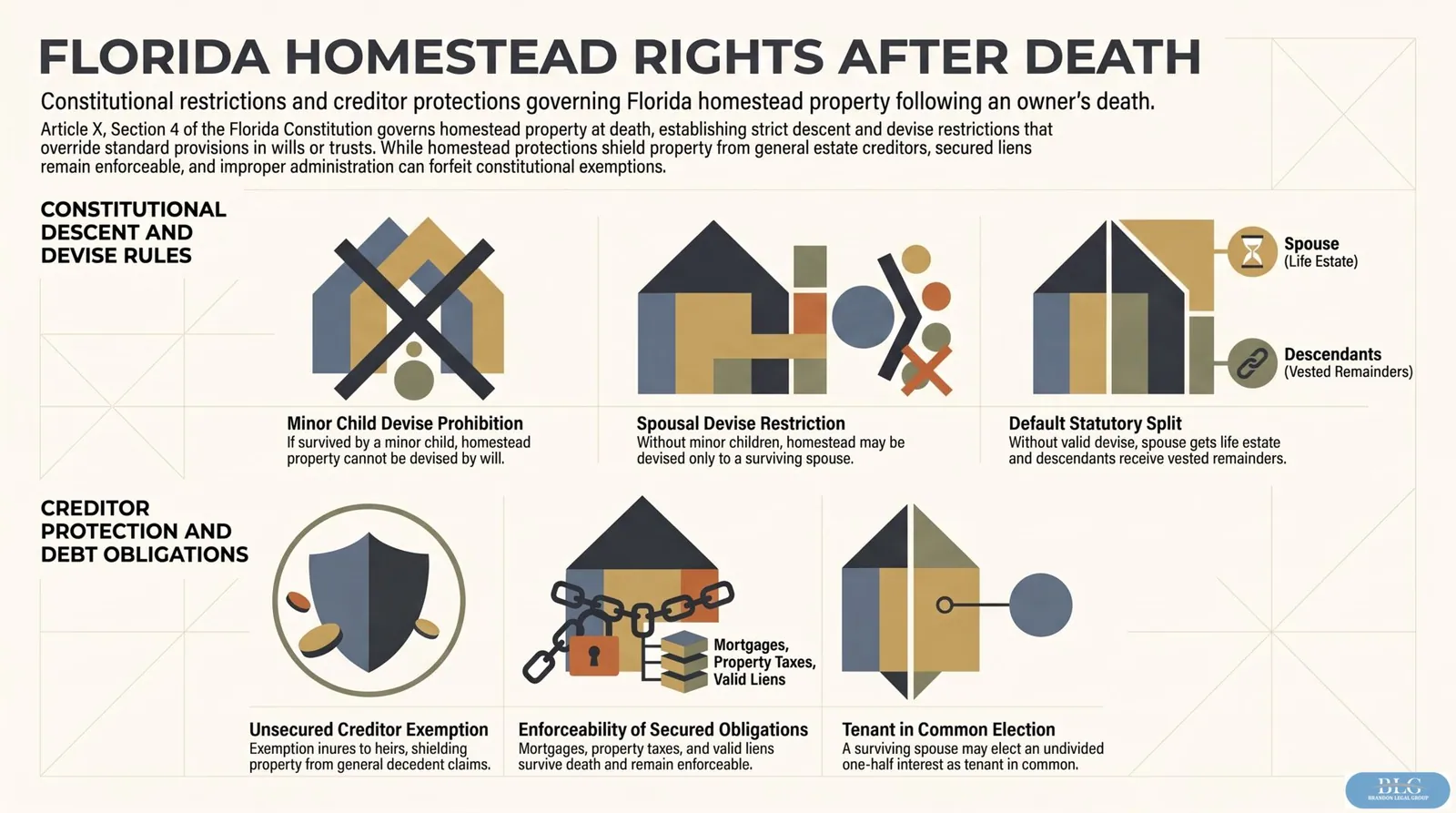
Article X, Section 4 of the Florida Constitution controls what can and cannot happen to homestead property at death. If the owner is survived by a minor child, the homestead cannot be devised by will at all. If the owner is survived by a spouse and no minor child, the homestead may be devised only to the surviving spouse. A provision leaving the homestead to an adult child, a friend, or a trust beneficiary is invalid if it violates those constitutional limits.
Florida Statute § 732.401 supplies the default result when the homestead is not validly devised and the decedent is survived by a spouse and descendants. The surviving spouse receives a life estate, and the decedent's descendants in being at the time of death receive a vested remainder per stirpes. That remainder can include adult children as well as minor children. Do not make the dangerous mistake of assuming only minor children matter; minor children restrict the power to devise, but descendants of any age may hold the remainder interest under the statute.
The surviving spouse's life estate is not a courtesy interest. It lasts for the spouse's lifetime unless released or replaced by a statutory election. The remainder beneficiaries hold a vested interest that the life tenant cannot defeat by acting alone. The life tenant gets possession and use; the remaindermen get a protected future interest. That split is where many family fights begin.
If no surviving spouse exists, the will may control unless a minor child survives. If a minor child survives, the constitutional prohibition on devise still applies and the homestead descends under Florida's intestacy rules. If there is no surviving spouse and no minor child, a valid will can generally direct the homestead, and creditor protection may still inure to qualifying heirs.
Creditor Protection Follows the Property, With Limits
Homestead property that passes to a surviving spouse or heirs remains shielded from most creditor claims against the decedent's estate. The source of that protection is Article X, Section 4 of the Florida Constitution, which provides that the exemption inures to the surviving spouse or heirs of the owner. Unsecured creditors who could not reach protected homestead during the owner's life generally cannot reach it after death merely because probate has opened.
The exception is narrow but consequential. Secured debts and property-based liens, mortgages, property taxes, valid assessment liens, and liens for work or improvements, survive the owner's death and remain enforceable against the property. Heirs receive the homestead subject to those obligations. If the estate lacks liquidity to satisfy secured debts, heirs must either pay them, refinance, negotiate, or risk foreclosure. The constitutional shield protects against general creditor claims; it does not erase debts tied directly to the property.
Protection also depends on proper classification. The property must satisfy Florida's constitutional homestead requirements, including use as the owner's residence and the applicable acreage limits. Florida Statute § 196.031 deals with the separate property-tax homestead exemption; it is relevant, but it is not the whole creditor-protection analysis. An estate that treats non-homestead property as if it were exempt invites litigation and exposes heirs to claims that should have been barred.
Title Transfer Mechanics and Probate Avoidance Tools
Heirs may acquire protected homestead interests by operation of law, but that does not mean title companies will accept a handshake and a family story. A surviving spouse holding a life estate and descendants holding vested remainders usually need a probate order determining homestead or a declaratory action confirming the interests before the property can be sold, refinanced, or insured without a title fight. The order establishes who owns what and records the division of legal and equitable title.
Some families attempt to bypass these mechanics using probate avoidance tools that appear to transfer homestead seamlessly. A revocable trust can hold homestead property during the grantor's life without automatically sacrificing constitutional protections, but it must be structured with care. Florida Statute § 732.4017 addresses certain inter vivos transfers of homestead to trusts, while § 732.4015 treats some trust dispositions as devises for purposes of the constitutional restrictions. Translation: a trust can be useful, but it does not give the owner permission to ignore a surviving spouse or minor child.
¶Enhanced life estate deeds, often called Lady Bird deeds, allow owners to retain a life estate with a power to convey, sell, or mortgage the property during life, while designating remainder beneficiaries who take title at death. The transfer can avoid probate and preserve homestead protections when properly executed. The trap is execution and family status. A married owner generally cannot alienate Florida homestead without the spouse's joinder, and a defective deed can leave the family back in court. These deeds are powerful tools, not magic paper.
Joint ownership with right of survivorship offers another mechanism. When homestead property is validly titled as tenants by the entireties or joint tenants with right of survivorship, the surviving co-owner takes title by operation of law. This can avoid probate and creditor claims against the deceased owner's estate, but it requires clear, valid titling at the time of death. An owner who adds a child as joint tenant may inadvertently trigger gift, tax, Medicaid planning, and family-control problems. If the owner is married and the spouse is not the co-owner, the lack of spousal joinder can become the lawsuit nobody budgeted for.
Blended Families and Conflicting Interests
Constitutional descent rules produce the sharpest conflicts in blended family estates. If a decedent dies with a surviving spouse and descendants from a prior relationship, the result depends first on whether the homestead was validly devised. If there is no minor child and the homestead was validly left to the surviving spouse, the spouse may take it. If the homestead was not validly devised, Florida Statute § 732.401 divides the interests: the surviving spouse receives a life estate, and the decedent's descendants receive vested remainders.
These divisions freeze the asset. A surviving spouse who needs liquidity to pay living costs cannot access home equity without dealing with remainder beneficiaries who may be minors, estranged, or openly adverse. Remainder beneficiaries who expected an immediate inheritance cannot force the life tenant out merely because they want cash. The conflict becomes litigation unless the decedent planned for it.
Florida Statute § 732.401(2) allows a surviving spouse to elect to take an undivided one-half interest in the homestead as a tenant in common instead of the life estate. The election must be made within the statutory deadline and handled correctly in the probate proceeding. The election can solve one problem and create another: it gives the spouse a saleable ownership share, but it also creates co-ownership that may lead to partition litigation.
- Life estate grants the surviving spouse exclusive possession but no unilateral power to sell fee simple title.
- Vested remainder gives descendants a protected future interest but no present right to occupy or control during the life estate.
- Election to take an undivided one-half interest replaces the life estate with tenancy in common, giving the spouse and descendants separate ownership shares.
- Partition actions become a serious risk when parties become co-tenants and co-ownership becomes unworkable.
Medicaid Estate Recovery and Post-Death Liens
Medicaid estate recovery requires careful handling because the rules do not line up neatly with family assumptions. Florida Statute § 409.9101 allows the state to pursue recovery from a Medicaid recipient's estate, but federal and Florida law restrict recovery when the recipient is survived by a spouse, a child under twenty-one, or a blind or disabled child. Separately, Florida constitutional homestead protection may keep protected homestead passing to a surviving spouse or heirs outside the reach of ordinary estate creditors.
The danger appears when the property is not protected homestead, passes to someone who is not within the protected class of heirs, is sold in a way that converts protected real property into exposed proceeds, or is mishandled inside probate. Adult children should not assume Medicaid recovery is impossible, but they also should not accept the lazy answer that the state automatically gets the house. The answer turns on title, heir status, probate posture, and whether the property retained its protected homestead character.
Estate planning can mitigate exposure using enhanced life estate deeds, properly structured trusts, or other asset-protection mechanisms, but those tools must be implemented before crisis mode. Transfers made within the Medicaid look-back period, currently sixty months in Florida, can trigger transfer penalties that delay eligibility. Families that attempt to shield the homestead after a diagnosis or nursing-home admission often discover that the strongest options are already gone.

Heirs inherit homestead protections only when the estate honors the rules that create those protections. The exemption is powerful, but it is not self-executing in the practical sense. Families that rely on assumptions about automatic transfers or universal creditor shields often discover too late that the constitution's promise requires precise delivery. The homestead is still protected after death, if the estate is handled correctly.
¶Closing Remarks
If a decedent's estate holds homestead property with a surviving spouse and children from different relationships, if the will or trust attempts to transfer the homestead in violation of constitutional rules, or if creditor claims threaten property assumed to be exempt, the estate needs immediate strategic intervention to preserve what the law protects. Brandon Legal Group represents personal representatives and heirs navigating Florida estate administration when homestead protections and constitutional descent rules collide. Contact us to secure the exemptions your inheritance is supposed to carry.
Frequently Asked Questions
Does the homestead exemption automatically pass to heirs when the owner dies?
The exemption itself does not pass like a bank account; the property passes with constitutional protections intact if the legal requirements are met. Florida Constitution Article X, Section 4 allows protected homestead to inure to the surviving spouse or heirs. The shield is not automatic in the practical sense; it depends on proper classification, title transfer, and estate administration that honors constitutional requirements.
Can a will override Florida's constitutional homestead descent rules?
No. If a decedent is survived by a minor child, the homestead cannot be devised by will. If the decedent is survived by a spouse and no minor child, the homestead may be devised only to the spouse. Any testamentary devise that conflicts with those limits is invalid. Estate planning tools like revocable trusts or enhanced life estate deeds can help, but only when they are built around the constitutional restrictions instead of pretending those restrictions do not exist.
What happens if the homestead has a mortgage when the owner dies?
Secured debts survive the owner's death and remain enforceable against the property. Heirs receive the homestead subject to the mortgage, and they must continue payments, refinance, sell, or satisfy the debt to avoid foreclosure. The constitutional creditor shield protects against many unsecured claims but does not eliminate debts tied directly to the property. Estate liquidity planning is essential when significant secured debt encumbers the primary asset.
Can a surviving spouse sell the homestead if descendants hold a vested remainder?
Not alone. A life estate grants possession and use but not the power to convey full fee simple title. If the surviving spouse needs to sell, to downsize, relocate, or access equity, the remainder beneficiaries generally must join in the deed, or the matter must be resolved through the court. When remainder beneficiaries are minors, additional guardianship or court approval issues may arise. The statutory structure protects the descendants' vested interest even when that restriction creates hardship for the life tenant.
Does Medicaid estate recovery apply to homestead property inherited by adult children?
Not automatically. Adult children do not fall within the federal under-twenty-one child exception, but Florida homestead protection may still protect property that passes to heirs and retains its protected homestead status. Medicaid recovery risk increases if the property is not protected homestead, passes to a non-heir, is converted into exposed proceeds, or is mishandled in probate. This is not an area for guesswork; the title and probate posture matter.
What is the difference between a Lady Bird deed and a revocable trust for homestead property?
Both tools can help transfer homestead property outside probate while preserving protections, but theyoperate differently. An enhanced life estate deed, commonly called a Lady Bird deed, lets the owner keep control during life while naming remainder beneficiaries who take title at death. A revocable trust transfers legal title to the trustee and can address incapacity, management, and distribution, but it requires proper funding and drafting. Both tools can fail or create litigation if they ignore Florida homestead restrictions, spousal joinder requirements, or Medicaid timing rules.
References
- Florida Constitution, Article X, Section 4
- Florida Statute § 196.031
- Florida Statute § 409.9101
- Florida Statute § 732.401
- Florida Statute § 732.4015
- Florida Statute § 732.4017