

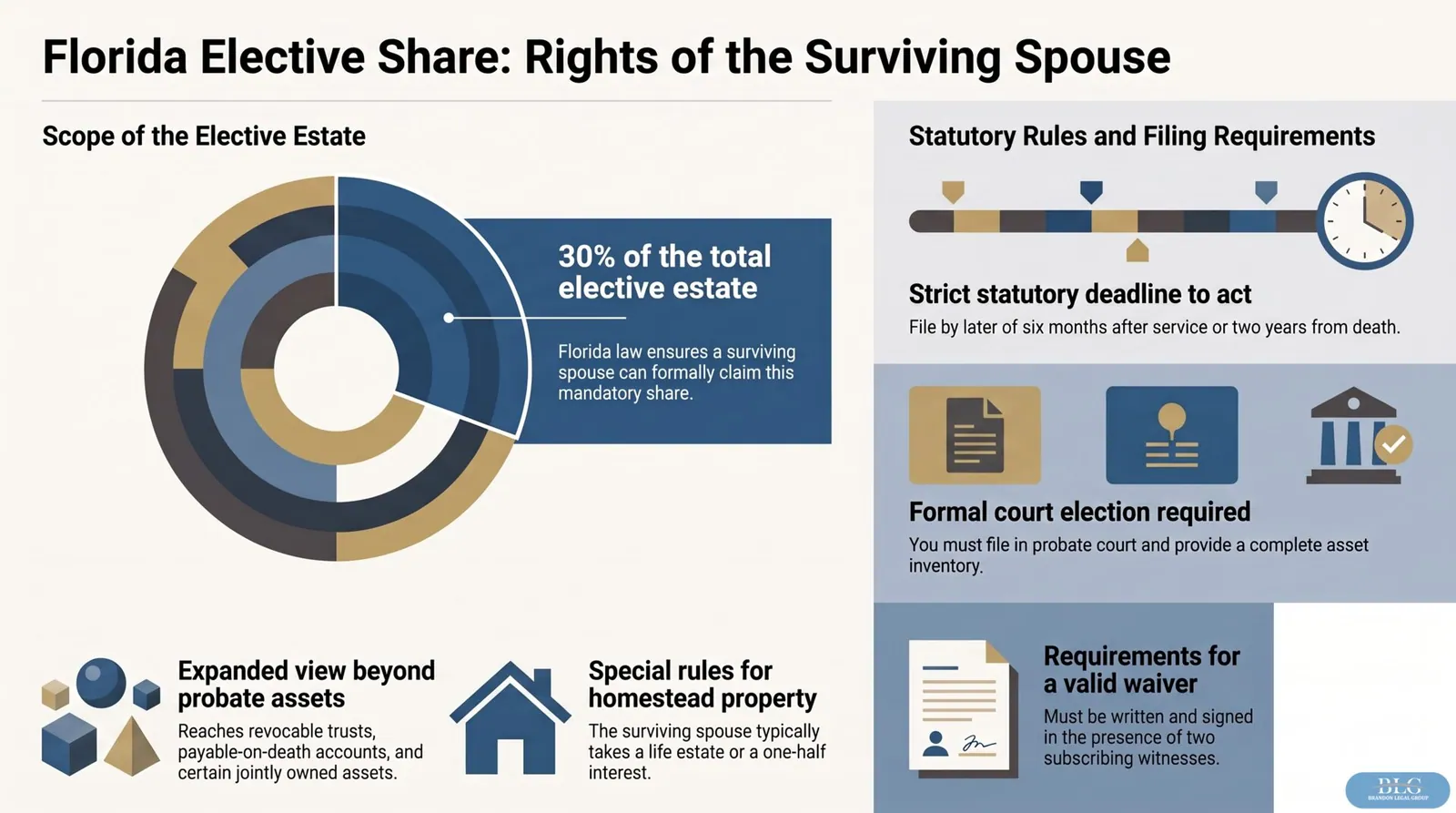
TL;DR: Florida law protects a surviving spouse from being completely disinherited. Even if a will leaves you nothing, you have a right to claim a portion of your deceased spouse's assets, 30% of the total “elective estate.” This is called the elective share. It overrides the will, but you have to act fast and follow strict legal procedures to claim it.
The will comes out after the funeral, and you read it in disbelief. Your name is nowhere, or you’re left a meaningless token while everything of value goes to someone else. Your spouse's message from the grave is loud and clear, but Florida law has the final say. The elective share isn't about feelings; it’s a legal shield. It recognizes that a marriage is a partnership, and one partner doesn't get to erase the other at the end. Asserting this right isn't emotional, it’s a strategic move to claim what the law says is yours.

Florida law ensures a spouse cannot be left with nothing. The right to the elective share is automatic, but it’s not self-enforcing. You have to formally claim it, and the clock is ticking. You have a narrow window to act: the election must be filed by the later of six months after service of the notice of administration on you, or two years from the date of death. Miss that deadline and your right disappears. The estate gets divided exactly as the will dictates, and you get left behind.
What the Elective Share Reaches
The “elective estate” is much bigger than just the assets listed in the will. The law looks at a wider financial picture to calculate your 30% share. It includes assets your spouse may have tried to move out of your reach, like property in revocable trusts, payable-on-death accounts, and certain jointly owned assets. The bottom line is, if your spouse kept control over an asset during their life, it’s likely part of the elective estate.
This is a critical distinction. People often use trusts and joint accounts thinking they can bypass a spouse. The elective share statute sees through these maneuvers. Your 30% claim applies to this much larger pot of assets, not just what’s going through probate. This prevents a spouse from using legal tricks to write you out of the financial partnership you built together.
Homestead property gets special treatment. The primary residence is governed by its own constitutional rules, and if the decedent left a surviving spouse and descendants, the spouse typically takes a life estate, or can elect a one-half interest as a tenant in common with the descendants. Certain retirement plan benefits governed by federal law may also be treated differently, and qualified plans covered by ERISA carry their own spousal protections that can override state rules. The result can be a layered outcome where you hold rights in the home and still have a claim against the rest of the elective estate.
How to Assert Your Claim
Claiming your share isn’t as simple as sending a letter. You must file a formal election with the probate court. You and your attorney are responsible for identifying and valuing every asset that belongs in the elective estate. Expect a fight. The estate’s personal representative and other beneficiaries will challenge your list, arguing over valuations and whether certain assets should be included. This is not a friendly discussion; it’s a legal battle over money.
Once you file the election, backing out is not simple. Florida allows a withdrawal only within a limited period and under conditions the court controls, so treat this as a binding decision. Before you pull the trigger, you need a cold, hard analysis of the estate’s true value, the strength of your claims to each asset, and whether there's enough liquid cash to pay your share without a fire sale of assets that destroys their value.
- File the formal election in the probate case before the deadline.
- Provide a complete inventory and valuation of all assets in the elective estate. 
- Notify everyone with a stake in the estate, the personal representative, beneficiaries, and trustees.
- Attend a court hearing to determine the final amount of your share and how it will be paid.
- Obtain a court order forcing the estate to pay you or transfer property to satisfy your claim.
When it comes time to pay, the law dictates whose inheritance gets cut first. Florida sets an order of contribution, and property that passed outside the will, like assets held in a trust, can be pulled in to satisfy your claim. The people who received those assets may be forced to give them up or pay you directly. This is often a nasty surprise for beneficiaries who thought their inheritance was safe and untouchable.
Waivers and When They Hold Up
You can give up your right to the elective share, but it must be done in a written agreement signed by you in the presence of two subscribing witnesses. Prenuptial and postnuptial agreements almost always contain these waivers, especially when one or both spouses have children from a previous marriage. A waiver signed before marriage can be enforced even without financial disclosure. A waiver signed after the marriage is different, there, fair disclosure of assets matters, and without it the waiver may be worthless.
When a waiver is challenged, courts look at it with a microscope. Was it signed under duress or coercion? Did both parties have their own lawyer? Was there honest financial disclosure where the law requires it? The person trying to enforce the waiver has to show it was executed properly. A waiver shoved in front of you days before the wedding, with no real explanation of what you’re giving up, is an invitation for a court to take a hard look.
Waivers don't exist in a bubble. A waiver drafted narrowly may leave homestead or other spousal rights untouched. Comprehensive estate planning, especially for blended families, demands a strategy that coordinates the waiver, the will, trusts, and other beneficiary designations. Understanding how these documents must work together is critical to ensure there are no gaps or loopholes.
Intersections with Probate Administration
An elective share claim throws a wrench into the probate process. The personal representative has to hold back assets until your claim is resolved. If they distribute money to other beneficiaries too early, they can be held personally liable for the shortfall. This puts immense pressure on them to deal with your claim before anyone else gets paid.
Your claim is measured against the elective estate after allowable deductions, things like valid debts and the costs of administration come off the top. If the estate is drowning in debt, there may be little or nothing left for you. Your 30% claim doesn't let you jump the line in front of legitimate creditors. It's a harsh reality, especially if your spouse spent lavishly or mismanaged money before death, leaving you with a claim to a hollow estate.
Forcing non-probate assets like trust funds or bank accounts to contribute to your share also complicates things. Trustees and bankers won't just hand over the money; they need a court order. Getting that order takes time and money, delaying the process and forcing you to cover your own expenses while the lawyers fight it out. Understanding how intestate heirs' rights work provides useful context for how Florida law prioritizes family claims when formal planning documents fall short, but an elective share claim is its own distinct battle.
Strategic Considerations Before Electing
Making the election isn’t always the right move. If you've already received significant assets outside the will, like life insurance proceeds, retirement accounts, or jointly owned property, filing for the elective share may leave you with nothing extra. The law counts many of those assets toward satisfying your 30% share. It can also change what you would otherwise take under the will. You can’t have it both ways.
You also need to consider the tax implications. Forcing the estate to pay your elective share can create a tax mess, unraveling the plan your spouse put in place. For instance, it can disrupt the tax-deferred treatment of retirement accounts or trigger other unwanted consequences. The deadline to file your claim won’t wait for you to get a clean tax analysis, and a rushed decision is hard to unwind.

Finally, prepare for war. If there are other beneficiaries, especially children from a prior marriage or business partners, they will fight you tooth and nail. A long, nasty court battle can drain the estate's resources and your own. Sometimes, a negotiated settlement gets you a better result than a full-blown fight. But to negotiate from a position of strength, you need to know exactly what the elective estate is worth and be ready to prove it in court.
Closing Remarks
If you've been cut out of a will, if assets were shifted into trusts before death, or if the deadline to file is looming, your window to act is closing fast. Brandon Legal Group stands with surviving spouses in these fights, and we defend beneficiaries from claims that threaten their inheritance. Don't let a statutory deadline dictate your future. Contact us now.
Frequently Asked Questions
Does the elective share apply if the surviving spouse inherited nothing under the will?
Yes. The entire purpose of the elective share is to stop a spouse from being completely disinherited. It doesn't matter if the will leaves you nothing or just a small amount. The law gives you the right to claim your 30% share of the elective estate, unless you signed that right away in a valid waiver.
Can a surviving spouse claim the elective share and also keep non-probate assets received as beneficiary?
You keep the assets, but many of them get counted against your 30% share. If the property you already received satisfies the elective share, you get nothing more from the estate. If it falls short, the estate and other contributing sources must make up the difference. You don't get the 30% elective share on top of everything else; it’s a legal floor, not a bonus.
What happens if the decedent placed everything in a revocable trust to avoid probate?
It doesn't work. Using a revocable trust is a common but failed strategy to disinherit a spouse. Florida law includes the property in a revocable trust as part of the elective estate. The trust does not shield that money from your claim, and a court can order the trustee to contribute toward satisfying it.
How long does a surviving spouse have to decide whether to file an elective share claim?
The election must be filed by the later of six months after the notice of administration is served on you, or two years from the date of death. Courts can extend the deadline only in narrow circumstances, so treat it as a hard stop. You need a legal analysis done quickly, because gathering the financial data to make an informed decision takes time.
Can the elective share be waived after marriage, or does the waiver have to be in a prenuptial agreement?
A waiver can be signed before or after the marriage. What matters is that it's done correctly: in writing, signed by the waiving spouse in the presence of two subscribing witnesses, and for agreements signed after the marriage, supported by fair disclosure of assets. A waiver signed under duress or without knowing what you are giving up is vulnerable to being thrown out by a court.