

TL;DR: Emergency custody motions in Florida demand proof of immediate, serious harm, not convenience, not preference, not anger. Courts grant temporary relief only when a child faces imminent danger that cannot wait for a standard hearing. Most situations that feel urgent to a parent do not meet the legal standard.
A parenting plan falls apart at 11 p.m. on a Tuesday. A child calls in tears. A co-parent misses another handoff. The impulse to file an emergency motion is immediate and overwhelming. But Florida family courts do not operate on parental anxiety. They operate on legal thresholds, and those thresholds are narrow, unforgiving, and intentionally hard to meet. Emergency relief exists to protect children from imminent harm, not to resolve scheduling disputes, punish bad behavior, or accelerate a modification that could wait thirty days. Misunderstanding what qualifies wastes time, money, and credibility. Worse, it can harden a judge against a legitimate emergency filing later.

Emergency custody motions sit at the intersection of urgent need and rigid procedure. The legal framework treats them as extraordinary relief, a short-circuit of due process justified only when waiting for a standard hearing would place a child in serious jeopardy. That means filing without the required factual predicate does not simply fail. It telegraphs poor judgment. Courts remember parents who cry wolf.
The Legal Framework for Emergency Relief
Florida Statute 61.13 governs parental responsibility and time-sharing. It does not create a separate emergency procedure. Emergency custody relief in Florida is instead a creature of case law and the court's inherent authority to protect children: a trial court may enter a temporary order without full notice only when a child is threatened with immediate and irreparable harm. Florida Family Law Rule of Procedure 12.610 supplies a related mechanism in the domestic and repeat violence context, where a court may enter a temporary injunction on an ex parte basis upon a showing of an immediate and present danger of violence. Neither source hands a parent a checklist. The contours of "irreparable harm" in a custody dispute come from appellate decisions and judicial discretion, and they are far narrower than most parents expect.
The standard is not whether a situation is bad. It is whether the situation is so dangerous and so imminent that a child cannot safely remain in the current arrangement for the two to three weeks it takes to schedule a standard temporary relief hearing. Judges apply this test with skepticism. They have seen every flavor of parental conflict dressed up as an emergency. A motion survives scrutiny only when the factual allegations, backed by admissible evidence, demonstrate a clear and present threat.
What Actually Meets the Threshold
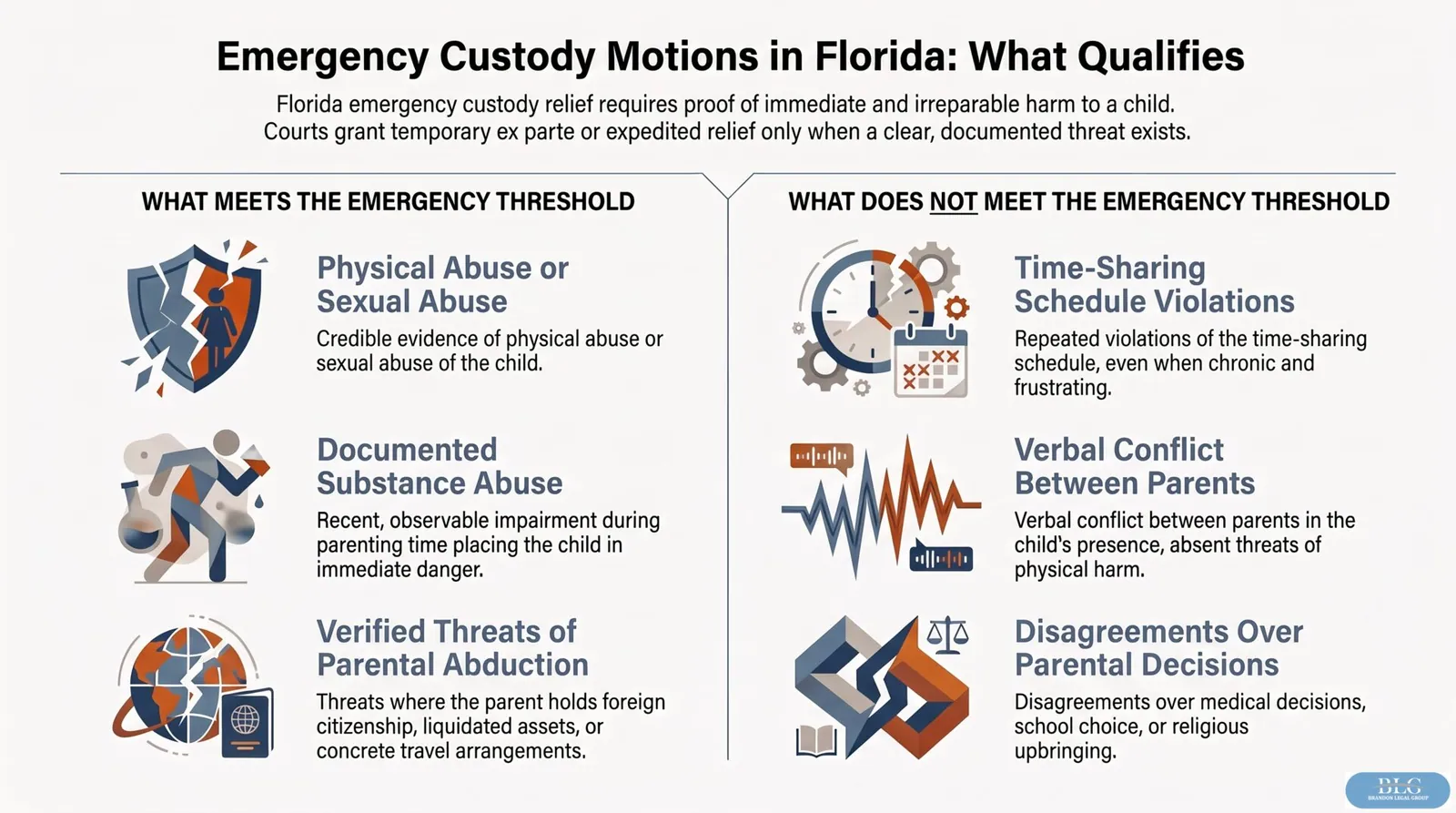
Certain fact patterns recur in granted emergency motions. They share a common thread: the harm is physical, immediate, and documentable. Courts have granted emergency relief in scenarios involving:
- Credible evidence of physical abuse or sexual abuse of the child, corroborated by medical records, photographs, or law enforcement reports
- Documented substance abuse by the other parent that places the child in immediate danger, not historical use, but recent, observable impairment during parenting time
- Verified threats of parental abduction, particularly when the other parent holds foreign citizenship, has liquidated assets, or has made concrete travel arrangements
- Serious neglect resulting in harm or near-harm, such as a young child left unattended, a failure to provide necessary medical care, or exposure to dangerous living conditions confirmed by child protective services or medical professionals
- Mental health crises involving the parent exercising time-sharing that render them incapable of providing basic care, supported by recent psychiatric records or law enforcement intervention
Each scenario hinges on evidence available at the time of filing. A parent's sworn testimony is rarely sufficient on its own. Courts expect corroboration: police reports, DCF investigations, medical records, school incident reports, or sworn affidavits from neutral third parties. The absence of documentation does not mean the harm is not real. It means the motion will likely fail.
The Role of Supervised Visitation in Emergency Proceedings
When an emergency motion succeeds, the relief granted is often temporary supervised time-sharing rather than a complete suspension of contact. Courts prefer to maintain some parental contact while mitigating risk. Supervised visitation orders typically require a neutral third party, either a professional supervisor or, in some cases, a vetted family member, to be present during all contact. The terms are specific: location, duration, who pays for supervision, and what behaviors trigger termination of the visit. These orders are not punitive. They are diagnostic. They allow the court to assess whether the alleged risk is real and whether the parent can demonstrate fitness under controlled conditions.
What Does Not Qualify, and Why Parents Misjudge the Standard
The gap between parental urgency and legal emergency is wide. Situations that feel intolerable, and may genuinely warrant modification through standard procedure, fall short of the emergency threshold. Common examples include:
- Repeated violations of the time-sharing schedule, even when chronic and frustrating
- Verbal conflict between parents in the child's presence, absent threats of physical harm
- Introduction of a new romantic partner the other parent considers unsuitable, without evidence that the partner poses a danger
- Disagreements over medical decisions, school choice, or religious upbringing, conflicts that implicate parental responsibility but do not threaten immediate harm
- A child's stated preference to live with the other parent, even when expressed emotionally
- Financial irresponsibility, failure to maintain health insurance, or other failures that cause stress but not imminent danger
These issues may support a modification petition under Florida Statute 61.13, which requires proof of a substantial, material, and unanticipated change in circumstances and a showing that modification serves the best interests of the child. But they do not justify bypassing notice and hearing rights. Filing an emergency motion on these grounds does more than waste filing fees. It signals to the court that the moving party either does not understand the law or is willing to misuse procedure for tactical advantage. Either impression is costly.
Parents misjudge the standard for predictable reasons. First, the emotional weight of the situation is real. When a child is distressed, a parent experiences that distress as urgent. Second, the other parent's behavior may be objectively bad, reckless, selfish, or harmful in ways that accumulate over time. But family courts operate on a different time scale. They distinguish between chronic dysfunction, which can be addressed through scheduled hearings, and acute danger, which cannot.
The Procedural Cost of Filing Without Foundation
An emergency motion that fails on its merits does not simply get denied and forgotten. It creates a record. It establishes that the moving parent was willing to claim an emergency that did not exist. If that parent later files a legitimate emergency motion, or pursues a standard modification, the prior filing can be used as evidence of poor judgment, overreaction, or bad faith. Judges are human. They form impressions. A parent who has cried wolf once will face heightened scrutiny the next time.
There is also a financial cost. Emergency motions require expedited hearings. That means attorney preparation time is compressed, and the risk of an adverse fee award increases if the court determines the motion was frivolous or filed in bad faith. Florida courts have authority under Florida Statute 57.105 and their inherent authority to award attorney's fees when a party has unnecessarily increased the cost of litigation. An unfounded emergency filing is a textbook example.
More subtly, an unsuccessful emergency motion can poison settlement negotiations. It signals to the other parent that standard conflict-resolution tools, such as negotiation, mediation, collaborative modification of the parenting plan, will not be respected. That increases defensiveness, reduces flexibility, and makes every subsequent dispute more adversarial.
When the Situation Is Urgent but Not Yet Provable
Some situations fall into a gray zone. A parent has credible concerns, for instance a co-parent's behavior is deteriorating, a child is showing signs of distress, or something feels wrong, but the evidence is not yet documented. The instinct to act immediately is understandable. The legal system, however, does not run on instinct. It runs on proof.
In these scenarios, the correct course is to begin building the evidentiary record while simultaneously consulting counsel about whether an emergency filing is viable. That means contemporaneous documentation: dates, times, witnesses, photographs, screenshots of communications. It means reporting concerns to appropriate authorities, such as school counselors, pediatricians, law enforcement, or the Department of Children and Families, so that if the situation escalates, there is a documented trail. It means resisting the urge to act unilaterally, which can itself become a basis for the other parent to file a counter-motion alleging interference with time-sharing.
Patience in this context is not passivity. It is strategic discipline. A motion filed one week later with corroborating evidence has a vastly higher chance of success than a motion filed today on parental testimony alone.

Emergency custody motions are not a release valve for parental frustration. They are a procedural scalpel, reserved for situations where a child's safety cannot tolerate delay. The bar is high because the stakes are high. A granted motion temporarily strips a parent of time-sharing rights without a full hearing. Courts do not take that step lightly, and neither should the parent seeking it. The decision to file carries reputational, financial, and strategic consequences that extend far beyond the motion itself. Knowing the difference between what feels like an emergency and what qualifies as one under Florida law is not legal trivia. It is the difference between protecting a child and undermining the credibility needed to do so.
Closing Remarks
If evidence points to immediate harm your child cannot safely endure until a standard hearing, if the other parent's conduct has crossed from dysfunction into danger, or if you are uncertain whether your situation meets Florida's threshold for emergency relief, the cost of guessing wrong is too high. Brandon Legal Group represents parents in high-conflict custody disputes where strategic clarity and courtroom credibility determine outcomes. Contact us before filing, not after the motion fails.
Frequently Asked Questions
Can a child's own statements support an emergency custody motion in Florida?
A child's statements can contribute to the factual basis for an emergency motion, but they are rarely sufficient on their own. Florida courts are cautious about relying on a child's statements in high-conflict custody disputes, particularly when the child is young or the statements are made exclusively to one parent. Corroborating evidence, such as a forensic interview conducted by a child advocacy center, a report from a mandated reporter like a teacher or counselor, or documentation of physical signs consistent with the child's account, significantly strengthens the motion. Without corroboration, the court is more likely to view the child's statements as part of the broader parental conflict rather than independent proof of imminent harm.
What happens if the judge denies an emergency custody motion?
Denial of an emergency motion does not prohibit the moving party from pursuing relief through standard modification procedures. The case can proceed as a normal petition for modification of parental responsibility and time-sharing under Florida Statute 61.13, which requires notice, opportunity to respond, and a full evidentiary hearing. However, the denial itself becomes part of the case record. If the motion alleged facts that the court found insufficient to justify emergency relief, that ruling may influence how the judge views subsequent filings. Additionally, the other parent may point to the failed emergency motion as evidence of overreach or lack of credibility, particularly when seeking attorney's fees or arguing against future modifications.
How quickly does a Florida court typically hear an emergency custody motion?
Timelines vary by circuit, by judge, and by docket, so no fixed schedule applies statewide. In practice, many Florida family courts set expedited hearings within roughly one to two weeks of filing when the motion is treated as a genuine emergency. Truly ex parte relief, an order entered without notice to the other parent, is reserved for the most extreme cases, such as credible threats of abduction or immediate physical danger, and Florida law strongly favors giving notice whenever it is practicable. In most cases the court will require at least short notice to the other parent. That compressed timeline means both parties have limited time to prepare, which is why emergency motions filed without strong, readily available evidence are particularly vulnerable to denial.
Can an emergency custody order be made permanent?
No. Emergency orders are by definition temporary. Florida law requires that a parent deprived of time-sharing on an emergency basis receive a prompt, full evidentiary hearing; the order cannot be left to stand indefinitely without one. At that hearing, both parties have the opportunity to present evidence, call witnesses, and cross-examine. The court then determines whether the facts support a modification of the parenting plan. If the evidence does not support the allegations that justified the emergency order, the court may reinstate the prior time-sharing arrangement. If the evidence does support modification, the court may enter a longer-term order or craft a new arrangement based on the best interests of the child. Any such order remains subject to future modification upon a substantial change in circumstances.
What role does the Department of Children and Families play in emergency custody cases?
The Department of Children and Families (DCF) investigates reports of child abuse, neglect, or abandonment. If DCF has an open investigation or has verified allegations against a parent, that finding can serve as powerful corroborating evidence in an emergency custody motion. Conversely, if DCF investigated and closed the report with no indicators, that outcome may undermine the motion. Courts give meaningful weight to DCF findings because the agency conducts independent investigations using trained investigators with access to records and other parties. A parent considering an emergency motion based on abuse or neglect allegations should report the concerns to DCF and, where the child's immediate safety allows, coordinate the filing with the investigation rather than racing ahead of it. A DCF record speaks with far more authority than a parent's affidavit alone.
References
- Fla. Stat. § 61.13. (Support of children; parenting and time-sharing; powers of court).
- Fla. Stat. § 57.105. (Attorney's fees; sanctions for unsupported claims or defenses).
- Fla. Fam. L. R. P. 12.610. Injunctions for Protection Against Domestic, Repeat, Dating, and Sexual Violence, Stalking, and Exploitation of a Vulnerable Adult
- Fla. Stat. § 39.201. (Mandatory reports of child abuse, abandonment, or neglect).