
TL;DNR
Divorce is a legal process designed to resolve rights, responsibilities, and structure, not to heal emotional wounds. Treating divorce like therapy often leads to poor legal decisions, increased conflict, higher costs, and weaker outcomes under Florida law. Clarity, strategy, and legal structure, not emotional processing, are what protect your future.
The Dangerous Misunderstanding About Divorce
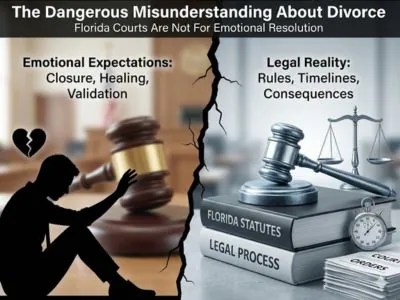 Many people enter divorce believing the process will bring closure, healing, or emotional validation.
They expect the court to acknowledge their pain, explain what went wrong, or provide a sense of fairness beyond the law.
Florida courts do none of those things.
Divorce is not a healing journey. It is a legal process with defined rules, timelines, and consequences.
Expecting emotional resolution from a legal system almost always leads to frustration, and often to decisions that undermine a person’s legal position.
What Divorce Is Actually Designed to Do
Under Florida law, divorce exists to accomplish very specific objectives.
These include:
• Legally dissolving the marriage under Florida Statute §61.052
• Dividing marital assets and debts under Florida Statute §61.075
• Establishing parental responsibility and time-sharing under Florida Statute §61.13
• Determining support obligations where applicable
Nowhere in Florida’s statutory framework is there a requirement, or mechanism, for emotional healing.
¶
¶ Courts are not counselors. Judges are not mediators of emotional truth. Their role is to issue enforceable orders based on evidence and statutory factors.
Why Treating Divorce Like Therapy Creates Legal Risk
When people approach divorce emotionally rather than strategically, several predictable problems arise.
First, decisions are often made to relieve short-term emotional pain rather than protect long-term interests.
Examples include:
• Agreeing to unfavorable custody arrangements to avoid conflict
• Conceding financial issues to “be done” with the process
• Sharing information that later becomes damaging evidence
• Delaying action in hopes emotions will settle
Florida courts do not adjust outcomes based on emotional motivation. Once an agreement is entered or an order is issued, undoing it is difficult and sometimes impossible.
Florida Courts Reward Clarity, Not Emotional Narratives
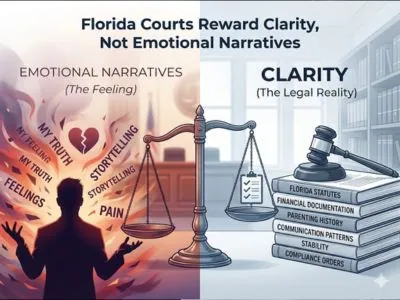 Florida’s family law system is built around structure and predictability.
Under statutes governing divorce, judges evaluate facts, not feelings.
¶
¶ They assess:
¶ • Financial documentation
• Parenting history and involvement
• Communication patterns
• Stability and consistency
• Compliance with court orders
Emotional storytelling may feel necessary, but it rarely influences legal outcomes unless it is tied directly to statutory factors.
This is why understanding the legal framework early is critical.
Why Emotional Processing Belongs Outside the Legal Process
Divorce often involves grief, anger, fear, and loss. Those emotions are real, and ignoring them entirely can be harmful.
¶
¶ But the courtroom is not the place to resolve them.
Florida courts expect parties to:
• Present clear evidence
• Follow procedural rules
• Comply with deadlines
• Engage in structured negotiation
Emotional processing is best handled with appropriate support systems outside the legal process. Expecting the court to provide emotional resolution only increases frustration and legal risk.
How Misaligned Expectations Increase Cost and Conflict
One of the primary drivers of prolonged litigation is misaligned expectations.
When people expect divorce to feel “fair” emotionally, they are more likely to:
• Reject reasonable settlement offers
• Escalate conflict unnecessarily
• Engage in repeated motions and hearings
• Increase legal fees dramatically
Florida courts strongly encourage resolution through mediation and settlement, but only within legal boundaries. Emotional stalemates often result in judges imposing outcomes neither party wanted.
Divorce Requires Strategy, Not Endurance
Divorce is not a test of how much pain someone can withstand.
It is a process that requires:
• Accurate financial analysis
• Clear parenting priorities
• Strategic timing
• Informed decision-making
This is especially true under Florida’s equitable distribution model. Delays, emotional concessions, and poorly planned agreements can permanently affect financial and parental rights.
Why Legal Structure Often Brings Emotional Relief Later
Ironically, many people report feeling emotional relief only after legal clarity is established.
Clear boundaries, enforceable orders, and predictable routines often reduce conflict and uncertainty, creating space for emotional healing to occur outside the courtroom.
This is why approaching divorce as a legal process first often leads to better long-term emotional outcomes, not worse.
How This Fits with January’s Decision Pattern
January forces honesty. People reassess what is working and what is not.
For many, the realization is not just that the marriage is over, but that waiting for emotional resolution before acting legally has created unnecessary risk.
This is why January often becomes a turning point.
For related insight, see:
The January Divorce Boom
Why “Staying for the Kids” Often Creates Bigger Legal Problems Later
Frequently Asked Questions
Does Florida law consider emotional pain in divorce decisions?
No. Florida courts focus on statutory factors such as finances, parenting, and stability, not emotional suffering or fault.
¶
Can emotional decisions during divorce hurt my case?
Yes. Emotional concessions can negatively affect custody, support, and property outcomes and may be difficult to reverse.
Is mediation meant to provide emotional closure?
No. Mediation is a structured legal process designed to resolve disputes efficiently, not to provide emotional validation.
When should I focus on emotional healing?
Emotional healing is important, but it should occur alongside, not instead of, sound legal strategy and outside the courtroom.