
When a marriage ends, most people immediately think of divorce. However, there’s another legal process, an annulment, which can also terminate a marriage. While both achieve a similar outcome: ending the marital relationship, their legal foundations, requirements, and consequences are fundamentally different. Understanding these distinctions is crucial, especially in Florida, where annulment laws are based primarily on case precedent rather than specific statutes. At Brandon Legal Group, we believe in providing strategic clarity and decisive strength to help you navigate these complex choices. Don’t make assumptions; get the unvarnished truth about what each process entails.
The Unvarnished Truth: A Marriage That Never Was vs. A Marriage That Ends
The core difference between an annulment and a divorce boils down to whether the marriage was legally valid from its inception. A divorce (or dissolution of marriage) ends a marriage that was legally valid when it began. It acknowledges the marriage existed but is now being terminated. In contrast, an **annulment** is a legal decree that declares a marriage void or voidable from the very beginning, as if it never legally existed. This distinction has profound implications for property, financial rights, and even how you’re viewed in the eyes of the law.
What is an Annulment?
An annulment legally erases a marriage, treating it as though it never happened. This is not a casual option; the courts grant annulments only under very strict and specific circumstances.
Grounds for Annulment in Florida (Strict Criteria)
Florida law recognizes two types of marriages that can be annulled:
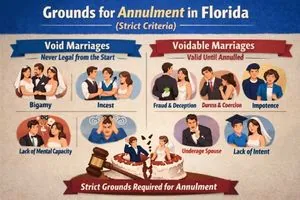 1. Void Marriages (Never Legal from the Start): These marriages are considered invalid without any legal action, but an annulment formalizes this status.
- Bigamy: One party was already legally married to someone else at the time of the new marriage.
- Incest: The parties are related within a prohibited degree of kinship (e.g., siblings, parent and child).
- Lack of Mental Capacity: One party lacked the mental ability to consent to marriage at the time of the ceremony (e.g., due to severe mental illness, intellectual disability, or extreme intoxication).
2. Voidable Marriages (Valid Until Annulled): These marriages are initially valid but can be declared invalid if challenged in court based on specific defects.
- Fraud or Misrepresentation: One party induced the other into marriage by a fraud that goes to the “essence” of the marriage (e.g., marrying solely for immigration purposes without intent to live as spouses, or concealing the inability to have children). Not every lie qualifies; it must be fundamental to the marital relationship.
- Duress or Force: One party was coerced or forced into the marriage against their will.
- Impotence: One party was physically and incurably unable to consummate the marriage, and the other party was unaware of this at the time of marriage.
- Underage Spouse: A party was under the legal age to marry and did not have the required parental or judicial consent.
- Lack of Intent: One or both parties entered the marriage as a joke or without a genuine intention to fulfill the marital relationship.
Key Impact of Annulment
If an annulment is granted, the law treats the parties as if they were never married. This means:
- Marital Status: You are legally considered single, as if the marriage never occurred.
- Property & Alimony: Generally, there is no “marital estate” to divide, and typically, no alimony is awarded because, legally, no marriage existed. However, courts may make equitable (fair) adjustments to return parties to their pre-marital financial status, or in rare cases, award alimony to an “innocent victim” spouse.
- Children: Children born of an annulled marriage are still considered legitimate, and the court will establish child custody, child support, and a parenting plan just as in a divorce.
What is a Divorce (Dissolution of Marriage)?
A divorce, or dissolution of marriage, is the most common legal process for ending a marriage in Florida. It terminates a legally valid marital relationship.
Grounds for Divorce in Florida
Florida is a “no-fault” divorce state, meaning you don’t need to prove fault (like adultery or abandonment) to get a divorce. The grounds are:
- Irretrievably Broken: This is the most common ground, meaning the marriage is beyond repair and there is no reasonable hope of reconciliation.
- Mental Incapacity: One party has been adjudged mentally incapacitated for at least three years prior to filing the petition.
Key Impact of Divorce
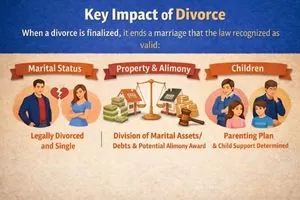 When a divorce is finalized, it ends a marriage that the law recognized as valid:
- Marital Status: You become legally divorced and single.
- Property & Alimony: The court will formally divide marital assets and debts (equitable distribution of assets and debts, including retirement accounts) acquired during the marriage. Alimony (spousal support) may be awarded based on factors like need and ability to pay, length of marriage, and standard of living.
- Children: The court will establish a parenting plan, including parental responsibility and timesharing, and determine child support obligations for any minor children.
Key Differences Summarized
| Feature | Annulment | Divorce (Dissolution of Marriage) |
|---|---|---|
| Legal Premise | Marriage was never legally valid from the start (void or voidable). | Marriage was legally valid but is now being terminated. |
| Grounds | Strict, specific defects in the marriage (e.g., bigamy, incest, fraud, duress, mental incapacity at time of marriage, underage). | Marriage is “irretrievably broken” or one party is mentally incapacitated for 3+ years. |
| Impact on Marital Status | Legally treated as if you were never married. | Legally declared “divorced” and single. |
| Property/Alimony | Generally, no “marital estate” or alimony. Courts may make equitable adjustments to restore pre-marital status. | Formal equitable division of marital assets/debts; alimony may be awarded. |
| Children | Children are legitimate; custody and child support still determined. | Children are legitimate; custody and child support still determined. |
| Frequency | Rare, due to strict legal requirements. | Common. |
The Brandon Legal Group Advantage: Guiding Your Strategic Choice
Deciding between an annulment and a divorce requires a thorough understanding of Florida law and a clear assessment of your unique circumstances. This isn’t a decision to take lightly or without expert legal counsel. At Brandon Legal Group, we provide the decisive strength and strategic clarity you need to navigate these complex waters.
Our direct, no-nonsense approach means we’ll clearly explain if annulment is a viable option for your situation, or if divorce is the only appropriate path. We will meticulously evaluate the facts of your case against the strict legal criteria for annulment or guide you through the process of no-fault divorce. Ingrid’s “broomstick” isn’t just for sweeping away legal messes; it sweeps away confusion, empowering you to make informed decisions that protect your rights and future. Whether it’s an annulment or a dissolution of marriage, our family law services ensure unapologetic advocacy on your behalf.
Illustrative Scenario: The Truth About Annulment Eligibility
Sophia had been married for two years when she discovered her husband, David, had married her solely to gain U.S. citizenship, having no intention of building a life together. Heartbroken and feeling used, she immediately thought of annulment, wanting to erase the entire painful chapter.
She contacted Brandon Legal Group, explaining her desire for an annulment based on fraud. Ingrid listened carefully, then explained the stringent requirements for annulment in Florida. While David’s actions might constitute fraud, the longer duration of the marriage (two years), potential co-mingled assets, and the “ratification” of the marriage through continued cohabitation after the fraud *might* make a divorce a more straightforward and legally predictable path. Ingrid explained that while the marriage *could* be deemed voidable, proving the fraud to the court’s satisfaction, especially after a period of time, could be challenging, and a divorce based on “irretrievably broken” would be far simpler to obtain.
Brandon Legal Group’s direct guidance helped Sophia understand that while her desire for annulment was understandable emotionally, a **divorce** was likely the more practical and strategically clear legal option, offering a more certain path to formal separation and the necessary division of the few joint assets they had accumulated. They proceeded with a divorce, ensuring Sophia’s rights were protected, rather than engaging in a potentially protracted and difficult battle for an annulment.
Disclaimer: This scenario is illustrative and does not represent any specific client or outcome. Every personal situation is unique and requires personalized advice.
Frequently Asked Questions About Annulment vs. Divorce
1. Is an annulment the same as a religious annulment?
No. A legal annulment is a civil court process that declares a marriage void or voidable under state law. A religious annulment is a decree by a religious authority (e.g., the Catholic Church) that a marriage was not valid in the eyes of that religion. Religious annulments have no legal standing in civil courts.
2. Can I get an annulment if my marriage was very short?
The length of the marriage is not, by itself, a direct ground for annulment. While shorter marriages might make certain grounds (like fraud or lack of consummation) easier to prove before “ratification” occurs, the core requirement is proving one of the specific legal defects (e.g., bigamy, fraud, duress) that made the marriage invalid from the start, regardless of duration.
3. If I get an annulment, does that mean my children are illegitimate?
No. In Florida, children born of an annulled marriage are still considered legitimate. The court will still enter orders for parental responsibility, timesharing (custody), and child support, just as in a divorce case. The annulment relates to the legal validity of the marital contract, not the legitimacy of the children.
4. Is it easier to get a divorce or an annulment in Florida?
It is generally much easier and more common to obtain a divorce in Florida. Florida is a no-fault divorce state, meaning you only need to prove the marriage is “irretrievably broken.” Annulments require proving specific, strict grounds that the marriage was legally defective from its inception, which often involves a higher burden of proof and fewer applicable cases.
Conclusion: Strategic Clarity for Your Future
While both annulment and divorce end a marital relationship, their legal foundations and consequences are profoundly different. An annulment erases a marriage as if it never existed, applicable only under very narrow, strict legal conditions. A divorce, conversely, ends a valid marriage, addressing critical matters such as property division, alimony, and child custody.
Understanding these distinctions and determining the correct legal path for your situation requires the strategic clarity and decisive strength that only experienced legal counsel can provide. Brandon Legal Group is committed to being your unapologetic advocate, guiding you through these choices to ensure your rights are protected and your future is secured with confidence.
_Social proof elements (e.g., testimonials) will be inserted here using the provided shortcode once confirmed._