
Roth Conversions + Trust Planning = Tax Smarts for Families: Your Blueprint for Keeping More Money
Combining a strategic Roth IRA conversion with a properly structured trust isn’t just financial planning; it’s a powerful shield against taxes that ensures your hard-earned wealth benefits your family, not the IRS. This is the definitive guide to making these advanced strategies work together for maximum, tax-efficient wealth transfer.
The Unbeatable Combo: Why Your Trust Needs a Roth Strategy
¶ A Roth IRA conversion, shifting funds from a traditional IRA to a Roth, means paying taxes now to eliminate them later. Pair this with a trust, and you move from a simple tax play to a sophisticated legacy protection plan. The goal isn’t to avoid probate; it’s to create a dynastic financial vehicle that controls assets long after you’re gone, minimizing the tax burden on your heirs.
How a Trust Protects Your Roth IRA From Your Heirs’ Mistakes
Naming a trust as your Roth IRA beneficiary adds a layer of control an individual beneficiary can’t provide. Without it, a young or financially inexperienced heir could drain the account immediately, triggering taxes and wasting decades of tax-free growth. A trust establishes rules, doling out distributions over time based on your instructions, not their impulses. This is a key part of a solid trustee selection and management strategy.
Consider this illustrative scenario: A client left a $1.5 million inherited Roth IRA directly to his son. The son, seeing a large sum, took a full distribution within a year. This move, while legal, converted over half a million dollars into taxable income, a massive and avoidable tax bill. A conduit trust would have mandated only Required Minimum Distributions (RMDs), preserving the tax-free status for decades.
Navigating the Critical Tax Pitfalls of Roth Trust Planning
The strategy is powerful, but the execution is everything. A misstep can trigger the very taxes you’re trying to avoid.
The Five-Year Rule and Trusts: Your Countdown Clock
All inherited Roth IRAs are subject to the five-year rule, requiring the account to be open for five years before earnings can be withdrawn tax-free. If you convert late in life and pass away before the five-year clock runs out, your heirs could owe income taxes on distributions. Strategic timing of your conversion is non-negotiable, much like understanding critical timelines in estate administration.
Choosing the Right Trust: Conduit vs. Accumulation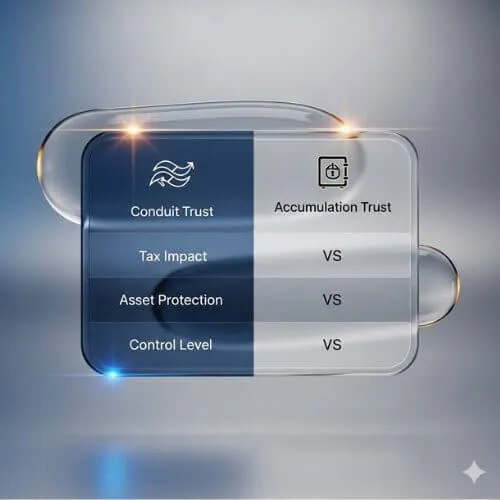
This is the most critical decision. A conduit trust forces all RMDs to be paid out to the beneficiary annually, which can protect the assets from the beneficiary’s creditors but adds that income to their tax return. An accumulation trust allows the trustee to hold RMDs inside the trust. This is a more complex trust structure for generational wealth that protects the money from the beneficiary’s creditors and lifestyle, but the trust itself pays taxes at compressed, high trust tax rates. The wrong choice here defeats the entire purpose.
Executing Your Tax-Smart Strategy: A No-BS Action Plan
This isn’t theoretical. It’s a step-by-step process for high-net-worth families who are serious about preservation. For many, this is a core part of their overall tax-efficient estate planning strategy.
Step 1: Model the Conversion Tax Impact
Before you convert a single dollar, you must know the tax bill. How will converting $100,000 push you into a higher tax bracket? Does it trigger NIIT? We run precise projections to find your optimal conversion amount, the sweet spot between paying a manageable tax now and saving a fortune later.
Step 2: Design the Trust as a Custom Tool
Your trust must be drafted with explicit language for inherited retirement accounts. Most boilerplate trusts are inadequate. It must specify whether it is a conduit or accumulation trust and grant the trustee clear powers to manage the complexities of RMDs and tax reporting.
Step 3: Coordinate the Entire Financial Picture
A Roth conversion doesn’t happen in a vacuum. It affects your Medicare premiums, the taxation of your Social Security benefits, and your overall estate value. We integrate this move with your entire plan so no financial domino falls unexpectedly.
The Bottom Line: Control, Certainty, and Kept Wealth
Picture this: instead of worrying about the IRS taking nearly half of what you leave behind, you own the confidence that your family’s financial future is secure. You feel the relief of knowing your wealth will educate your grandchildren, support your spouse, and build a legacy, all with minimal erosion from taxes. This isn’t just planning; it’s empowerment.
FAQ: Roth Conversions and Trust Planning
How does a Roth IRA conversion work with a trust?
You execute a Roth IRA conversion personally. Then, you name a specially drafted trust as the beneficiary of the new Roth IRA account. The trust does not own the IRA during your lifetime but inherits it upon your death, controlling the distributions to your heirs according to your rules. This is a key method for using trusts for Roth IRA protection.
What is the main benefit of naming a trust as my Roth IRA beneficiary?
The main benefit is control. It allows you to protect the Roth IRA assets from heirs who may be spendthrifts, financially inexperienced, or susceptible to creditors, while stretching out the tax-free growth over their lifetimes.
Can any trust be the beneficiary of a Roth IRA?
Technically, yes, but it must be carefully drafted as an “See-Through Trust” to ensure your heirs can use their own life expectancies for calculating RMDs. An poorly drafted trust can accidentally trigger the entire IRA to be paid out within five years, creating a massive tax liability.