
TL;DR: Verbal child support agreements often begin with good intentions, but they rarely hold up in Florida courts. Because child support belongs to the child, not the parents, you cannot privately “waive” it. Without a court order, paying parents risk paying twice, and receiving parents risk having no recourse when payments stop.
Many parents start with a simple understanding.
No paperwork.
No court involvement.
A shared belief that “we don’t need the law to tell us how to support our kids.”
At the beginning, verbal agreements can feel easier, faster, and less adversarial.
But child support is not a short-term favor. It is a long-term legal obligation that must survive changes in income, relationships, and life circumstances.
The “Right to Support” Belongs to the Child
 This is the most common misconception in Florida family law.
Parents often believe they can negotiate away child support (e.g., “I won’t ask for child support if you give me the house”).
In Florida, this is legally impossible.
Florida law establishes that child support is the right of the child, not the parent. Parents cannot sign away or verbally agree to waive their child’s right to financial support. Even if you “agreed” to zero support years ago, the court can overturn that agreement instantly because it violates public policy.
The Risk for the Paying Parent: “Paying Twice”
For the parent paying support, a verbal agreement is a financial minefield.

¶ If you pay voluntarily without a court order, especially via cash, Zelle, or Venmo without clear labeling, the court may view those payments as “gifts” rather than support.
When the other parent eventually files for formal support, the court can order Retroactive Child Support for up to 24 months prior to the filing.
If you cannot prove your previous payments were specifically for support, you could be ordered to pay that money again. A written order protects the payer just as much as the receiver.
Life Changes Faster Than Expectations
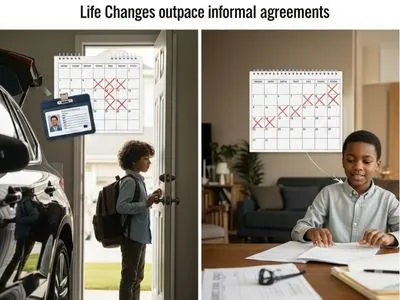 Verbal agreements rarely anticipate real-world friction.
Income fluctuates.
Jobs change.
One parent remarries.
Without clear terms, parents often disagree about what the money covers. Does the $500/month include health insurance? Who pays for braces? What about summer camp?
When these questions arise, a verbal “understanding” offers no answers.
Enforcement Is Impossible Without an Order
If a verbal agreement breaks down, the receiving parent has zero immediate enforcement power.
- The Department of Revenue cannot step in.
- You cannot suspend a driver’s license for non-payment.
- You cannot garnish wages.
To enforce the obligation, you must start from square one: filing a petition, establishing paternity (if applicable), and asking the court to set an amount. The verbal history is largely irrelevant to the judge’s calculation of current support.
Formalizing an Agreement Reduces Conflict
Contrary to common belief, putting child support terms in writing does not have to be an act of war.
In many cases, formalizing expectations early prevents future disputes by:
- Clarifying exactly what is owed and when
- Creating a record that protects the paying parent from arrears
- Ensuring the amount aligns with Florida Guidelines (keeping it fair)
Clarity preserves cooperation. Ambiguity destroys it.
Good Intentions Do Not Replace Legal Security
Most verbal agreements collapse not because one parent acted maliciously, but because circumstances changed.
Stress increases. Trust erodes. Expenses rise.
Child support exists to provide stability for the child. Stability depends on predictability and enforceability, qualities that verbal agreements simply cannot provide.
If you are relying on a verbal child support agreement, you are operating without a safety net. Speaking with an experienced Florida family law attorney can help you formalize your arrangement, protecting both your financial future and your child’s well-being.