

Revocable trusts offer flexibility and control during life but vanish as asset shields the moment death arrives. Irrevocable trusts sacrifice control in exchange for creditor protection and tax advantages that survive beyond the grave. The choice between them isn't philosophical; it's tactical, and the stakes show up when someone challenges the plan or comes looking for money.
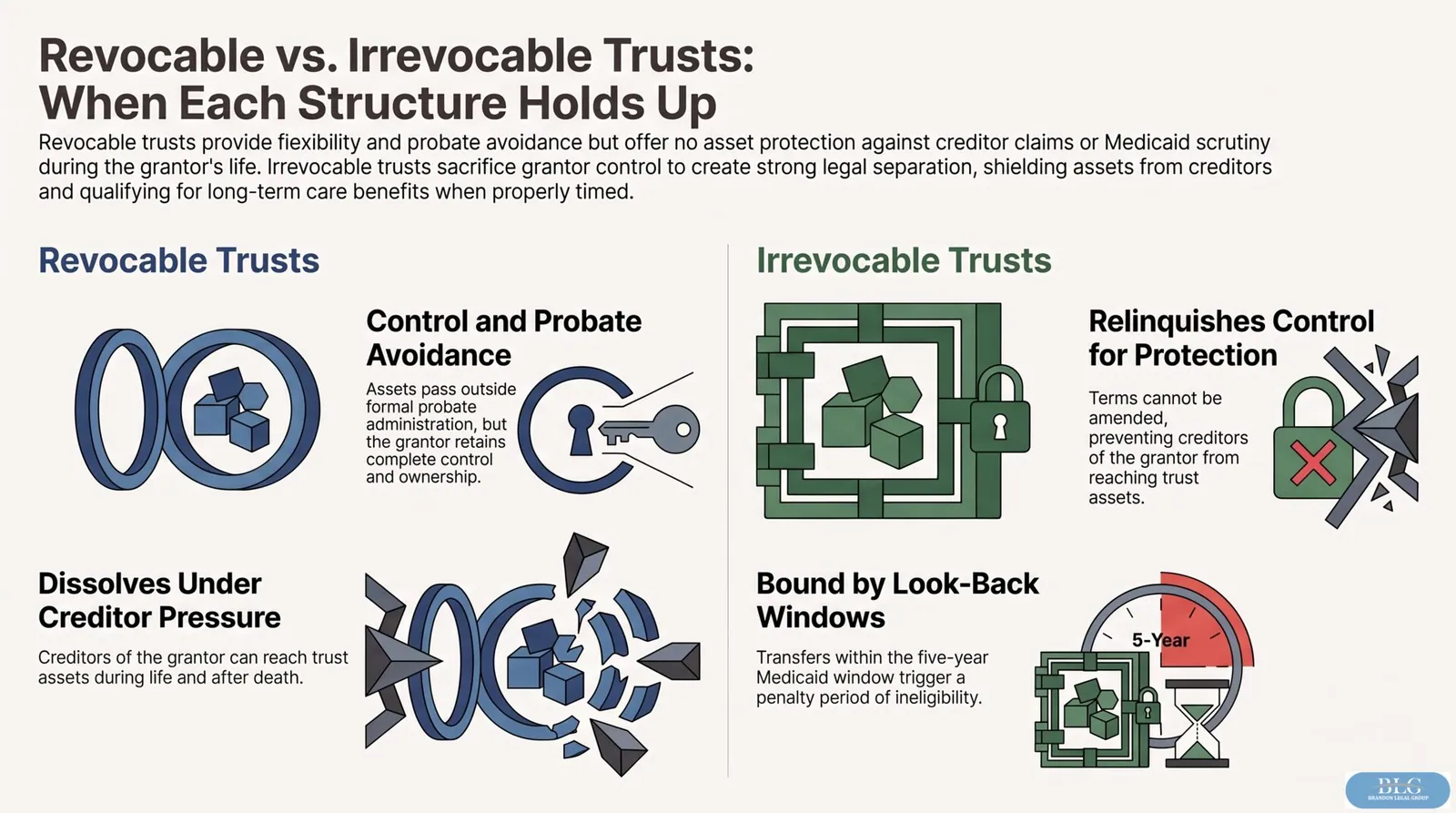
Estate plans fail most often at the pressure points: when creditors circle, when Medicaid looks backward, when an ex-spouse's lawyer starts digging, or when heirs decide the distribution wasn't fair. Revocable trusts are popular because they feel safe: control stays intact, changes remain possible, and probate gets avoided. Irrevocable trusts feel like giving up too much. But "holding up" isn't about what feels comfortable during the signing ceremony. It's about what survives the fight that comes later. The trust that works is the one built for the threat it will actually face.

Understanding when each structure holds its ground requires looking at the moments they get tested: creditor claims, Medicaid estate recovery, divorce proceedings, and challenges from disappointed heirs. The decision isn't revocable versus irrevocable in the abstract. It's which one stands when someone with a legal claim tries to reach the assets inside.
Revocable Trusts: Flexibility That Dissolves Under Pressure
¶ ¶A revocable trust, often called a living trust, lets the grantor retain complete control. Assets can be moved in and out. Terms can be amended or revoked entirely. The grantor typically serves as trustee, managing everything as if the trust didn't exist. For income tax purposes, it often doesn't; the IRS generally treats a standard revocable trust as a disregarded grantor trust. That flexibility makes revocable trusts the default recommendation in vanilla estate planning.
The trade-off arrives when someone comes looking for payment. Because the grantor retains control, the law treats trust assets as still belonging to the grantor. Creditors of the grantor can reach them. A judgment creditor can petition a court to compel the grantor to revoke the trust and distribute assets to satisfy the debt. Medicaid treats revocable trust assets as available resources when determining eligibility. Florida Statute 736.0505 makes this explicit: a creditor of the settlor may reach the maximum amount that can be distributed to or for the settlor's benefit.
Probate avoidance remains the primary advantage. Assets titled in the name of a revocable trust pass outside formal probate administration, avoiding the public inventory process and the court supervision that formal administration requires. For many families, that alone justifies the structure. But probate avoidance is administrative convenience, not asset protection. A revocable trust does not erase valid creditor claims. During the grantor's life, the same creditors who could have reached the grantor's property can often reach trust assets directly. After death, Florida law can still subject revocable trust assets to the settlor's estate expenses and creditor claims if the probate estate is insufficient.
Revocable trusts also preserve flexibility when family circumstances shift, remarriage, birth of grandchildren, sale of a business, or a child's substance-abuse relapse. Amendments take an afternoon, not a court petition. That adaptability matters when the plan needs to respond to life, not just death. Estate planning that can't bend often breaks, and a revocable trust bends as much as the grantor wants.
Irrevocable Trusts: Creditor Protection and Medicaid Planning
An irrevocable trust removes the grantor's control. Once established, the terms generally cannot be amended, and the grantor cannot reclaim the assets without beneficiary consent, a reserved modification power, or court intervention. That loss of control is the price of protection. Because the grantor no longer owns or controls the property, creditors of the grantor typically cannot reach it. Medicaid may treat the assets as unavailable resources only if the trust terms prevent distributions to or for the applicant and the transfer was completed outside the five-year look-back period.
Florida law recognizes several irrevocable structures designed for specific threats. Irrevocable life insurance trusts can remove policy death benefits from the taxable estate if the grantor retains no incidents of ownership and transfer-timing rules are satisfied, while also controlling how insurance proceeds reach beneficiaries. Medicaid asset protection trusts may allow a grantor to transfer a residence or other assets while preserving future eligibility for long-term care benefits, as long as the trust is drafted correctly and the transfer occurs at least five years before application. Qualified personal residence trusts can freeze the value of a home for estate-tax purposes while allowing continued occupancy under strict terms.
The durability of an irrevocable trust depends on its terms and the timing of its creation. A transfer made with actual intent to hinder, delay, or defraud a known creditor can be set aside as a fraudulent transfer under Florida Statute 726.105. A Medicaid applicant who transfers assets into an irrevocable trust within five years of applying faces a penalty period of ineligibility. But when the trust is established with clean hands, outside the look-back window, and without retained control or access, it becomes far harder to penetrate.
Irrevocable trusts also create tax consequences that revocable trusts avoid. The trust may be treated as a separate taxable entity, filing its own return and paying tax at compressed rates that hit the top bracket faster than individual rates. A transfer may be a taxable gift and may require a gift-tax return, though actual gift tax is usually driven by the grantor's available lifetime exemption, not just the annual exclusion. Generation-skipping transfer tax can apply if beneficiaries are more than one generation below the grantor. These aren't deal-breakers, but they require planning and ongoing administration that many families underestimate.
¶When Revocable Trusts Hold Up, and When They Don't
¶ ¶Revocable trusts survive most challenges from heirs. Florida law allows a settlor to disinherit anyone except a surviving spouse protected by elective share rights under Florida Statute 732.2025. A disappointed child has no statutory claim against a revocable trust that excludes them, assuming the settlor had capacity and wasn't subject to undue influence. The trust avoids probate for assets properly titled in the trust, so there may be no probate asset to fight over unless the pour-over will itself becomes the target. Even then, attacking the trust directly requires proving a recognized defect, such as lack of capacity under Florida Statute 736.0601, failure to satisfy trust-creation requirements under Florida Statute 736.0402, or fraud, duress, or undue influence under Florida Statute 736.0406.
Revocable trusts do not hold up against creditors with claims that arose during the grantor's life. A plaintiff who wins a judgment can reach trust assets the same way they could reach any other property the debtor controls. The trust offers no shield. Similarly, a divorcing spouse may be able to reach assets in a revocable trust if those assets would have been marital property outside the trust. The structure doesn't change the classification; it just changes the title.
Where revocable trusts demonstrate their value is in the transition after death. Once the grantor dies, the trust becomes irrevocable by operation of law. At that point, the successor trustee can administer assets without probate court supervision, and beneficiary interests are governed by the trust instrument. But the trust is not automatically free from the settlor's creditors. Florida Statute 736.0505 can still expose revocable trust assets to the settlor's estate administration expenses and creditor claims to the extent the probate estate is inadequate. After those settlor-level obligations are handled, a well-drafted trust with spendthrift provisions under Florida Statute 736.0502 can protect beneficiaries from their own creditors.
¶When Irrevocable Trusts Hold Up, and When They Fail
¶ ¶Irrevocable trusts hold up against creditors when they are created without fraudulent intent and when the grantor truly relinquishes control. A creditor who tries to attack an irrevocable trust years after its creation, when the grantor retained no beneficial interest and no power to revoke, faces a steep climb. The grantor no longer owns the property. Absent fraud, improper transfer, retained control, or another legal defect, the transfer is complete and difficult to unwind.
Medicaid estate recovery is another arena where irrevocable trusts prove their worth. Florida's Medicaid program can seek recovery from a recipient's probate estate after death under 42 U.S.C. § 1396p. Assets held in a properly structured irrevocable trust are not part of the probate estate and are generally not subject to Florida probate estate recovery, provided the trust is not structured in a way that gives the state a required repayment interest or otherwise triggers federal Medicaid recovery rules.
Irrevocable trusts fail when the grantor retains too much. If the trust instrument allows the grantor to change beneficiaries, direct distributions, or revoke the trust under any circumstance, courts may treat it as revocable in substance regardless of its label. If the grantor serves as trustee with discretion to distribute principal to himself, creditors can reach the maximum amount distributable. If the trust was created within the Medicaid look-back period, the transfer triggers a penalty, not protection. The durability of an irrevocable trust is only as strong as the separation it creates.
- Grantor retains no power to amend, revoke, or direct distributions
- Independent trustee holds all discretionary authority
- Trust created outside applicable look-back or fraudulent-transfer windows
- No retained beneficial interest that makes trust assets reachable for the grantor's debts
- Spendthrift provisions explicitly included under Florida Statute 736.0502
Even a carefully drafted irrevocable trust can be disputed in divorce if marital assets were transferred improperly, or challenged if the grantor lacked capacity or was coerced into creating the trust. These challenges are harder to prove than will contests because the trust often includes contemporaneous medical records, multiple witnesses, and attorney certifications of capacity. But the possibility exists, and the same evidentiary standards apply.
Choosing the Structure That Matches the Threat
The right trust depends on the risk profile. For a married couple with modest assets, no significant creditor exposure, and a desire for control and flexibility, a revocable trust paired with pour-over wills and beneficiary designations often suffices. The goal is probate avoidance and smooth administration. Asset protection isn't the priority because there's no meaningful threat.
For a professional facing malpractice liability, a business owner with ongoing litigation risk, or a parent preparing for long-term care within the next decade, an irrevocable trust may become the necessary tool. The cost is control. The benefit is stronger separation that creditors and Medicaid rules are less likely to penetrate, assuming the transfer occurs with proper timing and clean intent.
Blended families, second marriages, and situations involving disinherited heirs often call for trusts with clearly defined remainder beneficiaries and strict amendment rules. A fully revocable plan may leave room for later changes that cut out children from a prior marriage. An irrevocable trust, or a revocable trust that becomes irrevocable at the right moment, can lock in the distribution and reduce the risk of post-death manipulation.

Trusts don't hold up by accident. They hold up because they were designed for the pressure they encounter. Revocable trusts excel at administrative simplicity and family flexibility but crumble under lifetime creditor claims and Medicaid scrutiny. Irrevocable trusts sacrifice control in exchange for stronger protection, but only if the separation is real and the timing is clean. The structure that works is the one that anticipates the threat and responds before the challenge arrives.
Closing Remarks
If assets are at risk from creditors, Medicaid planning is inside the five-year look-back horizon, or family dynamics require a distribution plan that cannot be casually undone, the trust structure matters as much as the terms inside it. Brandon Legal Group builds estate plans that hold up when tested, irrevocable trusts that protect, revocable trusts that flex, and strategies that match the real threats families face in Florida. Contact us to design a plan built for what comes next, not just what feels safe today.
Frequently Asked Questions
Can a revocable trust be changed after the grantor dies?
No. A revocable trust becomes irrevocable upon the grantor's death. At that point, the terms are locked, and beneficiaries' interests vest according to the trust instrument. Successor trustees must administer the trust as written, and amendments are no longer possible without court intervention or unanimous beneficiary consent under limited circumstances recognized by Florida law.
Does putting a house in an irrevocable trust affect the homestead exemption?
It can. Florida's homestead exemption protects a primary residence from most creditors and provides property tax benefits, but transferring title to an irrevocable trust may forfeit those protections unless the trust is specifically structured to preserve them. Some irrevocable trusts, such as certain Medicaid asset protection trusts or qualified personal residence trusts, can maintain homestead status if the grantor retains a life estate or qualifies under an exception. Timing, trust terms, and the grantor's continuing residence all matter.
Can creditors reach assets in an irrevocable trust if the grantor is also a beneficiary?
Often, yes. If the grantor retains any beneficial interest, such as the right to receive income or discretionary distributions, creditors may reach the maximum amount that could be distributed for the grantor's benefit under Florida Statute 736.0505. True asset protection requires the grantor to relinquish all beneficial interests. A grantor who needs access to trust assets during life will not achieve creditor protection, even if the trust is labeled irrevocable.
What happens if an irrevocable trust is created less than five years before applying for Medicaid?
The transfer triggers a penalty period during which the applicant is ineligible for Medicaid long-term care benefits. The penalty is calculated by dividing the value of the transferred assets by the average monthly cost of nursing home care in Florida. The resulting number of months represents the period of ineligibility. Transfers made more than five years before application are not penalized. Timing is the single most important factor in Medicaid planning with irrevocable trusts.
Can a revocable trust protect assets from a lawsuit?
No. Revocable trusts provide no asset protection during the grantor's lifetime. Because the grantor retains the power to revoke the trust and reclaim the assets, courts treat those assets as available to satisfy judgments against the grantor. A creditor with a valid claim can compel the grantor to exercise that power or can reach the trust assets directly through legal process. Revocable trusts avoid probate; they do not avoid creditors.