

A properly completed Qualified Domestic Relations Order (QDRO) is supposed to lock in retirement account division after the divorce is final. When it gets delayed, by attorney neglect, plan administrator confusion, or simple inertia, the alternate payee watches helplessly as the account-holder changes jobs, takes loans, or retires, and the division that was supposed to be protected can evaporate.
The Final Judgment of Dissolution of Marriage says the 401(k) gets split. The marital settlement agreement spells out the formula. Everyone shakes hands. Then nothing happens. Six months pass. A year. The lawyer says the QDRO is "in progress." The plan administrator says they never received anything. Meanwhile, the account-holder spouse retires, rolls the account into an IRA, or takes a hardship withdrawal, and the division that was supposed to be ironcladbecomes a collection problem against someone who no longer has the asset. This is not a paperwork delay. It is a financial ambush, and it happens with stunning regularity.

A QDRO is a court order that tells a qualified retirement plan administrator to pay a portion of one spouse's retirement account to the other spouse, the alternate payee, without triggering the 10% early withdrawal penalty and, when rolled over correctly, without creating an immediate tax hit. Under federal law, specifically the Employee Retirement Income Security Act (ERISA), a QDRO is the mechanism that allows a non-participant spouse to claim a share of an ERISA-governed qualified retirement plan in divorce. Florida courts order equitable distribution of retirement accounts routinely, but the order itself does not transfer the money. The QDRO does. And until the QDRO is submitted to the plan administrator, approved, and implemented, the alternate payee has nothing but a piece of paper and a hope that the account is still there when the process finally completes.
Why QDROs Get Delayed and What Happens During the Gap
The delay usually begins innocuously. The divorce is final, emotions are raw, and everyone wants to be done. The attorney says the QDRO will be drafted "post-judgment." Weeks turn into months. The plan administrator requires specific language that wasn't in the original settlement. The participant spouse's employer merged with another company and the plan changed administrators. Nobody told anyone. The QDRO gets rejected for technical deficiencies; wrong account number, ambiguous valuation date, missing survivor benefit elections, and goes back to the drafting attorney, who is now working on fifty other cases.
During this gap, the participant spouse generally retains practical control over the account unless another court order or plan restriction stops them. Loans can be taken. Beneficiary designations can be changed. The participant can retire and elect a lump-sum distribution or roll the balance into an IRA, which is not subject to QDRO division under ERISA because IRAs are not "qualified plans." The alternate payee, sitting on an unenforced judgment, has no direct claim against the plan until the QDRO is in place. By the time it is, the account balance may be drastically reduced, or gone entirely.
¶ ¶ ¶The Mechanics of Retirement Division in Florida Divorce
Florida law treats retirement accounts accumulated during the marriage as marital property subject to equitable distribution. This includes 401(k) plans, 403(b) plans, defined-benefit pensions, and other ERISA-governed accounts. The court determines the marital portion, typically the amount accrued from the date of marriage to the date of filing, and assigns a percentage or fixed dollar amount to each spouse. The division itself is not taxable at the time of transfer if done correctly through a QDRO, and the alternate payee can roll their share into their own retirement account without penalty.
But the division on paper and the division in practice are two different things. The Final Judgment might say the wife is entitled to fifty percent of the husband's 401(k) as of the filing date. If the QDRO is not entered and served on the plan administrator before the husband retires and takes a distribution, the wife is left chasing a debt. She may have a claim for breach of the marital settlement agreement, but that requires new litigation, new attorney fees, and the cooperation of a spouse who may no longer have liquid assets. The strategic error is treating the QDRO as an administrative formality rather than the enforcement mechanism it actually is.
For more context on how Florida courts classify and divide property acquired during marriage, see Marital vs. Non-Marital Property: How Florida Courts Draw the Line.
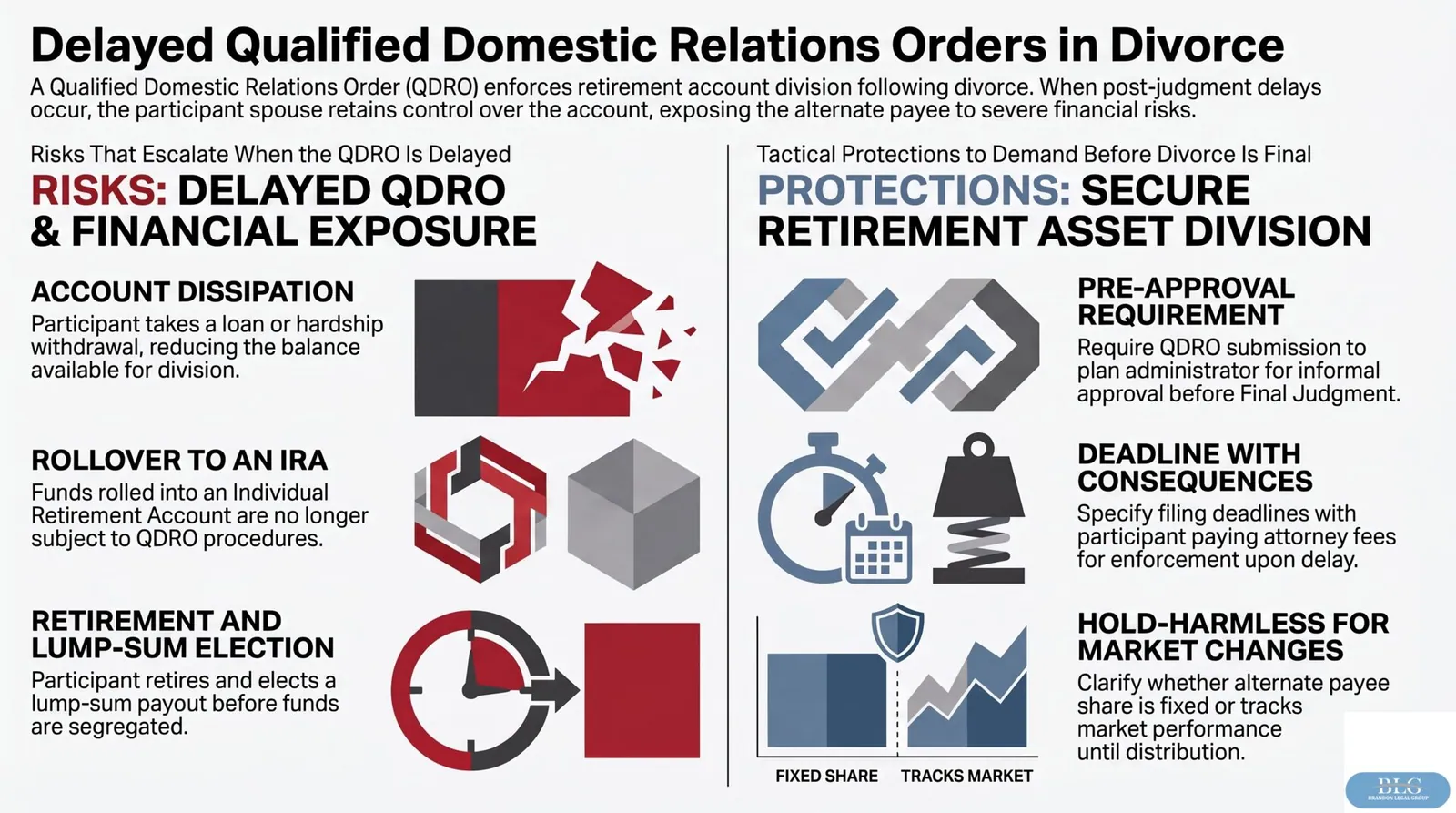
Risks That Escalate When the QDRO Is Delayed
Several specific risks crystallize when months pass without a finalized QDRO:
- Account dissipation: The participant takes a loan or hardship withdrawal, reducing the balance available for division.
- Rollover to an IRA: Once funds are rolled into an Individual Retirement Account, they are no longer subject to QDRO procedures. The alternate payee must pursue collection through contempt or breach of contract.
- Retirement and lump-sum election: The participant retires and elects a lump-sum payout. The alternate payee's share, if not yet segregated by the plan, may be consumed by taxes, spent, or hidden.
- Beneficiary manipulation: While a QDRO can override beneficiary designations for the covered portion, delays give the participant time to remarry and designate a new spouse as beneficiary, complicating enforcement.
- Plan termination or merger: Corporate restructuring can terminate or freeze plans, and if the QDRO is not on file, the alternate payee may lose priority in distribution.
Each of these scenarios transforms a clean division into contested litigation. The alternate payee who assumed the settlement was self-executing discovers that enforcement requires new motions, new court dates, and often, new counsel.
What Plan Administrators Require and Why They Reject QDROs
Every retirement plan has its own internal procedures for reviewing and approving QDROs. Plan administrators are not obligated to accept any order a court signs; the order must comply with both ERISA and the plan's specific terms. Common reasons for rejection include:
- The QDRO requests a form of payment the plan does not offer.
- The valuation date is ambiguous or inconsistent with plan records.
- The order fails to specify whether the alternate payee is entitled to cost-of-living adjustments or early retirement subsidies in a defined-benefit pension.
- Survivor benefit elections are missing or contradictory.
- The order attempts to assign benefits that have not yet vested.
Each rejection adds weeks or months to the timeline. Meanwhile, the account remains under the participant's exclusive control. Experienced counsel drafts QDROs with the plan's procedures in hand, often submitting a draft for informal review before filing with the court. This preemptive approach prevents the reject-and-redraft loop that stalls so many cases. When QDROs are treated as an afterthought, the alternate payee pays the price.
Tactical Protections to Demand Before the Divorce Is Final
The best defense against QDRO delay is to make its timely completion a condition of the divorce settlement. Several clauses offer protection:
- Pre-approval requirement: The marital settlement agreement can require that the QDRO be submitted to the plan administrator for informal approval before the Final Judgment is entered.
- Deadline with consequences: The agreement can specify that if the QDRO is not filed and approved within 60 or 90 days of the Final Judgment, the participant spouse must pay the alternate payee's attorney fees for enforcement.
- Prompt plan-review trigger: Once a domestic relations order is submitted, ERISA plans generally must follow procedures for determining whether the order is qualified, including segregating amounts that would be payable during the determination period. Do not wait until after judgment to start that clock if the account is at risk.
- Hold-harmless for post-judgment growth or loss: The agreement should clarify whether the alternate payee's share is fixed as of the date of filing or continues to track market performance until distribution. Ambiguity here fuels litigation.
These provisions shift the risk back onto the participant and create leverage for timely completion. Without them, the alternate payee is at the mercy of the participant's cooperation, or lack thereof.
¶ ¶ ¶Understanding your rights to marital property division is essential when retirement accounts are at stake, especially when delays threaten enforcement.
Defined-benefit pensions present additional complexity. Unlike 401(k) accounts, pensions pay a monthly benefit rather than a lump sum, and the valuation depends on assumptions about retirement age, interest rates, and survivor elections. A delayed QDRO in a pension case can mean the alternate payee misses the window to elect shared payment versus a separate interest, or loses the ability to receive payments if the participant dies before retirement. The stakes are not theoretical. Pension QDROs require actuarial precision and plan-specific drafting, and delay compounds every variable.

No misconception in divorce has cost alternate payees more money than the assumption that a court order is self-enforcing. The judgment says the retirement account gets split. The settlement is signed. But until the QDRO is filed, approved, and implemented, the division is a promise without a mechanism. Delays are not inevitable. They are the result of inattention, inexperience, or the mistaken belief that post-judgment work can wait. It cannot.
Closing Remarks
If your Final Judgment ordered retirement division months ago and the QDRO still hasn't been filed, if your ex-spouse just retired and you have no confirmation your share was segregated, or if the plan administrator rejected the order and nobody has told you why, the window to protect what you were awarded is closing. Brandon Legal Group handles delayed QDROs, enforcement of retirement division orders, and contempt actions when a spouse obstructs distribution. Contact us before the account disappears.
Frequently Asked Questions
Can the plan administrator refuse to honor a court-ordered retirement division?
A plan administrator cannot refuse a properly drafted QDRO that complies with ERISA and the plan's terms. However, administrators routinely reject orders with technical deficiencies, ambiguous language, incorrect account details, orprovisions the plan does not support. The rejection does not invalidate the divorce judgment; it simply means the order must be revised and resubmitted. This is why preemptive review with the plan before filing is critical.
What happens if the participant spouse retires before the QDRO is finalized?
If the participant retires and begins receiving pension payments or takes a lump-sum distribution before the QDRO is in place, the alternate payee's claim becomes significantly harder to enforce. The funds may no longer be in the plan, and depending on how they were distributed, may no longer be subject to QDRO procedures. The alternate payee may need to pursue contempt proceedings or file a separate collection action, both of which are slower, costlier, and less certain than a timely QDRO.
Does the alternate payee have any control over the timing of the QDRO?
The alternate payee may have more control than they think. Their attorney, or a specialist QDRO drafter, can push the order, demand plan documents, submit a draft for review, and file a motion to compel if the other side isobstructing. The marital settlement agreement can, and should, include deadlines and enforcement mechanisms. If the participant's attorney is responsible for drafting the QDRO and misses deadlines, the alternate payee can seek court intervention and attorney fees. Passive waiting is not a strategy.
Can the QDRO be filed before the Final Judgment is entered?
In some cases, a QDRO can be submitted to the plan administrator for pre-approval before the divorce is final, and then formalized and entered simultaneously with the Final Judgment. This approach eliminates post-judgment delay and ensures the division is enforceable immediately. It requires coordination between counsel and the plan administrator, but it is often the cleanest path, especially when the participant spouse is nearing retirement or the account balance is high.
What is the risk if the QDRO assigns a percentage rather than a fixed dollar amount?
Assigning a percentage of the account "as of the date of distribution" means the alternate payee's share continues to fluctuate with market performance, and, unless the order says otherwise, may be affected by loans, withdrawals, or contributions the participant makes post-divorce. If the QDRO is delayed and the participant takes a loan against the account, the alternate payee's percentage may be calculated against a reduced balance. Assigning a fixed dollar amount as of a certain date, typically the filing date, locks in the division and prevents post-divorce erosion, but it requires precise valuation and clear language in both the settlement agreement and the QDRO.
References
- Fla. Stat. § 61.075 (Equitable distribution of marital assets and liabilities).
- 29 U.S.C. § 1056(d) ((3), Qualified Domestic Relations Orders).
- U.S. Department of Labor, QDROs: The Division of Retirement Benefits Through Qualified Domestic Relations Orders
- IRS Publication 504, Divorced or Separated Individuals