

TL;DR: As of May 2026, the U.S. State Department is no longer waiting for you to apply or renew. If you owe more than $2,500 in certified child support arrears, your passport can be revoked while it’s sitting in your drawer. This article explains how the program works, what Florida parents on both sides of the issue need to do this week, and how it changes the leverage in custody and support disputes.
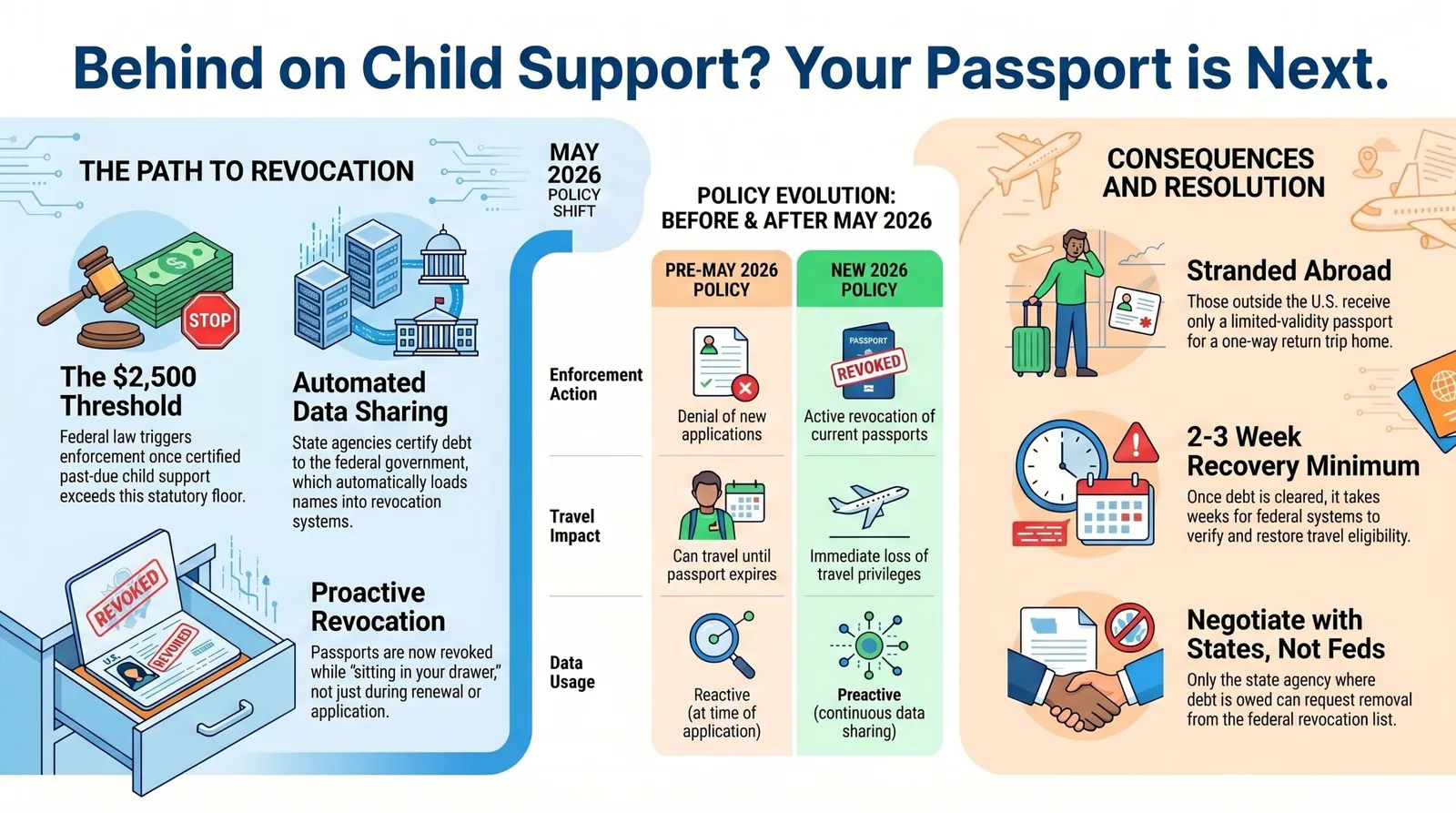 If you owe child support and you have a passport, the rules just changed on you.
For decades, the federal Passport Denial Program has technically allowed the State Department to refuse a passport to anyone certified as owing more than $2,500 in past-due child support. In practice, almost nobody noticed. The penalty only kicked in when you walked into a passport office to apply or renew. If your existing passport was good for another five years, you could keep traveling, keep working overseas, keep visiting family abroad, all while the arrears piled up.
¶
¶ That window is closed.
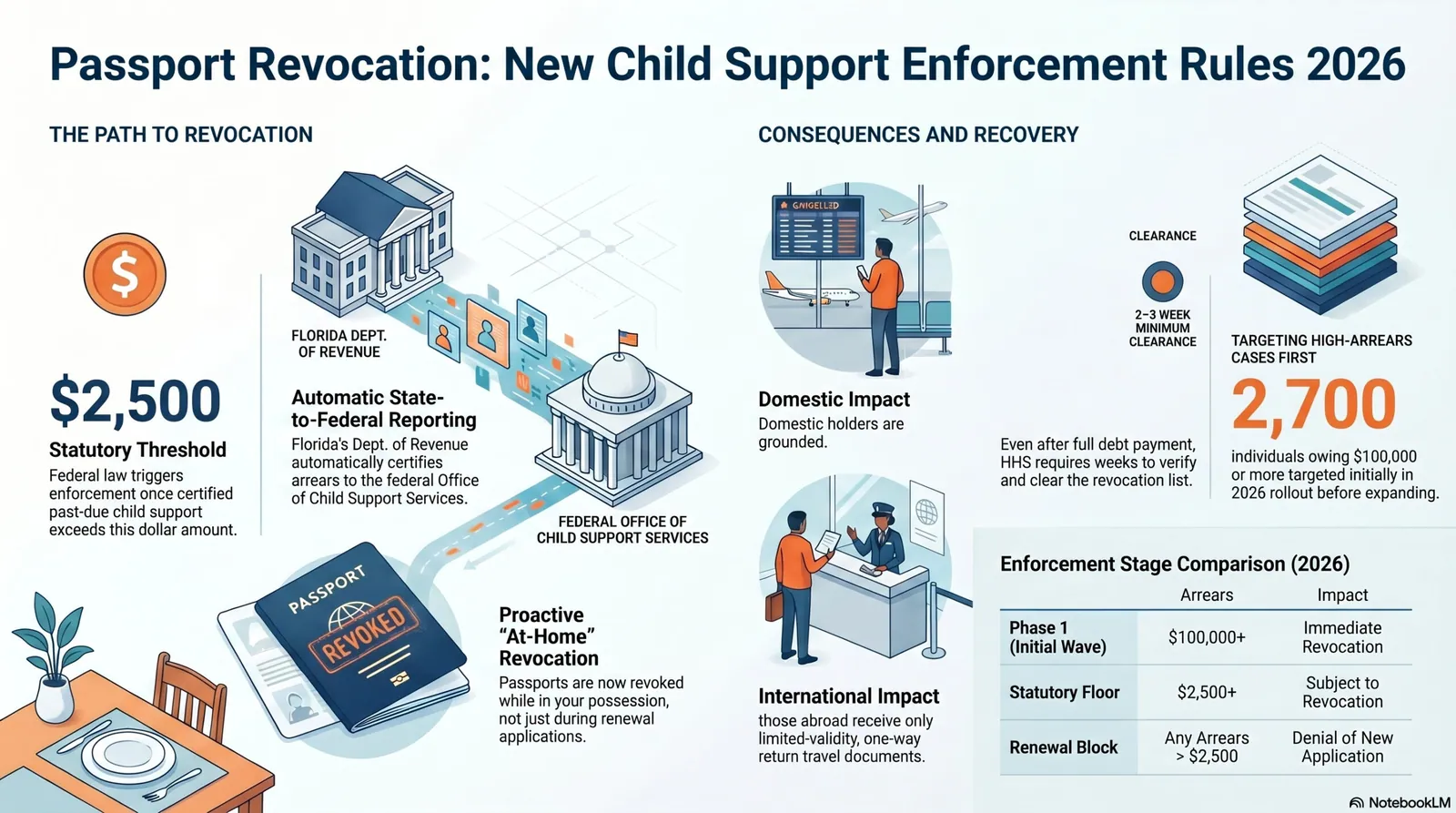
On May 8, 2026, the State Department began proactively revoking existing passports based on data shared directly by the Department of Health and Human Services. The first wave is targeting roughly 2,700 Americans who owe $100,000 or more. Officials have already confirmed the program will expand toward the statutory floor of $2,500, which would put thousands more parents in the line of fire.
This is not a rumor. It is not a meme. It is current federal policy, and if you are a parent in Florida, on either side of a child support order, it changes how you need to think about your case.
How the Program Actually Works
The legal authority comes from the Personal Responsibility and Work Opportunity Reconciliation Act of 1996, codified at 42 U.S.C. § 652(k). The threshold has been $2,500 in certified arrears since 2007. The chain runs like this:
- The state child support enforcement agency (in Florida, the Department of Revenue’s Child Support Program) tracks your arrears.
- Once you cross $2,500 in past-due support, the state certifies you to the federal Office of Child Support Services.
- OCSS forwards your name to the State Department, which loads it into the Consular Lookout and Support System (CLASS).
- As of this month, that listing no longer just blocks a renewal. It triggers active revocation of any passport you currently hold.
If you are inside the United States when your passport is revoked, you are stuck here until you resolve the debt. If you are outside the United States, on vacation, on a work assignment, visiting family, you are eligible only for a limited-validity passport for direct return to the U.S. Not a full passport. Not a round-trip. A one-way ticket home, and then you deal with the arrears from American soil.
Removal from the list is not instant either. After you pay or set up an approved payment plan with the state, the State Department itself says the verification process takes a minimum of two to three weeks before HHS clears your name and you can apply for a new passport. If you have urgent travel, two to three weeks is forever.
If You Are the Parent Who Has Not Been Paid
Most articles on this topic talk to the parent who owes. Let’s start with the one who is owed, because in our practice, that is more often the parent picking up the phone.
You have probably been told, by lawyers and friends both, that child support enforcement in Florida is a slow, frustrating process. Wage garnishment, license suspensions, contempt motions, occasional jail threats, all of it real, all of it slow. Passport denial is the one tool that actually scares the people who think they are above the system, because it touches something they care about: their freedom to travel.
If your ex has fallen significantly behind, here is what you should know:
- You do not have to do anything to trigger this. If your case is enforced through the Florida Department of Revenue (which it is, by default, in any IV-D case), certification to the federal program is automatic once arrears exceed $2,500. The system is doing the work whether you call them or not.
- Verify your case is in the system. Some cases, particularly ones handled entirely through private attorneys without a state enforcement component, may not be flowing data to OCSS. If you are owed substantial arrears and you are not sure whether your case is certified, that is a question to answer this week, not next year.
- This is leverage you can name in negotiation. If you are in mediation, a contempt hearing, or a settlement discussion with a non-paying ex, the looming reality of passport revocation is a legitimate, factual point to put on the table. It is not a threat. It is the law. Some parents who have ignored the Department of Revenue for years suddenly become very interested in a payment plan when their ability to leave the country is at stake.
- If you are worried about international abduction, this is a different conversation. Passport revocation is not the same as the Children’s Passport Issuance Alert Program (CPIAP), which is what you use to be notified if someone tries to obtain a passport for your child. If you have real concerns that your ex may take the children out of the country, both tools matter, and you need to talk to an attorney about them now, not after a flight is booked.
¶
¶
If You Are the Parent Behind on Support
Read this part carefully, because most of the legal commentary on the new policy is written for someone else and the practical advice you need is buried.
First: a passport revocation does not erase your debt, does not lower your obligation going forward, and does not give you any defense in a Florida contempt proceeding. It is an enforcement tool layered on top of everything the state was already going to do to you. License suspension, bank levies, tax intercepts, and contempt, all still on the table.
¶
¶ Second: the way out is narrower than people assume. You cannot negotiate with the State Department. The State Department is not the decision-maker here; they are running a list. The decision-maker is the state child support agency in the state where you owe. If you owe in multiple states, you have to clear it in every one of them. Paying off Georgia does not help you if Florida still has you certified.
Third: emergency exceptions exist but they are narrow. The State Department can issue a limited-validity passport in genuine life-or-death situations, typically the serious illness, injury, or death of an immediate family member abroad, but the documentation required is substantial and the timeline is not in your favor. “I have a work trip next week” is not a life-or-death situation, and the answer will be no.
Fourth: if your child support order does not reflect your actual current income, that is a problem you should have fixed already, but it is the only legitimate path that addresses the underlying issue. Florida law allows modification of child support when there is a substantial change in circumstances, typically a 15% or $50/month change in the calculated amount, whichever is greater. If you lost a job two years ago and never went back to court, the arrears built up against an order that no longer matched your reality. The order keeps running until a court changes it. The arrears are the arrears regardless of whether the underlying number was fair, and that is exactly the kind of preventable disaster a family law attorney is supposed to help you avoid.
The honest version of the advice is this: if you are behind, you needed to deal with it last year. The second-best time is today. Call the Florida Department of Revenue Child Support Program, find out exactly where your case stands, and either pay it down below the threshold or get on a formal payment plan that the state will accept. Then, if your underlying order is wrong for your actual circumstances, file for modification. Do not wait until you are sitting in a foreign airport being told your passport is no longer valid.
What This Means for Custody and Parenting Plan Cases
Passport status now belongs in any parenting plan that contemplates international travel, and frankly, in plenty that don’t.
¶
¶ If your exhas a history of unpaid support and has talked about taking the kids on a trip abroad, the parenting plan should address it. International travel provisions, written consent requirements, passport possession rules, and CPIAP enrollment are all standard tools that should be considered when there is any meaningful risk. Florida courts can, under the § 61.13(3) best-interests factors, consider both the financial responsibility of each parent and the risk of removal from the jurisdiction. A pattern of arrears combined with international ties is the kind of concrete, documented behavior that judges actually act on.
If you are the parent paying support and you travel internationally for work, pilots, contractors, energy sector employees, cruise crew, anyone who depends on a passport to do their job, the calculus is different and more urgent. A passport revocation is not just a personal inconvenience; it is potentially a job-ending event, which then cascades into your ability to make support payments at all. The system has been criticized for exactly this reason. The criticism does not change the policy. If your livelihood depends on travel, your child support compliance is no longer a private matter between you and the state. It is a precondition for working.
The Bottom Line
The Passport Denial Program has existed for thirty years. What changed in May 2026 is that it grew teeth. The State Department is no longer waiting for you to apply for something. It is actively pulling passports out of circulation based on a list it gets from HHS, and the program is set to expand from the $100,000 tier down to the $2,500 statutory floor in stages.
If you are owed support, this is a tool that is finally working the way it was supposed to. If you are behind on support, this is the moment to stop hoping the problem will resolve itself and deal with it directly. Either way, the worst position to be in is the one most people are in right now: vaguely aware that something changed, unsure whether it applies to them, and waiting to find out the hard way.
That is not a position Brandon Legal Group leaves clients in. If you have a child support question, enforcement, modification, or arrears, a parenting plan that needs international travel provisions, or a custody case where the other parent’s compliance has become part of the picture, call us. We will tell you exactly where you stand and exactly what to do about it.
Strength is not the same as patience. The system is moving. You should be too.
Frequently Asked Questions
What is the dollar threshold that triggers passport denial or revocation?
$2,500 in certified past-due child support arrears. The threshold has been at this level since the Deficit Reduction Act of 2005, and it applies regardless of how long it took you to accumulate that balance or whether you are currently making payments. Once the state certifies your case to the federal Office of Child Support Services, the State Department will deny new applications and, as of May 2026, actively revoke existing passports.
I just paid off my arrears. How fast can I get my passport back?
Not as fast as you want. The State Department says the verification process takes a minimum of two to three weeks after the state notifies HHS that your debt is resolved. In practice, plan on longer. If you have international travel coming up, do not assume that paying the arrears the week before your flight will solve the problem. It will not.
¶
Can I just get a payment plan instead of paying everything in full?
In many cases, yes. Florida’s Department of Revenue Child Support Program will often accept a formal payment plan that brings you into compliance and removes you from the certification list, even if the full arrears balance is not paid off. The terms are not standardized; they depend on the amount owed, your income, and your payment history, and the plan has to be one the state accepts, not one you propose unilaterally. An attorney can help you negotiate terms that are realistic and that the state will actually approve.
I owe child support in two states. Does paying one of them help?
No. If multiple states have certified arrears against you, every one of them has to be cleared before the State Department will remove you from the list. Resolving Georgia does not help you if Florida still has a hold, and vice versa. This is one of the most common ways people get blindsided: they fix the case they remember and forget about the older one in another state.
My ex is way behind on support and I never reported it. Is the passport revocation automatic?
It depends on whether your case is enforced through the Florida Department of Revenue. Most Florida child support orders are IV-D cases by default, which means the state is already tracking arrears and certifies cases to the federal program automatically once they cross $2,500. If your case has always been handled privately, through your own attorney, with no state enforcement component, the data may not be flowing to the federal program at all. If you are not sure which category your case falls into, that is a question worth answering this week.
Can the State Department make an exception for a work trip or a family vacation?
No. Emergency exceptions exist, but they are narrow and typically limited to genuine life-or-death situations involving an immediate family member abroad: serious illness, injury, or death. The required documentation is substantial. A work trip, a wedding, a long-planned vacation, or a job that depends on international travel does not qualify as an emergency under the State Department’s rules, no matter how important it feels.
I lost my job two years ago and the support order never changed. Am I stuck?
The arrears are the arrears, and they will keep accruing against the original order until a court modifies it. Florida law allows modification of child support when there is a substantial change in circumstances, generally a 15% or $50/month change in the calculated amount, whichever is greater. A modification typically does not erase arrears that built up before you filed, but it can stop the bleeding going forward and is often a necessary step before you can negotiate a realistic payment plan on what you already owe. The earlier you file, the better.
Can passport revocation be used against my ex in our custody case?
It is not a custody factor on its own, but the underlying behavior, chronic non-payment of support, a pattern of arrears, financial irresponsibility, is something Florida courts can and do consider under the § 61.13(3) best-interests factors. If your ex’s pattern of non-payment is part of a larger picture that affects the children, it belongs in the case. Talk to your attorney about how to present it.
Should I worry about my ex taking the kids out of the country?
If you have any genuine concern about international removal, you need two separate tools, and they do different things. Passport revocation applies to your ex’s own passport based on their support arrears. The Children’s Passport Issuance Alert Program (CPIAP) is what flags your child’s passport application so you are notified if anyone tries to obtain one. Both have a place in a high-conflict parenting plan, and both are conversations to have with an attorney before there is a problem, not after.