

Joint accounts with rights of survivorship can bypass probate and transfer directly to the surviving account holder at death, but they can also expose funds to creditor disputes, Medicaid eligibility problems, tax issues, and family fights over intent. Florida law generally presumes survivorship for multi-party deposit accounts unless the account documents or clear evidence show otherwise, making account titling and document review critical before a death makes the transfer hard to unwind.
A joint account with rights of survivorship sounds like the easiest estate planning tool available: add a name, skip probate, done. And for years, it works invisibly, until the day the first owner dies and the survivor discovers the account also created a creditor fight, a Medicaid eligibility problem, a tax issue, or a family dispute no one planned for. By then, the money may have already moved, and the argument shifts from "what did they want" to "what does the account contract say." That document, often signed years ago in a bank lobby without much thought, becomes the evidence that matters.
¶
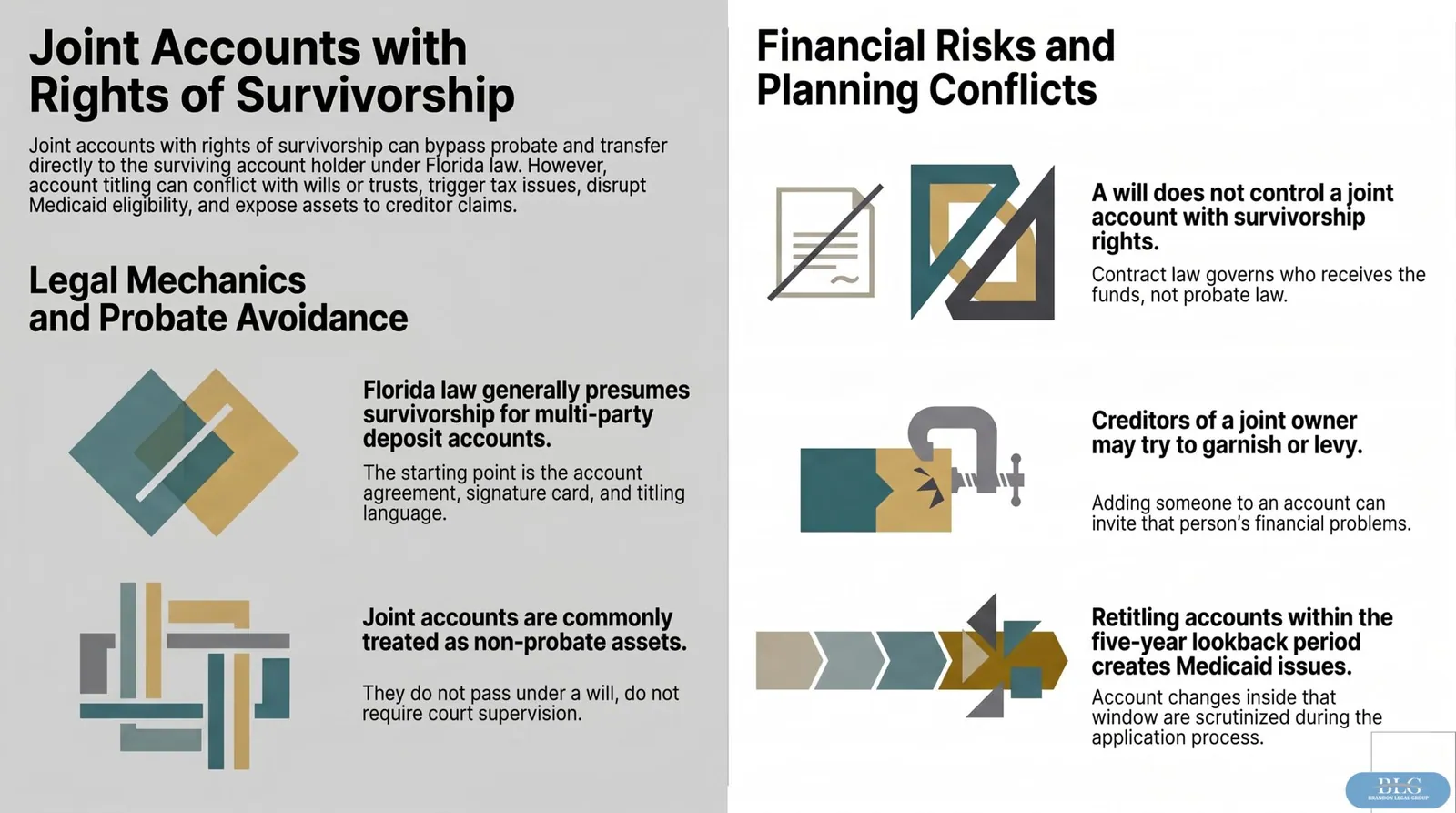
Joint accounts are commonly treated as non-probate assets. They do not pass under a will, do not require court supervision, and do not wait for an estate to open when valid survivorship rights exist. Florida Statute § 655.79 creates a strong survivorship presumption for deposit accounts held in two or more names unless the account contract says otherwise or clear and convincing proof shows a different intent. That transfer can be automatic and powerful. But avoiding probate is not the same thing as avoiding every legal consequence.
How Survivorship Rights Are Created and Proven
Survivorship does not depend only on a family member's memory of what the account owner supposedly wanted. The starting point is the account agreement, signature card, and titling language. Phrases like "joint tenants with right of survivorship," "JTWROS," or "payable to survivor" make the intent clear. But under Florida law, survivorship may also be presumed for a multi-party deposit account unless the documents expressly provide otherwise or there is clear and convincing proof of a contrary intent.
Banks use standard forms, and those forms vary. Some include survivorship language by default; others require the applicant to select or initial a specific option. The critical moment is account opening or retitling, not account use. Years of joint deposits, shared statements, and co-signed checks do not fix bad documentation. When survivorship is disputed, by an heir, a creditor, or another interested party, the financial institution produces the account records, and those records are treated as contract evidence. If they are ambiguous, incomplete, or missing, the presumption under Fla. Stat. § 655.79 may still matter, but the dispute becomes factual, expensive, and ugly fast.
Creditor Claims and Medicaid Issues Involving Joint Accounts
Survivorship rights do not make an account untouchable. While the account is active, creditors of a joint owner may try to garnish or levy against that owner's interest in the account. The result depends on the account structure, the source of the funds, whether the owners are married, and whether the non-debtor owner can prove ownership of some or all of the balance. The hard truth is simple: adding someone to an account can invite that person's financial problems into money you thought was protected.
After death, a valid survivorship transfer generally occurs outside probate, so ordinary probate creditors of the deceased usually do not collect from that account through the normal probate claims process. But that does not mean the account is risk-free. A transfer made to hinder or defraud known creditors may be challenged under fraudulent transfer principles. Creditors of the surviving owner may also pursue the account after the survivor owns it outright.
Medicaid requires a separate analysis. In Florida, Medicaid estate recovery is generally pursued through the deceased recipient's probate estate under Fla. Stat. § 409.9101, so a survivorship account that never enters probate may not be reached through the ordinary estate recovery claim process. That is different from Medicaid eligibility planning during life. Adding a non-spouse joint owner, allowing withdrawals, or retitling accounts within the five-year lookback period can still create serious eligibility and transfer-penalty issues. Do not confuse "outside probate" with "safe for Medicaid planning." They are not the same thing.
- The account may pass automatically to the survivor at death
- Probate creditors generally do not pursue it through the ordinary probate claims process after a valid survivorship transfer
- Fraudulent transfer claims and surviving-owner creditor claims can still create exposure
- Medicaid eligibility rules during life may scrutinize retitling, withdrawals, and transfers within the five-year lookback period
For blended families or late-life planning, these dynamics create tension. Adding an adult child to an account for convenience can unintentionally disinherit other children, complicate Medicaid eligibility, or expose the original owner's funds to the child's divorce, judgment, or bankruptcy. The convenience of estate planning shortcuts often collides with asset protection realities years later.
When Survivorship Conflicts with a Will or Trust
A will does not control a joint account with survivorship rights. The account agreement is a contract, and contract law governs who receives the funds, not probate law. If a will says "I leave all my assets to my daughter" but a joint checking account names a son as co-owner with survivorship rights, the son may receive the account and the daughter may receive nothing from it, even if the decedent's broader estate plan said something different.
Disputes arise when the joint account was created for convenience rather than inheritance. An elderly parent adds a child to an account to help pay bills, not to give the child the balance at death. But unless the account documentation clearly limits the child's role or evidence proves a contrary intent, Florida's survivorship presumption can be hard to defeat. Intent must generally be proven with clear and convincing evidence, and that standard is difficult to meet with testimony alone.
Revocable trusts face the same problem. If the trust is named beneficiary of other accounts but a joint account remains titled individually with a survivorship co-owner, that account does not fund the trust. It passes to the survivor. The result is an incomplete estate plan. Part of the estate flows through the trust according to the carefully drafted distribution scheme, and part bypasses it entirely. Coordination between account titling and trust funding is not automatic. It requires deliberate alignment, usually during the trust creation process, and periodic review when accounts are opened or closed.
Tax and Gift Implications of Adding a Joint Owner
Adding a joint owner can create federal gift tax issues, but the rule is more nuanced than people assume. For many joint bank accounts, the IRS generally treats a gift as complete when the added owner withdraws funds for that person's own benefit, not necessarily the moment the name is added. Other assets, such as jointly titled investment accounts or securities, may be treated differently. The tax result depends on the account type, the source of funds, and the rights given to the new owner.
For Medicaid planning, the danger is practical and immediate. Retitling an account, adding a joint owner, or allowing a child to withdraw funds can be treated as a transfer for less than fair market value unless an exception applies. That can trigger a penalty period during which the applicant is ineligible for long-term care Medicaid benefits. The lookback period is five years, meaning account changes inside that window are scrutinized. The excuse that the co-owner "never meant to take the money" may not save the plan if the paperwork and transactions tell a different story.
From an income tax perspective, the surviving owner may receive a basis adjustment for the portion of the account or investment assets attributable to the deceased owner. That often results in a partial step-up in basis, not a full step-up, and can create a mixed-basis scenario if the survivor later liquidates appreciated assets held in the account.
Probate Avoidance Does Not Mean Planning Clarity
Joint accounts with survivorship rights are effective probate-avoidance tools. They are not substitutes for comprehensive estate planning. They bypass the court, but they do not automatically coordinate with other documents, protect against creditor claims, or clarify intent when family circumstances are complicated. A checking account shared with one child may make bill-paying easier, but it does not reflect a parent's desire to treat all children equally at death. That gap between mechanism and intent becomes a problem when the account holds substantial value and the survivor's entitlement is questioned by siblings, a surviving spouse, or inconsistencies with digital asset planning.
For married couples, joint accounts often function as expected: the surviving spouse receives the account, and Florida's homestead and elective share protections are generally not implicated by the account transfer itself. For unmarried individuals, blended families, or second marriages, the same account structure can create unintended disinheritance, sibling conflict, or Medicaid planning problems. Retitling accounts to add survivorship is quick; undoing the consequences after death is not.

When survivorship language is unclear, the account holds significant value, or the estate plan includes a trust intended to receive all assets, the default assumption, that the joint account will "just work", becomes aliability. Coordination is not optional. Reviewing account agreements, confirming titling, and ensuring alignment with broader estate goals prevents the common scenario in which probate is avoided but the estate plan still fails.
Closing Remarks
If a joint account was created years ago without reviewing the survivorship clause, or if the estate plan includes a revocable trust but some accounts remain individually titled with co-owners, or if Medicaid planning is on the horizon and account retitling has already occurred, the assumptions built into those decisions deserve a second look before the transfer becomes final. Brandon Legal Group structures estate plans that coordinate account titling, beneficiary designations, and trust funding to work together rather than against each other. Contact us to review how your accounts are titled and whether your current setup aligns with what you intend to happen.
Frequently Asked Questions
Does a joint account with survivorship rights avoid probate in Florida?
Yes. A properly titled joint account with survivorship rights generally passes automatically to the surviving owner at death and does not become part of the probate estate. The transfer does not require court approval, letters of administration, or compliance with the ordinary probate claims process. However, the account may still be involved in disputes over intent, fraud, creditor exposure, or Medicaid eligibility planning.
Can I add my child to my bank account without triggering a gift tax?
Sometimes, but do not guess. For many joint bank accounts, a completed gift may occur when the child withdraws money for the child's own use, not merely when the child's name is added. Other types of jointly titled assets can be treated differently. If the transfer exceeds the annual exclusion amount, a gift tax return may be required, and larger transfers may consume part of the lifetime estate and gift tax exemption. Medicaid applicants face separate consequences if retitling or withdrawals are treated as uncompensated transfers.
What happens if my will says one thing and my joint account says another?
The joint account agreement usually controls. Survivorship rights arise from the account contract, not from probate law, and a will does not override a valid survivorship arrangement. If the account names a co-owner with survivorship rights, that individual may receive the funds regardless of contrary instructions in a will. Proving that the account was intended only for convenience, and not for inheritance, requires strong evidence and often results in litigation among heirs.
Can creditors take money from a joint account after the original owner dies?
Ordinary probate creditors of the deceased generally do not collect from a valid survivorship account through the probate claims process because the account passed outside probate. However, creditors of the surviving owner may pursue the account after the survivor owns it outright. If the joint account was created to hinder or defraud known creditors, the transfer may also be challenged. During life, a creditor of one joint owner may attempt to garnish that owner's interest, which can force the other owner to prove the source and ownership of the funds.
Will adding a joint owner affect my eligibility for Medicaid long-term care benefits?
It can. Adding a non-spouse joint owner, changing account title, or allowing another person to withdraw funds may create Medicaid eligibility problems if the transaction is treated as a transfer for less than fair market value. The lookback period is five years, meaning account changes within that window are scrutinized during the application process. Before adding a joint owner for convenience, get advice on whether a power of attorney, trust, or other planning tool would accomplish the same goal with less risk.
How do I remove survivorship rights from an existing joint account?
Survivorship rights are controlled by the account agreement, and removing them typically requires closing the account or opening a new one with different titling. Some financial institutions allow amendment of the account terms if both owners consent and execute a new signature card. Unilateral removal is generally not permitted. If one co-owner is incapacitated or refuses to cooperate, court intervention may be necessary. Any retitling should be done with awareness of potential tax, creditor, and Medicaid consequences, particularly if the original account was opened years earlier under different circumstances.
References
- Fla. Stat. § 655.79
- Fla. Stat. § 409.9101
- Treas. Reg. § 25.2511-1(h)(4)