

Joint accounts with right of survivorship typically pass outside probate and avoid most estate freezes, but not all. Tax levies, garnishment writs, court orders, ownership disputes, and bank compliance holds can still lock down access even when survivorship rights are clear. What survives probate does not always survive scrutiny.
Joint accounts with right of survivorship are sold as the escape hatch; transfer wealth outside probate, bypass the freeze, hand the survivor immediate access. And most of the time, that's exactly what happens. Until it doesn't. The account clears probate, but the bank will not release it. The co-owner's name is on the signature card, but the funds are frozen anyway. Survivorship rights do not override IRS levies, active garnishment writs, court orders, fraud investigations, or a serious dispute over whether the account was truly a survivorship account. The will never mentioned the account, so it may never enter the estate, but that does not mean the bank will hand over the money without a fight.

Understanding what gets frozen, and why, is the difference between liquidity and a standoff that drains months and legal fees.
How Right of Survivorship Actually Works in Florida
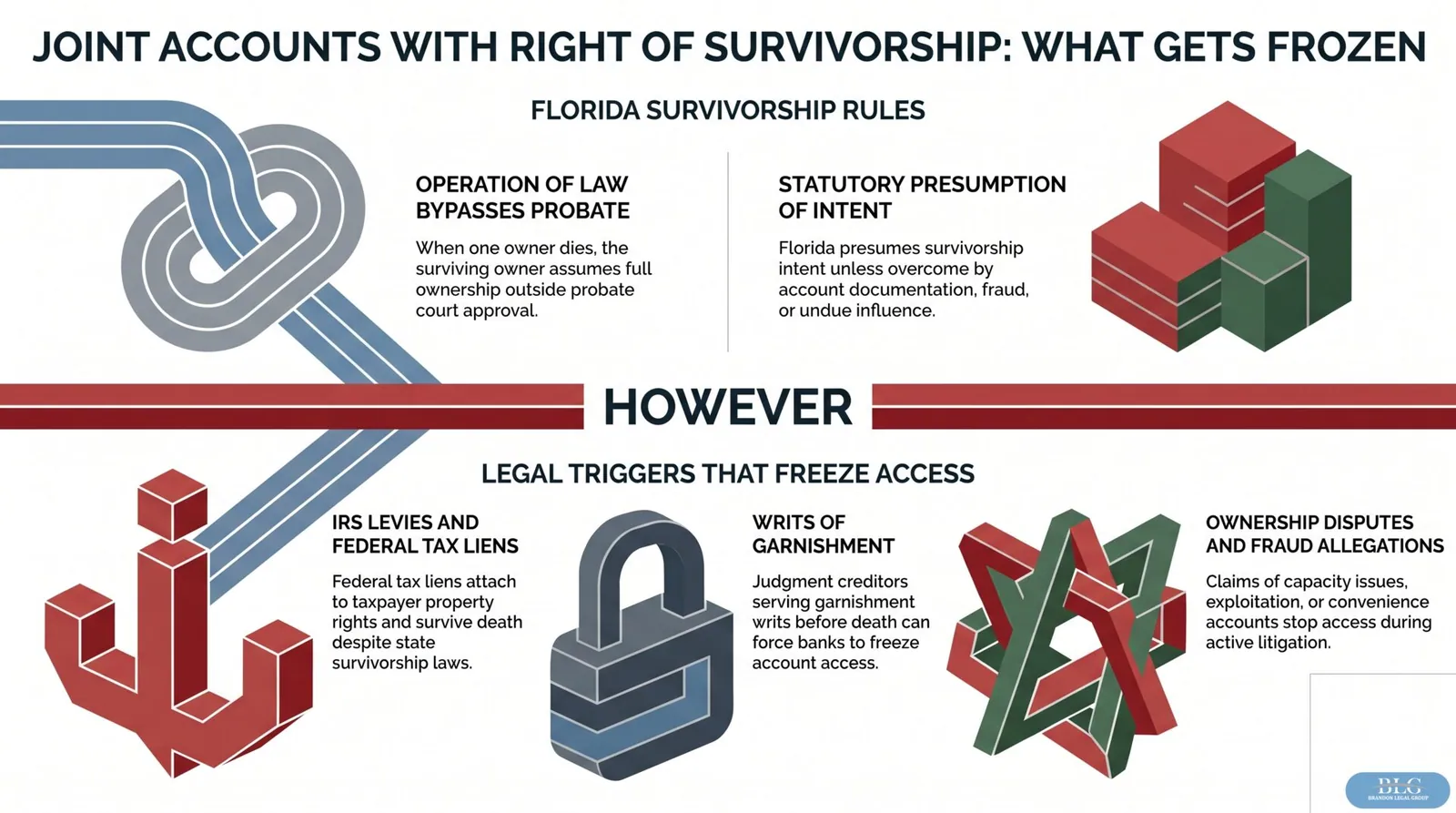
A joint account with right of survivorship operates under a simple rule: when one owner dies, the surviving owner assumes full ownership by operation of law. The account does not pass through the will, does not enter the probate estate, and does not require probate court approval to transfer. Florida Statute § 655.79 governs this mechanism for accounts held at financial institutions, and it is straightforward when no complications arise.
The statute presumes that both account holders intended survivorship, and that presumption can be overcome only by the account documentation itself, proof of fraud or undue influence, or clear and convincing evidence of a contrary intent. Signature cards, account agreements, and deposit contracts matter. If the documentation shows joint ownership with survivorship rights, the survivor usually can access the account after presenting a death certificate. The financial institution has no duty to distribute the account under the will and no obligation to treat it as a probate asset, unless something else intervenes.
But survivorship does not cleanse the account of existing legal problems. It does not erase federal tax liability. It does not cancel a garnishment already served on the bank. And it does not stop a court from freezing funds while ownership, fraud, or undue influence is litigated.
What Triggers a Freeze Despite Survivorship Rights
Survivorship rights govern ownership. They do not automatically defeat enforcement, investigation, or court control. Even when the account passes outside probate, certain claims and procedures can freeze access:
- IRS levies and federal tax liens. The IRS does not yield to state survivorship law when unpaid federal taxes are involved. A federal tax lien attaches to the taxpayer's property and rights to property. If the decedent had an interest in a joint account, the IRS may assert that lien against that interest and may levy the account after death if the tax liability remains unpaid.
- Court orders and garnishments. If a judgment creditor served a writ of garnishment before death, the financial institution may freeze the account even after one owner dies. The writ reaches the debtor's interest as of the time the writ attaches. The surviving owner may have to intervene and prove what portion of the funds, if any, belongs solely to the survivor.
- Ownership disputes, undue influence claims, and fraud allegations. Joint accounts created late in life, funded entirely by the decedent, or changed shortly before death invite attack. A personal representative, heir, or interested party may argue the co-owner was added for convenience only, that the decedent lacked capacity, or that the account change resulted from exploitation. Once that fight reaches the bank or the court, access can stop fast.
- Suspicious activity and compliance reviews. Financial institutions flag accounts when death certificates are presented alongside recent large deposits, sudden account changes, elder exploitation concerns, or patterns suggesting fraud. These holds are administrative, not probate transfers, but they are real. Banks do not release funds until their compliance concerns are resolved.
- Probate litigation affecting the account. A routine probate creditor claim does not automatically make a valid survivorship account part of the estate. But if the estate alleges the account was not truly a survivorship asset, was fraudulently transferred, or was funded with property belonging to the estate, the court can restrict access while the dispute is resolved.
- Medicaid-related probate issues. Florida Medicaid estate recovery generally proceeds through claims against the recipient's probate estate, not every non-probate survivorship account. But if the account lacks valid survivorship documentation, is pulled into a probate dispute, or is alleged to have been transferred improperly, Medicaid-related claims can become part of the fight.
Each scenario uses a different legal mechanism, but the result is the same: the account holder with apparent survivorship rights cannot access the funds until the hold, levy, order, or dispute is resolved.
Creditor Claims and Non-Probate Asset Exposure
Florida law draws a hard line between probate assets and non-probate transfers. Creditors do not get to ignore that line just because the estate is short on cash. A valid joint account with right of survivorship usually belongs to the survivor at death and is not automatically available to ordinary estate creditors.
That does not mean the account is untouchable. A creditor or estate fiduciary may have a path if there is a separate legal basis: a federal tax lien, a garnishment, a court order, a fraudulent transfer claim, a successful challenge to the account documentation, or proof that the account was merely a convenience account and not intended to pass by survivorship. Courts examine contribution patterns, control over withdrawals, timing of account creation, capacity, and the paperwork signed at the bank.
This exposure is not automatic. Filing a probate claim is not the same thing as freezing a survivorship account. The claimant must use the correct legal procedure and prove the account is reachable. But once litigation starts, financial institutions often refuse to release funds until a court order tells them what to do. The freeze can last months, and the surviving owner may need counsel to prove ownership of funds that were supposed to transfer automatically.
This is why survivorship accounts are not substitutes for comprehensive estate planning. They serve a purpose: avoiding probate delays and providing liquidity, but they do not resolve tax exposure, creditor enforcement, incapacity planning, elder exploitation risk, or Medicaid planning issues by themselves.
Medicaid Estate Recovery and Joint Accounts
Medicaid estate recovery is a federally required program that allows states to recover certain long-term care costs after a recipient dies. Florida administers recovery through state law, and the practical target is generally the deceased recipient's probate estate. That distinction matters. A bank account that validly passes to a surviving joint owner by right of survivorship is usually not a probate asset merely because the deceased person was once named on it.
Do not twist that into false comfort. Medicaid planning still has teeth. Transfers made to qualify for Medicaid can trigger lookback penalties during life. Accounts without clean survivorship documentation can end up in probate. A late-life account change can be challenged as exploitation, lack of capacity, or a transfer made for the wrong reason. If the account is brought back into the estate through litigation or was never validly non-probate in the first place, recovery questions can follow.
The survivor's best defense is documentation: signature cards, account agreements, deposit records, contribution histories, and statements showing who controlled the account. Most families do not keep that evidence because they assume a joint account is simple. Simple is not the same thing as safe.
Medicaid planning often involves restructuring assets long before a crisis. Adding a child or spouse to an account at the last minute is not a plan. Timing, intent, account title, contribution history, and Medicaid eligibility rules all matter; those rules are not forgiving.
Secured Debts, Liens, and Priority Claims
Some debts do not vanish at death. Federal tax liens, levies, garnishments, and court orders can follow or restrict a decedent's property interest even when the account is jointly titled. Survivorship changes ownership. It does not erase every enforcement tool already aimed at the account.
A federal tax lien, for example, attaches to all property and rights to property held by the taxpayer. That can include the taxpayer's interest in a joint account. When the taxpayer dies, the lien does not disappear just because the account has survivorship language. The IRS can levy to satisfy the debt, and a financial institution receiving a levy will freeze the account until the tax issue is resolved or the levy is released.
State court judgments usually reach bank accounts through garnishment. If the bank is served with a valid writ, it freezes the account and waits for the court process to play out. The survivor may need to file a claim of exemption, prove source of funds, or show that the debtor had no reachable interest in the money.
Homestead property enjoys constitutional protection from many creditor claims, but an ordinary survivorship bank account does not become homestead just because someone died. Some accounts or funds may be protected for other reasons, such as tenancy by the entireties, exempt wages, or protected benefits. But survivorship itself is not a creditor exemption. The account may avoid probate, but it does not automatically avoid enforcement.

Survivorship accounts are useful tools, but they are not armor. They streamline transfer, but they do not block every claim, levy, or dispute. Knowing what survives probate and what survives creditor pursuit are two different questions, and estate planning answers both, or it answers neither.
Closing Remarks
If a joint account has been frozen despite clear survivorship rights, a tax levy or garnishment has hit the account, or a financial institution is holding funds pending fraud review, the legal exposure is real and the clock is running. Brandon Legal Group resolves estate disputes, creditor claims, and probate complications that freeze what should transfer cleanly. Contact us and get the account released or the claim defeated.
Frequently Asked Questions
Does a joint account with right of survivorship go through probate in Florida?
No. A properly designated joint account with right of survivorship passes directly to the surviving owner by operation of law under Florida Statute § 655.79. The account does not enter the probate estate and does not require probate court approval for transfer. However, survivorship does not shield the account from tax levies, garnishments, court orders, fraud investigations, or litigation challenging the account itself.
Can Medicaid recover funds from a joint bank account after the owner dies?
In Florida, Medicaid estate recovery generally targets the deceased recipient's probate estate. A valid joint account with right of survivorship usually passes outside probate and is not automatically subject to recovery merely because the recipient was a co-owner. But Medicaid issues can still arise if the account lacks valid survivorship documentation, was transferred improperly, or becomes part of a probate dispute.
What happens if the IRS files a lien on a joint account before the owner dies?
A federal tax lien can attach to the decedent's property rights in the joint account and may survive the transfer to the surviving owner. The IRS can levy the account to satisfy unpaid tax liabilities. The financial institution will freeze the account upon receiving a levy, and the funds remain inaccessible until the tax debt is resolved, the levy is released, or a court determines the government's reach.
Can creditors freeze a joint account even if it has right of survivorship?
Yes, but not just because they filed a probate claim. Creditors generally need a valid legal mechanism, such as a garnishment writ, levy, court order, fraudulent transfer action, or successful challenge to the account's ownership. Administrative holds triggered by fraud investigations or compliance reviews can also freeze accounts regardless of survivorship language. The surviving owner may need to litigate to release the funds.
How can someone protect a joint account from creditor claims and estate recovery?
Protection strategies depend on timing, intent, account title, contribution history, and the type of claim involved. Clean documentation, early planning, and proper titling can reduce exposure. Irrevocable trusts, Medicaid planning, tenancy by the entireties where appropriate, and careful account designation may provide stronger protection than a last-minute joint account. Transfers made shortly before death or during Medicaid lookback periods invite scrutiny. Effective protection requires advance planning and compliance with both state and federal rules, which is why estate planning that anticipates creditor claims is essential.
References
- Florida Statutes § 655.79 (Deposits and accounts in two or more names; presumption as to vesting on death).
- Florida Statutes § 409.9101 (Medicaid estate recovery).
- 42 U.S.C. § 1396 (p (Liens, adjustments and recoveries, and transfers of assets)).
- 26 U.S.C. § 6321 (Lien for taxes).
- Florida Statutes Chapter 77 (Garnishment).
The July 1, 2026 probate reform (CS/HB 1337, Chapter 2026-57) amended Chapter 655 only as to safe-deposit boxes; it did not alter § 655.79 or the survivorship-account rules described here.
This article is provided for general informational purposes only and does not constitute legal advice, nor does reading it create an attorney-client relationship. Florida law changes and every situation turns on its own facts. Consult a licensed Florida attorney about your specific circumstances before acting.