
The words “separation” and “divorce” are often used interchangeably, but in the legal world, especially in Florida, their meanings and implications are vastly different. Many individuals contemplating the end of their marriage consider “legal separation” as a softer alternative to divorce, perhaps hoping for reconciliation or to retain certain benefits. However, at Brandon Legal Group, we believe in giving you the unvarnished truth and strategic clarity. The reality is that **Florida does not formally recognize “legal separation”** as a statutory process like many other states do. So, what are your options, and how do they truly differ from divorce? Let’s break it down with the decisive strength you need to make informed decisions about your future.
The Unvarnished Truth: Florida’s Stance on “Legal Separation”
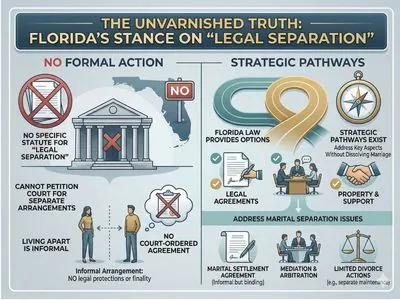 Unlike states such as New York or California, Florida has no specific statute outlining a formal “legal separation” action in court. This means you cannot simply file a petition for “legal separation” and receive a court order establishing separate living arrangements, property division, or support, while remaining legally married, in the same way you would for a divorce. While you and your spouse can certainly live apart and consider yourselves “separated,” this informal arrangement doesn’t automatically grant you the legal protections or finality that a court order would.
This doesn’t mean you’re without options if you wish to separate without immediately pursuing a full divorce. Florida law provides strategic pathways to address certain aspects of a marital separation, even without dissolving the marriage.
Understanding Divorce in Florida: The Finality
Divorce, or “Dissolution of Marriage” as it’s formally known in Florida, is the legal process that permanently terminates a marriage. When a divorce is finalized, you are no longer legally married to your spouse, and both parties are free to remarry. A final judgment of dissolution of marriage typically addresses all aspects of the marital relationship, including:
- **Division of Marital Assets and Debts:** Florida is an equitable distribution state, meaning marital property and liabilities are divided fairly, though not necessarily equally. This is a core part of legal considerations when planning for divorce.
- **Alimony (Spousal Support):** If applicable, a court may order one spouse to pay financial support to the other.
- **Child Custody (Parental Responsibility and Time-Sharing):** A comprehensive parenting plan is established outlining decision-making authority and a schedule for children to spend time with each parent.
- **Child Support:** Financial support for the children is determined based on state guidelines.
Florida is a “no-fault” divorce state, meaning the only ground required for divorce is that the marriage is “irretrievably broken.” This streamlines the process by removing the need to prove marital misconduct. Divorce offers comprehensive finality, allowing both parties to move forward with fully separate lives.
Florida’s Alternatives to Formal “Legal Separation”: Strategic Pathways
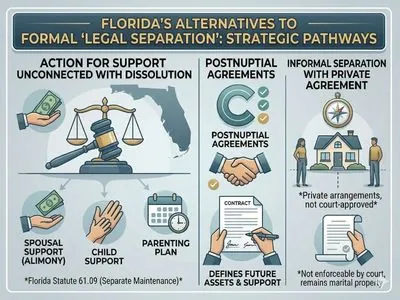 While a statutory legal separation isn’t an option, Florida offers distinct legal mechanisms that can formalize aspects of your separation without ending the marriage. These options require proactive, strategic planning:
1. Action for Support Unconnected with Dissolution of Marriage (Separate Maintenance Action)
This is the closest Florida comes to a formal “legal separation” in terms of court involvement. Under Florida Statute 61.09, a spouse living separately from their partner can petition the court for:
- Spousal Support (Alimony): If one spouse is in need of support and the other has the ability to pay, the court can order alimony, even while the couple remains married.
- Child Support: Orders for child support can be established.
- Parenting Plan: The court can establish a legal parenting plan, outlining parental responsibility and time-sharing for minor children.
Crucially, this action does not dissolve the marriage or formally divide marital property and debts. You remain legally married. This path is often chosen for reasons such as:
- Retaining Benefits: One spouse may rely on the other’s health insurance, military benefits, or Social Security benefits tied to marital status.
- Religious or Cultural Objections to Divorce: Some individuals cannot, or choose not to, divorce due to deeply held beliefs.
- Hope for Reconciliation: It allows a couple to formalize financial and parenting arrangements while leaving the door open for potential reconciliation.
However, it does not provide the comprehensive property division that a divorce does, and future assets/debts incurred during this separation period may still be considered marital if a divorce is later filed.
2. Postnuptial Agreements
A postnuptial agreement is a legally binding contract entered into by spouses *during* their marriage. It can define how assets, debts, and support would be divided in the event of a future separation or divorce. While not a “separation” action itself, a well-drafted postnuptial agreement can serve as a comprehensive roadmap for an informal separation, providing clarity and enforceability without court intervention at the time of separation. This can be a powerful tool for those seeking to protect their interests while living apart.
3. Informal Separation with Private Agreement
You and your spouse can simply agree to live separately. Many couples do this as a “trial separation” before deciding on divorce. You can also draft a private, informal agreement covering child custody, support, and temporary financial arrangements. However, without court approval or a properly executed postnuptial agreement, such private agreements may not be legally enforceable if one party later reneges or if a formal divorce is filed. Assets and debts accumulated during this informal separation period typically remain marital property until a divorce is finalized.
Key Differences & Considerations (Florida Context)
| Feature | Divorce (Dissolution of Marriage) | Alternatives (e.g., Separate Maintenance Action/Postnup) |
|---|---|---|
| Marital Status | Legally single; marriage is terminated. | Still legally married. |
| Remarriage | Can remarry. | Cannot remarry another person. |
| Benefits (Health, Social Security, Military, Tax) | Generally lost upon divorce. | Often retained due to continued marital status. |
| Property & Debt Division | Comprehensive and final division of all marital assets/debts. | Generally not comprehensively divided; some limited property issues may be addressed if part of support orders or a comprehensive postnup. Assets/debts acquired during separation often remain marital until divorce. |
| Alimony & Child Support | Can be established as final orders. | Can be established via court order (Separate Maintenance Action). |
| Emotional & Psychological Closure | Offers legal and emotional finality. | Can prolong uncertainty and prevent full emotional closure (see emotional impact of divorce). |
Why Choose an Alternative in Florida?
Given Florida’s stance, why would someone pursue a “separate maintenance action” or a postnuptial agreement instead of outright divorce?
- Religious or Moral Beliefs: Some individuals have strong objections to divorce.
- Financial or Health Benefits: Crucial for retaining health insurance, military benefits, Social Security benefits, or even certain tax filing advantages.
- Reconciliation Potential: A formal separation allows couples to live apart while leaving the door open for a trial reconciliation.
- Time to Prepare: Provides time for one spouse to become financially self-sufficient or to plan for new living arrangements.
The Brandon Legal Group Advantage: Your Clear Path Forward
Navigating the nuances of separation and divorce in Florida requires strategic clarity and decisive legal counsel. At Brandon Legal Group, we don’t sugar-coat the fact that Florida’s approach to “legal separation” is unique. Instead, we equip you with the knowledge and the strong advocacy needed to choose the path that aligns with your specific goals.
Whether you’re exploring a separate maintenance action to secure support while remaining married, drafting a robust postnuptial agreement to formalize your separation terms, or embarking on the comprehensive process of divorce, our divorce and family lawyers in Brandon provide the unapologetic guidance and strength you need. We’ll help you understand the long-term implications of each decision, empowering you to move forward with courage and confidence.
Illustrative Scenario: Weighing the Options
Sarah and David had been married for 15 years. David had a chronic health condition, and Sarah’s excellent health insurance through her employer was critical for his ongoing care. They both knew their marriage was ending, but David would lose his health coverage immediately upon divorce, and obtaining new, affordable insurance would be incredibly difficult. They approached Brandon Legal Group feeling stuck, wanting to separate but fearing the financial fallout.
Ingrid and the team at Brandon Legal Group explained that while Florida doesn’t have a formal “legal separation” statute, they could pursue a “Support Unconnected with Dissolution of Marriage” action. This would allow Sarah to continue carrying David on her health insurance as they would remain legally married, while simultaneously establishing court-ordered child support and a parenting plan for their two children, and outlining spousal support to help David with other living expenses.
Additionally, Brandon Legal Group advised drafting a comprehensive postnuptial agreement. This agreement, separate from the court’s support order, would define how their substantial assets (including their home and retirement accounts) and debts would ultimately be divided *if* they later decided to divorce. This strategic, two-pronged approach provided Sarah and David with the legal framework to live separate lives with defined responsibilities, protect crucial benefits, and maintain a pathway to future divorce if needed, all while securing their immediate financial interests. This nuanced strategy empowered them to move forward without sacrificing critical financial stability.
Disclaimer: This scenario is illustrative and does not represent any specific client or outcome. Every personal situation is unique and requires personalized advice.
Frequently Asked Questions About Legal Separation vs. Divorce in Florida
1. Does Florida recognize legal separation?
No, Florida does not have a formal legal separation statute. While you can live separately, you remain legally married. However, Florida courts can issue orders for support unconnected with dissolution of marriage (separate maintenance actions) and recognize valid postnuptial agreements to formalize aspects of separation.
2. Why would someone choose a “separate maintenance action” instead of divorce in Florida?
Common reasons include a desire to retain marital benefits (like health insurance, military, or Social Security), religious or cultural objections to divorce, or to allow time for potential reconciliation while having court-ordered support and parenting plans in place.
3. Can I divide assets and debts in a separate maintenance action in Florida?
Generally, a “Support Unconnected with Dissolution of Marriage” action does not comprehensively divide marital assets and debts. While it can address financial support (alimony, child support) and parenting plans, a full division of property and liabilities typically only occurs in a formal divorce. However, a postnuptial agreement can be used to pre-define property division terms.
4. Can I remarry if I am legally separated or have a separate maintenance order in Florida?
No. If you have a separate maintenance order or are informally separated, you are still legally married. You cannot legally remarry until your marriage has been formally dissolved through a final judgment of divorce.
Conclusion: Making Your Informed Choice with Strength
The distinction between legal separation (and its Florida alternatives) and divorce is critical. While Florida may not offer a direct “legal separation” as defined in some other states, strategic legal pathways exist to formalize aspects of your separation without ending your marriage.
Understanding these differences, their benefits, and their limitations is paramount. Brandon Legal Group provides the decisive strength and strategic clarity needed to navigate these complex decisions. We empower you to choose the path, whether it’s a separate maintenance action, a postnuptial agreement, or a full dissolution of marriage, that best protects your interests and aligns with your unique circumstances, ensuring you move forward with courage and confidence.