
Florida's homestead exemption delivers powerful creditor protection and property tax savings, but only while the legal requirements are kept intact. Death, abandonment, rental use, deed changes, trust transfers, and secured liens can all change the analysis. Some protections may continue for a surviving spouse or heirs; others require a new tax application. Understanding the statutory tripwires prevents expensive surprises during estate transitions and financial crises.
The homestead exemption sits quietly doing two jobs: blocking most creditors and reducing property taxes. It works beautifully until the facts stop supporting it. That day may arrive without ceremony. No dramatic hearing, no warning siren, just a changed status that opens the door to liens, claims, reassessments, or a denied exemption. The triggers are statutory, specific, and unforgiving. Missing one costs families protection they assumed would last forever.

Florida homestead law draws its authority from Article X, Section 4 of the Florida Constitution and implements strict conditions through the tax statutes. The exemption is not a courtesy; it is a constitutional shield with tax rules attached. When the required ownership, residency, or use conditions break, the shield can fracture. Recognizing the fracture points means keeping protection intact through ownership changes, estate transfers, and property use decisions that carry hidden consequences.
Death of the Homestead Owner: When Constitutional Protection Fractures
The moment a homestead owner dies, two separate systems matter: constitutional creditor protection and the county property tax exemption. They do not operate identically. Florida's Constitution says homestead protection from forced sale can inure to the surviving spouse or heirs of the owner. That means the protection does not automatically disappear just because the owner dies, but it also does not protect every person who might receive the property.
If the decedent was survived by a spouse or minor child, Florida's constitutional descent and devise restrictions control what can happen to the property. A surviving spouse must meet the legal definition at the time of death; estranged spouses may still qualify if the marriage remains legally valid, while domestic partners outside a valid marriage generally do not. Minor children trigger additional restrictions that can override a will or trust provision that looked simple on paper.
When the decedent leaves no spouse and no minor child, the owner generally has more freedom to devise the property. But creditor protection depends heavily on who receives it. If the property passes to heirs under Florida law, such as adult children in many family situations, the constitutional protection against the decedent's unsecured creditors may continue. If the property is devised to someone outside the protected heir class, creditor exposure becomes a real problem during probate. Claims filed within the statutory window of Florida Statute 733.702 can matter a great deal when the homestead was not structured to pass to a protected recipient.
Consider a hypothetical: A widowed father owns a homestead free and clear. His two adult children are named in his will as beneficiaries. Because adult children are often heirs under Florida law, the homestead creditor protection may inure to them even though no spouse or minor child survived. The tax exemption, however, does not simply become theirs forever. If one child moves into the property as a permanent Florida residence, that child must apply for the homestead tax exemption in that child's own right. If no heir occupies the property, the tax benefits can be lost even when creditor protection for the transfer itself remains intact.
Now change one fact: the same father leaves the property to a friend, romantic partner, or distant beneficiary who is not an heir under Florida homestead law. That is where families get blindsided. The devise may be legally permitted if there is no spouse or minor child, but the creditor shield may not inure to that recipient. Estate planning that ignores homestead descent rules leaves survivors scrambling.
Revocable trusts, enhanced life estate deeds, and carefully drafted beneficiary structures can preserve homestead protection through ownership transitions, but only if they are built before death and executed in compliance with constitutional restrictions on devise and alienation.
Abandonment and Change of Permanent Residence
The homestead exemption requires actual residence as the owner's permanent home. Moving out does not always destroy the exemption, but it invites scrutiny. Florida law does not define a specific number of days away that automatically triggers forfeiture in every situation. The core test is intent and conduct: Has the owner established a new permanent residence elsewhere?
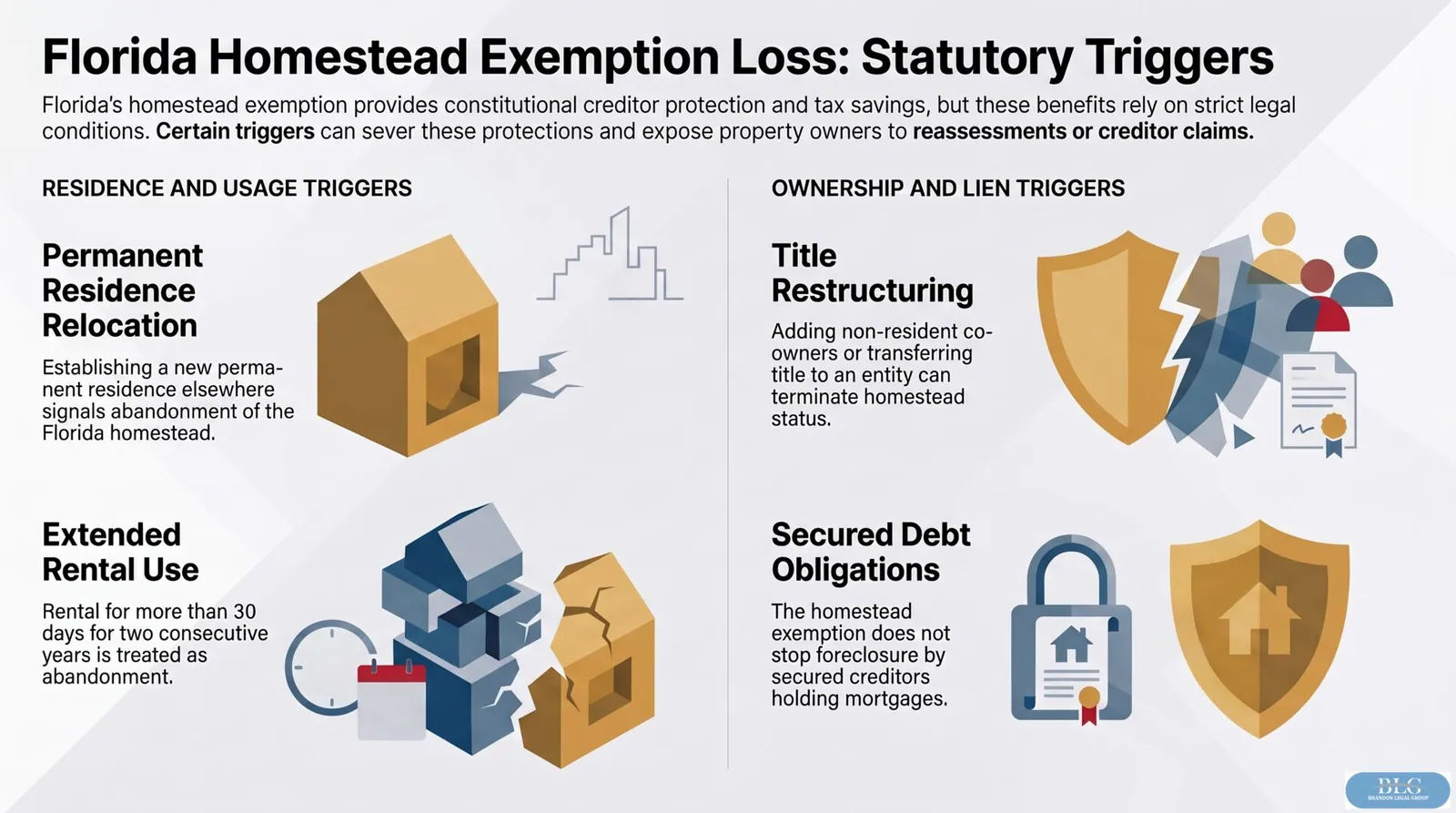
Abandonment occurs when the owner relocates and manifests an intent not to return. Buying a new home in another state, registering to vote there, obtaining a driver's license with that address, and filing a homestead exemption on the new property all signal abandonment of the Florida homestead. Once abandonment becomes evident, the property appraiser can remove the tax exemption and reassess the property without the same benefits. Tax bills can jump hard. Creditor protection can also vanish if the property is no longer the owner's permanent residence.
Temporary absences for work, medical care, or military deployment generally do not trigger abandonment if the owner maintains intent to return and does not claim homestead elsewhere. But intent is a question of fact, and facts are proven through conduct. Filing a homestead exemption in two states simultaneously is asking for trouble and can trigger penalties for an improper or fraudulent filing.
Snowbirds who spend summers in Michigan and winters in Florida must choose one permanent residence. The homestead exemption follows that choice. Attempting to preserve exemptions in both states is fraud, and the statutory penalties; back taxes, interest, and a 50% penalty under Florida Statute 196.161; make the gamble expensive.
¶Rental and Commercial Use: Converting the Homestead into Income Property
Leasing the entire homestead to a third party while the owner lives elsewhere can convert the property's character from residence to income asset and threaten both tax and creditor protection. The rule is blunt: homestead status depends on the owner's permanent residence. Renting the entire property to tenants while establishing a home somewhere else is dangerous.
For Florida property tax purposes, rental use is governed in part by Florida Statute 196.061. Rental of all or substantially all of a homestead for more than 30 days in a calendar year for two consecutive years is generally treated as abandonment, subject to statutory exceptions. That is not a technicality. It is the kind of detail that turns a short-term income idea into a tax bill with teeth.
¶Partial rentals, leasing a spare bedroom or an accessory dwelling unit on the same parcel, fall into a gray zone governed by county property appraiser interpretation and the extent of the commercial activity. A single renter in one bedroom of an owner-occupied home typically does not destroy the exemption. Converting the property into a short-term vacation rental listed on booking platforms is a different animal, especially if the owner moves out and manages the property remotely.
The loss is not always discovered immediately. Property appraisers discover rental activity through deed recordings, business licenses, code enforcement actions, short-term rental platforms, and tax return disclosures. Once discovered, the exemption can be revoked retroactively, and the owner may receive a bill for back taxes, penalties, and interest.
Homeowners considering rental income to offset mortgage costs during temporary relocations must understand the trade: rental income versus homestead protection. The calculus changes sharply if creditor exposure exists. A judgment creditor barred by homestead exemption may gain leverage if rental use and abandonment convert the property into non-exempt real estate.
Transfer of Title and Deed Restructuring
Any change in legal title that removes the resident owner from qualifying ownership risks exemption forfeiture. Deeding the property into a poorly drafted trust, adding non-resident co-owners, or transferring title to an entity such as an LLC can terminate homestead status unless the structure complies with narrow statutory and constitutional rules.
Florida recognizes homestead protection for properties held in a revocable trust if the settlor retains the required beneficial interest, control, and right to occupy the property. That structure can preserve exemption because beneficial ownership and residence have not truly changed. Irrevocable trusts are more dangerous, but they are not all the same. Some trust structures may preserve tax homestead treatment if the resident beneficiary holds the required beneficial interest and right to use the property. Others, especially asset-protection or Medicaid-planning transfers drafted without Florida homestead discipline, can sever the ownership link required for protection. The exemption can die at the transfer.
Enhanced life estate deeds, sometimes called lady bird deeds, allow an owner to retain a life estate with powers to sell, lease, or mortgage during life, while designating remainder beneficiaries who take title at death. Because the original owner retains control during life, the homestead exemption generally continues uninterrupted until death. At death, the property passes outside probate to the named beneficiaries, and creditor protection depends on whether those beneficiaries fall within the protected class under Florida homestead law, including a surviving spouse or heirs.
Adding an adult child as a joint tenant with right of survivorship changes the ownership structure in ways that can create tax, creditor, gift, and family-control consequences. The exemption belongs to the natural person residing in the home, not to title holders who live elsewhere. A parent and adult child who both live in the property as their permanent residence may have a cleaner path than a parent who adds a non-resident child to title. County property appraisers may scrutinize the transfer, and the result can depend on the deed language, ownership shares, and actual occupancy.
Quitclaim deeds, warranty deeds, and other title instruments used in estate planning, divorce settlements, or asset protection strategies must be evaluated for homestead impact before recording. Once title transfers, the exemption does not automatically follow, and clawing back protection after forfeiture requires re-establishing residency and re-filing the exemption application, processes that take time and leave the property exposed in the interim.
Secured Debts, Liens, and Mortgage Defaults
The homestead exemption blocks many unsecured creditors, credit card judgments, personal loans, medical debt, but it does nothing to stop foreclosure by secured creditors holding mortgages, property tax liens, homeowners association liens, or mechanic's liens for construction work. These secured debts and liens attach to the property itself and survive homestead protection.
Defaulting on a mortgage does not technically terminate the homestead exemption, but foreclosure removes the owner from title, which ends the exemption by operation of law. A homeowner who loses the property at a foreclosure sale ceases to own it; without ownership and occupancy, no exemption can exist.
Property tax liens take priority over virtually all other claims, including mortgages. Failing to pay property taxes results in a tax certificate sale, and if the taxes remain unpaid through the redemption period, the certificate holder can apply for a tax deed. A tax deed sale extinguishes the owner's title and subordinate interests, including the homestead exemption.
Homeowners who fall behind on secured obligations sometimes attempt to shield the property by transferring title to a trust or relative. These transfers, if made with intent to delay or defraud creditors, are voidable as fraudulent transfers under Florida Statute 726.105. A secured creditor can pursue avoidance and reach the property despite the transfer. Worse, the transfer itself may have already damaged the homestead exemption, leaving the property exposed to both secured and unsecured claims.
Medicaid estate recovery is another place where sloppy planning causes damage. While the homestead exemption may protect the property during the Medicaid recipient's lifetime, Florida can pursue estate recovery after death against assets that are part of the recoverable estate, subject to federal and state limits. If the formerly protected homestead ends up in probate and no protected survivor or planning structure blocks recovery, the state may file a claim. Strategic use of lady bird deeds and other lawful transfer mechanisms may reduce estate recovery exposure, but only if executed correctly before the Medicaid recipient's death.

Homestead protection depends on maintaining a precise configuration: qualifying ownership, occupancy as a permanent residence, and compliance with constitutional restrictions on transfer and devise. Disruptions to any element, death with the wrong devise, abandonment, rental use, title change, or secured default, can trigger loss or limit the protection. Once lost, the exemption does not self-restore. Reinstatement requires affirmative steps: re-establishing residency, re-filing with the property appraiser, and waiting for approval. During that gap, creditors who were previously barred may move in. Families who assume the exemption is indestructible discover otherwise when probate claims, contested estates, or judgment execution reach property they believed was untouchable.
Closing Remarks
If a family member has died leaving a homestead with unclear descent rights, a property has been converted to rental use without understanding the tax and creditor consequences, or a pending title transfer could forfeit constitutional protections, the stakes are immediate. Brandon Legal Group structures estate plans that preserve Florida homestead protection through ownership changes, probate, and creditor challenges. Contact us before the exemption is lost, not after the claim is filed.
Frequently Asked Questions
Does the homestead exemption automatically transfer to heirs when the owner dies?
Not automatically in the tax sense. The constitutional creditor protection may inure to a surviving spouse or heirs under Florida law, including adult children in many cases. But the county property tax exemption must be claimed by the new owner based on that owner's own eligibility, occupancy, and residency. If the property passes to someone outside the protected heir class, creditor exposure can become a serious probate issue.
Can a homeowner rent out part of the homestead without losing the exemption?
Renting a single room in an owner-occupied residence typically does not destroy the exemption, but converting the property into a full rental, vacation rental, or commercial space can. For tax purposes, Florida Statute 196.061 treats rental of all or substantially all of the homestead for more than 30 days in a calendar year for two consecutive years as abandonment, subject to exceptions. The key question is whether the owner continues to occupy the property as a permanent residence.
What happens to the homestead exemption if the property is transferred into a trust?
A transfer into a properly drafted revocable trust can preserve the exemption if the settlor keeps the required beneficial interest, control, and right to occupy the property. An irrevocable trust is riskier and must be reviewed carefully; some structures may preserve homestead treatment, while others terminate it by stripping the resident owner of the required interest. Trust-based transfers must be drafted around Florida's homestead rules, not bolted on after the fact.
Can creditors reach a homestead property if the owner defaults on a mortgage?
Yes, if the creditor is secured by the property. Mortgage lenders, property tax authorities, homeowners associations, and certain lienholders can foreclose regardless of homestead status. The homestead exemption blocks many unsecured creditors like credit card companies and judgment holders, but it does not prevent foreclosure by secured lenders or tax collectors. Losing the property through foreclosure extinguishes the exemption because the owner no longer holds title.
How does moving to another state affect Florida homestead protection?
Establishing a new permanent residence in another state constitutes abandonment of the Florida homestead and can terminate the exemption. Filing a homestead exemption in the new state, registering to vote there, or obtaining a driver's license with that address all provide evidence of abandonment. The Florida property appraiser may revoke the exemption retroactively, and the owner may owe back taxes, interest, and penalties. Snowbirds must choose one permanent residence and file homestead in only that state.
Can the homestead exemption be reinstated after it has been lost?
Reinstatement is possible but not automatic. The owner must re-establish permanent residency, re-apply with the county property appraiser by the statutory deadline, and demonstrate that all eligibility requirements are again met. During the gap between forfeiture and reinstatement, the property may remain exposed to creditor claims and reassessment without the same tax benefits. Strategic planning prevents forfeiture in the first place rather than trying to recover protection after it is lost.
References
- Art. X, § 4, Fla. Const. (Homestead; exemptions)
- Fla. Stat. § 196.031 (Exemption of homesteads).
- Fla. Stat. § 196.041 (Extent of homestead exemptions).
- Fla. Stat. § 196.061 (Rental of homestead to constitute abandonment).
- Fla. Stat. § 196.161 (Homestead exemptions; lien imposed on property of person claiming exemption who is not entitled thereto).
- Fla. Stat. § 409.9101 (Recovery for payments made on behalf of Medicaid-eligible persons).
- Fla. Stat. § 726.105 (Transfers fraudulent as to present and future creditors).
- Fla. Stat. § 733.702 (Limitations on presentation of claims).
This article is provided for general informational purposes only and does not constitute legal advice, nor does reading it create an attorney-client relationship. Florida law changes and every situation turns on its own facts. Consult a licensed Florida attorney about your specific circumstances before acting.