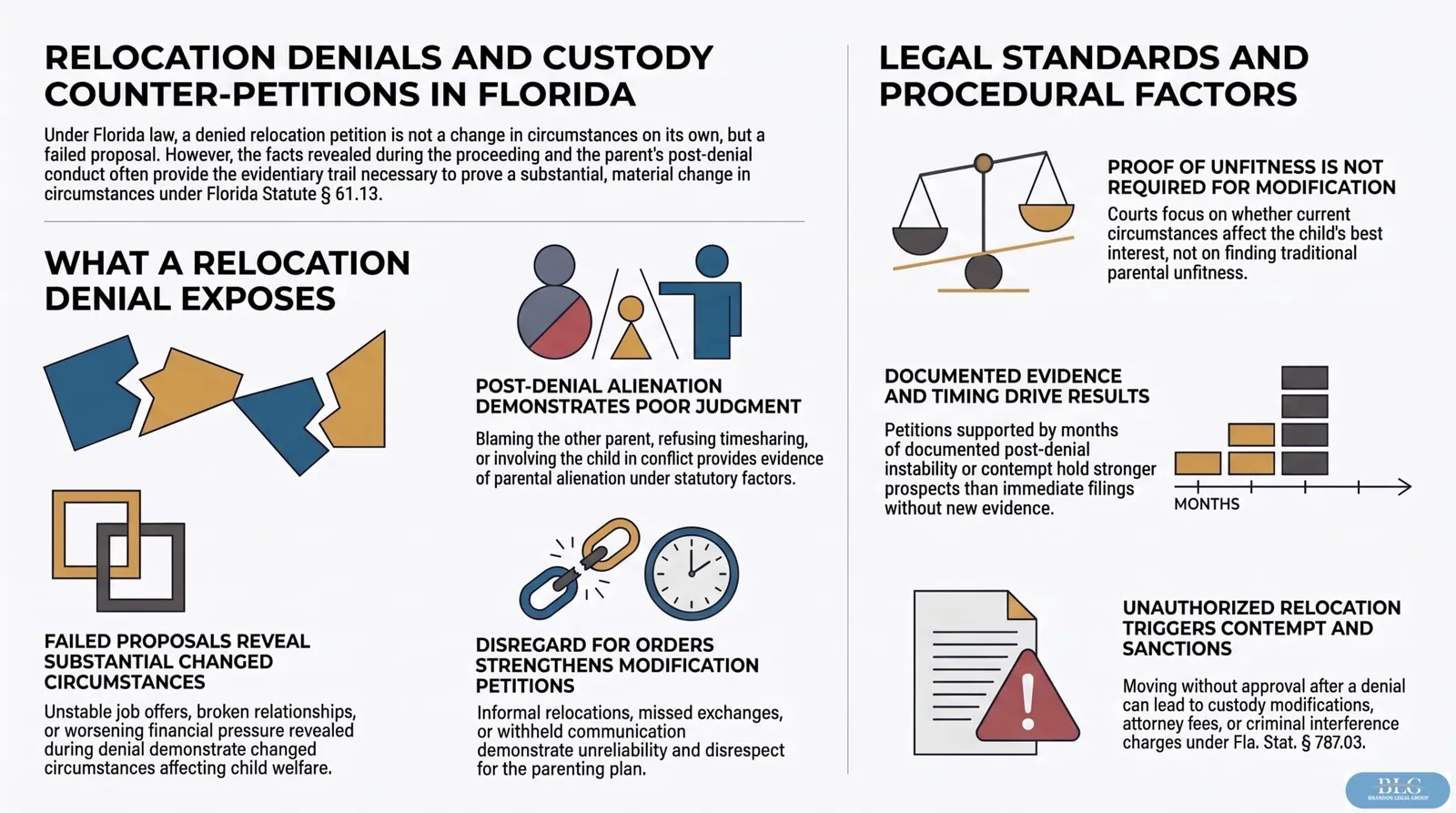
When a parent tries to relocate with a child and the court denies it, the other parent often files a counter-petition seeking custody modification, timesharing changes, or sole parental responsibility. Success depends on evidence that the relocation attempt itself revealed changed circumstances, financial instability, parental alienation, disregard for court authority, or proof the child's best interest was never the actual priority.
A relocation denial is rarely the end of the story. It is the moment when one parent's plan collapses and the other parent's counter-petition gains traction. The parent who fought the move now has ammunition: a failed relocation attempt becomes evidence of poor judgment, financial desperation, or willingness to uproot a child for reasons unrelated to the child's welfare. Courts that deny relocation petitions have already found the proposed move harmful or unsupported. A counter-petition asks the court to act on that finding by changing custody, timesharing, or parental responsibility. What makes a counter-petition succeed is not the denial itself. It is what the denial revealed.
Florida law treats relocation and custody modification as separate proceedings, but they intersect when a denied relocation attempt exposes changed circumstances. The parent who tried to move has now demonstrated something about their priorities, stability, or willingness to follow court orders. That demonstration becomes the foundation of a counter-petition. The question is whether the evidence crosses the threshold required to justify modification under Florida Statute § 61.13.
Changed Circumstances: What the Denial Proves
Modification of a parenting plan requires proof of a substantial and material change in circumstances. The denied relocation itself is not a change. It is a failed proposal. But the facts underlying the relocation petition often are. A parent who planned to move for a job that no longer exists, a romantic partner who has since left, or financial pressures that have worsened since the denial; all of these become provable changes. The counter-petition does not argue "the other parent wanted to move." It argues "the other parent's situation has deteriorated, and that deterioration now affects the child."
Consider a hypothetical: A mother petitions to relocate with the child to accept a job offer in another state. The father objects. The court denies the petition after finding the job offer vague and the mother's true motive appears to be reuniting with a boyfriend. Three months later, the mother loses her current job, the boyfriend relationship ends poorly, and she begins making statements to the child about the father "ruining her life." The father files a counter-petition for sole parental responsibility. The denied relocation is not the change. The instability it revealed, now worsened, is the change. Courts assess whether the circumstances affecting the child have shifted enough to justify revisiting custody.
Under Florida law, the burden is on the parent seeking modification. The counter-petition must show that the change is substantial enough to affect the child's welfare and that modification serves the child's best interest. A denied relocation petition creates an evidentiary trail: testimony about motives, financial records, evidence of the child's ties to the current location, and often admissions about instability or conflict. That trail becomes the foundation for proving changed circumstances. For more context on how Florida courts weigh parental responsibility decisions, see Custody Attorneys.
Parental Fitness and Alienation After Denial
Relocation denials sometimes expose parental alienation or retaliatory behavior. A parent who loses a relocation petition may blame the other parent openly, involve the child in adult conflict, or begin undermining the child's relationship with the parent who objected. Florida courts consider parental conduct when assessing the best interest of the child under § 61.13(3). A parent who cannot accept a court's decision without punishing the child or the other parent demonstrates poor judgment and a willingness to prioritize their own grievances over the child's stability.
Counter-petitions that succeed after relocation denials often include evidence of:
Statements made to the child blaming the other parent for the failed move
Refusal to facilitate timesharing or communication after the denial
Attempts to relitigate the relocation decision by informal means, such as extending a "visit" to another state indefinitely
Sudden requests for modification of the parenting plan that align with punishing the other parent rather than serving the child's needs
Evidence of instability, job loss, housing insecurity, new relationships that introduce risk
Parental alienation is difficult to prove in isolation, but post-denial conduct creates a clear timeline. Text messages, witness testimony, and the child's own statements (when age-appropriate and properly presented) become critical. Courts do not tolerate a parent who uses the child as a tool for retaliation. When the counter-petition can show that the denied relocation was followed by alienating behavior, the court has both motive and evidence to modify custody or parental responsibility.
Financial Instability and the Best Interest Standard
Relocation petitions often hinge on claimed employment opportunities or cost-of-living improvements. When the court denies the petition, it sometimes does so because the financial justification was weak, speculative, or secondary to personal motives. A counter-petition can leverage that finding by showing the financial instability has worsened. If the parent who sought relocation cannot maintain stable housing, employment, or living conditions in the current location, that instability affects the child directly.
Florida courts assess the best interest of the child using statutory factors that include each parent's capacity to provide a stable home environment, the mental and physical health of each parent, and the ability to maintain a routine. A parent whose relocation petition revealed financial desperation and who now faces eviction, job loss, or dependence on transient partners presents a deteriorating situation. The counter-petition does not need to prove the parent is unfit in the traditional sense, only that the circumstances affecting the child have changed enough to justify shifting custody or timesharing to the more stable parent.
Modification does not always mean sole parental responsibility. It may mean a shift in the majority timesharing, a requirement for supervised visitation, or a change in decision-making authority over education or healthcare. The goal of the counter-petition is to match the parenting plan to the current reality, not to punish the other parent. Courts focus on what serves the child now, not what the parenting plan assumed three years ago. For a deeper look at how parenting plans govern these decisions, see Parenting Plans in Florida: What They Control Beyond Visitation.
Contempt, Disregard for Court Orders, and Credibility
Some parents respond to a relocation denial by attempting to relocate anyway, informally. They move without court approval, keep the child out of state longer than agreed, or manufacture emergencies that justify staying away. Other parents simply stop complying with the existing parenting plan: they miss exchanges, refuse to communicate, or withhold access. Both patterns give the counter-petition strong footing.
Contempt of court is a separate remedy, but evidence of contemptuous conduct strengthens a modification petition. A parent who disregards a relocation denial or violates the parenting plan demonstrates unreliability and disrespect for the legal framework meant to protect the child. Florida courts have broad discretion to modify custody when one parent proves unable or unwilling to follow court orders. The counter-petition does not need to wait for a contempt finding. It can use the same evidence to argue that the parent's conduct has created changed circumstances requiring modification.
Credibility matters. A parent who testified during the relocation hearing that they had no intent to alienate the child, then sent dozens of text messages blaming the other parent, has damaged their own credibility. A parent who claimed financial stability during the relocation petition, then fell behind on rent immediately after the denial, has undermined their own case. Counter-petitions that succeed are built on contradictions between what the relocating parent promised and what actually happened after the court said no.
Timing and Procedural Posture
Florida law does not impose a waiting period before filing a modification petition after a relocation denial, but timing affects both the strength of the evidence and the court's receptiveness. A counter-petition filed immediately after the denial, with little new evidence, will struggle. A counter-petition filed six months later, supported by documented instability, alienation, or contemptuous conduct, has far better prospects.
The procedural posture also matters. If the relocation petition and counter-petition are both pending before the same judge, the court has the full context. If the relocation case closed and the counter-petition is filed months later in front of a different judge, the movant must reestablish the factual foundation. Transcripts from the relocation hearing, prior orders, and evidence that ties the current petition to the prior denial become essential.
Judges are not required to modify custody simply because a relocation was denied. They are required to assess whether the current parenting plan still serves the child's best interest. The parent filing the counter-petition must show that something has changed since the last order, not just that the relocation attempt failed, but that the failure revealed or accelerated a problem that now requires court intervention.
A successful counter-petition after a relocation denial is not about revenge. It is about evidence. The denial itself is a data point. What happens next, how the other parent responds, whether their situation stabilizes or deteriorates, whether they respect the court's authority or attempt to circumvent it, determines whether modification is justified. Courts do not revisit custody lightly, but when the facts show that the child's welfare is at stake, Florida law provides the tools to act. The question is whether the counter-petition can prove the case with documentation, credible testimony, and a clear connection between the relocation denial and the change in circumstances.
Closing Remarks
If you opposed a relocation petition, won, and now face alienation, instability, or outright defiance of the court's order, or if the other parent's situation has collapsed in ways that put your child at risk. The window to act is open but not indefinite. Brandon Legal Group represents parents who need modification petitions that hold up under scrutiny, backed by evidence that courts actually credit. Contact us to build the counter-petition that matches the moment you're in.
Frequently Asked Questions
Can a relocation denial alone justify modifying custody?
No. The denial itself is not a change in circumstances. Modification requires proof that the facts underlying the relocation attempt, or the conduct that followed the denial, have created a substantial, material change affecting the child's welfare. The denial is evidence of what the court found at that time; the counter-petition must show what has changed since.
How long after a relocation denial can a counter-petition be filed?
There is no statutory waiting period, but the counter-petition must be supported by evidence of changed circumstances. Filing too soon, before meaningful change has occurred, weakens the case. Filing too late risks allowing harmful conditions to persist. The timing depends on when sufficient evidence exists to meet the legal standard for modification under Florida Statute § 61.13.
What kind of evidence supports a counter-petition after relocation denial?
Documentation of financial instability, housing insecurity, job loss, or dependence on unstable relationships. Text messages, emails, or recorded statements showing parental alienation or blame directed at the other parent. Witness testimony about changes in the child's behavior, school performance, oremotional state. Evidence of contemptuous conduct, missed exchanges, withheld communication, attempts to relocate informally. Medical or psychological records if the child's health has been affected. The stronger the documentation, the stronger the petition.
Does the parent who lost the relocation petition have to prove they are unfit?
No. Modification does not require a finding of unfitness. It requires proof that circumstances have changed enough to affect the child's best interest and that the current parenting plan no longer serves the child's welfare. A parent can be fit but unstable, or fit but alienating, or fit but unable to provide the environment the child needs. The focus is on the child's current situation, not the parent's moral character.
Can a counter-petition seek sole parental responsibility after a relocation denial?
Yes, if the evidence supports it. Sole parental responsibility requires proof that shareddecision-making would be detrimental to the child, often because of domestic violence, parental alienation, substance abuse, or a demonstrated inability to cooperate or make decisions in the child's best interest. A relocation denial that revealed alienating conduct, disregard for court orders, or instability can support a petition for sole responsibility if the evidence is strong enough to meet the statutory standard.
What happens if the parent who lost the relocation petition tries to move anyway?
Relocating without court approval after a denial is contempt of court and can result in sanctions, modification of custody, makeup timesharing, attorney's fees, and in extreme cases, criminal charges for interference with custody. A counter-petition can cite the unauthorized relocation as evidence of changed circumstances and disregard for the parenting plan, strengthening the case for modification or even sole parental responsibility. Courts take unauthorized relocations seriously because they interfere with the child's relationship with the other parent and violate a direct court order.
Sources verified against the current Florida Statutes as of July 2026. Since the 2023 amendments to § 61.13 (SB 1416, effective July 1, 2023), modification of a parenting plan or time-sharing schedule requires asubstantial and material change in circumstances, the previously required "unanticipated" element was removed.This article is provided for general informational purposes only and does not constitute legal advice, nor does reading it create an attorney-client relationship. Florida law changes and every situation turns on its own facts. Consult a licensed Florida attorney about your specific circumstances before acting.