
Estate Planning for Entrepreneurs After the Big Beautiful Bill: From Startup Stock to Dynasty Trust
If you are building a company in 2025 and beyond, the One Big Beautiful Bill Act (“OBBBA”) did more than change your tax return. It quietly reshaped the way founders, early employees, and investors should think about wealth, exits, estate and family planning.
Under OBBBA, three big building blocks now work together:
- A higher Qualified Small Business Stock (QSBS) gain exclusion cap (up to $15 million per issuer for qualifying stock acquired after July 4, 2025).
- A higher, currently stabilized estate and gift tax exemption (now $15 million per person; many married couples can effectively use up to $30 million with proper planning and elections).
- Stable long-term capital gains brackets (0%, 15%, 20%) without a new general federal surcharge layered on top.
For entrepreneurs, that combination creates a simple but powerful question: Are you structuring your startup, and your estate plan, to take advantage of the rules as they exist now, before your big liquidity event?
If you are expecting a significant exit in the next decade, you don’t just need a “sale plan.” You need an estate plan that matches the new tax law.
 Step One: Understand the New Playing Field for Founders
QSBS: More Room at the Top
QSBS under IRC § 1202 has always been a uniquely generous rule for startup stock. OBBBA effectively supercharges it:
- The per-issuer capital gain exclusion cap increases to $15 million (or 10× your basis, whichever is greater) for qualifying stock acquired after July 4, 2025.
- The basic structure of the exclusion remains familiar: if your company qualifies and the stock meets the holding period and other requirements, a substantial portion of the gain on sale can be federally tax-free.
For a founder, that means: if you do the groundwork early, $15 million of gain (or more, in some structures) may never show up on your federal capital gains bill at all.
Serial entrepreneur note: If you sell qualifying QSBS before you have held it for the full five-year period, IRC § 1045 may, in some situations, allow you to roll over gain into new QSBS of another startup within a short reinvestment window (generally 60 days). Done properly, this can defer tax and keep QSBS potential alive in your next venture. The timing and qualification rules are strict, and this is primarily a tool for early exits and serial founders, not a general strategy for every sale.
Estate and Gift Tax: A Bigger, But Not Untouchable, Exemption
At the same time, OBBBA raises and stabilizes the federal gift, estate, and generation-skipping transfer (GST) tax exemption at $15 million per person, indexed for inflation. For a married couple, that often means up to $30 million combined can be used with proper planning, portability elections, and trust design.
In practical terms, that gives founders more room to:
- Transfer equity out of a taxable estate while it is still relatively low in value,
- Fund dynasty or multi-generational trusts, and
- Combine lifetime gifting with QSBS planning around an expected exit.
Current regulations are generally favorable to people who use today’s higher exemption, even if the exemption is later reduced. However, no Congress can bind a future Congress. That’s why many families treat this as a golden window for planning, not a reason to procrastinate.
Capital Gains Brackets: No Surprise Surcharge (For Now)
OBBBA preserves the familiar federal long-term capital gains framework:
- 0%, 15%, and 20% brackets remain in place,
- No new general capital gains surcharge is layered on top for high earners.
That stability is a gift for planning. You can run real numbers, not guesses.
Structuring Your Startup to Potentially Qualify as QSBS
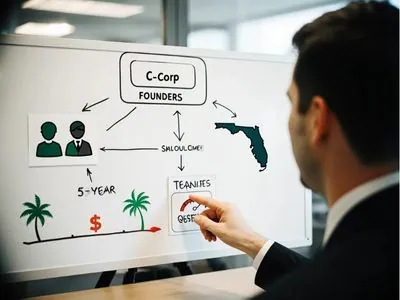 QSBS is not automatic. To potentially qualify for the exclusion:
- The company typically must be a C-corporation for federal tax purposes.
- Stock must be acquired at original issuance (not secondhand) in exchange for money, property, or services.
- The company must broadly meet the active business requirement and fall within allowed industries (certain service, financial, and asset-heavy businesses are excluded).
- The company must generally stay under applicable gross asset thresholds at the time of issuance, with aggregation rules for related entities.
- The stock must be held for at least the required five-year holding period to claim the full exclusion, unless a properly executed rollover strategy under IRC § 1045 applies.
For founders, that means entity choice and capitalization decisions are no longer just about “what my accountant likes”, they are about what the exit could mean for you and your family long-term.
Florida note: Because Florida has no state income tax, qualifying QSBS treatment can be even more powerful for a Florida resident founder. If both your federal and state tax on a big chunk of the gain are effectively zero, the difference in net proceeds can be life-changing.
Why Early Gifting of Founder Shares Matters
Estate tax is calculated on the value of what you own when you die, not on how hard you worked for it. For startup founders, the danger is simple:
By the time your company is clearly valuable, your shares may already be too big to move easily out of your estate.
Early, thoughtful planning can flip that script.
Freeze the Value Before the Rocket Launches
If you transfer a portion of your founder shares into one or more irrevocable trusts when the company is:
- Pre-revenue or early revenue,
- Valued modestly based on early funding rounds or discounts, and
- Still several years away from an expected exit,
you effectively:
- Freeze the value that counts against your $15 million (or $30 million) exemption today, and
- Push the future growth into the trust and out of your taxable estate.
From an estate tax perspective, you are using today’s relatively small number to shelter tomorrow’s potentially much larger one.
How the QSBS Holding Period Works When You Gift
One reason early gifting works so well for founders is that, under current law, when you make a completed gift of qualifying QSBS to a properly structured trust:
- The trust generally steps into your shoes for QSBS purposes, including your original acquisition date and holding period, and
- The stock can retain its QSBS character if all other requirements continue to be met.
In other words, the five-year clock typically starts when you acquired the stock, and does not reset just because you later gifted those shares to a trust. That tacking is a major reason founders often move shares early, while valuations are still low.
Multiplying QSBS Exclusions Across Trusts and Beneficiaries
Under current law, when trusts and beneficiaries each own qualifying QSBS, it may be possible, within the rules, for multiple QSBS exclusions to apply at sale:
- You, personally, could claim a QSBS exclusion on the stock you still own.
- Each properly structured, completed-gift non-grantor trust (with its own beneficiaries and tax identity) holding qualifying QSBS could also claim its own exclusion, subject to the per-issuer caps and other requirements.
Done carefully, this can turn a single $15 million per-issuer cap into multiple layers of excluded gain across your family’s overall holdings.
However, this is a highly technical and evolving area:
- The IRS has offered limited guidance on “trust stacking,” and anti-abuse rules (including multiple-trust concepts and substance-over-form doctrines) can apply.
- Some advisors are comfortable with a more aggressive approach; others are more conservative and will limit the number and design of such trusts.
The takeaway: the idea of multiplying QSBS exclusions exists on a spectrum of risk tolerance. It can be powerful when done thoughtfully, but it is not a one-size-fits-all tactic and should never be implemented without careful modeling and legal advice.
Building the Entrepreneur’s Dynasty Trust
For many founders, the anchor vehicle for this planning is a dynasty trust (or a series of related trusts) designed to last for children, grandchildren, and beyond.
Key Features of a Founder-Focused Dynasty Trust
- Initial funding with founder shares: You gift or sell a carefully chosen slice of your startup equity to the trust, often when valuation is still relatively low.
- QSBS awareness: The trust is drafted so that any QSBS treatment at the trust level is preserved to the extent allowed, and the trust can, if appropriate, make its own QSBS calculations at exit.
- GST planning: The trust is designed to be GST-exempt, meaning transfers to grandchildren and later generations can avoid additional federal transfer tax.
- Asset protection: Properly structured, the trust can shield assets from beneficiaries’ creditors, divorces, and lawsuits.
- Distribution standards: You define how and when future generations receive support, for education, business ventures, home purchases, or other major life needs, instead of leaving a lump sum outright.
Grantor vs. Non-Grantor: Choosing the Trust’s Tax Identity
A critical design choice for founder trusts is whether they will be treated as grantor or non-grantor for income tax purposes:
- Grantor trusts: For income tax, you are treated as the owner. Income and deductions are reported on your personal return. This can simplify planning and allow you to “pay the tax for the trust,” effectively making additional tax-free gifts. However, for QSBS, grantor trust status generally means the trust does not create a separate taxpayer for its own §1202 exclusion.
- Non-grantor trusts: The trust is a separate taxpayer. It files its own return, pays its own tax, and, if properly structured, may potentially qualify for its own QSBS exclusion. The trade-off is that non-grantor trusts face compressed income tax brackets and more complex administration.
There is no universal “right” answer. The best design depends on:
- How focused you are on QSBS optimization,
- Your liquidity and cash-flow comfort with paying tax personally, and
- Your appetite for complexity and potential IRS scrutiny.
Florida as the Launchpad: Homestead and No State Income Tax
If you are a Florida-based entrepreneur, your state is not just where you live. It is part of your long-term planning strategy.
- No Florida state income tax: This makes QSBS and capital gains planning even more attractive. When a large portion of your gain is federally excluded and Florida does not tax that gain, the after-tax difference compared to a high-tax state can be dramatic.
- Homestead protections & restrictions: Florida’s homestead rules can provide powerful protection for your primary residence against certain creditors and also deliver property tax benefits. At the same time, the Florida Constitution imposes strict limits on how homestead can be titled and left at death if you have a spouse or minor children. You generally cannot assume you can drop your Florida homestead into just any trust or leave it under the same terms as your other assets. Homestead is often a special-case asset that needs its own, Florida-specific plan.
- Broader asset protection & no state estate tax: Florida’s overall asset protection environment (including LLC and entity rules) and the absence of a state-level estate or inheritance tax can make it an excellent home base for long-term founder planning, especially when combined with QSBS and trust structures.
In short: Florida can be an excellent “home base” for founder wealth planning, but only if your documents are drafted with Florida law, homestead rules, and multi-state complexity in mind.
Putting It Together: From Startup Stock to Legacy Capital
A Simple Example
Imagine you are a Florida founder who:
- Holds a large block of founder shares in a promising C-corp startup,
- Has raised an early round at a modest valuation, and
- Believes a significant exit (sale or IPO) is possible in 7–10 years.
A coordinated plan might look like:
- Confirm QSBS eligibility: Work with counsel to confirm that your structure, industry, capitalization, and stock issuances are aimed at QSBS qualification, and discuss whether a future IRC § 1045 rollover might ever be relevant if an earlier-than-planned sale occurs.
- Design dynasty and SLAT or similar trusts: Using your $15 million (or up to $30 million combined) exemption, you fund trusts for your spouse, children, and grandchildren with a portion of your founder equity at today’s valuation, choosing grantor or non-grantor treatment based on your goals.
- Document the intent: The trust instruments clearly state long-term purposes: education, entrepreneurship, home purchases, charitable initiatives, and multi-generational support.
- Address valuation and filings: You and your advisors carefully document valuation for gift tax purposes, and you file gift tax returns (even if no tax is due) to start the statute of limitations and provide a clear record.
- Adjust over time: As the company grows and raises new rounds, you revisit valuations, consider additional planning, and ensure no QSBS or estate-tax land mines have been triggered.
- Plan the exit: When a liquidity event becomes likely, you coordinate with your attorney and CPA before closing to confirm who owns what, how QSBS exclusions (and any prior rollovers) will apply, and how sale proceeds will be divided among you and the trusts.
After the exit, the result can be:
- You personally benefit from a significant QSBS exclusion and favorable capital gains rates.
- One or more trusts each benefit from their own QSBS exclusions and now hold a diversified investment portfolio instead of concentrated startup stock.
- Future growth on the trust assets occurs outside your taxable estate, under the guardrails you designed today.
When to Start the Conversation
The best time to align your estate plan with the new rules is before your company’s value is obvious to everyone else.
Good signals that it is time to talk to Brandon Legal Group and your tax advisors:
- You are organizing a new startup or converting an existing LLC to a C-corp with real growth potential.
- You have completed an institutional seed or Series A round at a valuation that makes your equity meaningful on paper.
- You are discussing term sheets for a strategic sale, growth equity investment, or IPO in the next several years.
- Your net worth has crossed a threshold where estate tax and multi-generational planning are suddenly relevant.
If you’re an entrepreneur expecting a big liquidity event in the next decade, you don’t just need a “sale plan”, you need an estate plan that matches the new tax law.
At Brandon Legal Group, we help founders and families build that bridge, from startup stock to dynasty trust, from a single exit to long-term legacy capital.
FAQ: Estate Planning for Entrepreneurs After the Big Beautiful Bill
Do I need to move my company to Florida to benefit from these rules?
No. QSBS is a federal tax provision and applies based on federal law, not the state where your company is incorporated. However, living in Florida (with no state income tax) can make the combined federal and state outcome more favorable when you sell. You should still consider where your company operates, where your investors and employees are located, and what state corporate law regime is best for your business.
What if my startup is already worth a lot? Is it too late to plan?
It is not necessarily too late, but the planning looks different. Early gifting to trusts at low valuations is the cleanest path to freezing value, but there may still be opportunities using sales to intentionally defective grantor trusts, recapitalizations, or other structures. The key is to model the numbers and coordinate closely with tax and legal advisors before signing any definitive sale or IPO documents.
Does QSBS apply to all types of businesses?
No. QSBS is limited to certain types of active businesses and excludes many service-based, financial, and asset-intensive industries. Whether your company qualifies depends on its activities, assets, and structure over time. A careful review with counsel is essential; you cannot assume QSBS status just because you are a startup.
What are the risks of using multiple trusts to multiply QSBS exclusions?
While the law contemplates that separate taxpayers, including trusts, can each evaluate QSBS exclusions, structures designed solely to multiply the exclusion without real non-tax purposes can attract IRS scrutiny. Each trust should have its own beneficiaries, terms, and planning rationale (such as creditor protection and multi-generational stewardship), and any strategy should be documented and implemented with caution. Different advisors have different comfort levels in this area.
Can QSBS benefits continue if I sell one company and start another?
In some situations, yes. If you sell qualifying QSBS before you have held it for the full five-year period, IRC § 1045 may allow you to roll over the gain into new QSBS of another startup within a limited reinvestment window, potentially deferring tax and preserving QSBS potential. The timing, holding period, and qualification rules are strict, and the new company must itself qualify as a QSBS issuer, so this strategy should be evaluated and implemented with experienced tax counsel.
How do I get started?
Start by taking inventory: your current capitalization table, existing estate documents, jurisdiction of residence, homestead situation, and your best estimate of possible exit scenarios and timing. Then, schedule a coordinated meeting with an estate planning attorney who understands QSBS and a tax advisor who can model the numbers under current law. From there, you can decide whether QSBS-focused trusts, dynasty planning, and Florida-specific strategies make sense for you.
This article is for general informational purposes only and does not constitute legal, tax, or financial advice. The rules governing QSBS, estate and gift tax, trusts, rollover strategies, and Florida homestead are complex and may change. You should consult with your own qualified advisors before implementing any strategy described here.