

⚠️ Who This Article Is For
This article is written for clients navigating separation, divorce, or significant marital conflict, and is intended to help our family and divorce law clients manage their estate planning during and after that process. The framing assumes a relationship where trust has broken down or is in the process of unwinding.
If you are in a healthy marriage or partnership, this article is not written for you. For general estate planning guidance, including how couples can work together to build and maintain a plan that reflects shared goals, please contact our estate planning team directly.
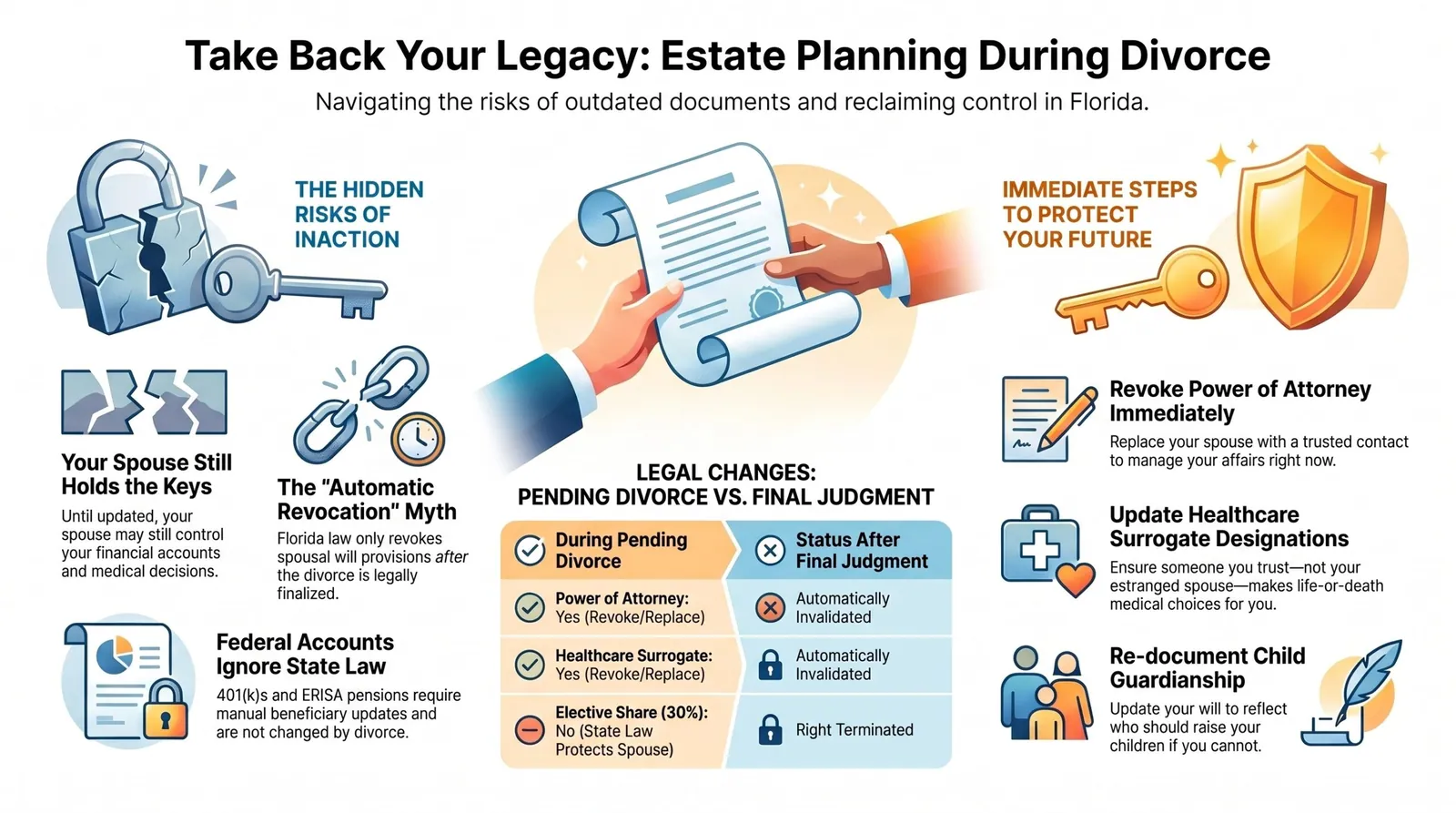
TL;DR: You built something. You earned something. And right now, there’s a real chance your spouse, the person you may be trying to leave, or the one you’ve been quietly tolerating, has more control over your future than you do. An estate plan isn’t just for when you die. It’s the document that decides who raises your kids, who touches your money, and who makes decisions for you if you can’t. If that plan still has your spouse’s name all over it, you haven’t protected yourself. You’ve handed them the keys.
 Your Estate Plan Is a Power Document: Does It Reflect Your Power?
¶ Most people think estate planning is something you do once, file away, and forget. They sign a will when they get married, name their spouse as beneficiary on everything, and move on. That made sense at the time. But that was then.
¶
¶ If your marriage has changed, if trust has eroded, if you’re walking on eggshells, if you’re quietly planning your exit or already in the middle of one, your estate plan may be working against you. Right now. Today.
This isn’t a hypothetical. It’s a legal reality. Until you change those documents, your spouse may still be the person who controls your financial accounts if you’re incapacitated. They may still be the person who inherits your assets. They may still be the person with authority to make medical decisions on your behalf.
That’s not a legacy. That’s a trap you built for yourself before you knew better.
What “Control” Actually Looks Like in an Estate Plan
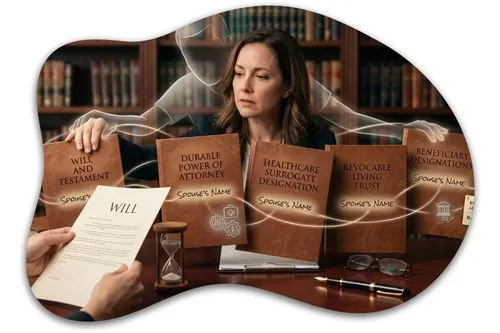 When people hear “estate planning,” they picture a will. But a will is only one piece. The documents that give your spouse the most immediate, day-to-day control over your life and assets are often the ones people forget to update.
¶
¶ Here’s where a spouse’s name tends to live, and where it can do the most damage if your situation has changed:
-
¶
- Beneficiary designations: These are on your life insurance policies, retirement accounts, and bank accounts. A will does not override a beneficiary designation. If your spouse is named, they get the money. Period. Note: Retirement accounts governed by federal law (such as most 401(k)s and employer pension plans under ERISA) are not covered by Florida’s automatic revocation rules; these always require a manual beneficiary update.
- Durable Power of Attorney: This document gives someone authority to manage your finances and legal affairs if you become incapacitated. If your spouse holds this, they can access accounts, sign documents, and make financial decisions on your behalf while you’re unable to stop them.
- Healthcare Surrogate Designation: This names who makes medical decisions if you can’t. If that’s your spouse and your relationship has deteriorated, that’s a significant problem.
- Revocable Living Trust: If you have a trust and your spouse is named as a successor trustee or primary beneficiary, they may have broad authority over assets you intended to protect.
- Your Will: Yes, this one too. If your spouse is the sole beneficiary and executor of your estate, they control everything after you’re gone.
¶
¶
¶
None of this updates automatically when your relationship falls apart. You have to act.
¶
The Paralysis Is Real. But So Is the Risk
¶ Here’s what I see constantly: people who know they need to make changes but keep putting it off. They’re waiting for the “right time.” Waiting until the divorce is final. Waiting until they’ve had the hard conversation. Waiting until things settle down.
Nothing settles down on its own. And while you wait, those documents sit there doing exactly what they were designed to do, putting someone else in control of your life.
¶
¶ If something happened to you tomorrow, an accident, a medical event, a sudden death, your spouse would step into every role you gave them on those documents. The version of you that signed those papers trusted that person completely. Does today’s version of you agree with that decision?
If the answer is no, that’s not a feeling. That’s a legal problem you can fix.
¶
What You Can Do Right Now: Before the Divorce Is Even Final
¶ This is where a lot of people get it wrong. They assume they have to wait until the divorce is over to update their estate plan. In Florida, that’s not entirely true.
There are specific steps you can take during a separation or pending divorce to protect yourself:
- Update your Power of Attorney immediately. You can revoke your existing POA and name a trusted family member or friend. This removes your spouse’s authority over your financial and legal affairs right now.
- Change your Healthcare Surrogate. Name someone you actually trust with those decisions.
- Review and update beneficiary designations where legally permissible. Some changes may be restricted by a court order during active divorce proceedings, so you need an attorney advising you on what’s allowed and what isn’t.
- Revise your will. While Florida law does automatically revoke spousal provisions in a will upon divorce, that protection only kicks in after the divorce is finalized. Until then, your spouse remains in that document.
- Consider a new trust structure that protects your separate assets and clearly designates your chosen beneficiaries, including your children.
¶
¶ The point is this: you are not powerless while you’re in the middle of this. You have options, and the earlier you act, the more protected you are.
Working with our Estate Planning Attorneys at Brandon Legal Group means you get a clear-eyed look at exactly what your documents say right now, and a direct plan to change what needs to change.
What You Can’t Change Until the Divorce Is Final
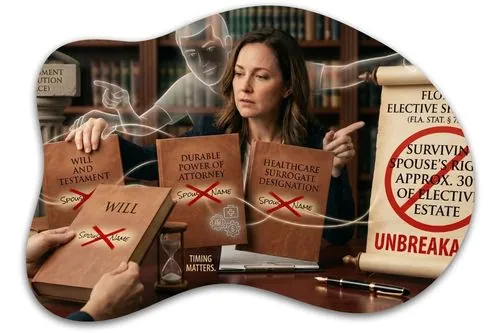 There’s an important limit to be honest about: Florida’s elective share law (Fla. Stat. § 732.201) gives a surviving spouse the right to claim approximately 30% of the elective estate, regardless of what your will says; and that right exists as long as you are legally married. Separation doesn’t end it. A pending divorce doesn’t end it. Only the entry of a Final Judgment of Dissolution does.
What this means in practice: you can immediately revoke your spouse’s authority as Executor, Power of Attorney, Healthcare Surrogate, and Trustee. You can change non-ERISA beneficiary designations where court orders permit. But you cannot fully disinherit your spouse from your estate until the divorce is final. If something happens to you before that day, your spouse retains elective share rights no matter what your updated will says.
¶
¶ This is exactly why timing and strategy matter, and why working with an attorney during this window is not optional. The sooner the divorce is final, the sooner that exposure ends.
Your Kids Deserve a Plan That Reflects Your Current Wishes
If you have minor children, this conversation gets more serious. Your estate plan is the document that names who raises your kids if something happens to you. If you haven’t updated your guardianship designations, or if you named your spouse as the sole guardian back when things were fine, that decision is still sitting in your paperwork.
Yes, a surviving biological parent typically has legal rights to custody of the children. But a clearly documented, legally sound estate plan that reflects your current intentions matters. It matters in court. It matters when there’s a dispute. It matters when you’re not there to speak for yourself.
Your children deserve a plan that reflects your current wishes, not decisions made under different circumstances. That starts with getting your legal house in order.
¶
This Isn’t About Being Vindictive. It’s About Being Smart
¶ Protecting your estate plan isn’t a hostile act. It’s a responsible one. You are allowed to make decisions about your own assets, your own health, your own legacy. Updating these documents isn’t punishing your spouse. It’s taking back what was always yours, the right to decide.
¶
¶ The version of you who signed those old documents made the best decision they could with the information they had. You have new information now. Use it.
Frequently Asked Questions
Can I change my estate plan while my divorce is pending?
¶ Yes, in most cases, but with real limits. You can typically update your Power of Attorney, Healthcare Surrogate, and Will during a pending divorce. However, most Florida circuits impose an automatic or standing temporary injunction once a divorce is filed, which restricts changes to beneficiary designations on insurance and retirement accounts until the case is resolved or the court grants permission. An estate planning attorney working alongside your divorce attorney can tell you exactly what you can and cannot change, and when.
Does divorce automatically update my estate plan in Florida?
Florida law does revoke spousal provisions in a will automatically upon divorce, but only upon divorce, not separation. It does not automatically update beneficiary designations on life insurance or retirement accounts. Notably, retirement accounts governed by federal law (ERISA); which includes most 401(k)s and employer-sponsored pension plans, are not covered by Florida’s automatic revocation rules at all. The plan administrator pays whoever is named on the beneficiary form, even after divorce. Those require direct action on your part. Waiting for the law to fix it is a mistake.
What if my spouse is already listed on my life insurance?
You can update your beneficiary designation directly with the insurance company. This is separate from your will and can often be done with a simple form. However, during active divorce proceedings, you should confirm with your attorney whether a court order or automatic temporary injunction restricts this change.
Do I need an attorney to update my estate plan, or can I do it myself?
Technically, some documents can be changed without an attorney. Practically, doing it wrong can make the documents invalid, or leave gaps that your spouse can challenge later. If you’re in a contested or high-conflict situation, getting it done correctly the first time is not optional. It’s protection.
How do I know if my current estate plan is putting me at risk?
Pull out every document you’ve signed: your will, any trust documents, your Power of Attorney, your Healthcare Surrogate form, and the beneficiary designation forms for every financial account and insurance policy. Read every name on every line. If you see your spouse’s name in a role you’re no longer comfortable with, that’s your answer. Then call an attorney.
You’ve been waiting for the right moment to take control. This is it. Brandon Legal Group works with clients who are done being reactive and ready to make decisive, strategic moves. Talk to our estate planning attorneys and find out exactly where you stand, and exactly what it takes to change it.