
⚠️ Who This Article Is For
This article is written for people in Florida marriages where one spouse con trols the money and the other has been locked out , financially, emotionally, or both. If that describes your situation, keep reading.
If you and your spouse share financial decisions openly and honestly, this article is not written for you. For general family financial planning, please contact our team directly.
The Day You File Is the Day Financial Control Ends
TL;DR: You don’t know what’s in the accounts. You haven’t seen a tax return in years. Every time yo u ask about money, the conversation goes sideways , and you’re starting to wonder if that’s the point. Here’s what most financially-controlled spouses don’t realize: in Florida, the moment a divorce petition is filed, your spouse is legally required to hand over everything. Bank statements. Tax returns. Pay stubs. Business records. Credit card bills. All of it. The control they’ve spent years building disappears the day the case is filed. The only question is when you decide to file.
 You Already Know. You Just Haven’t Said It Out Loud.
You’ve been quietly Googling for weeks. Maybe months. You’ve cleared the browser history more than once. You know the password to one account but not the others. You know roughly what comes in but not where it goes. You’ve been told , in tone, in implication, sometimes in words , that the money isn’t your business. That you wouldn’t understand. That asking is ungrateful.
You’ve been walking on eggshells around the topic so long you’ve stopped noticing the eggshells.
Stop. Read this carefully: the structure that has kept you in the dark is a paper structure, and Florida law has a shredder built into it.
Florida Doesn’t Care Who Controls the Money
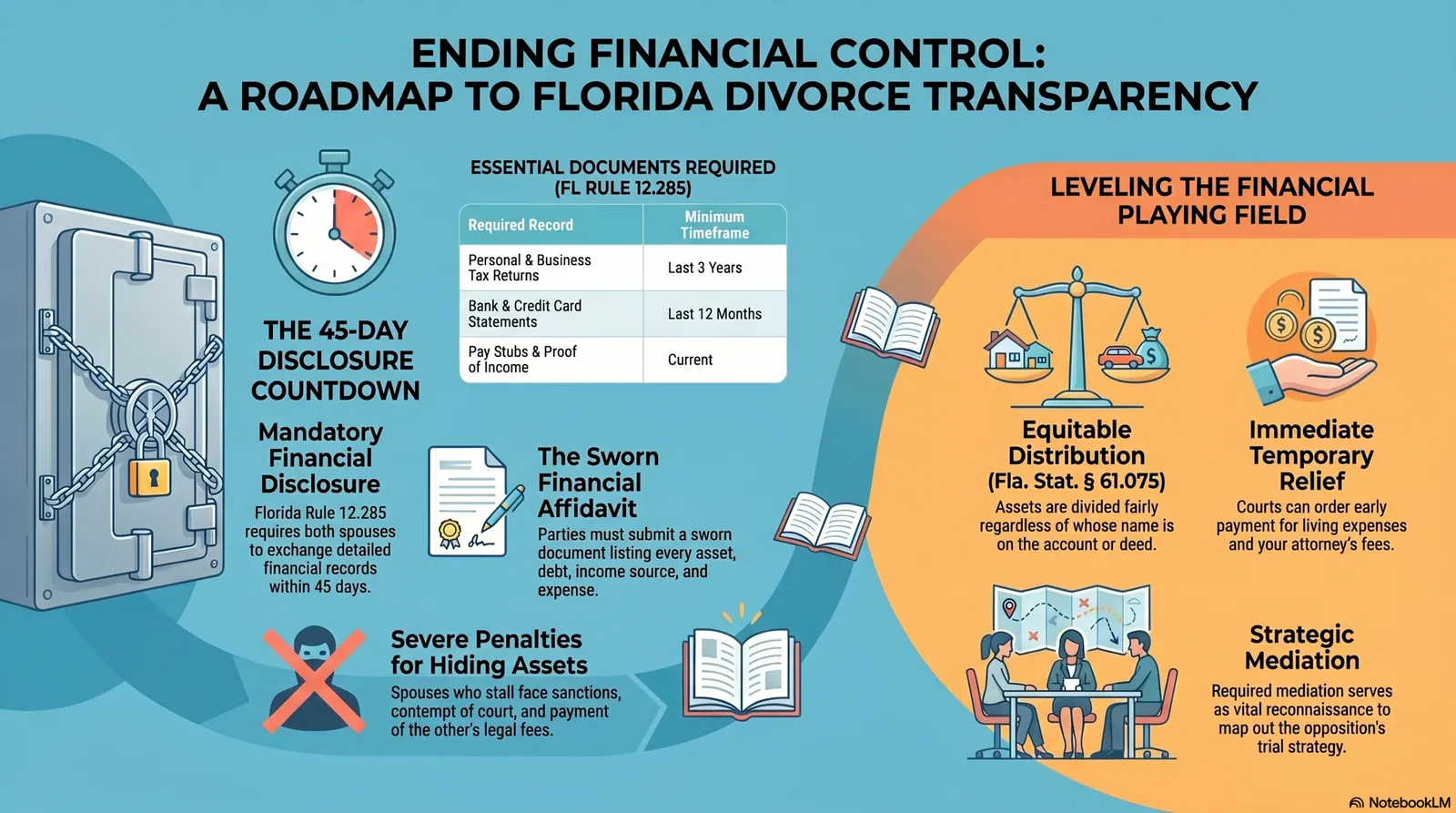
 Here’s the part nobody told you. Florida is an equitable distribution state under Fla. Stat. § 61.075. That means marital assets and marital debts get divided fairly between the spouses regardless of whose name is on the account, who earned the paycheck, or who “ran the finances.” Your spouse’s name on the brokerage account doesn’t make it theirs. Your name not being on the deed doesn’t make the house not yours.
The control is a story they’ve been telling you. The law tells a different one.
Mandatory Financial Disclosure: The Rule That Changes Everything
This is the single most important thing you need to understand before you do anything else.
Under Florida Family Law Rule of Procedure 12.285, both s pouses in a Florida divorce are required , not asked, not encouraged, required , to exchange detailed financial information within 45 days of service of the petition. That includes:
- A sworn financial affidavit listing every asset, debt, income source, and expense
- The last three years of personal and business tax returns
- Pay stubs and proof of income
- The last 12 months of statements for every bank account, credit card, brokerage, and retirement account
- Loan application s submitted in the last 12 months (these are gold , people lie to spouses but not to lenders)
- Deeds, titles, and corporate documents for any business interests
- Health and life insurance policy information
¶
This isn’t optional. A spouse who refuses or stalls faces sanctions, contempt, adverse inferences in court, and attorney’s fees awarded against them. Judges in Florida family court have seen every flavor of “I forgo t,” “I can’t find it,” and “my accountant has it” , and they have very little patience left.
¶
¶ The day your petition is served, your spouse’s information advantage starts dying. Forty-five days later, it’s gone.
“But I Don’t Even Know What We Have”
Good. You don’t have to. That’s what the rule is for.
Plenty of clients walk into our office unable to tell us their household income within $50,000. They don’t know if there’s a 401(k). They don’t know if there’s a HELOC on the house. They’ve signed tax returns without reading them for a decade. None of that is a problem for the case. It’s a problem your spouse now has to solve, on a deadline, under penalty of perjury.
¶
¶ If they hide something, we have tools , subpoenas to banks and employers, depositions, forensic accountants, lifestyle analyses that compare reported income to actual spending. Hidden assets get found. People who hide them lose credibility with the judge for the rest of the case, which costs them far more than what they were trying to hide.
Temporary Relief: You Don’t Have to Wait Until the End
Another thing they didn’t tell you. You don’t have to wait until the divorce is final to get access to money.
Under Fla. Stat. § 61.071 and § 61.13, the court can enter temporary orders early in the case, often within weeks, covering temporary spousal support, temporary child support, exclusive use of the marital home, and payment of household expenses and attorney’s fees. If your spouse has been controlling the money, the court can order them to fund your side of the case. Yes, including the lawyer fighting them. That isn’t a loophole. That’s the system working as designed, because the legislature understood exactly the situation you’re in.
Mediation Is Not the Enemy. Read This Twice.
Most contested family law cases in Florida are required to attempt mediation before going to trial. Many clients hear “required” and assume mediation is a hurdle to clear before the real fight starts. That’s the wrong frame.
Mediation is one of the most strategically valuable rooms you will ever sit in. Here’s why:
In mediation, opposing counsel has to start tipping their hand. They have to make arguments. They have to defend valuations. They have to react to proposals. Your attorney is sitting across from them watching all of it, what they emphasize, what they dodge, what makes them uncomfortable, what their client’s tells are. Even if mediation fails, especially if mediation fails, you walk out with a map of how the other side intends to fight at trial.
A failed mediation is not a failed step. It’s free reconnaissance. Smart clients welcome the chance to send their attorney into that room. Going in begrudgingly because a judge made you go is leaving strategic value on the table.
Welcome the room. Use the room.
¶
Prenuptial and Postnuptial Agreements: If You’re Still Reading and Not Yet Filing
¶ Some readers aren’t ready to file. They’re trying to figure out whether the marriage can be saved or restructured. If that’s you, a postnuptial agreement under Florida common law (or a prenup if you’re not yet married) is a legitimate tool. It clarifies, in writing, who owns what and what happens financially if the marriage ends.
People assume these agreements are romantic poison. In a marriage where one spouse controls the money, they can be the opposite; a forcing function that brings the actual financial picture into the daylight where both spouses can see it. If your spouse refuses to sign one, refuses to disclose what would go in one, or treats the request as betrayal, you’ve learned something important about whether the financial control is going to change voluntarily.
It usually isn’t.
What Filing Actually Looks Like
 Filing a petition for dissolution of marriage in Florida is a paper act. It’s a document. Your attorney prepares it, you sign it, it gets filed with the clerk, and your spouse gets served. That’s the moment the rules change.
From that moment forward:
- An automatic or standing temporary injunction may take effect (varies by circuit) preventing either spouse from hiding, dissipating, or transferring marital assets
- The 45-day clock under Rule 12.285 starts running on full financial disclosure
- You can request temporary support, temporary use of the home, and temporary attorney’s fees
- Your spouse loses the unilateral ability to make major financial decisions about marital property
None of this happens while you’re still “thinking about it.” All of it happens once you act.
The Honest Part
This won’t be pleasant. Divorce is hard, and divorce from a spouse who has used money as a leverage point is harder. They will not enjoy losing the information advantage. They may threaten. They may try to move money before they’re served (which is why you talk to an attorney before filing, so we can advise on timing and on capturing a snapshot of accounts the right way). They may tell you that you’ll never make it on your own.
None of that changes the law. None of that changes the rules. None of that changes what happens 45 days after they’re served.
You already know what you need to do. You’ve known for a while. You wouldn’t have read this far if you didn’t. The only question left is whether you’re going to keep tolerating a situation that has been quietly teaching your kids exactly what to expect from a marriage, or whether you’re going to pick up the phone.
¶
Frequently Asked Questions
I don’t have access to any of our financial records. Can I still file?
Yes. You don’t need the records to file. You need them to settle or try the case, and your spouse is required to produce them under Rule 12.285 once the case is filed. Many clients arrive knowing almost nothing about the household finances. That’s not an obstacle, that’s the situation the rule was written to fix.
How can I afford an attorney if my spouse controls the money?
Florida courts can order the financially-controlling spouse to pay for the other spouse’s attorney’s fees as part of temporary relief, under Fla. Stat. § 61.16. This is specifically intended to prevent one spouse from using financial control to deny the other spouse legal representation. We’ll discuss your specific situation in the consultation, including what temporary fee relief might look like in your case.
What if my spouse hides assets or lies on their financial affidavit?
Lying on a sworn financial affidavit is perjury. We have tools to find what’s hidden, subpoenas to banks, employers, and business partners; depositions; forensic accounting; lifestyle analysis that compares reported income against actual spending. When a spouse gets caught hiding assets, the consequences in Florida courts are severe and lasting: lost credibility with the judge, sanctions, attorney’s fees, and often a worse division of what they did disclose.
Is mediation just a delay before trial?
No. Mediation is required in most contested Florida family law cases, and it’s strategically valuable even when it doesn’t settle the case. It’s the first time both sides have to put their actual positions on the table, and your attorney learns enormously from watching opposing counsel argue, react, and defend. A failed mediation is intelligence you didn’t have before, go in expecting to use the room, not endure it.
¶
What’s the difference between a prenup and a postnup?
A prenuptial agreement is signed before marriage. A postnuptial agreement is signed during the marriage. Both clarify ownership of assets and what happens financially if the marriage ends. In Florida, prenups are governed by the Uniform Premarital Agreement Act (Fla. Stat. § 61.079). Postnups are governed by common law and require careful drafting to be enforceable. Both can be useful tools for clarifying a financial picture that has been deliberately murky.
How long does a Florida divorce take?
¶ It varies. Uncontested cases can resolve in a few months, contested cases with significant assets or custody disputes can take a year or more. What matters for your immediate situation isn’t the end date. It’s that the protections; disclosure, temporary support, temporary fee awards, kick in at the beginning, not the end.
¶
¶
You’ve been quiet long enough. Brandon Legal Group represents clients who are done tolerating financial control and ready to move with strategy and spine. We don’t coddle and we don’t sugarcoat, we tell you the truth about your situation and we hand you a plan. Call to schedule a consultation.