

TL;DR: Digital assets, from cryptocurrency wallets to social media accounts, often sit outside traditional estate plans, creating confusion and loss when someone dies. What transfers depends on platform terms of service, account structure, and whether the decedent took specific steps to grant access. Without proper planning, these assets frequently vanish or remain locked, inaccessible to even legally appointed personal representatives.
The login credentials are stored in a browser autofill. The cryptocurrency sits in a cold wallet somewhere in a desk drawer. The cloud storage holds fifteen years of family photos. The PayPal account has a balance. The Instagram account memorializes a life. And when someone dies without addressing any of it, the digital estate becomes a locked vault with no map, no key, and a tangle of user agreements that were never written with death in mind. The law is slow to adapt, treating digital assets like an afterthought because, until recently, they were one. Now they represent significant financial value, irreplaceable personal history, and strategic leverage, and most estate plans do not account for them at all.

Digital assets in divorce proceedings do not transfer the way physical property transfers. Probate law evolved around tangible things: real estate, bank accounts, stock certificates. Digital property exists in a different legal dimension, governed less by Florida Statutes and more by the terms of service agreed to with a click years earlier. Those terms frequently prohibit account transfer, even to an estate. The result is a fractured landscape where some assets move seamlessly to survivors, others require court orders and months of negotiation with unresponsive platforms, and still others disappear entirely.
What Qualifies as a Digital Asset
The category is broader than most people assume. It includes anything stored electronically or accessible through an online account: financial accounts held at online-only institutions, cryptocurrency wallets and exchange accounts, domain names and intellectual property registered digitally, email and cloud storage, social media profiles, subscription services with residual value, customer loyalty points and rewards accounts, digital media libraries (music, books, films purchased or licensed online), and business assets like client databases or websites. Florida's Fiduciary Access to Digital Assets Act, Florida's version of the Revised Uniform Fiduciary Access to Digital Assets Act (RUFADAA), codified beginning at Fla. Stat. § 740.001, recognizes this breadth but stops short of mandating automatic access.
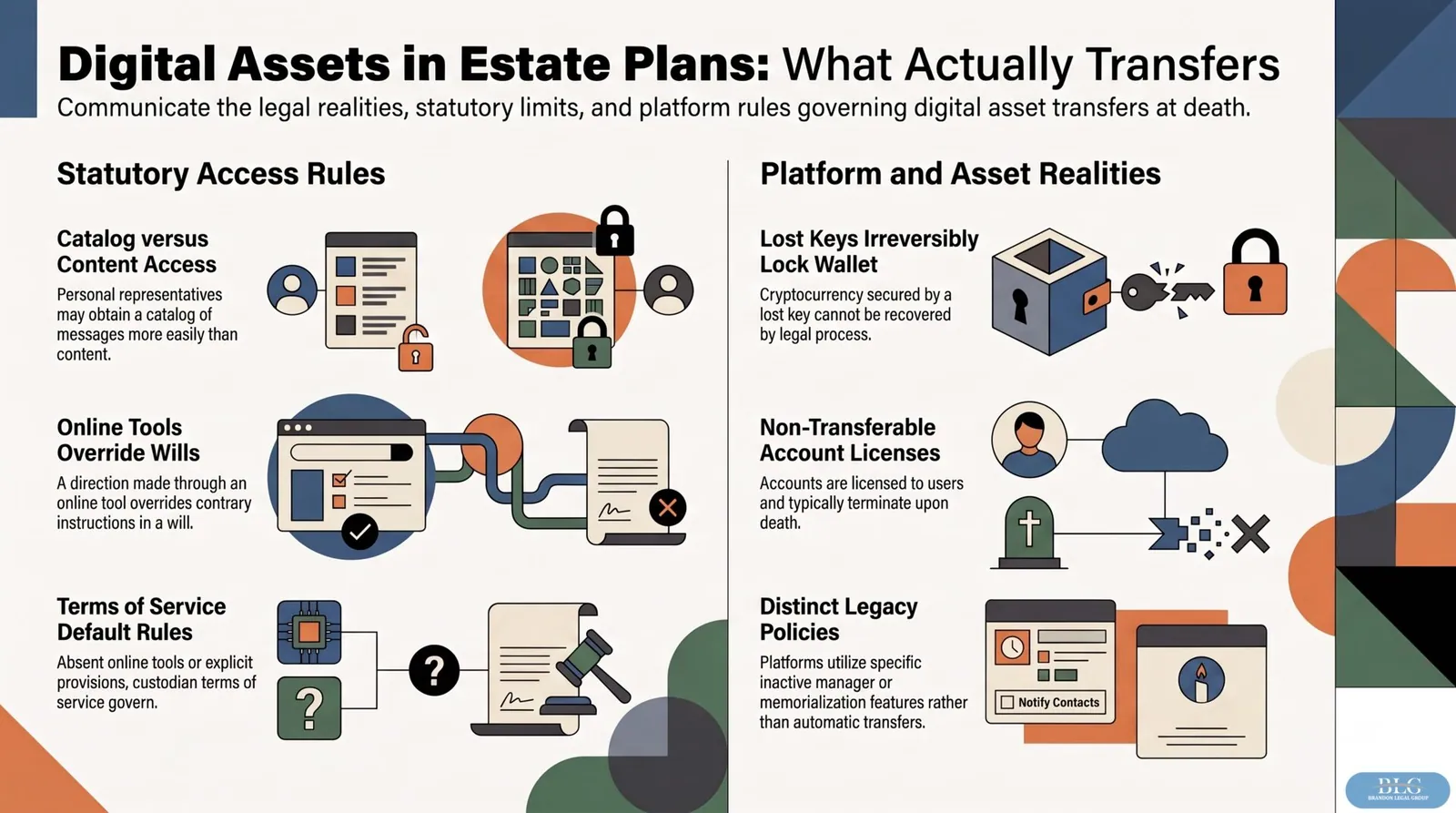
The statute distinguishes between the content of electronic communications and the catalog of those communications, a critical line. A personal representative may obtain a list of emails (the catalog) more easily than the emails themselves (the content), unless the decedent affirmatively granted broader access. That distinction matters when financial records live in Gmail, business dealings in Slack, or estate-plan documents in Dropbox.
Beneficiary Designations and Non-Probate Transfer
Some digital assets bypass probate entirely through mechanisms similar to those used for traditional accounts. A transfer-on-death (TOD) designation, if the platform supports it, directs the asset to a named beneficiary without court involvement. Some payment platforms and cryptocurrency exchanges allow a named beneficiary or a decedent's representative to claim funds with a death certificate and supporting documentation, though adoption of formal beneficiary designation features remains inconsistent across the industry. When these mechanisms exist and have been completed, transfer is straightforward.
The problem is that most platforms do not offer them. Google, Meta, Apple, and Microsoft each have distinct policies, none of which involve automatic transfer to heirs. Google allows a user to designate an "Inactive Account Manager" who gains access after a specified period of inactivity. Facebook offers memorialization or deletion, with a legacy contact permitted limited management, but does not permit account transfer. Apple now offers a "Legacy Contact" feature; without it, access generally requires a court order. The absence of a uniform standard forces personal representatives to navigate each platform individually, often with minimal cooperation and maximum delay. Platform policies change frequently, so verify current terms before relying on any of them.
Terms of Service as the Hidden Governing Document
Every online account is a contract. The terms of service dictate what happens at death, and those terms typically prohibit transfer. Email accounts, social media profiles, and cloud storage are licensed to the user, not owned by the user. The license terminates at death unless the agreement provides otherwise. A personal representative's letters of administration, valid authority under Florida probate law, carry little weight with an out-of-state tech company operating under its own contractual terms unless Florida's digital assets act compels disclosure, and even then, only to the extent the statute reaches.
Consider a hypothetical: A decedent operated a side business selling digital templates through an online marketplace. The business generated consistent monthly income. The terms of service for the marketplace prohibit account transfer and specify that upon the account holder's death, the account will be closed and remaining funds disbursed to the estate after a holding period. The personal representative cannot continue operating the business, cannot access customer lists, and cannot retrieve the intellectual property used to create the templates if it was stored in the platform's proprietary system. The asset's value, its ongoing revenue stream, is effectively destroyed by a clause buried in an agreement no one read.
Florida's act provides a framework for fiduciary access, but it operates as a floor, not a guarantee. Under Fla. Stat. § 740.004, if a custodian provides an online tool that allows the user to direct disclosure or nondisclosure of digital assets, a direction made through that tool overrides a contrary instruction in a will, trust, power of attorney, or other record. If no online tool exists, or the tool does not allow the user to modify the direction, the user may grant or prohibit access through a will, trust, power of attorney, or other record. Absent either, the custodian's terms of service govern, and a personal representative is generally limited to the catalog of electronic communications rather than their content.
Cryptocurrency and Digital Wallets
Cryptocurrency is property, but its transfer depends entirely on whether anyone can access it. A decedent who held Bitcoin in a hardware wallet secured by a private key has created an asset that exists but cannot be reached if the key is lost. There is no customer service line. There is no "forgot password" link. The asset is mathematically inaccessible, and its value is irretrievable regardless of how clearly the will directs its distribution.
Cryptocurrency held on an exchange operates more like a traditional brokerage account, governed by the exchange's terms of service and accessible, sometimes, with a court order and death certificate. But exchanges have failed, disappeared, or locked accounts indefinitely while "investigating" an estate claim. Unlike FDIC-insured bank deposits, there is no comparable federal insurance backstop. The personal representative may know the cryptocurrency exists, may be able to prove ownership, and still never gain access.
Effective planning requires documentation: where wallets are stored, how private keys are secured, which exchanges hold which assets, and clear instructions on access. A comprehensive estate plan that ignores digital assets is a plan with a blind spot the size of the decedent's entire online life.
Secured Access Without Compromising Security
The tension between access and security is real. Putting passwords in a document filed with a will means those credentials can end up in the public probate record, visible to anyone who requests the file. Referencing them through a revocable trust offers more privacy but requires updating the document every time a password changes, a process few follow. Third-party password managers offer emergency access features, allowing a designated person to request access after a waiting period, but that requires setup before death and trust in the platform's continued operation.
A durable power of attorney with explicit authority over digital assets can grant an agent access during incapacity, but it terminates at death. Fiduciary authority over the decedent's digital assets vests in the personal representative only after appointment, which means a gap exists between death and the issuance of letters of administration, a gap during which accounts may be closed, data deleted, or assets frozen. Advance planning closes that gap.
Intellectual Property and Revenue-Generating Content
Digital assets increasingly include intellectual property with ongoing economic value: YouTube channels with ad revenue, Substack newsletters with paid subscribers, Etsy shops, licensed stock photography, self-published e-books. These are not just accounts; they are businesses. Whether they transfer depends on platform terms and the structure of ownership.
A YouTube channel generally cannot be handed to an heir the way a car title changes hands, but the personal representative may be able to download content (if the decedent authorized content access) and the estate may continue to receive revenue payments for a period. An online shop may be closed by the platform upon notice of death, cutting off an income stream even if physical inventory and intellectual property could otherwise continue generating sales. A newsletter platform may allow the estate to maintain the subscriber list and archive, or it may not; there is no consistency, and the only way to know is to locate the account, review the terms, and negotiate with the platform.
Transferable intellectual property, such as copyrights, trademarks, and patents, moves through probate or a revocable trust like any other intangible property, but access to the platform where that property is monetized does not follow the same rules. Separating the legal right from the practical ability to exercise it is a common and costly gap in digital estate planning.
Social Media and Personal Accounts
Social media accounts hold different value. They are not financial, but they are personal, evidentiary, and sometimes business-critical. A decedent's Facebook account may contain the only copies of family photos, the only record of communications relevant to estate disputes, or the only evidence of a business relationship. It may also contain information a family prefers remain private.
Memorialization policies vary by platform, and they change. As of publication:
- Facebook allows a legacy contact to manage a memorialized account but not to log in or read private messages.
- Instagram offers memorialization or removal, generally at the request of a verified immediate family member or authorized representative.
- X (formerly Twitter) will deactivate the account of a deceased user upon request from a verified family member or authorized person, with no option to maintain or transfer the account.
- LinkedIn will memorialize or remove the profile of a deceased member once notified, at the requester's election.
None of these policies result in "transfer" in any traditional sense. The account does not become property of the estate. It is managed according to platform policy, which the estate has limited power to influence. If the decedent designated a legacy contact or granted explicit content access, the family's options expand. Without it, they depend on the platform's willingness to cooperate, which is inconsistent at best.
One often-overlooked consideration: privacy. Granting a fiduciary full access to email and social media means granting access to everything, including communications the decedent might not have wanted disclosed. Florida's digital assets act allows nuance: the user can permit catalog access but restrict content access, or grant access to some accounts and prohibit it for others. The same precision applied to probate avoidance strategies should extend to digital assets.

What actually transfers is a question with no single answer. It depends on asset type, platform policy, account structure, and whether the decedent took deliberate steps to authorize access. Default rules favor platform control, not heir access. Digital assets do not automatically flow to beneficiaries the way a payable-on-death bank account does. They do not pass under a will unless access has been separately granted. They do not land in a revocable trust unless someone thought to address them. The gap between legal ownership and practical access swallows value, erases history, and leaves families locked out of accounts they have every emotional and financial reason to reach.
Closing Remarks
If a decedent held cryptocurrency in a wallet no one can access, operated a revenue-generating online business governed by non-transferable platform terms, or stored estate-critical documents in cloud accounts now frozen by terms of service, the estate faces loss that planning could have prevented. Brandon Legal Group structures estate plans that account for digital assets with the same precision applied to real property and financial accounts. Contact us to ensure access, preserve value, and close the gaps default law leaves open.
Frequently Asked Questions
Can a personal representative access a decedent's email without prior authorization?
Under Florida's Fiduciary Access to Digital Assets Act, a personal representative may generally obtain a catalog of electronic communications, a list of messages and account activity, unless the decedent directed otherwise or a court orders otherwise. Access to the content of those communications (the messages themselves) requires affirmative authorization from the decedent through an online tool, a will, a trust, or another written record, or a court order. Without one of those, the personal representative can confirm that emails exist but cannot read them.
What happens to cryptocurrency held in a hardware wallet if no one has the private key?
In practical terms, it is gone. Cryptocurrency secured by a private key that has been lost or never disclosed generally cannot be recovered by any technical, legal, or judicial process. The asset remains on the blockchain, provably associated with the decedent's wallet address, but unreachable. The estate owns an asset it cannot liquidate, distribute, or use. This is one of the few scenarios in estate administration where value is destroyed by nothing more than an absence of information.
Do beneficiary designations on digital accounts override instructions in a will or trust?
If a platform offers a transfer-on-death or beneficiary designation feature and the decedent completed it, that designation generally controls, just as it does for life insurance or retirement accounts. The asset transfers outside of probate directly to the named beneficiary, regardless of contrary provisions in a will or trust. The issue is that very few digital platforms currently offer such features, leaving most digital assets without a non-probate transfer mechanism unless structured intentionally.
Can a durable power of attorney give someone authority over digital assets during incapacity?
Yes, but only if the power of attorney explicitly grants authority over digital assets and electronic communications. A general grant of financial powers may not be read to include email, social media, or cloud storage access. The authority must be clear and specific. Even then, the agent's power terminates at the principal's death, leaving a gap between death and the appointment of a personal representative unless separate testamentary authorization has been granted.
What should be included in a digital asset inventory?
An effective inventory identifies each account or asset, the platform or service provider, the username or account identifier, the location of any hardware (such as external drives or hardware wallets), the existence and location of recovery keys or passwords, and any beneficiary designations or legacy contact settings already in place. It should also specify what the fiduciary is authorized to do: access content, download data, close the account, continue operating a business, or distribute assets. The inventory is useless if stored only inside an account no one can access; it must exist in a format the fiduciary can actually reach, whether that is a secured physical document held with the estate planning instruments or a password manager with emergency access configured.
References
- Fla. Stat. §§ 740.001 et seq., Florida Fiduciary Access to Digital Assets Act. Link: http://www.leg.state.fl.us/statutes/index.cfm?App_mode=Display_Statute&URL=0700-0799/0740/0740.html
- Fla. Stat. § 740.004, User Direction for Disclosure of Digital Assets. Link: http://www.leg.state.fl.us/statutes/index.cfm?App_mode=Display_Statute&URL=0700-0799/0740/Sections/0740.004.html
- Fla. Stat. § 740.002, Definitions (including "digital asset," "catalogue of electronic communications," and "content of an electronic communication"). Link: http://www.leg.state.fl.us/statutes/index.cfm?App_mode=Display_Statute&URL=0700-0799/0740/Sections/0740.002.html
- Fla. Stat. § 740.006, Disclosure of Content of Electronic Communications of a Deceased User. Link: http://www.leg.state.fl.us/statutes/index.cfm?App_mode=Display_Statute&URL=0700-0799/0740/Sections/0740.006.html