

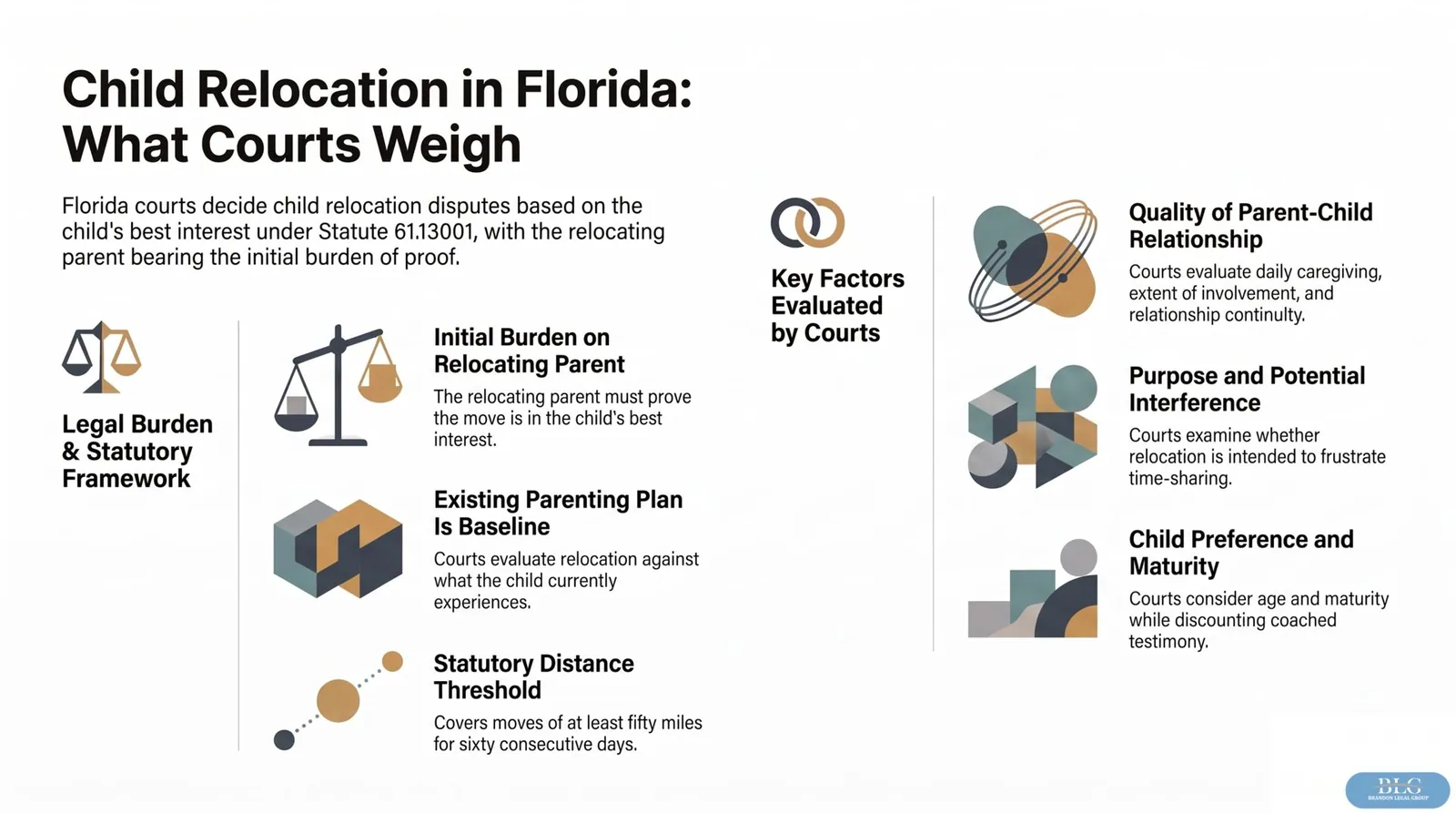
Florida courts deciding relocation cases don't start with distance or job offers. They start with whether moving serves the child's best interest. That calculation turns on the current parenting plan, the strength of each parent-child relationship, and whether the move is designed to interfere with time-sharing. Distance alone proves nothing.
Relocation isn't about geography. It's about power. The parent who wants to move usually frames it as opportunity: better job, lower cost of living, family support. The parent who opposes it frames it as erasure: taking the child away, destroying the relationship, punishing the other parent. Florida courts don't decide the case based on either narrative. They care about one thing first: whether the move serves the child's best interest under the existing parenting plan. Every other argument is downstream from that.

Most parents filing relocation petitions believe the burden is on the other side to prove harm. That belief costs them the case. Florida Statute 61.13001 puts the initial burden on the relocating parent, who must prove by a preponderance of the evidence that the move is in the child's best interest. Only if that burden is met does it shift to the objecting parent to show the opposite. The statute creates no presumption for or against relocation either way. It also requires proper statutory compliance and a detailed sworn petition when there is no written agreement. Courts don't assume the move is fine unless the other parent can show damage. The relocating parent must affirmatively justify disrupting the current arrangement.
The Existing Parenting Plan Is the Baseline
Florida courts begin every relocation analysis by examining the current parenting plan. Not the ideal plan. Not what the parents wished they had negotiated. The plan that governs right now. If that plan includes substantial time-sharing, overnights, weekday involvement, school pickup, extracurriculars, relocation immediately threatens the non-relocating parent's ability to exercise those rights. The court evaluates relocation against what the child currently experiences, not against some abstract notion of sufficient contact.
Consider a hypothetical: One parent has the child Monday through Wednesday, the other Thursday through Sunday. The Monday-Wednesday parent wants to move 200 miles away for a job promotion. Even if the job is real and the opportunity legitimate, the Thursday-Sunday parent loses midweek school involvement, drop-offs, and the rhythm of regular overnight contact. The court doesn't ask whether occasional weekend visits are "enough." It asks whether the relocation damages what the child already has. If the current plan works and the child thrives, moving becomes exponentially harder to justify.
This is why parents who secured favorable time-sharing during the initial divorce or custody case hold leverage in relocation disputes. The parenting plan isn't just a schedule. It's the evidentiary foundation the court uses to measure harm. Weak time-sharing makes relocation easier to approve. Robust time-sharing makes it harder.
The Quality of Each Parent-Child Relationship
Courts weigh the relationship each parent has with the child, not the relationship each parent claims to have. That distinction matters. A parent who sees the child every other weekend and skips phone calls will lose ground against a parent who coaches soccer, attends school conferences, and manages medical appointments. Relocation cases surface the operational reality of who does what.
Florida Statute 61.13001 directs courts to evaluate the nature, quality, extent of involvement, and continuity of the child's relationship with both parents. Courts examine:
- Who handles day-to-day caregiving
- Who maintains relationships with teachers, doctors, and coaches
- Who participates in extracurriculars and school events
- Whether the non-relocating parent has been actively involved or sporadically present
- Whether the child has a strong bond with extended family in the current location
A parent seeking to relocate will argue the other parent's involvement has been minimal and the child's primary attachment is to the relocating parent. A parent opposing relocation will document every instance of involvement, every text exchange, every event attended. Courts do not accept generalities. They want specifics: dates, communications, participation records. The parent with documentation walks into court with the stronger position.
Whether the Move Is Designed to Interfere
Florida courts explicitly evaluate whether the relocation is intended to frustrate the other parent's time-sharing. Motive matters. A parent relocating for a documented job offer with a thirty percent salary increase will be treated differently than a parent moving to a new partner's home two states away with no change in employment. Courts review the reasons for relocation and ask whether those reasons justify the disruption to the child's relationship with the non-relocating parent.
¶If the relocation appears punitive, moving shortly after a contentious custody battle, relocating to a location with no family ties, refusing to propose a revised time-sharing plan that preserves meaningful contact, the court will view the petition skeptically. The statute requires the relocating parent to propose a revised time-sharing schedule. If that proposal is facially inadequate, offering the other parent only summer breaks and one holiday, for instance, it signals intent to marginalize, not accommodate.
Bad faith does not need to be overt. A pattern of gate-keeping behavior, limiting phone contact, withholding information about school or medical appointments, discouraging the child's affection for the other parent, will inform the court's view of the relocation petition. If the relocating parent has a history of interference, the court may treat the move as an extension of that pattern.
¶The Child's Preference, When It Counts
¶Older children can express a preference about relocation, but Florida courts do not defer to that preference automatically. The child's age, maturity, and reasons matter. A sixteen-year-old with strong ties to a school, friend group, and extracurricular program will carry more weight than a seven-year-old repeating a parent's talking points. Courts evaluate whether the child's preference reflects genuine attachment or coaching.
Judges sometimes appoint a guardian ad litem to interview the child and assess the preference independently. The GAL's report can carry serious weight. If the child expresses anxiety about losing contact with one parent, if the child demonstrates loyalty conflict, or if the preference appears scripted, the court may discount it. Conversely, a mature child with clear, consistent reasoning rooted in educational opportunity, friendships, or family support can influence the outcome, especially if the child is approaching the age where enforcement becomes impractical anyway.
Parents should never coach a child on what to say. Courts and guardians ad litem are trained to detect it. Coached testimony backfires. If the child's testimony appears rehearsed or inconsistent with prior statements, the court may infer manipulation, and that inference can harm the relocating parent's case more than silence would have.

Relocation petitions are won and lost on specifics. Courts do not decide these cases on sentiment. They decide them on whether the relocating parent has met the statutory burden, whether the current parenting plan will be damaged, and whether the move serves the child's best interest measured against the life the child has now. Distance is not dispositive. Intent, involvement, and the quality of what already exists determine the result. Parents who assume relocation will be approved because the reason sounds good, or denied because the other parent objects loudly, misunderstand how Florida courts approach the question. The framework is statutory, the burden is clear, and the outcome turns on evidence, not narrative.
Closing Remarks
If a former spouse has filed a relocation petition that threatens your time-sharing, if you're considering a move and need to know whether it will survive judicial scrutiny, or if the other parent is using relocation as leverage in a broader custody fight, the deadlines are short and the consequences are long. Brandon Legal Group represents parents in high-stakes custody and relocation disputes across Florida. Contact us now for a consultation that starts with strategy, not sympathy.
Frequently Asked Questions
How much notice is required before relocating with a child in Florida?
Florida Statute 61.13001 applies when a parent seeks to move at least fifty miles from the principal residence in place at the time of the last order establishing or modifying time-sharing (or the filing of the pending action), for at least sixty consecutive days, not including a temporary absence for vacation, education, or health care. If the other parent does not agree in writing, the relocating parent must file and serve a sworn petition to relocate before moving. The petition must include the required relocation information, the reasons for the move, and a proposed revised time-sharing schedule. The other parent generally has twenty days after service to object. Failure to follow the statute can result in denial of relocation, an order returning the child, contempt, and attorney's fees.
Can a court deny relocation even if the relocating parent has a legitimate job offer?
Yes. A legitimate job offer is a factor, but it does not override the child's best interest. Courts evaluate the economic benefit against the damage to the child's relationship with the non-relocating parent. If the current parenting plan provides substantial involvement and the relocation would eliminate that involvement without sufficient countervailing benefit, the court can deny the petition even when the job offer is real and financially advantageous.
What happens if a parent relocates without court approval?
Relocating without approval when approval is required can violate Florida's relocation statute and any existing parenting plan or time-sharing order. The non-relocating parent can file an emergency motion for return of the child, seek contempt sanctions, request modification of the parenting plan based on the violation, and pursue attorney's fees. Florida courts take unauthorized relocation seriously. In egregious cases, it can contribute to a change in majority time-sharing.
Does the court consider the child's school and community ties?
Yes. Florida's relocation statute requires courts to consider the child's developmental needs, the likely impact of relocation, educational opportunities, and any other factor affecting the child's best interest. A child deeply involved in a school program, established friendships, or specialized services in the current location presents a stronger case for the parent opposing relocation. Courts weigh stability against the claimed benefits of the move.
Can the non-relocating parent propose an alternative arrangement instead of opposing outright?
Yes. A parent opposing relocation can file an objection and propose either denial of the move or, alternatively, a different revised time-sharing schedule that preserves meaningful contact if the court allows relocation. Some non-relocating parents propose that the child remain with them for majority time-sharing if the other parent insists on moving. Courts appreciate solutions that focus on the child's best interest rather than purely oppositional posturing, but the statutory burden remains on the relocating parent to justify the move. For more insight into what terms should be locked down during negotiation stages, see our article on Parenting Plan Negotiations.
References
- Florida Statutes § 61.13001 ((Parental relocation with a child). The Florida Senate).
This article is provided for general informational purposes only and does not constitute legal advice, nor does reading it create an attorney-client relationship. Florida law changes and every situation turns on its own facts. Consult a licensed Florida attorney about your specific circumstances before acting.