

Using Charitable trusts for tax planning: The Smart Path to Giving and Saving
A charitable trust isn’t about giving money away. It’s about strategically redirecting your wealth to support causes you care about while securing significant tax advantages of charitable trusts and a lifetime income stream for yourself. This is how you build a legacy without sacrificing your financial security.
Beyond the Checkbook: How does a Charitable trust work
Forget silent auctions and annual donations. A charitable trust is a powerful financial engine. You transfer assets, highly appreciated stocks, real estate, a business, into an irrevocable trust. The trust then sells these assets tax-free, reinvests the proceeds, and pays you (or a beneficiary) an income for a set term or life. This process of setting up a charitable trust is a cornerstone of advanced planning. At the end of the term, the remaining balance goes to your designated charity. You win with income and tax breaks. The charity wins with a major future gift.
The Two Main Types: CRTs vs. CLTs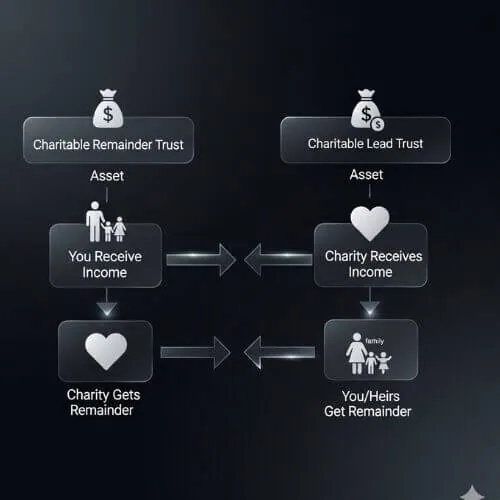
Choosing the right vehicle is everything. Your goals dictate the structure. Understanding the types of charitable trusts is the first step.
Charitable Remainder Trust (CRT): You get the income now. The charity gets what’s left later. Ideal for supplementing retirement income while avoiding capital gains tax on the sale of a highly appreciated asset.
Charitable Lead Trust (CLT): The charity gets the income now. You (or your heirs) get what’s left later. Ideal for high-net-worth individuals who want to support a charity immediately while moving assets out of their taxable estate at a reduced gift tax cost.
Charitable trust tax benefits: It’s More Than a Deduction
The IRS rewards this strategic philanthropy. The benefits are immediate and multi-layered, forming a key part of using charitable trusts for tax planning.
The Triple Tax Advantage
When you fund a CRT, you trigger a powerful three-part tax benefit:
- Immediate Income Tax Deduction: Based on the present value of the future gift to charity. This can be carried forward for years if it exceeds your annual income limits.
- Avoidance of Capital Gains Tax: The trust sells the asset. Not you. This means 100% of the proceeds are reinvested to generate your income, not a reduced amount after a 20-30% tax hit.
- Estate Tax Reduction: The assets placed in the trust are removed from your taxable estate, potentially saving your heirs millions in estate taxes.
Is a Charitable Trust Your Right Move? The BLG Assessment
It isn’t for everyone. It’s for individuals with significant appreciated assets, a philanthropic intent, and a desire for sophisticated tax and income planning.
A Charitable Trust Might Be Right For You If:
- Low-basis stock or investment property they want to diversify.
- A high current or projected income tax liability.
- A taxable estate that may be subject to federal estate tax.
- A genuine desire to make a major gift to a charitable organization.
Consider this illustrative scenario: A couple owns $2 million in company stock they bought for $100,000. Selling it would incur over $400,000 in capital gains tax. Instead, they fund a CRT. The trust sells the stock tax-free, nets the full $2 million, and provides them with a 5% annual income ($100,000/yr). They get a large partial income tax deduction the year they fund the trust and avoid all capital gains tax. The charity later receives the remainder.
Beyond the Numbers: Controlling Your Legacy
Picture this: you feel the pride of funding a scholarship or building a hospital wing in your family’s name. You own the confidence of a bolstered retirement income that’s partially tax-free. You see the relief on your heirs’ faces knowing their inheritance is protected from excessive taxation. This is the power of a plan that works for you.
Ready to see if your generosity can also be your smartest financial move? Schedule a strategic session with Brandon Legal Group to crunch the numbers and build a plan that serves your goals. Call (813) 902-3576 today.
FAQ: Charitable Trusts Demystified
What is the main tax benefit of a charitable remainder trust?
The main tax benefits are threefold: an immediate partial income tax deduction, the complete avoidance of capital gains tax on the sale of appreciated assets held by the trust, and the removal of those assets from your taxable estate. This powerful charitable remainder trust tax deduction strategy is unique to these tools.
Can I be the trustee of my own charitable trust?
Yes, you can typically be a trustee of your own charitable trust, but it requires meticulous adherence to IRS rules. We often recommend an independent trustee or corporate co-trustee to manage investments and distributions, ensuring compliance and reducing administrative burden.
What is the difference between a charitable lead trust and a charitable remainder trust?
The key difference is the timing of the benefits. A Charitable Remainder Trust (CRT) provides income to you first, with the remainder going to charity later. A Charitable Lead Trust (CLT) provides income to the charity first, with the remainder returning to you or your heirs later. CLTs are primarily used for estate tax reduction strategies.