

Alimony doesn't end the day the ink dries on the final judgment. For modifiable awards, when either party's income shifts, whether through job loss, retirement, illness, or a sudden windfall, Florida law may allow modification. But reopening the case requires proof of a substantial, involuntary, and permanent change, and the window to act is narrow.
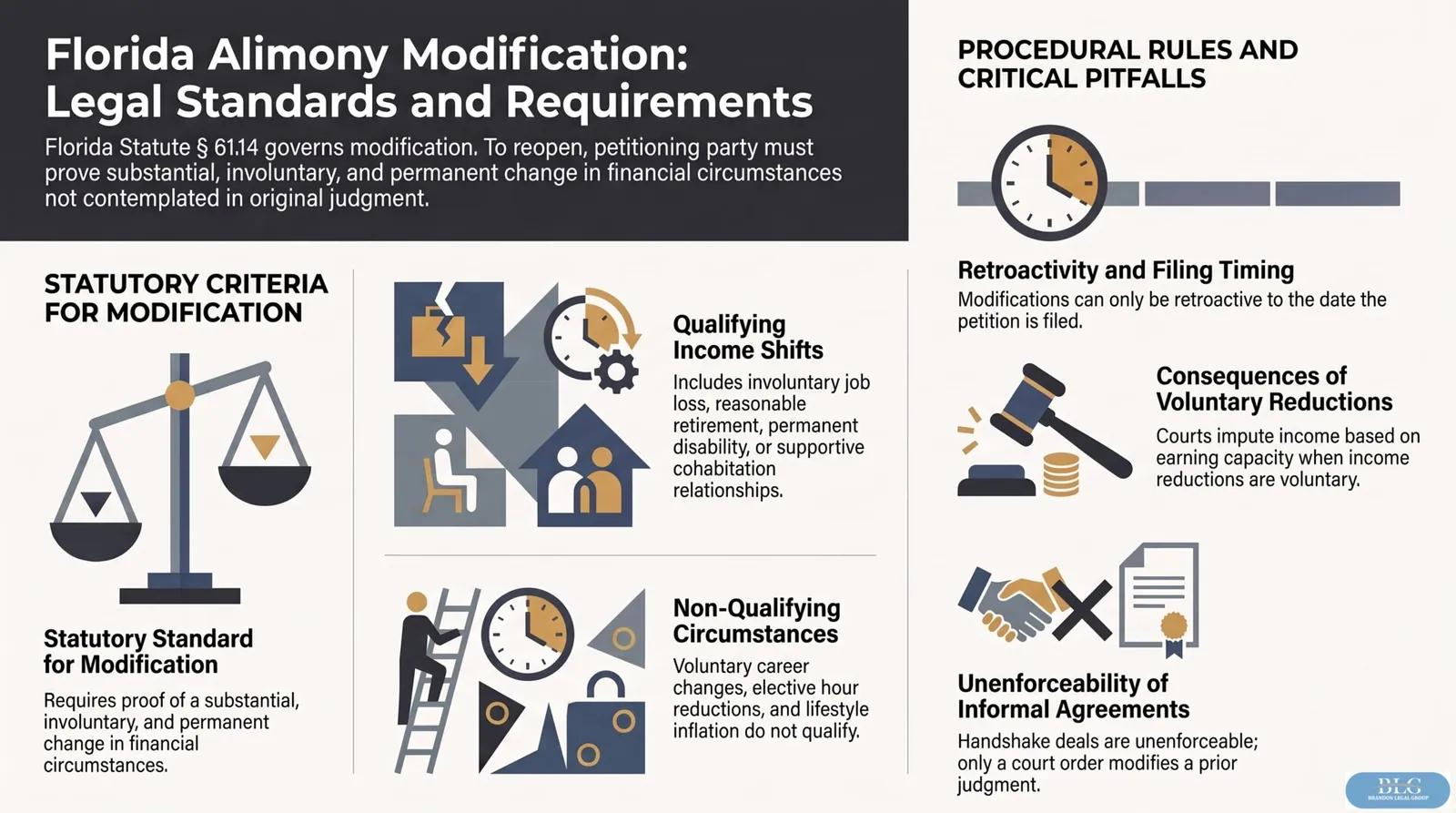
Alimony orders rest on a snapshot of income taken at the time of divorce. That snapshot rarely ages well. A layoff happens. A business fails. A remarriage brings new expenses. Or the paying spouse gets a promotion and suddenly the original calculation feels like ancient history. Florida law doesn't expect anyone to stay locked into a modifiable alimony arrangement that no longer reflects reality, but it also doesn't make modification easy. Some awards, including bridge-the-gap alimony and some nonmodifiable agreements, may be off limits. When modification is legally available, courts demand proof that the change is substantial, involuntary, and permanent, and they scrutinize every claim. The difference between a successful petition and a dismissed motion often comes down to documentation, timing, and understanding what the court will actually consider.

Modification isn't automatic. Filing a motion doesn't pause the obligation. Missing payments while the case winds through the docket can trigger contempt, wage garnishment, or worse. The burden sits entirely on the moving party to prove that circumstances have changed enough to justify judicial intervention. Courts won't reopen a case to fine-tune an arrangement or adjust for routine fluctuations. The standard is high, and the consequences of misjudging that standard are immediate.
What Florida Law Considers a Substantial Change
Florida Statute § 61.14 governs modification of modifiable alimony awards. The threshold requirement is a substantial change in circumstances that was not contemplated at the time of the original judgment. Substantial means material, large enough to alter the financial equilibrium the court originally struck. A five percent pay cut doesn't qualify. A fifty percent income drop might. The change must also be involuntary and permanent. Voluntarily quitting a job to avoid alimony will backfire. Courts impute income based on earning capacity, and that imputation can exceed the actual alimony owed.
Permanent doesn't mean forever. It means the change isn't temporary or seasonal. A six-month furlough might not meet the standard. Permanent disability may, if the medical evidence proves the loss of earning capacity is not temporary. Retirement is evaluated under Florida's statutory factors and the facts of the case; reaching a retirement milestone helps, but it does not automatically erase an alimony obligation. The question is whether the court can reasonably expect the financial situation to return to what it was. If the answer is no, the door to modification opens.
The same statute applies whether the payor or the recipient seeks modification. A recipient whose own income has fallen, due to layoff, disability, or market forces, can petition for an increase if the need has grown and the payor retains ability to pay. Conversely, a payor whose income has collapsed can seek a reduction or termination. The standard is symmetrical, but the burden of proof never shifts.
Income Changes That Trigger the Right to Modify
Not every income shift justifies reopening the case. Courts distinguish between changes driven by external forces and changes engineered to manipulate the obligation. The categories that most commonly meet the statutory threshold include:
- Involuntary job loss due to layoff, plant closure, or elimination of position, provided the payor actively seeks comparable reemployment.
- Reasonable retirement supported by the statutory retirement factors, including age, health, motivation for retirement, customary retirement age, and the economic impact on both parties.
- Permanent disability supported by medical documentation showing an inability to work at prior capacity.
- Significant reduction in business income for self-employed payors, backed by multiple years of tax returns, profit-and-loss statements, and third-party verification.
- Substantial increase in payor income where the original award was based on lower earnings and the recipient can demonstrate increased need as well as the payor's ability to pay more.
Courts also consider changes in the recipient's financial circumstances. The recipient's remarriage can affect alimony depending on the type of award and the language of the judgment or marital settlement agreement, so it should be reviewed carefully rather than guessed at. Cohabitation in a supportive relationship can also reduce or eliminate need. Under Florida Statute § 61.14(1)(b), a payor can petition for modification if the recipient enters into a supportive relationship, a domestic arrangement that functions economically like marriage. Proving that relationship requires more than suspicion; it demands financial records, living arrangements, and patterns of mutual support.
What Doesn't Qualify
Voluntary career changes, elective reductions in work hours, and lifestyle-driven income adjustments rarely survive scrutiny. A payor who leaves a high-paying job to pursue a passion project or relocates without comparable employment lined up will find the court unsympathetic. The same applies to payors who funnel income into new ventures that generate losses for years. Courts will impute income based on demonstrated earning capacity, prior work history, and available employment in the relevant market. If a payor earned $150,000 annually as an executive and now claims $40,000 as a consultant by choice, expect imputation at or near the former level.
Similarly, a recipient's claim of increased need must be rooted in genuine changed circumstances, medical expenses, loss of employment, or care obligations that didn't exist at the time of divorce. Lifestyle inflation, discretionary spending increases, or generalized claims of hardship won't suffice. The need must be real, documented, and tied to a specific change.
Timing and Procedure for Filing a Modification Petition
Modification motions must be filed in the same court that entered the original judgment. Florida requires the moving party to demonstrate the substantial change through a verified petition supported by financial affidavits, income documentation, and any relevant third-party records. The non-moving party has the right to respond, to challenge the claimed change, and to present countervailing evidence.
Timing matters. Courts may make an alimony modification retroactive to the date the petition is filed, but not earlier than that. A payor who loses a job in January but waits until June to file will remain liable for the full alimony amount through the pre-filing period. The longer the delay, the larger the arrears, and arrears don't disappear even if the court ultimately grants a reduction. Filing promptly preserves options. Waiting eliminates them.
Once the petition is filed, the obligation continues unless the court enters a temporary order modifying it pending final hearing. Temporary modifications are discretionary and granted only when the change is clear and the need immediate. Even then, the original amount remains due until the court says otherwise. Unilateral decisions to reduce or stop payments invite contempt findings, which carry penalties including attorney's fees, interest, and in extreme cases, incarceration.
Cases involving divorce attorneys in Florida often turn on how well the modification petition is documented from the outset. A bare assertion of hardship loses. A detailed financial package with corroborating records, employer statements, tax returns, and medical documentation builds the foundation for relief.
How Courts Recalculate Alimony After a Modification Petition
When a court finds that a substantial change has occurred and modification is legally available, it doesn't simply slash the alimony amount by the same percentage the payor's income dropped. The court revisits the applicable factors under Florida Statute § 61.08, which govern the type, amount, and duration of alimony. Those factors include the standard of living established during the marriage, the duration of the marriage, the age and health of both parties, the financial resources of each, and the contributions each made to the marriage.
The recalculation is not a fresh divorce trial. The court examines the new financial reality in light of the original award's purpose. If the alimony was intended to bridge a gap while the recipient retrained for employment, and that employment has now been secured, modification or termination may follow only if the governing law and order allow it. If the alimony was durational or an existing pre-2023 permanent award and tied to long-term need, the court assesses whether the payor's reduced income still permits some level of support and whether the recipient's need persists.
Consider a hypothetical: A former spouse was awarded $3,000 per month in an existing pre-2023 permanent alimony award based on the payor's $120,000 annual income and the recipient's $30,000 part-time earnings. Five years later, the payor suffers a disabling injury and can no longer work, receiving only Social Security disability of $2,200 per month. The court will weigh the payor's inability to meet the original obligation against the recipient's ongoing need, the length of the marriage, and any assets or income sources available to each party. The result might be a reduction to $500 per month, temporary suspension, or in rare cases, termination. But only if the evidence supports it.
¶ ¶Conversely, if a payor receives a windfall, inheritance, large bonus, or significant raise, and the recipient's circumstances have worsened, the court can increase alimony if the original award was based on lower earnings, the recipient's need justifies upward adjustment, and the payor has the ability to pay more. The inquiry is always fact-specific and rooted in the statutory factors.
Common Pitfalls That Derail Modification Cases
Modification petitions fail for predictable reasons. The most common missteps include:
- Filing too late. Waiting months after the income change allows arrears to accumulate and signals that the change wasn't truly urgent.
- Insufficient documentation. Claiming a business downturn without producing years of tax returns, profit-and-loss statements, and bank records invites dismissal.
- Voluntary income reduction. Taking a lower-paying job, retiring early without demonstrating necessity, or shifting income to avoid alimony triggers imputation and often costs more in legal fees than it saves in payments.
- Failing to disclose all income sources. Courts require full financial transparency. Hiding side income, rental revenue, or investment returns destroys credibility and can result in sanctions.
- Assuming informal agreements suffice. Handshake deals to reduce or waive alimony are unenforceable. Only a court order modifies a court order.
Each of these errors is avoidable, but they recur in case after case because parties underestimate the procedural and evidentiary demands. Courts view alimony as a binding obligation, not a suggestion, and modification motions as extraordinary relief, not routine adjustments. The burden is always on the moving party, and the standard is always substantial, involuntary, and permanent.
For context on how courts assess financial circumstances in related disputes, the principles governing hidden assets in divorce often overlap with modification inquiries, particularly when self-employment or business ownership complicates income verification.

Modification cases succeed when the documentation is thorough, the timing is prompt, and the legal standard is met head-on. Income changes reopen the door, but only evidence and strategy push it open all the way. The difference between relief and rejection often comes down to how the case is built and who is building it.
Closing Remarks
If your income has dropped due to disability, job loss, or retirement. Or if your former spouse's income has surged while your need remains, Florida law may provide a path to modify alimony, but the window is narrow and the standard unforgiving. Brandon Legal Group handles alimony modification cases in Florida with the documentation, strategy, and courtroom presence required to meet the statutory burden. Contact us to evaluate your case and file the petition before arrears accumulate and options disappear.
Frequently Asked Questions
Can alimony be modified if the payor remarries?
Remarriage alone does not constitute a substantial change in the payor's circumstances under Florida law. The fact that a payor has new household expenses or support obligations to a new spouse is generally not grounds for reducing alimony to the former spouse. Courts expect payors to honor existing alimony obligations regardless of new financial commitments. However, if remarriage coincides with another substantial change, such as loss of employment or disability, the combined factors may support modification. The key is whether the payor's ability to pay has materially changed, not merely whether new expenses have arisen.
How quickly can a court modify alimony after a petition is filed?
Modification becomes effective only upon entry of a court order, and the timeline varies by jurisdiction, docket congestion, and case complexity. Emergency or temporary modification orders can sometimes be obtained within weeks if the change is sudden and the evidence overwhelming, but final hearings often take several months. During that period, the original alimony amount remains due unless a temporary order provides otherwise. The court has discretion to modify retroactively to the date of filing, but cannot reach back further. Delays in filing translate directly into liability for the full original amount during the intervening months.
What happens if a payor voluntarily retires before reaching full retirement age?
Early retirement is scrutinized closely. If retirement is voluntary and the payor remains capable of working, courts typically impute income based on earning capacity rather than actual retirement income. Florida law does not permit payors to manufacture a change in income by choosing to stop working when they could continue. However, if early retirement is involuntary, due to employer-imposed age limits, disability, or elimination of the position, and the payor can demonstrate genuine inability to find comparable employment, modification may be granted. The burden is on the payor to prove both the involuntary nature of the retirement and the permanence of the reduced income.
Can alimony be increased if the recipient's financial situation worsens?
Yes, if the award is modifiable and the recipient can prove a substantial, involuntary, and permanent change that increases need while the payor retains the ability to pay more. Common scenarios include the recipient's job loss due to layoff, onset of disability, or increased medical expenses. The recipient must file a modification petition, provide updated financial affidavits, and demonstrate both the change in need and the payor's continued financial capacity. Courts are more receptive to upward modification petitions when the original alimony award was modest, the payor's income has grown, and the recipient's circumstances have deteriorated through no fault of their own.
Does cohabitation automatically terminate alimony in Florida?
Cohabitation does not automatically terminate alimony unless the original judgment or marital settlement agreement includes a specific provision to that effect. However, Florida Statute § 61.14(1)(b) allows a payor to petition for reduction or termination of alimony if the recipient has entered into a supportive relationship, a relationship where the recipient and another person reside together and receive financial support from one another in a manner similar to marriage. The payor bears the burden of proving the supportive relationship exists, which requires detailed evidence of shared expenses, joint assets, economic interdependence, and the nature and extent of the relationship. Courts consider numerous factors, and the outcome depends on the specific facts presented.
What if the payor hides income or underreports earnings to reduce alimony?
Courts have broad authority to impute income when a payor attempts to manipulate financial circumstances to avoid alimony. If evidence shows that income is being hidden, diverted to third parties, or underreported, the court can base its calculation on earning capacity, prior income history, and lifestyle indicators rather than claimed income. Recipients suspecting income concealment can seek discovery of tax returns, bank statements, business records, and lifestyle expenditures. Deliberate misrepresentation of income can also result in sanctions, attorney's fee awards, and findings of contempt. Transparency is not optional; it is legally required, and evasion carries consequences that often exceed the cost of compliance.
References