
TL;DR: You already know what you need to do. You’ve been circling it for months, maybe years. This article is not going to tell you divorce is scary but you’re strong and everything happens for a reason. This article is going to tell you how Florida divorce actually works, why no-fault law strips away the excuses your spouse may be leaning on, and what you should be doing right now instead of researching at 2 a.m. for the hundredth time.
 The Article You Just Read Somewhere Else Was Useless
There is a specific flavor of divorce content online that pretends to help you while telling you nothing. It says things like “divorce is a process, not an event.” It reminds you that “you don’t have to go it alone.” It tells you to be brave. Then it asks you to book a consultation.
That is not advocacy. That is a brochure with feelings.
You did not click through to a law firm’s website because you needed affirmation. You clicked through because something in your life is broken and you are trying to figure out how to deal with it. You deserve a real answer, not a pep talk. So here is the real answer.
Florida Is a No-Fault State. Your Spouse Cannot Stop This.
 This is the single most important thing to understand before anything else. In Florida, you do not have to prove your spouse cheated, lied, drank too much, disappeared, or did anything else wrong in order to get divorced. The law requires only one of two grounds:
- The marriage is irretrievably broken, meaning, in plain English, one spouse believes it is over, and
- (In rare cases) one spouse has been mentally incapacitated for at least three years.
The first ground covers almost every Florida divorce. And the key phrase is “one spouse.” Not both. One. If you believe the marriage is done, your spouse cannot block you by refusing to sign, refusing to talk, or insisting everything is fine. That is not how this works. They can fight you on the terms, property, money, kids, but they cannot force you to stay married.
If you have been staying because you were waiting for your spouse’s permission, stop. The law already gave you that permission.
Now, a caveat worth understanding: no-fault means you don’t have to prove fault to get divorced. It does not mean behavior is irrelevant. Hidden assets, wasted money, domestic violence, and certain other conduct can still affect how alimony is set, how property is divided, and how time-sharing is decided. So behavior matters where it matters, just not to the question of whether the divorce happens. That question is already answered the moment you decide.
What a Florida Divorce Actually Involves
Once one spouse files a petition for dissolution of marriage, the court needs to resolve a specific set of issues before it will sign a final judgment. These are the pieces you will actually be negotiating, arguing over, or settling:
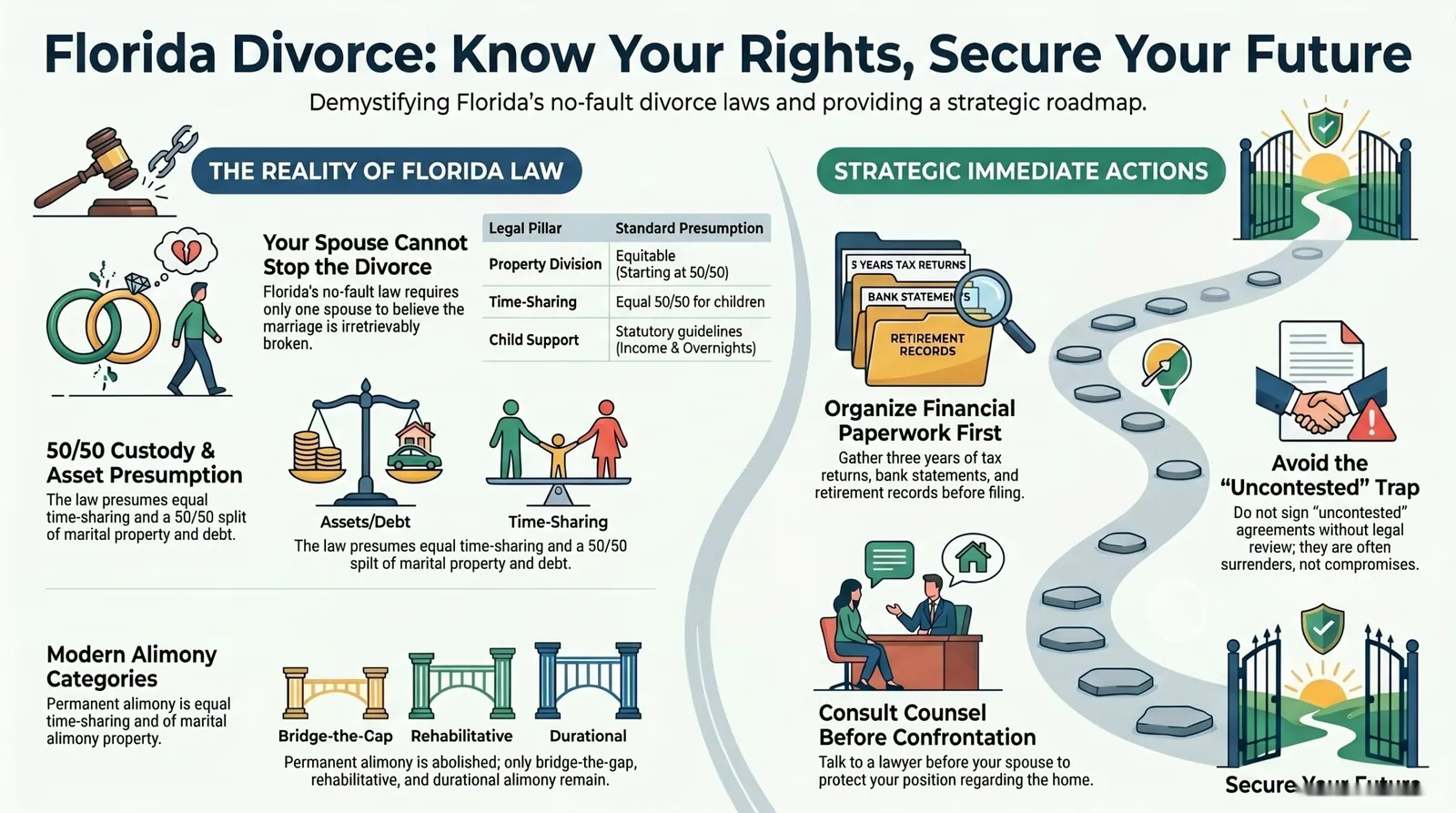
Equitable distribution of marital property and debt. Florida starts from a presumption of a 50/50 split of marital assets and debts, then adjusts based on statutory factors. This covers real estate, retirement accounts, business interests, vehicles, investments, and the debts tied to any of it. Non-marital property, generally what you brought into the marriage or inherited, stays with its owner, assuming it hasn’t been commingled.
Alimony. Florida overhauled alimony in 2023. Permanent alimony is gone. What remains is bridge-the-gap, rehabilitative, and durational alimony, each with its own purpose and rules. Who pays, how much, and for how long depends heavily on the length of the marriage, each spouse’s financial picture, and the specific needs in play.
Time-sharing and parental responsibility. Florida no longer uses the word “custody.” You will build a parenting plan that spells out time-sharing (when the kids are with each parent) and parental responsibility (who makes the major medical, educational, and religious decisions). Florida now presumes equal 50/50 time-sharing is in the child’s best interest, though that presumption can be rebutted with evidence.
Child support. Calculated under Florida’s statutory guidelines based on both parents’ incomes, the overnight breakdown, and a handful of other variables. It is not something either parent gets to negotiate around freely, the court has to sign off.

¶ Each of these is aplace where you either protect what you are entitled to or you don’t. None of them are appropriate to work out at the kitchen table with no representation.
Contested, Uncontested, and the Lie in Between
 An uncontested divorce, where both sides genuinely agree on everything, can move fast. A contested divorce, where you disagree on anything meaningful, requires mandatory financial disclosure, usually mediation, and potentially a trial. Most Florida cases land somewhere in the middle: mostly cooperative, with one or two real fights embedded in them.
Here is the trap. People get told their divorce is “uncontested” when what they actually have is a spouse who drafted terms that heavily favor themselves and a partner too exhausted to push back. That is not agreement. That is surrender dressed up in friendly language. If a lawyer has not reviewed the terms before you sign, you do not know what you are agreeing to. Full stop.
What You Should Be Doing Right Now
Before you have the conversation with your spouse, before you move out, before you post anything on social media, do this:
- Gather financial documents. Tax returns for the last three years, bank and retirement statements, mortgage paperwork, business records, credit card statements. Florida requires mandatory financial disclosure in every contested case. The person who walks in organized wins ground the other person never gets back.
- Do not move out of the marital home without legal advice. It can affect your time-sharing position and create arguments about the house that didn’t exist yesterday.
- Do not make large financial moves. Draining an account, transferring assets to a parent or sibling, taking on significant new debt, these can be treated as dissipation and held against you.
- Assume social media is evidence. Because it is.
- Talk to a lawyer before you talk to your spouse. Once that conversation happens, the dynamic shifts. You want to know your rights and position before you tip your hand, not after.


Why the Lawyer You Pick Actually Matters
Here is a truth you need to understand: divorce law is not a place for passive representation. You need an attorney who does more than just process paperwork, collect a fee, and forward settlement offers.
At Brandon Legal Group, true advocacy means giving you a strategy, not a checklist. Our family law attorneys take the cases other firms refer out, the ones that are emotionally charged, financially tangled, and legally complex, because that is exactly the kind of work this firm was built for. You will get the truth, even when it is uncomfortable. And you will get someone in your corner who is not afraid of the other side.
If you have been waiting for a reason to act, stop waiting. The law does not require your spouse’s buy-in. It does not require you to have everything figured out. It requires you to make a decision and move. The people who regret divorce later are rarely the ones who ended bad marriages. They are almost always the ones who waited too long to do it.
Frequently Asked Questions
Do I have to prove my spouse did something wrong to get divorced in Florida?
No. Florida is a no-fault state. You only need to show the marriage is irretrievably broken. However, misconduct like hiding assets or domestic violence can still affect alimony, property division, and time-sharing.
Can my spouse stop the divorce by refusing to sign?
No. One spouse’s belief that the marriage is irretrievably broken is enough to proceed. Your spouse can contest the terms, but cannot force you to stay married.
How long does a Florida divorce take?
An uncontested divorce can sometimes be resolved in a few weeks to a few months. A contested divorce with disputes over assets or time-sharing can take a year or longer. The earlier you get represented, the more control you have over the pace.
Should I talk to my spouse before I call an attorney?
No. Get legal advice first. Once you have that conversation, the dynamic changes in ways that are difficult to walk back.
Is Brandon Legal Group the right fit if my case is complicated?
Yes. BLG deliberately takes on the cases that are legally, financially, and emotionally complex, including the cases other firms refer out. If your situation has real stakes, that is exactly the work this firm is built for.